Tradescantia Zebrina Light: Best Window & Stripe Color
Tradescantia Zebrina Light: Best Window & Stripe Color
Tradescantia Zebrina Light: Best Window & Stripe Color
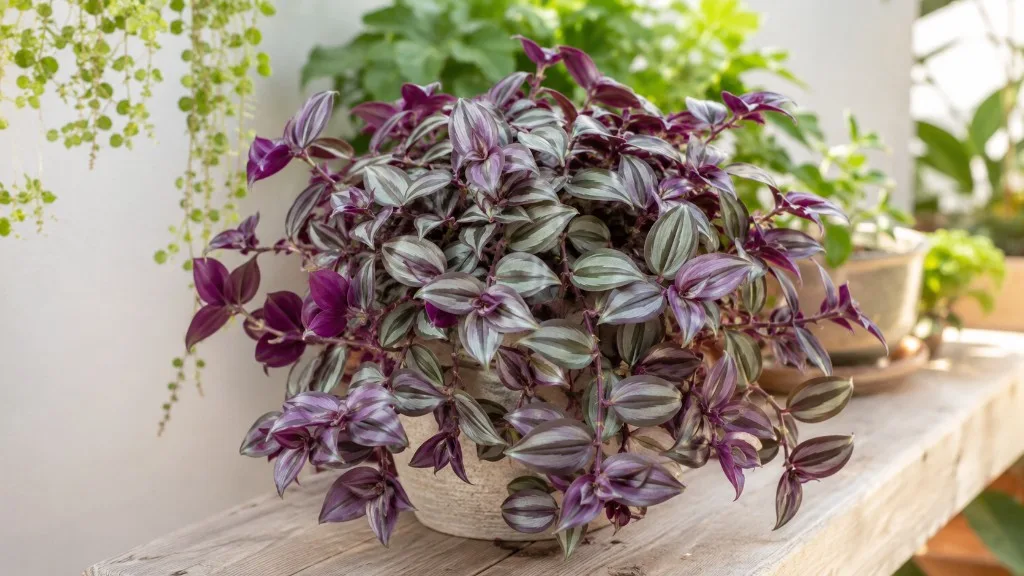
At forest edges from Mexico to Colombia, Tradescantia zebrina grows as a fast-spreading herbaceous perennial where dappled brightness filters through canopy gaps - never deep shade, rarely all-day blazing sun. That ecology is the key to every indoor stripe argument. The inch plant, wandering dude, and silver inch plant are sold for metallic silver-green striping flushed deep purple underneath, and that display is a light-dependent pigment balance, not a fixed nursery paint job. Move zebrina to a dim corner and silver-purple contrast dulls within a few new leaves; blast unacclimated foliage through hot west glass and you get bleached patches and crispy necrosis on the window-facing face. Light is the primary dial for the look you bought the plant to keep.
The practical indoor target is bright indirect light for most of the day - strong ambient brightness at the canopy, not merely a room that feels lit to your eyes. NC State Extension recommends filtered sun for best results and notes that in bright light the leaves “appear to sparkle,” while in low lighting stems lose lower leaves and remaining foliage loses color. Wisconsin Horticulture Extension adds that zebrina does best in bright light indoors and that too much sun in southern locations can wash out color. For full culture context - watering rhythm, pet safety, and renewal pruning - see the Tradescantia Zebrina overview; light changes how fast the pot dries, so pair any placement move with the watering guide once you have read one new leaf pair in the brighter spot.
Hanging-basket trap (read this first): zebrina is often sold in baskets whose leaves sit below window-sill height while the room looks bright. Light falls off sharply below the glass plane. Before you blame fertilizer or underwatering, confirm the top of the trailing canopy sees window sky, not just reflected ceiling brightness three meters from the pane.
Quick Answer - How Much Light Zebrina Needs
Tradescantia zebrina wants roughly 6 to 10 hours of strong ambient brightness daily at leaf level - the kind that casts a soft, readable shadow at midday without sustained direct sun on the leaf disk during the hottest hours. Medium indirect light keeps many tradescantias alive, but stripe intensity usually softens within a few new leaves. Too little light produces green drift, stretch, and faded silver-purple contrast; too much produces bleached patches and scorched leaf faces on the window side. Bright indirect light also sets the pace for watering and crown density: a zebrina in proper brightness uses water faster, branches more willingly after pinching, and holds vivid undersides on new leaves. The same plant in a dim corner with wet soil stretches toward the window, thins at the base, and loses the metallic striping that made you buy it.
Four Rules for Busy Growers
If you only remember four rules, use these. Default placement: bright indirect light within 1 to 4 feet (30 to 120 cm) of an east-facing window, or a filtered west or south window where the plant sees sky but not a hard sun disk at midday. Color goal: prioritize brightness enough that new leaves keep obvious silver striping and purple-flushed undersides; fading on old leaves alone is not the test. Direct sun rule: brief morning sun can work when acclimated and often intensifies purple tones; unfiltered midday and hot afternoon sun through west or south glass is high risk for scorch. Diagnostic habit: judge light by the newest leaf or tip growth after 10 to 14 days in a spot - old damage does not heal, only new growth tells the truth.
Do not change light, watering, and pot size in the same week. Move the plant, wait for a new leaf pair, then adjust water if dry-down speed changed.
Why Light Controls the Silver and Purple Stripes
The stripes on Tradescantia zebrina are not decorative ink. They are living chemistry. Green zones carry chlorophyll for photosynthesis. Silver-white zones reflect more light and carry less chlorophyll. Purple undersides and purple-flushed upper surfaces come largely from anthocyanins - the same pigment class that makes autumn leaves red and many fruits dark. Michigan State University Extension explains that anthocyanins are protective compounds that shade photosynthetic tissue from excess light, and that their production increases with light intensity - which is why purple-leaf plants are not truly purple unless environmental conditions favor anthocyanin synthesis. (MSU Extension)
When light drops below what zebrina needs for both growth and pigment maintenance, the plant faces a budget problem. Anthocyanins cost energy to produce. Chlorophyll is the faster path to more photosynthesis per square inch. In dim conditions, zebrina redirects resources toward chlorophyll, and the signature silver-purple contrast dulls toward plain green or grey-green. That is efficient acclimation - and your cue to add light, not fertilizer.
Research on the related Tradescantia pallida (Purple Heart) found a strong positive correlation between light intensity and anthocyanin content in leaves, with lower light triggering more chlorophyll relative to protective pigments. (SciELO Brazil) Zebrina shows the same general pattern in home cultivation even though its leaf pattern is striped rather than solid purple: more bright filtered light, more vivid purple; less light, greener and leggier.
Anthocyanins, Chlorophyll, and the Low-Light Trade-Off
Chlorophyll does more than make leaves green. It is the core photosynthetic machinery and participates in managing light energy flow through the leaf. In silver-striped zones, chlorophyll density is lower by design - those cells reflect more light, which creates the metallic stripe effect, but they also have less capacity to convert photons when light is scarce. In low light, zebrina cannot afford to maintain high-contrast variegation across fast-growing stems. It compensates by pushing more chlorophyll into newer growth, which reads as greener, duller foliage with weaker purple undersides.
When strong direct rays land on leaves adapted to lower light, energy can outpace protective chemistry. The result is photobleaching - white or tan dry patches - followed by necrosis on the most exposed zones. Zebrina leaves are somewhat succulent, so they intercept substantial energy near sunny glass. Bright indirect light delivers intensity without that spike. Direct midday sun through unfiltered west or south panes is where most indoor scorch happens.
Stripe Fade vs Genetic Reversion
Low-light fade on zebrina is usually a physiological response, not a permanent genetic switch. In dim conditions, the plant produces leaves with more green pigmentation and less silver-purple contrast because chlorophyll is the fastest path to more photosynthesis. Internodes may lengthen as the stem leans and stretches toward the brightest vector in the room. New leaves can emerge smaller, paler, and less striped - not because the plant lost its species identity, but because it is rationing pigment under weak light. Growers often describe this as stripes “washing out” before green takes over entirely. For step-by-step fade recovery, see not enough light on Tradescantia zebrina.
True genetic reversion - shoots that produce fully green leaves with no striping pattern at all - is uncommon in healthy stock. Before assuming it, rule out months on a dim shelf or a hanging basket too far from glass where the room looks bright but leaf-level flux is low. Move to brighter indirect light, acclimate over 7 to 14 days, and inspect the next two sets of new leaves - returning silver-purple contrast means fade, not reversion. If a stem runs fully green, pinch it back and let striped side shoots take over once light improves. Zebrina is a fast-renewing plant; refreshing with tip cuttings in better light often beats trying to rehabilitate months of stretch.
How Much Light Inch Plant Actually Needs Indoors
Tradescantia zebrina is native from Mexico to Colombia, where it grows as a fast-spreading herbaceous perennial in bright, filtered conditions at forest edges and disturbed ground. (NC State Extension) Indoors, that ecology translates to a plant that wants open-sky brightness without baking in the midday sun disk for hours on end. Wisconsin Horticulture Extension recommends bright light indoors and an east-facing window or a spot several feet from a west- or south-facing window as a practical starting point.
For home growers, zebrina should receive roughly 6 to 10 hours of strong ambient brightness daily. Medium indirect light keeps many tradescantias alive, but stripe intensity usually softens there within a few new leaves. If you need a measurable reference - optional, not mandatory - many foliage houseplants in active growth sit around 200 to 400 foot-candles (roughly 2,000 to 4,000 lux) at the leaf surface in bright indirect placements, per general Illinois Extension houseplant lighting foot-candle bands for medium-to-bright interior light. Zebrina stripe maintenance toward the lower end of that band is an editorial placement estimate, not a single mandated reading; the new-leaf color test matters more than chasing one lux number.
What Bright Indirect Means in a Real Room
Use these room-level checks instead of guessing from ceiling brightness.
Shadow test: At midday, hold your hand between the plant and the window. A fuzzy, soft shadow with visible edges means useful indirect brightness. A sharp, dark shadow means direct sun is hitting the plane - fine for a few morning minutes if acclimated, risky at midday on zebrina leaves that have not hardened off. No meaningful shadow means the spot is too dim for strong color long term.
Leaf-level test: Place the pot so light lands on the canopy, not just the floor beside it. Zebrina is often grown in hanging baskets or on shelves where the room looks bright but the leaves sit below window height. “Near a window” should mean the top of the plant sees window sky, not that the basket hangs in a corner while the glass is three meters away.
Season test: Winter sun angle can pull rays onto a previously safe sill - add a sheer curtain or move back if stripes bleach. Summer heat through west glass can do the same even when winter placement was perfect.
Outdoors in frost-free climates, NC State lists zebrina for partial shade - direct sunlight only part of the day, 2 to 6 hours - with full sun intensifying color where heat does not wash it out. (NC State Extension) A patio or balcony in USDA Zones 9 through 11 can deepen striping when acclimated gradually after frost passes; pull back or diffuse during heat waves when afternoon sun washes color, matching Wisconsin’s note that too much sun in southern locations fades intensity.
Reading New Leaves for Color Health
Old leaves are history. On zebrina, judge light by the newest unfurling leaf and the youngest fully opened pair at the stem tip.
Healthy bright-indirect growth looks like this: the new leaf opens firm and plump without crisping; silver striping is obvious within days of unfurling, with clear contrast against the green field; purple undersides are visible when you lift a stem or view the plant from below; internodes stay relatively short, so the plant looks stacked rather than ladder-like; and trailing tips stay full enough that the crown does not hollow out from the base.
Low-light new growth looks different: leaves emerge smaller than recent predecessors; stripes fade toward grey-green or disappear on the upper surface; purple undersides wash out to dull green-bronze; the stem may elongate between leaves before the next pair opens; and the whole shoot may angle sharply toward the brightest window. These are not cosmetic flaws - they are the plant reporting photon deficit. Route persistent fade patterns to not enough light if two new leaf pairs stay dull after a brighter move.
High-light new growth failures show up as tan or brown dry patches during or right after unfurling, translucent bleached zones where silver striping used to be, curling on the window-facing margin even when soil moisture is correct, or sudden leaf collapse after a move from shade to blazing glass. If scorch appears one-sided on leaves facing the window, you are almost certainly looking at direct sun or reflected heat, not root rot.
Best Window Placement for Tradescantia Zebrina
Window direction is a map, not a guarantee. A “west window” shaded by a porch roof may behave like east light, while an east window with no outdoor obstructions can deliver surprisingly strong morning rays. Still, compass orientation gives a reliable starting point for distance from glass and curtain strategy.
Zebrina performs best when it can live close enough to benefit from window brightness but protected from sustained direct beams during the hottest hours. For many homes, that means east exposure or offset placement from south and west glass - not pressed against unfiltered panes through hot afternoon hours. Wisconsin Horticulture Extension specifically recommends bright light indoors and an east-facing window or placement several feet from west- or south-facing glass as ideal for inch plants.
East, South, West, and North Compared
| Window | Typical indoor behavior | Starting distance | Scorch risk | Stripe / growth outcome |
|---|---|---|---|---|
| East | Bright morning sun, cool; indirect rest of day | 1–3 ft (30–90 cm) | Low–moderate | Best default; vivid stripes, gentle morning direct OK when acclimated |
| South | Strongest year-round sun; winter asset, summer heat load | 3–5 ft (90–150 cm) or sheer curtain | Moderate–high in summer | Excellent color if diffused; unfiltered noon glass risky |
| West | Hot afternoon sun; highest heat + light combo | 2–4 ft (60–120 cm) or curtain | High | Trial placement only; scorch common without diffusion |
| North | Low–moderate indirect all day | As close as possible | Very low | Survival OK; stripe fade and stretch likely without LED |
An east-facing window is the most reliable default for zebrina. Morning sun is bright but relatively cool, which helps intensify purple tones without instantly bleaching striped tissue. Many growers report that gentle morning direct rays on an acclimated plant deepen undersides within one to two weeks.
A south-facing window delivers the strongest year-round sun. In winter, south light can work pulled back from the pane or behind sheer fabric. In summer, south glass can magnify heat and scorch leaves within days - use diffusion at peak hours. NC State’s partial shade (2 to 6 hours direct sun) guidance confirms some outdoor direct tolerance in mild conditions but does not mean unfiltered indoor south glass at noon is safe year-round. (NC State Extension)
A west-facing window is higher risk indoors. Afternoon sun carries more heat load, and harsh midday and afternoon direct sun causes the most predictable scorch on zebrina. West can work with 2 to 4 feet (60 to 120 cm) of setback or a sheer curtain - treat it as a trial placement, not a default.
A north-facing window usually provides low to moderate indirect light. Zebrina may survive here in summer, but stripe fade and leggy growth are likely without supplemental LED.
Distance From Glass and Seasonal Shifts
Distance controls intensity more precisely than compass labels. Use distance as your fine dial after choosing the best available window.
East glass: start 1 to 3 feet (30 to 90 cm) from the window. Move closer if new leaves show low-light fade; move back if morning-facing leaves crisp despite acclimation.
South glass: start 3 to 5 feet (90 to 150 cm) back or on the sill behind sheer curtain. Watch the window-facing leaf face daily for the first week after any move.
West glass: start 2 to 4 feet (60 to 120 cm) back unless curtained. Heat plus light kills striped tissue faster than light alone.
North glass: keep as close as possible to the brightest zone; add a full-spectrum grow light overhead if new leaves shrink or green out.
Seasonal shifts matter on zebrina because the plant grows quickly and damage shows within days. In winter, lower sun angle can suddenly put a previously safe sill into direct beam path - bleach appears on striped zones even though “nothing changed” in your routine. In summer, longer days and higher heat may require pulling the pot back or adding diffusion even if winter placement was perfect.
For hanging baskets, remember that height matters. A basket that looked safely indirect on a shelf may receive direct rays once hung at window center. Check leaf level, not pot level. Wisconsin Horticulture Extension notes that zebrina foliage ranges in color from green to purple depending on light exposure, confirming that hanging height and window proximity directly change the display you see. (Wisconsin Horticulture Extension)
Worked example: a 12-inch basket hung so the topmost leaf sits 24 inches (60 cm) below an unobstructed east sill usually receives strong indirect brightness all day plus 30–60 minutes of gentle morning direct - enough for vivid striping on new growth within two leaf pairs. The same basket hung at window-center height on a west sill in July may scorch within 48 hours without a curtain.
Morning Sun and Direct Light Tolerance
Tradescantia zebrina is not a full-shade houseplant indoors, and it is not a desert cactus either. It occupies a middle band: bright filtered light with optional gentle direct exposure. The useful question is not “can it survive a sunbeam?” It is “what happens to the silver-purple striping when it does?”
The answer is that brief early-morning direct sun on acclimated plants often deepens purple undersides and tightens internodes without immediate damage. NC State Extension notes that in full sunlight the greatest color intensity can be appreciated, though in southern locations sun can wash out color. The Royal Horticultural Society recommends bright, filtered light and warns that direct sun may scorch the leaves - a reminder that duration and heat load matter as much as compass direction.
Increase indirect brightness first before adding direct beam hours. Most indoor scorch happens when a plant jumps from a dim shop shelf to a blazing west sill in one afternoon.
Seven-to-Fourteen-Day Acclimation Protocol
Leaves formed in lower light have pigment and structural chemistry adapted to that level. Moving zebrina suddenly into strong direct sun is how you get bleached patches, curling, and leaf drop within 48 hours even though the plant “wanted more light.”
Use a 7 to 14 day acclimation bridge:
Days 1 to 3: Move to bright indirect only - closer to east glass or behind sheer curtain on south/west - and watch the newest leaf for color improvement without crisping.
Days 4 to 7: Allow 30 to 60 minutes of early-morning direct sun if the window is east, or add 15 to 30 minutes of filtered direct if south/west is curtained. Extend only if new leaves stay firm.
Days 8 to 14: Increase morning direct in 15-minute increments if no bleaching appears on new growth. Stop immediately if older window-facing leaves show tan patches - old tissue will not re-stripe, but you can prevent further damage.
When scorch happens, move immediately to bright indirect light. Pinch or trim fully brown sections later with clean tools - tradescantia sap can irritate skin on sensitive people, and the plant is toxic to pets if chewed. (ASPCA) Wear gloves if you are sap-sensitive. Contact your veterinarian if a cat or dog chews leaves and shows oral irritation, drooling, or vomiting - do not wait for symptoms to worsen. Scorched tissue does not re-purple; only new leaves restore appearance.
Low-Light Limits, Leggy Growth, and Stripe Fade
Zebrina is often marketed as an easy trailing houseplant, and the genus does tolerate lower light better than many pink-variegated tropicals - for a while. Tolerance is not the same as quality performance. In dim conditions, zebrina usually lives while silver-purple contrast fades, internodes stretch, and new leaves shrink - a slow downgrade that owners blame on watering because the pot still looks “fine” from across the room.
Wisconsin Horticulture Extension states that in low light conditions, stems lose lower leaves and remaining foliage loses much of its coloring. NC State Extension lists fading leaf variegation from insufficient light as a common cultural problem, with the fix being brighter indirect exposure. Always pair light diagnosis with a moisture check per the watering guide, but do not water your way out of a photon shortage.
Low light also changes dry-down speed. A dim zebrina uses less water; if you keep the summer watering cadence from a bright window, soil stays wet too long and roots suffer - which then shows as soft stems at the soil line and compounds the false “maybe it needs more water” loop. Zebrina crowns also bare out faster in dim light because lower leaves drop while stems stretch, leaving long naked vines that look tired even when the tips still grow. Stressed plants in dim, stagnant air attract spider mites more readily - another reason to fix light before chasing pest sprays alone.
When Dim Rooms Still Work - and When They Don’t
Dim rooms can work for zebrina when your goal is basic survival and you accept muted striping. A hallway with reflected office light, a north room with large white walls, or a spot several meters from a bright window may keep the plant trailing for months if watering is conservative.
Dim rooms fail zebrina when you want vivid purple stripes, compact crowns, and dense hanging-basket display. If the plant leans sharply, produces small greenish new leaves, or loses silver contrast on consecutive new leaves, the room is below the display threshold even if the plant is technically alive.
No fertilizer fix restores stripe pattern without more light - relocate the plant, add a grow light, or accept muted color. Zebrina is faster and more obviously trailing than Nanouk, with stems that age quickly at the base. The practical strategy many experienced growers use is to grow it brightly, prune hard, and root tips back into the pot rather than chase old faded vines. If striping dulls, the plant is usually asking for more light rather than more food.
Compared to Tradescantia Nanouk, zebrina is somewhat more forgiving in moderate indirect light - Nanouk’s pink and white zones fade faster - but zebrina still needs real brightness for the metallic purple display. Compared to Tradescantia pallida (Purple Heart), zebrina needs less direct sun to look good but more than a dim corner provides.
Grow Lights When Natural Light Falls Short
When window light cannot support vivid striping - north rooms, deep floor plans, winter sun angle loss, or office cubicle constraints - a full-spectrum LED grow light is the cleanest fix. Grow lights do not replace the need for correct watering, but they restore photon budget without scorching striped tissue the way unfiltered west glass can.
MSU Extension notes that blue and ultraviolet wavebands are especially effective at triggering anthocyanin production, and that LED fixtures emitting at least 10 to 15% blue light outperform older high-pressure sodium lamps for purple coloration - relevant when choosing a household grow bulb for pigment, not just survival. (MSU Extension) UMN Extension recommends 12 to 14 hours daily of supplemental light for foliage houseplants that lack adequate window brightness - a sensible timer baseline for zebrina under LED.
Fixture Distance, Hours, and Spectrum
Start with a full-spectrum LED rated for houseplants - not cheap purple-only bulbs that skew growth - mounted 8 to 14 inches (20 to 35 cm) above the tallest leaf, and run it 10 to 12 hours daily on a timer to mimic a coherent day length. If new leaves green out or stretch toward the bulb, raise intensity gradually by lowering the fixture 2 inches (5 cm) at a time and waiting for one new leaf pair between changes. If striped zones show dry patches despite good watering, raise the fixture or shorten hours - you have overshot.
For growers using a lux meter app, aim for roughly 2,000 to 4,000 lux at leaf level as an editorial stripe-maintenance band aligned with Illinois Extension’s medium-to-bright interior foot-candle guidance - not a species-specific NC State prescription. If you cannot measure, use the new-leaf stripe test after two weeks under the lamp.
Use even top lighting across the crown, especially when the plant trails - lower stems shaded by upper growth will fade faster. Combine with modest window light when possible. Increase watering checks slightly after adding light per the watering guide, but do not change fertilizer at the same time.
Warning Signs: Too Much vs Too Little Light
Light stress on zebrina is readable if you separate too little from too much and ignore old leaves that only tell you where the plant used to live.
Too little light usually shows as leggy stems with long spaces between leaf pairs; strong lean toward the brightest source; smaller new leaves than older ones; silver striping fading to grey-green on consecutive new growth; purple undersides washing out; slow opening of new pairs; bare crown with lower leaf drop; and soft stems paired with soil that stays wet too long because metabolism dropped. If you see this cluster, increase indirect brightness first - closer to window with diffusion if needed, or add LED - rather than fertilizing. Persistent patterns belong on the not enough light problem page.
Too much light usually shows as bleached silver zones turning paper-thin and translucent before browning; crispy necrotic spots concentrated on the window-facing leaf face; brown leaf edges on the sun side; curling or wilting during midday even when soil moisture is correct; and stalled new growth despite bright conditions because stress paused expansion. If damage is one-sided, rotate and reduce direct beam intensity immediately.
Mixed mistakes happen when a plant is moved from dim to harsh sun in one jump - a recipe for shock, leaf drop, and scorched tissue at once. Always bridge through bright indirect for a week before adding morning direct.
Use the two-leaf-pair rule: one new pair after a correction tells you direction; two consecutive pairs with stable silver-purple contrast confirm the placement works.
Conclusion
Tradescantia zebrina rewards a specific light band: bright indirect strong enough to keep silver striping and purple undersides vivid on new leaves, with some morning sun as a useful bonus when acclimated - not direct midday and hot afternoon sun that bleaches and scorches faster than the plant can adapt. East and filtered bright windows are the practical starting map; south and west need distance, diffusion, or both; north usually needs LED if color is the goal. Low light does not kill zebrina quickly - it dulls the stripes, stretches the stems, and quietly complicates watering until the plant looks like a greener, lankier version of itself.
Place the pot where the canopy sees sky brightness, not where the room merely feels lit to you. Acclimate changes over 7 to 14 days, judge results on new growth, and adjust water when dry-down speed shifts. When windows fail, a full-spectrum grow light at sane distance restores contrast without the scorch lottery of hot glass. Get that band right and zebrina stays the fast, metallic trailing plant it was built to be - tight internodes, purple-flashed undersides, and silver stripes that still read from across the room.
When to use this page vs other Tradescantia Zebrina guides
- Tradescantia Zebrina overview - Start here for whole-plant context before deep-diving this topic.
- Tradescantia Zebrina problems hub - Jump to symptom-specific fix guides when this care topic does not resolve the issue.
- Leggy Growth on Tradescantia Zebrina - Escalate here when light adjustments are not enough.