Syngonium Albo Propagation: Stem Cuttings Guide
Syngonium Albo Propagation: Stem Cuttings Guide
Syngonium Albo Propagation: Stem Cuttings Guide
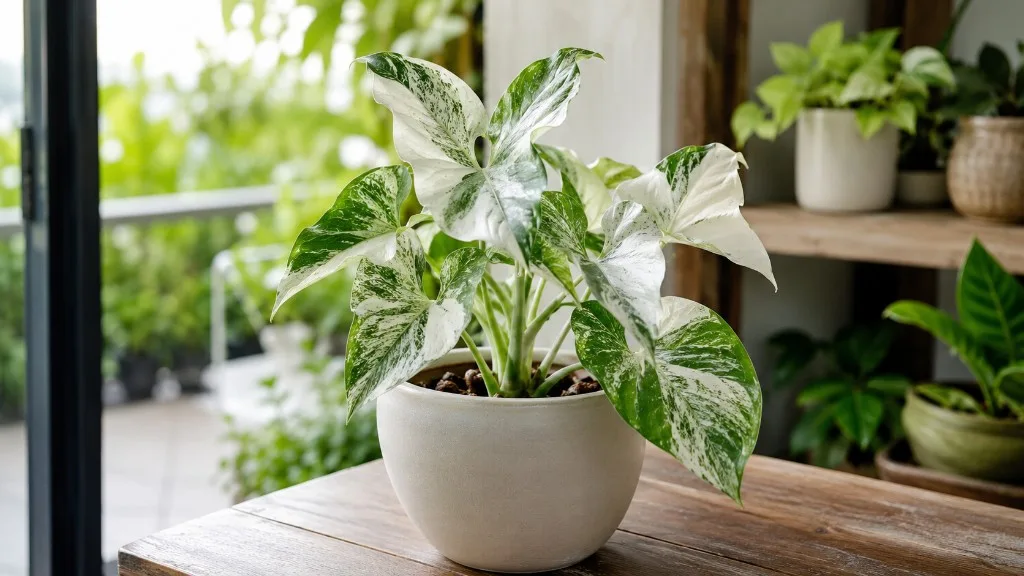
Syngonium albo propagation is straightforward in technique and demanding in judgment. Syngonium podophyllum ‘Albo Variegatum’ - the white-splashed arrowhead vine collectors pay premium prices for - roots easily from stem cuttings because it is a fast-growing aroid that produces aerial roots at every node. The hard part is not getting roots; it is choosing a node whose chimeric cell makeup will produce variegated leaves on the new plant rather than an all-green clone that looks like a common Syngonium. Every propagation decision flows from that biology. This guide covers why stem cuttings work, how to inspect nodes for variegation before you cut, water and moss rooting workflows, aftercare, and what to do when new growth starts reverting.
Unlike seed propagation - which will not replicate the parent cultivar - or tissue culture - which requires lab equipment - stem cuttings clone the parent genetically. What you see on the cutting at the moment of harvest is what the new plant starts with. That is both the opportunity and the trap. Pick a node with strong white patterning in the stem tissue and you give the cutting the best possible starting point. Pick a node from a stem that already reverted to green and you have propagated a green Syngonium, no matter how pretty the last variegated leaf above it looked.
If symptoms persist, see the Yellow Leaves on Syngonium Albo guide.
Why Stem Cuttings Are the Best Method for Syngonium Albo
Vegetative propagation through stem cuttings is the standard home method for Syngonium albo because the plant’s anatomy is built for it. Each node along the vine carries an axillary bud - a dormant growing point - plus meristematic tissue capable of producing roots and new shoots. Aerial roots often emerge just below nodes on mature stems, giving you a head start before the cutting ever enters water or moss. Division works when a pot holds multiple stems at the base, but most indoor specimens grow as a single trailing or climbing vine, making cuttings the practical default.
The method also scales. One long vine can yield several independent plants without killing the parent, provided you leave enough nodes behind for the donor to recover its shape. Syngonium albo grows quickly in warm bright conditions - often pushing new leaves every one to two weeks during active growth - so a well-timed pruning session doubles as propagation harvest. What separates a collector-quality result from a disappointing green revert is not the rooting medium you choose; it is node selection tied to variegation biology.
How Chimeric Variegation Works in Syngonium Albo
Syngonium albo variegation is chimeric, not a stable genetic pattern fixed in every cell. Two genetically distinct cell populations coexist in the same plant: one produces chlorophyll normally (green tissue), and one carries a mutation that disrupts chlorophyll development (white or cream tissue). The marbled leaf pattern you admire is the visible boundary between those populations. This type of variegation - shared with Monstera albo, Philodendron Pink Princess, and standard Golden Pothos - is inherently less stable than pattern variegation found in cultivars like Marble Queen pothos, where the mutation is fixed across the cell population.
Syngonium albo often displays sectorial chimera structure, meaning the white and green cells occupy slices of the stem rather than neat layers. That makes variegation variable leaf to leaf and node to node. Green cells photosynthesize more efficiently than white cells, which contribute little or no energy. When the plant is stressed - especially by insufficient light - it favors green tissue because survival beats aesthetics. Over time, green cells can outcompete white cells at the growing tip, producing fully green leaves from a node that once gave variegated ones. Understanding this mechanism is not academic trivia; it is the reason the node you cut today determines the plant you pot up in six weeks.
No propagation method guarantees permanent variegation. Even tissue-cultured Syngonium albo can show somaclonal variation. What stem cuttings do guarantee is that you replicate the chimeral composition present at the chosen node at the moment of cutting. Your job is to select nodes where that composition still includes meaningful white tissue in the stem and bud, then maintain Syngonium Albo light guide afterward so the new plant does not immediately shift toward green dominance.
What Makes a Node the Right Propagation Unit
A node is the slightly swollen joint on the stem where a leaf petiole attaches, aerial roots may emerge, and an axillary bud sits ready to activate. Inside that node is meristematic tissue - cells that can divide into roots, stems, or leaves depending on hormonal signals. Auxin, a growth hormone, accumulates at cut surfaces and triggers root formation when a node is present. Cut anywhere else on an internode without including node tissue and nothing useful happens, no matter how impressive the leaf looks floating in a jar.
This is why a leaf without a node cannot become a full plant. Single-leaf Syngonium albo cuttings sometimes persist in water for weeks, drawing on stored starch, then yellow and decline because leaves lack the meristem needed to generate new shoots. UF/IFAS notes that Syngonium propagation is done via nodal cutting, tip cuttings, or air layers - each method requires node tissue, not leaf tissue alone. Sellers occasionally offer “wet sticks” - node segments without leaves - and those can root if the node is healthy and variegated, though they need careful humidity management until the first leaf unfolds. For most home propagators, the ideal unit is one node with one or two attached leaves, giving the cutting both photosynthetic capacity and the meristem that drives root and shoot development.
Syngonium albo also produces aerial roots at nodes, especially on mature vines. UF/IFAS reports that in most environments, each node sports adventitious roots. These are not required for propagation success, but they often accelerate water rooting because the tissue is already primed for absorption. When taking a cutting, include any visible aerial roots below the node in your segment; submerge them in water or bury them lightly in moss. They are bonus infrastructure, not a substitute for the node itself.
Selecting Cuttings That Preserve Variegation
Node selection is the entire variegation game. Two cuttings from the same parent vine, taken six inches apart, can produce radically different offspring - one splashed white and green, one solid green - because the chimeral balance at each node differs. Ranking pages that jump straight to “place in water” skip the step that matters most for Syngonium albo. Before you sterilize scissors, walk the vine and evaluate both leaf pattern and stem tissue at every candidate node.
The goal is balanced variegation: enough white to match the cultivar’s character, enough green to fuel rooting and early growth. Syngonium albo leaves that are more than roughly 60–70 percent white - sometimes called ghost leaves - contain too little chlorophyll to sustain the cutting through the energy-intensive rooting phase. They can succeed in perfect conditions but fail more often than balanced leaves. Conversely, leaves that are mostly green with a small white speck may root vigorously while producing a disappointingly green new plant. The sweet spot for most home setups is a leaf showing roughly 25–40 percent or more visible white patterning, with corresponding variegation visible in the stem.
Reading Variegation in Leaves and Stem Tissue
Start with the leaf - it is the easiest signal. Look for clear white or cream sectors on the blade, not just a pale green wash that can mimic variegation under low light. A healthy variegated leaf should feel firm, show crisp color boundaries, and attach to a stem segment that is green and sturdy, not mushy or brown. Then drop your eyes to the stem tissue at the node itself, because this is where experienced propagators look.
Variegated stem tissue shows light streaks, flecks, or patches running through the internode and into the axillary bud junction - the “eye” where the next shoot will emerge. Solid green stem at the junction strongly predicts solid green new growth, even if the attached leaf still shows white splashes. That mismatch happens because the leaf you see may be older output from a previously variegated tip, while the bud below has already shifted toward green dominance. Always trust the stem over the leaf when they disagree.
Also inspect the vine above and below your target node. If the stem section leading upward has produced two or three consecutive all-green leaves, that growth point has likely reverted and should not be propagated. Instead, move down the vine to the highest node that still shows variegation in stem tissue - the last variegated node before the green takeover. This is the same logic behind the chop and prop technique: remove reverted material from the parent and propagate only from nodes where the chimeric white cells still hold meaningful territory.
The Stem Stripe Rule for Reliable Node Choice
The stem stripe rule simplifies node selection into one inspectable criterion: choose nodes where a stripe or patch of white variegation runs through or directly beneath the axillary bud. A white streak passing through the bud junction gives the highest probability that the shoot emerging after rooting will carry the variegation mutation. A node with a beautifully variegated leaf but a solid green stem at the bud is a gamble you will usually lose.
Apply the rule systematically before every cut. Hold the vine up to light if needed - variegation streaks in stem tissue can be subtle. Mark candidate nodes with a loose tie or chalk if you are planning multiple cuttings from one long vine. Prioritize nodes that also carry aerial roots, because they combine strong variegation signals with faster water rooting. Avoid nodes from stems that sit in deep shade on the parent plant; those segments often skew green even when the plant overall looks variegated, because the plant already adjusted cell balance toward photosynthesis in that zone.
When choosing between two acceptable nodes, pick the one with more balanced leaf variegation rather than the ghost leaf. Rooting speed and post-propagation stability both improve when the cutting can photosynthesize adequately from day one. You can always select for more white on future generations once the plant is established and rooted under bright indirect light - but a dead cutting preserves no variegation at all.
When to Propagate Syngonium Albo
Timing affects rooting speed more than it affects variegation genetics, but stressed plants produce weaker cuttings that revert faster after rooting. Propagate when the parent is actively growing, well hydrated, and free of pests - not as an emergency response to every yellow leaf or cosmetic blemish. A cutting taken from a vine in metabolic decline may still root, but it starts life with fewer resources to maintain the unstable chimeric balance that keeps white tissue competitive.
That said, Syngonium albo is forgiving compared with slow aroids like Hoya or finicky calatheas. Indoor growers with stable warmth and supplemental light can root cuttings year-round if the parent is healthy. Match your expectations to the season: spring and summer cuttings root in weeks; winter cuttings may idle for a month before showing progress.
Best Season and Active Growth Windows
Spring through early summer is the optimal propagation window in most homes. Day length increases, ambient temperatures sit in the 18–27°C (65–80°F) range Syngonium albo prefers, and the parent plant pushes new leaves on a predictable rhythm. Root initials form faster when soil and water temperatures stay warm - below about 15°C (59°F), rooting slows sharply and rot risk in water rises because bacterial growth outpaces tissue healing.
If your parent shows fresh unfurling leaves with firm texture and normal variegation patterning in March or April, that is your signal. Late autumn and winter propagation is viable under grow lights and consistent room heat, but extend your patience window and change water more frequently to combat stagnation. Avoid taking cuttings immediately after shipping a plant, Syngonium Albo repotting guide, or recovering from root rot; give the parent two to four weeks of stable care so its hormone profile normalizes before you remove tissue.
Outdoor growers in frost-free climates can propagate whenever the vine is actively extending, but bring cuttings indoors for rooting unless nighttime lows stay above 10°C (50°F). Cold damage to cuttings is irreversible and often appears as translucent mush rather than obvious black rot.
Signs Your Parent Plant Is Ready
A propagation-ready parent shows firm stems, evenly hydrated leaves, and no active pest infestation. Run through a quick checklist before cutting: are mealybugs or spider mites present on leaf undersides? Does the pot drain within a few days after watering, indicating healthy roots? Is the newest leaf proportional and appropriately variegated for the plant’s typical pattern? Weak, floppy vines from chronic underwatering or root loss can root, but they often produce green-heavy growth because the plant prioritizes photosynthetic tissue under stress.
Consider the parent plant’s appearance after harvest. Removing every variegated segment from a small specimen leaves you with a bare stick and a long recovery wait. A practical rule: take no more than one-third of the vine length per session, leaving enough foliage on the donor to continue photosynthesizing. If you want many plants, stagger two harvests two weeks apart rather than stripping the vine in one go. Syngonium albo responds to pruning by activating dormant nodes below cuts - so a thoughtful harvest often produces a bushier parent over time, especially if you cut above variegated nodes and discard reverted tips.
How to Take Syngonium Albo Stem Cuttings
The physical act of taking a cutting takes minutes. Preparation determines whether those minutes produce a thriving variegated plant or a jar of rotting stem. Gather sharp pruning shears or scissors, 70% isopropyl alcohol for sterilization, a clean work surface, and your propagation containers filled and ready before you cut. Once tissue is severed, the clock starts on hydration loss and oxidation at the wound.
Work in good light so you can see stem variegation clearly. If the vine is tangled on a moss pole or trellis, gently unwrap it rather than tearing tissue. Identify your target nodes using the stem stripe rule, then plan cut placement so each segment includes at least one node, preferably with one or two leaves attached.
Sterile Tools and Correct Cut Placement
Sterilize blades with alcohol between cuts, especially if you previously trimmed diseased tissue or are processing multiple plants. A clean diagonal or straight cut just below the node - leaving a few millimeters of internode beneath the bud - is standard. Some growers cut halfway between two nodes to create a two-node segment; others cut directly under a single node for shorter “wet stick” propagations. Either works if meristem tissue is included.
Remove excess leaves from multi-node segments if the cutting would otherwise lose water faster than it can absorb. A two-node cutting with four large leaves often struggles; reducing to two leaves total improves balance. Never remove all leaves from a node cutting unless you are deliberately propagating a bare wet stick in high humidity - leafless nodes need a humidity dome or sealed moss bag to prevent desiccation.
Place cuttings in water or moss within minutes of cutting when possible. Syngonium albo does not require extended air-drying like succulents, but leaving cut segments on a dry counter for hours in hot air accelerates wilt. If you must pause, stand stems in a cup with a damp paper towel over the cut end or mist the aerial roots lightly.
Single-Node vs Multi-Node Cutting Strategies
Single-node cuttings - one node, one or two leaves - are the most common format for water propagation. They fit cleanly in jars, root predictably, and let you distribute variegation risk across several independent plants from one vine. Each jar represents one genetic lottery ticket; diversity across cuttings protects you if one node skews green.
Multi-node cuttings - two or more nodes on one segment - produce a fuller plant faster after potting because multiple growth points may activate. They work well in moss bags or large propagation boxes where the whole segment lays horizontally with nodes partially buried. The trade-off is concentration of risk: if the segment came from a zone with weak variegation, the entire new plant reflects that. Multi-node strategies suit experienced growers propagating from a well-characterized variegated section of a mature vine, not from a plant whose stability you have not yet observed.
For beginners, default to single-node cuttings in water until you can read stem variegation confidently. Once rooting succeeds and new leaves match expectations, scale to multi-node harvests for faster bushy specimens. Label jars if running a comparison batch - “node 3, white stripe” beats relying on memory when six identical stems sit on the same windowsill.
Water Propagation Step by Step
Water propagation is the most popular Syngonium albo rooting method because it is visible, forgiving, and aligns with how the plant behaves in nature - aerial roots readily absorb moisture from humid air and water surfaces. UF/IFAS describes the simplest Syngonium method as cutting vine sections into single-node cuttings with an attached leaf and adventitious roots placed into rooting medium under mist. Success rate is high when nodes are variegated, water stays clean, and light is bright but filtered.
Follow this sequence for each cutting:
- Fill a clear jar with room-temperature water. Clear glass lets you monitor root progress and spot rot early.
- Submerge the node and any aerial roots, keeping attached leaves above the water line. Leaves sitting in water rot quickly and foul the container.
- Place in bright indirect light - an east window or several feet back from south glass. Avoid direct sun on de-rooted cuttings; white tissue burns easily before roots supply water.
- Change water every five to seven days, or sooner if it clouds or smells. Fresh water limits bacterial load that causes stem mush.
- Wait for roots to reach 2.5–5 cm (1–2 inches) before potting. This typically takes two to six weeks in warm active growth, sometimes faster on cuttings with existing aerial roots.
- Pot into well-draining aroid mix and transition to normal care rhythm.
Cuttings with heavily white leaves may root slower than balanced ones - plan extra patience, not extra fertilizer. Do not add liquid fertilizer to propagation water; the cutting has no roots to absorb it properly and algae blooms accelerate. A gentle warmth source like a heat mat set to 21–24°C (70–75°F) can speed rooting without cooking the jar; it is optional, not mandatory.
If roots appear but the stem base turns soft, remove the cutting, trim back to firm green tissue with a sterile blade, and restart in fresh water after a brief air-dry of the cut face. Early intervention saves cuttings that would otherwise dissolve completely.
Rooting in Sphagnum Moss or Aroid Mix
Sphagnum moss propagation is the second-best method for Syngonium albo and the preferred route for growers who want to skip the water-to-soil transition shock. Long-fiber sphagnum holds moisture while maintaining air pockets around the node - the same balance aroids expect in epiphytic conditions. Moss also supports wet stick propagation of leafless nodes when paired with a humidity dome or sealed plastic bag.
Moisten sphagnum with distilled or rainwater until damp but not dripping. Wrap a handful around the node and aerial roots, forming a ball around the stem. Place the moss bundle in a small cup or propagation box, or wrap the outside with perforated plastic to retain humidity while allowing gas exchange. Keep in bright indirect light at warm room temperature. Open the bag briefly every few days to refresh air and check for mold or rot.
Roots typically emerge in two to four weeks, similar to water. When you see roots threading through moss, pot the cutting into well-draining aroid mix - a blend of potting soil or coir, perlite, and orchid bark in roughly equal parts works for most homes. Do not bury the node deeper than it sat in moss; aroids rot when nodes sit in compacted wet soil without established roots.
Direct soil or mix propagation without pre-rooting is possible but less reliable for beginners. Insert the node into lightly moist mix, cover with a humidity dome, and wait. Success improves with heat, bright indirect light, and a node that already has aerial roots. Without visual confirmation, you are guessing whether roots exist - which tempts overwatering. Most experienced Syngonium albo propagators root in water or moss first, then pot up.
LECA and Alternative Rooting Setups
LECA (expanded clay pebbles) offers a middle path between water and soil for growers who want moisture monitoring without the full soil transition. Place the node in a clear container with LECA filled one-third with water below the pebble line - the node sits above standing water while capillary moisture wicks upward. Roots emerge into the airy pebble structure, reducing rot compared with dense soil.
LECA propagation suits Syngonium albo well because the plant tolerates semi-hydro conditions once roots adapt. Change or top up water every one to two weeks and rinse pebbles if algae accumulates. Transition to soil or maintain in semi-hydro permanently once roots fill the container - both paths work if fertilizer is adjusted for the medium.
Air layering is a lower-risk option when you want roots before severing the vine from the parent. Wrap a node still attached to the plant in moist sphagnum, secure with plastic wrap, and wait for roots to penetrate the moss. Cut below the rooted node only when the root mass is substantial. Air layering preserves the parent’s energy supply during rooting, which helps ghost-leaf or marginal variegation cuttings that might fail if detached too early. The downside is time and awkward moss bundles on display plants.
Propagation boxes - plastic containers with damp sphagnum holding multiple cuttings under a lid - scale batch propagation efficiently. Vent daily to prevent mold. This setup mirrors what commercial growers use for variegated aroids, adapted for home batches of five to ten cuttings.
Aftercare for Newly Rooted Syngonium Albo
A newly potted Syngonium albo cutting is not a mature plant. Its root mass is small, white leaf tissue is vulnerable, and the chimeric balance is easiest to disrupt in the first four to eight weeks after potting. Treat this phase as stabilization, not acceleration - no heavy fertilizer, no repotting into oversized containers, no sudden moves to harsh light.
Keep the plant in bright indirect light consistently. Variegated Syngonium albo needs more light than green arrowhead varieties to maintain white patterning, but direct sun on freshly potted cuttings scorches leaves before roots can transport water. A grow light at moderate intensity helps in dim apartments; aim for the same conditions that kept the parent variegated, not a dark shelf because the pot is small.
Water when the top 2–3 cm (1 inch) of mix dries - roughly the same rhythm as a mature Syngonium albo, but err slightly dry rather than wet while roots expand. Fertilizer can wait until the plant produces one or two new leaves after potting, then apply quarter-strength balanced liquid feed monthly during active growth. High-nitrogen fertilizer pushes green tissue growth and can accelerate reversion; balanced or slightly lower-nitrogen formulas are safer for variegated specimens.
Humidity around 50–65% supports unfurling leaves without demanding a greenhouse. Syngonium albo tolerates average indoor humidity if watering and light are correct, but very dry air below 30% can crisp white leaf margins on new growth. Grouping with other plants or using a pebble tray adds modest humidity without the fungal risk of constant leaf misting.
Quarantine new propagations from your main collection for two weeks if the parent ever had pests. Mealybugs transfer on cuttings silently. Inspect new unfurling leaves closely - the first leaf after rooting often reveals whether your node selection worked. If variegation matches expectations, you have a success. If the leaf emerges solid green, refer to the reversion section rather than hoping the next leaf fixes itself.
Managing Reversion After Propagation
Reversion after propagation means the new plant produces consecutive all-green leaves despite starting from a variegated parent. Causes fall into two buckets: you propagated from a node that already skewed green, or the rooted plant is now in conditions that favor green cell dominance - usually insufficient light, excessive nitrogen, or unstable temperature swings.
If the first or second new leaf after rooting is solid green, inspect the stem below the growing tip for variegation streaks. When streaks remain, improve light gradually and hold fertilizer; the next leaf may return to variegation - there is no guarantee, but the chimeric white cells may still compete if conditions improve. When the stem at the active node is solid green, pruning is required: cut back to the last node showing white streaks in stem tissue, exactly as you would on the parent vine. Propagate the trimmed variegated tip if it includes a viable node rather than composting it.
Remove reverted stems promptly on both parent and propagated plants. Each green leaf is a photosynthetic advantage that helps green cells spread through the meristem. Ohio State University Extension guidance on variegated plants emphasizes that prompt removal of non-variegated growth before it dominates the shoot apex improves the odds of retaining patterning - the same principle applies to your propagation stock.
Do not interpret a single ghost leaf - all white - as success. Ghost leaves often die because they cannot photosynthesize. One ghost among balanced leaves is tolerable; three consecutive ghosts signal you should prune back to a node with greener variegation balance. The propagated plant may look less dramatic short term but will survive and produce stable patterned growth long term.
Common Propagation Mistakes and How to Fix Them
Most Syngonium albo propagation failures trace to node errors, water hygiene, or light deficits - not mysterious bad luck.
Propagating from a reverted or green-heavy node produces an all-green plant every time. Prevention is the stem stripe rule before cutting. Fix requires starting over from a variegated node on the parent, not hoping the green cutting changes.
Leaf-only cuttings without a node yellow and fail. No fix except taking a proper node cutting.
Stale cloudy water breeds bacteria that mush stem tissue. Change water weekly, use clear jars, and trim soft tissue back to firm green before restarting.
Ghost-leaf cuttings root slowly or die mid-process. Re-cut from a node with balanced variegation, or air-layer on the parent until roots form before severing.
Potting too early into dense wet soil before roots reach 2.5–5 cm causes rot underground where you cannot see it. Wait for adequate root length; use airy aroid mix.
Low light after rooting triggers green dominance within two to three new leaves. Move to brighter indirect light gradually; add a grow light if windows are insufficient.
Over-fertilizing with high-nitrogen products pushes green growth. Hold fertilizer until new leaves establish; then feed lightly.
Ignoring pests on the parent transfers mealybugs to every jar. Treat the donor plant first; quarantine new propagations.
Expecting guaranteed variegation leads to disappointment and poor node choices based on leaf cosmetics alone. Inspect stem tissue, accept uncertainty, and propagate multiple nodes to spread risk.
Conclusion
Syngonium albo propagation succeeds when technique and biology align. Stem cuttings with variegated nodes - selected by the stem stripe rule, not leaf appearance alone - clone the chimeric white-and-green balance that makes this cultivar worth growing. Water propagation is the most accessible method; sphagnum moss and LECA offer strong alternatives for growers who prefer to skip or soften the transition into soil. Rooting is the easy part, often complete in two to six weeks during active growth. Preserving variegation on the new plant is the ongoing work: bright indirect light, balanced moisture, restrained fertilizer, and prompt removal of reverted green growth.
If you remember three principles, make them these: every node carries the genetic starting point for the new plant, white tissue needs green tissue nearby to survive rooting, and conditions after potting matter as much as node selection before the cut. Apply those consistently and Syngonium albo becomes one of the more rewarding aroids to multiply - each jar a test of observation skill, each rooted cutting a shareable piece of a pattern that nature never promised to hold still forever.
When to use this page vs other Syngonium Albo guides
- Syngonium Albo overview - Start here for whole-plant context before deep-diving this topic.
- Syngonium Albo problems hub - Jump to symptom-specific fix guides when this care topic does not resolve the issue.