Syngonium Albo Light Requirements for Strong Variegation
Syngonium Albo Light Requirements for Strong Variegation
Syngonium Albo Light Requirements for Strong Variegation
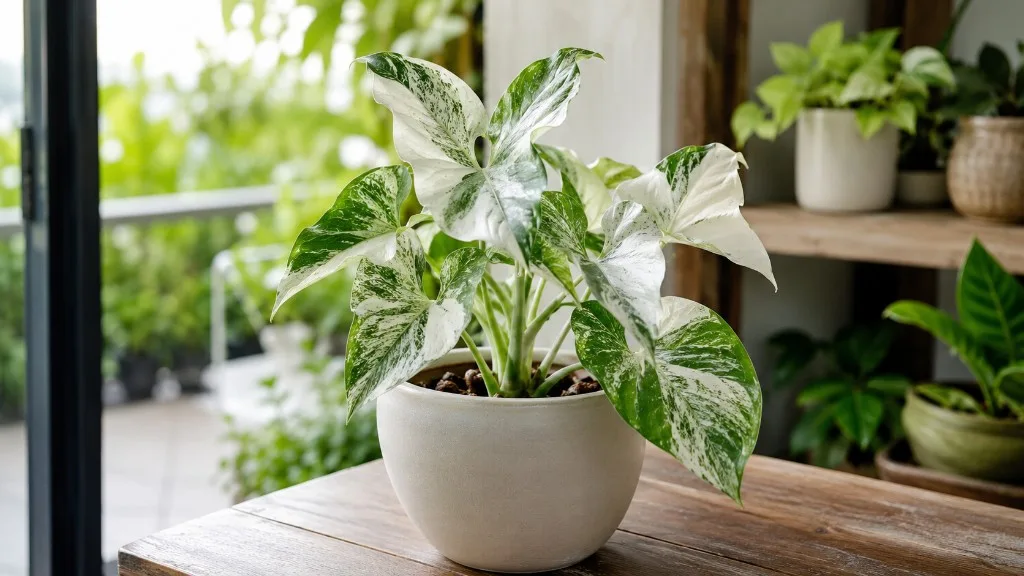
Syngonium podophyllum ‘Albo Variegatum’ - the arrowhead vine collectors call Syngonium albo - is one of those plants where light is not a background detail. It is the main lever. Get the exposure right and you get creamy white sectors, compact nodes, and steady climbing growth. Get it wrong in either direction and the plant either reverts toward solid green or scorches the very white tissue you bought it for. The frustrating part is that both failure modes can look like “something is off with my albo” until you learn to read new leaves instead of old damage.
This guide focuses on syngonium albo light requirements for variegation - how much brightness the plant actually needs, where to put it in a typical home, when grow lights make sense, and how to tell within one or two new leaves whether your current spot is working. The goal is not a vague “bright room” recommendation. It is a practical light target you can test, adjust, and maintain through seasonal changes.
If symptoms persist, see the Yellow Leaves on Syngonium Albo guide.
Why Light Matters More for Syngonium Albo Than Most Arrowhead Vines
A fully green Syngonium podophyllum can survive in moderate indoor light because nearly every cell in every leaf contains chlorophyll - the green pigment that captures light energy and drives photosynthesis. Your albo is different. Its white and cream sectors are visually striking precisely because they contain little or no functional chlorophyll. Those pale areas contribute almost no energy to the plant. Only the green portions of each leaf are doing the photosynthetic work.
That changes the care equation in two ways. First, the plant needs more total light than a green arrowhead vine to produce the same amount of energy, because a meaningful share of each leaf’s surface area is effectively offline. Second, the white tissue that makes albo desirable is physically weaker in bright direct sun. Green leaves have pigments and structural defenses that help them handle stronger light. White sectors lack that protection and can bleach, brown, or crisp long before the green parts show stress.
Horticultural references consistently rank light as the top challenge for maintaining albo variegation indoors. Ohio State University Extension explains that all-green portions of variegated plants are often more vigorous than variegated tissue because green leaves contain more chlorophyll - so insufficient light accelerates variegation loss, while bright direct light can burn white leaves. That is basic plant physiology applied to a chimeral cultivar.
How White Sectors Change the Photosynthesis Math
Think of each leaf as a small solar panel. On a green syngonium, the whole surface collects energy. On an albo leaf that is half white and half green, you have roughly half the collecting area - sometimes less, depending on how much of the leaf is pale. The green tissue has to compensate. In dim conditions, the plant’s survival instinct pushes it toward producing more chlorophyll-rich green tissue in new growth, which shows up as reversion: new leaves with smaller white sectors, muted cream coloring, or solid green shoots entirely.
Reversion is not always permanent, and light is not the only trigger. Compaction, inconsistent watering, and genetic instability in chimeral plants all play roles. But insufficient light is the most common correctable cause of fading variegation in home collections. If your albo sits in a spot that would be fine for a standard green arrowhead, it may slowly shift toward greener growth simply because the green cells photosynthesize more efficiently and outcompete the variegated tissue at the growing tip.
The opposite mistake - blasting the plant with direct afternoon sun to “force” variegation - fails for a different reason. White sectors cannot use that extra intensity productively, but they absorb heat and UV stress readily. You end up with bleached patches, brown crispy edges on pale tissue, and sometimes whole leaves collapsing after a sudden move to a hot window. The correct approach sits in the middle: bright, diffuse, consistent light that keeps the green engine running without cooking the white display panels.
What Bright Indirect Light Actually Means for Albo
“Bright indirect light” is the phrase every syngonium albo care page uses, and it is accurate - but only if you translate it into something you can check at home. For white-variegated aroids including Syngonium albo, Missouri Botanical Garden recommends bright indirect light with protection from direct sun indoors - the same qualitative target the shadow test below measures. White tissue scorches faster than green when unfiltered sun hits the leaves.
You do not need expensive equipment to get close. What matters is that the plant receives strong ambient light for most of the day without the leaf surface heating up in direct sunbeams. A spot where you can comfortably read without turning on a lamp usually qualifies as moderate light. A spot where the plant casts a soft, diffused shadow with a recognizable outline for several hours - not a sharp dark shadow, not no shadow at all - is closer to the bright indirect sweet spot albo prefers.
Consistency matters as much as peak intensity. A plant that gets excellent light for three hours and dim light the rest of the day behaves differently from one that receives steady moderate brightness from morning through afternoon. Variegated syngoniums respond well to full-day bright indirect exposure when you can provide it, which is why an east window or a well-filtered south or west window often outperforms a deep interior shelf that only catches a short sun patch.
The Shadow Test You Can Use at Home
On a reasonably bright day, hold your hand or a sheet of white paper between the window and the plant’s position. Look at the shadow it casts on the leaf surface or the wall behind the plant. A sharp, dark shadow with hard edges means direct sun - too strong for most albo unless the plant is acclimated and the exposure is gentle morning light. A soft shadow with fuzzy edges indicates bright indirect light - the target for variegation maintenance. A faint shadow or no shadow at all means the spot is too dim for long-term variegation stability, even if the room feels bright to your eyes.
Run this test at different times of day. A spot that passes at 9 a.m. may fail at 2 p.m. when west or south sun shifts. Season matters too: winter sun sits lower and can reach deeper into a room, while summer sun is more intense even at the same window. The shadow test takes two minutes and prevents the most common placement error - assuming a pretty corner is bright enough because you personally would not need a lamp to walk through it.
Best Window Placement for Syngonium Albo Variegation
Window direction is a shorthand, not a guarantee. Obstructions, overhangs, neighboring buildings, sheer curtains, and distance from the glass all change the actual light landing on the leaves. Still, orientation gives you a reliable starting map for syngonium albo window placement.
East-Facing Windows
An east window is the easiest win for most homes. Morning sun is gentler and shorter than afternoon sun, and the plant receives a bright boost early in the day followed by steady indirect light. Place the pot on the sill or within one to three feet of the glass. If leaves show any sign of morning sun stress - pale bleaching on white sectors by midday - pull the plant back slightly or add a sheer curtain. For many collectors, east exposure provides enough energy to maintain crisp variegation without constant sunburn monitoring.
North, West, and South Exposures
North windows supply consistent but lower-intensity light. In cloudy climates or during winter, a north exposure alone may not sustain strong variegation. Albo can look healthy for months on a north sill and still produce progressively greener new leaves. If you use north light, watch new foliage closely and be ready to supplement with a grow light or move the plant closer to a brighter exposure during the growing season.
West windows deliver strong afternoon sun that intensifies in summer. Syngonium albo can live in west-facing rooms, but rarely on the sill without protection. Set the plant three to six feet back from the glass, or use sheer curtains to diffuse direct beams. The white sectors will tell you quickly if the spot is too hot - brown crisping on pale tissue often appears within days of a bad placement.
South windows offer the highest light potential and the highest scorch risk. A south sill with unfiltered midday sun is inappropriate for most albo plants unless they were grown in comparable light and acclimated over one to two weeks. A south room with the plant set back from the window, or behind a diffuser, can be excellent for variegation. The Missouri Botanical Garden recommends bright indirect light and protection from direct sun for Syngonium podophyllum indoors.
Wherever you place it, prioritize plant-facing light over room aesthetics. Syngonium albo belongs where bright indirect light is realistic for most of the day, not only where the pot looks best on a shelf.
Direct Sun: What Albo Can Tolerate and What It Cannot
Syngonium albo evolved in the filtered understory of Central and South American forests, climbing tree trunks in dappled light. It is not a full-sun tropical. Direct sun tolerance is limited and conditional. Some gentle early-morning rays on acclimated leaves can be acceptable. Midday or afternoon direct sun through glass - which amplifies heat - is where white sectors fail first.
Direct sun damage on albo is distinctive. White and cream areas bleach to papery translucent patches or turn dry and brown while green sections may still look fine initially. You may see curling during the brightest hours, sun-facing leaf collapse, or sudden damage within 24–48 hours of a move to a hot sill. These are not nutrient problems and they will not heal on the damaged tissue. Correct the exposure and judge success by the next one or two leaves.
Can syngonium albo take direct sunlight at all? Yes, in small, acclimated doses - typically soft morning light for an hour or two. Should it sit in direct sun for most of the day? No. The variegation you are trying to preserve is the first tissue type to fail under harsh rays.
Acclimating Leaf Tissue to Stronger Light
Plants adapt to the light they were grown in. A syngonium albo from a greenhouse or a dim shop will have leaves structured for lower intensity. Moving it immediately to your brightest window shocks the existing foliage even if that window is technically “correct” long term.
Acclimate over one to two weeks. Start at the current light level, then move the plant incrementally closer to the target window or remove one layer of diffusion at a time. Watch the newest leaf, not the oldest. If the emerging leaf shows good variegation and firm texture, hold the position for several days before increasing again. If you see bleaching or crisping, step back to the last safe spot and wait for a healthy new leaf before retrying.
Avoid changing light, watering, and pot size simultaneously. Light stress plus repot stress plus a new watering routine makes every symptom harder to interpret. Change light first, wait for one new leaf, then adjust other variables if needed.
Low-Light Limits and Variegation Reversion
Syngonium albo can survive in lower light for a while. It often cannot maintain strong variegation there long term. Low light is one of the most common reasons collectors report albo “turning green” or producing smaller, less patterned leaves over time.
Watch for these reversion and under-lighting signals on new growth:
- Smaller white sectors on leaves that previously showed bold variegation
- Solid green shoots emerging from a variegated stem - these grow faster and can dominate the plant if left unpruned
- Longer internodes (stretched gaps between leaves) and a leggy, reaching habit
- Smaller leaf size compared to earlier foliage at the same node spacing
- Slower unfurling and softer, thinner new leaves
- Pale or yellow-green coloring across the whole leaf rather than crisp white-green contrast
If you see these patterns, increase light gradually - not overnight. Move closer to the window, shift to a brighter exposure, or add a grow light before reaching for fertilizer or Syngonium Albo repotting guide. Fertilizer does not restore variegation that light deprivation suppressed. In fact, high-nitrogen feeding can push greener growth because nitrogen is a core component of chlorophyll.
Prune solid green reverting shoots back to the last node with visible variegation if you want to preserve the cultivar’s look. Propagate from variegated nodes, not from all-green sections, or the cutting will likely continue as green growth. Light alone cannot undo genetic reversion at a shoot that has already switched, but good light on remaining variegated tissue slows further takeover - and Ohio State University Extension advises removing non-variegated reversion promptly before green growth outcompetes variegated tissue.
Grow Lights When Natural Light Falls Short
Natural light is ideal when you have it. Grow lights are the backup that keeps variegation stable in apartments with small windows, north-facing rooms, winter light drop, or shelves away from glass. A full-spectrum LED grow light mimics the wavelengths syngonium albo uses for photosynthesis without the heat stress of incandescent bulbs.
Grow lights matter most when:
- New leaves trend greener despite a “bright” room
- Winter reduces daylight hours and window intensity
- The plant lives more than four to six feet from any window
- Sheer curtains or external shade cut light below the variegation-maintenance threshold
Distance, Duration, and Spectrum Basics
Position a full-spectrum LED 12–18 inches (30–45 cm) above the canopy as a starting point. Run it 10–14 hours daily on a timer to approximate a long bright day. If leaves look heat-stressed or bleached, raise the fixture. If new growth stays leggy and under-variegated, lower it slightly in small increments - never more than an inch or two at a time.
Spectrum choice is simpler than the product marketing suggests. A balanced full-spectrum white LED designed for houseplants works well. You do not need a specialized “variegation” bulb. What variegated tissue needs is adequate total light delivered gently, not a specific colored diode.
Monitor temperature at the leaf surface. If the canopy feels warm to the touch after the light has been on for an hour, increase distance. Grow lights should deliver steady plant-facing brightness, not heat stress that mimics sun scorch.
Seasonal Light Shifts and Winter Adjustments
Light is not static indoors. Seasonal change affects syngonium albo as much as outdoor plants, just more subtly. Winter brings shorter days, lower sun angle, and - for plants near glass - cold drafts that slow metabolism even when light is technically sufficient. Summer brings longer days and stronger rays that can scorch white tissue through the same window that was safe in January.
In late fall and winter, watch for the low-light reversion signals on new leaves. Move the plant closer to the window if cold allows, or add a grow light to extend the effective day length. Reduce watering frequency in step with slower growth - a dimmer plant in a cooler room uses less water, and overwatering in winter compounds light stress with root stress.
In spring and summer, monitor for scorch as sun intensity rises. A spot that was perfect in March may need a sheer curtain by June. Rotate the pot weekly so one side does not dominate toward the light source, which keeps growth symmetrical and lets you compare leaf quality on all sides.
If you move the plant outdoors for summer - common in warm climates - treat it like a shade-loving aroid, not a patio succulent. Dappled shade or bright shade matches its understory ecology. Direct outdoor sun, even for an hour, can destroy white sectors faster than the same exposure indoors because wind and UV add stress.
Warning Signs Your Albo Has Too Much or Too Little Light
Diagnosis starts with the newest leaf or unfurling leaf, because old damage does not reverse. Use the lists below as a quick reference, then cross-check against your window timing with the shadow test.
Under-Light Symptoms
- Leggy stems with unusually long spaces between leaves
- Smaller new leaves than older ones at similar vine positions
- Loss of white variegation on successive new leaves - more green, less cream
- Solid green shoots outpacing variegated growth
- Slow growth or leaves that stay folded or soft long after unfurling
- Soil staying wet longer than expected because the plant is not using water at normal speed
- Leaning or reaching toward the nearest window
Under-lighting is the more common long-term problem for indoor albo because the plant tolerates dim conditions quietly until variegation fades over several weeks.
Over-Light Symptoms
- Bleached white patches turning papery or translucent
- Brown, crispy edges on pale sectors while green areas still look intact
- Leaf curling during midday bright hours
- Sudden leaf collapse or wilting after a window move - distinct from root rot because the mix may still be appropriately dry
- Sun-facing side damage on only one portion of the leaf
- Heat stress - leaves feel warm or look dull after direct sun exposure
Over-lighting often shows up within days of a bad move, whereas under-lighting creeps in over multiple new leaves. That timeline difference helps you pick a direction quickly.
How Light Connects to Watering, Growth Speed, and Pruning Decisions
Light and water move together on syngonium albo. A plant in brighter light photosynthesizes faster, transpires more, and dries its pot quicker. The same Syngonium Albo watering guide that worked on a dim shelf will overwater the plant after you move it to an east window. When you increase light, check moisture more often and let the top inch of soil guide timing rather than a fixed calendar.
Growth speed follows the same logic. In strong bright indirect light with warm temperatures and adequate humidity, albo puts out new leaves steadily and benefits from a moss pole or trellis - climbing encourages larger, more mature arrowhead shapes. In lower light, growth slows and the plant may stay in juvenile leaf forms longer. That is not always a crisis, but paired with fading variegation it confirms the need for more light, not more fertilizer.
Pruning decisions also hinge on light. If you remove a reverting green shoot, place the plant in confirmed adequate light afterward or the next growth point may revert again. If you propagate, take cuttings from nodes with stable variegation patterns visible on the stem, not from emergency green growth. Light will not fix a cutting that started from reverted tissue, but it gives variegated cuttings the energy they need to root and push patterned leaves.
Humidity and temperature sit adjacent to light but are secondary. Moderate to high humidity (roughly 50–65%) helps leaf edges on heavily white foliage stay supple, but humidity cannot replace brightness. Comfortable indoor temperatures between 18°C and 27°C (65–80°F) support growth; cold drafts on a window ledge in winter can stall new leaves even when light looks sufficient on paper.
A Practical Light-Testing Routine After Every Move
Treat every placement change as an experiment with a defined observation window. Step one: record the date and the new position relative to the window - distance, orientation, and any curtain layer. Step two: run the shadow test at mid-morning and mid-afternoon on a clear day. Step three: wait for the next new leaf to unfurl fully before judging. One leaf is a signal; two consecutive leaves in the same direction confirm the trend.
If the new leaf shows strong variegation, firm texture, and reasonable internode length, the spot is working. Hold steady. If the new leaf shows greener, smaller, or stretched growth, increase light incrementally over the next week. If the new leaf shows bleaching or crisp pale sectors, reduce intensity or add diffusion and acclimate again more slowly.
Do not stack interventions. If light is wrong, fix light first. Watering, fertilizer, and repotting can all mimic light-stress symptoms and send you in circles. The useful checkpoint for syngonium albo is simple: bright indirect light that produces well-variegated new leaves without scorch. Pair that with a well-draining aroid mix and watering when the top inch of soil dries, and most light-related failures resolve before they become collection-wide problems.
Conclusion
Syngonium albo light requirements come down to a balanced trade-off that generic arrowhead advice misses: the plant needs more brightness than a green syngonium to fuel variegated growth, but its white sectors tolerate less direct sun than green tissue. Aim for full-day bright indirect light in the rough range of 2,500–10,000 lux - soft shadow, not harsh beam - with east windows and filtered south or west exposures as the most reliable indoor starting points. Use the shadow test, acclimate over one to two weeks, and judge every change by the newest leaf.
When natural light falls short, a full-spectrum LED on a 10–14 hour timer fills the gap better than hoping a dim room will suffice. Watch for leggy green-leaning growth as the signal to add light, and bleached crispy pale tissue as the signal to pull back. Fix light before you repot, fertilize, or prune aggressively - and when variegation is stable, adjust watering to match the faster or slower metabolism your brightness level creates. That is how you keep Syngonium albo white without burning what makes it worth growing.
When to use this page vs other Syngonium Albo guides
- Syngonium Albo overview - Start here for whole-plant context before deep-diving this topic.
- Syngonium Albo problems hub - Jump to symptom-specific fix guides when this care topic does not resolve the issue.