Syngonium Albo Fertilizer: When, How, and Mistakes to Avoid
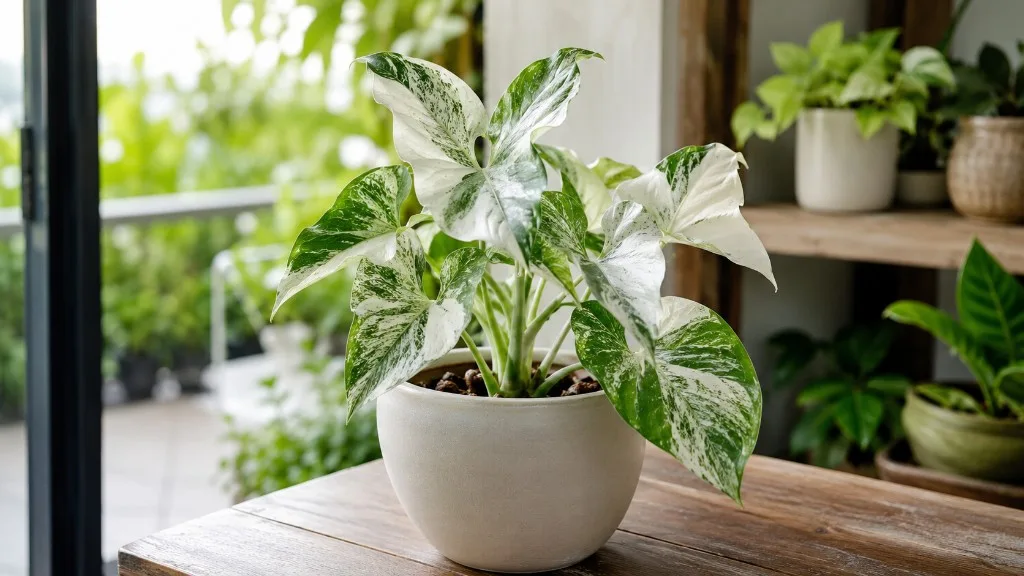
Syngonium Albo Fertilizer: When, How, and Mistakes to Avoid
Syngonium Albo Fertilizer: When, How, and Mistakes to Avoid
Syngonium albo fertilizer decisions are simpler than collector forums make them sound - and more consequential than most growers realize. Syngonium podophyllum ‘Albo Variegatum’, the variegated arrowhead vine sold as Syngonium albo, is grown almost entirely for its white-and-green marbled foliage. Those white patches contain little or no chlorophyll, which means each leaf produces less energy than a fully green one. Fertilizer does not paint white onto leaves, but steady, appropriate feeding during active growth helps the plant push out healthy new tissue with stable patterning - provided light is strong enough to support the variegation in the first place. Feed too much, too often, or onto dry roots, and you get the opposite: brown leaf margins, a white salt crust on the soil surface, stunted roots, and sometimes greener new leaves that look like reversion even when the real problem is stress or insufficient light.
The practical goal for most home growers is straightforward: use a balanced water-soluble houseplant fertilizer at half the label strength, apply it every three to four weeks from spring through early fall while the plant is actively growing, and pause entirely in late fall and winter. Water onto moist soil, never onto dry roots. Avoid heavy nitrogen formulas marketed for lawns or outdoor vegetables - Syngonium albo is a moderate feeder, not a hungry outdoor crop, and excess nitrogen combined with weak light is one path to greener new growth. Container plants in small pots need more consistent salt management than large specimens on poles; freshly repotted or stressed plants need none until they recover.
This guide covers when to fertilize, how much to use, which products work best for variegated aroids, how to read deficiency versus burn, and the mistakes that cause more damage than skipping a month ever would.
If symptoms persist, see the Yellow Leaves on Syngonium Albo guide.
Why Fertilizer Matters for Syngonium Albo
Syngonium albo is a moderately fast-growing tropical aroid in the Araceae family, native to the rainforests of Central and South America. Indoors it typically reaches 30–90 cm as a bushy juvenile and can climb much taller on a moss pole or trellis, producing progressively larger leaves as it matures. That growth pulls nitrogen, phosphorus, potassium, and trace elements out of the potting mix with every new leaf, node, and root tip. Watering leaches some of those nutrients over time. Root growth and microbial activity in organic matter consume others. Fertilizer replaces what the plant uses - but only up to the point its roots can absorb without salt damage.
The Spruce recommends feeding syngonium albo once a month during the growing season with an indoor plant fertilizer reduced to half strength, and watering the plant before feeding (The Spruce - Syngonium Albo Growing Guide). That conservative approach matches how variegated aroids behave in containers: they benefit from regular but gentle nourishment rather than heavy doses. Variegated tissue has reduced photosynthetic capacity because white sectors lack chlorophyll. The plant still needs the same structural nutrients to build leaves and stems, but it cannot convert fertilizer into energy as efficiently as a fully green plant in identical conditions. Think of feeding as maintenance for a healthy, actively growing specimen - not a rescue tool for a plant that is pale because it sits in too little light, dries out repeatedly, or struggles in waterlogged mix.
Fix light and water first, then add nutrients on a conservative schedule. Half-strength liquid feeding and occasional salt flushing match how Syngonium albo handles nutrition in small containers far better than full label rates. A plant pushing out firm new leaves with crisp white sectors in Syngonium Albo light guide is using nutrients well. A plant sitting in a dim corner with soggy soil will not respond to fertilizer no matter how premium the bottle is.
When to Fertilize Syngonium Albo: Active Growth vs Rest
Timing is the first decision, and it follows the plant’s metabolism more than the calendar on your wall. Feed when Syngonium albo is actively producing new leaves and extending stems or climbing a support, and stop when growth slows sharply. Outdoors in USDA zones 10–11, that rhythm tracks warm weather and long days. Indoors, heated rooms and supplemental grow lights can extend the window - but most houseplant syngoniums still slow noticeably in late fall and winter even if old foliage stays upright.
A Syngonium albo kept indoors through winter often looks “alive,” which tricks growers into feeding on a summer schedule through December. In practice, lower light and shorter days reduce new shoot production even when existing leaves stay firm. Unused nutrients then accumulate as soluble salts while roots absorb water more slowly - a common path to brown tips and weak spring growth. The signal is always new tissue, not the mere presence of green leaves.
Spring and Summer Feeding Window
Start feeding when you see fresh growth at stem tips - new arrow-shaped leaves unfurling with visible white variegation, side shoots filling in after pruning, and roots visibly active if you gently inspect the drainage holes. In temperate climates, that usually means mid-spring through late summer, roughly April through September depending on your home’s light and temperature. Growers in bright, warm rooms with grow lights may start a few weeks earlier; those in cooler homes may wait until May.
During this active window, a half-strength balanced liquid feed every three to four weeks works for most container plants. Vigorous climbers on moss poles in bright indirect light may sit at the three-week end; smaller pots in moderate light may need only monthly feeding. Both are reasonable if leaves stay appropriately variegated for the cultivar, internodes stay reasonably short, and the soil surface stays free of heavy salt crust. Some growers report success feeding even less frequently when the potting mix is rich with worm castings or fresh aroid substrate - that is valid, but watch for pale new growth or smaller leaves as signs the plant wants a light supplement.
| Month (temperate climate) | Growth phase | Feeding guidance |
|---|---|---|
| March–April | Waking up, new shoots | Start half-strength liquid if active growth visible |
| May–August | Peak growth, climbing | Feed every 3–4 weeks on moist soil |
| September | Growth slowing | Reduce to once if still actively pushing leaves |
| October–February | Rest or minimal growth | Pause fertilizer; plain water only |
| March (following year) | Resume when new growth returns | Restart at half strength after 2–3 plain waterings |
Fall Taper and Winter Pause
Do not fertilize Syngonium albo in winter when the plant is not producing meaningful new growth. Most indoor specimens enter a rest period from late autumn through early spring, even in heated homes, because day length and light intensity drop. The Spruce explicitly recommends eliminating fertilizer in fall and winter when the plant is dormant (The Spruce - Syngonium Albo Growing Guide). Holding off protects roots from salt buildup when the plant cannot use nutrients efficiently.
If your syngonium sits under strong grow lights year-round and pushes new leaves every few weeks through winter, you can feed lightly - but that describes a minority of home setups. For most growers, plain water from November through February is the safer default. Resume feeding only when you see active new growth in spring, not because the calendar flipped to March. Give the plant two or three plain waterings first to re-establish a normal moisture rhythm after the dry winter stretch many homes impose on tropical plants.
Best Fertilizer Type for Syngonium Albo
The best Syngonium albo fertilizer for most home growers is a balanced, water-soluble houseplant formula - not a lawn product, not a bloom booster, and not a slow-release pellet dropped into a small pot without monitoring. Liquid fertilizers let you control dose precisely, dilute to half strength easily, and skip a month without leaving unpredictable granules dissolving in the mix. Organic options like diluted fish emulsion or seaweed extract work for growers who prefer them, but they smell, vary in nutrient analysis, and still need conservative dosing in containers.
Balanced Liquid Formulas and NPK Ratios
Look for a balanced NPK ratio such as 10-10-10 or 20-20-20 on a label designed for indoor foliage plants. These numbers represent the percentage by weight of nitrogen (N), phosphorus (P), and potassium (K) - the three macronutrients that drive leaf, root, and overall plant function. A balanced formula gives Syngonium albo enough nitrogen for foliage development, enough phosphorus for root and energy transfer, and enough potassium for water regulation and stress tolerance without skewing heavily toward flowering.
Some aroid-focused growers prefer a 3-1-2 ratio (or similar foliage-weighted formulas such as 9-3-6) that supplies slightly more nitrogen relative to phosphorus. That approach reflects how tropical foliage plants allocate nutrients toward leaf production rather than blooms. Both balanced 1-1-1 ratios and foliage-weighted 3-1-2 ratios work in practice when diluted properly - the critical variable is dose and frequency, not whether you chose 10-10-10 or 9-3-6. What matters more is avoiding products with extreme nitrogen spikes designed for turf grass or heavy outdoor vegetables.
Always dilute to half the label strength for Syngonium albo in containers. If the bottle says 1 teaspoon per gallon for houseplants, use half a teaspoon per gallon instead. Young plants, fresh cuttings, and recently repotted specimens should start at quarter strength for the first few feeds. Synthetic water-soluble formulas deliver nutrients immediately; organic liquids release more gradually and may need even lighter application. Either can work if you watch the plant’s response and flush salts periodically.
Variegation, Nitrogen, and What to Avoid
Variegation makes Syngonium albo feeding slightly different from feeding a solid-green houseplant, but not in the way social media sometimes suggests. Fertilizer alone cannot create white sectors - variegation is a genetic trait expressed in tissue. White patches exist because those cells lack chlorophyll. The plant compensates by needing bright indirect light so the green portions photosynthesize efficiently enough to support the whole leaf. Stable nutrition helps the plant maintain energy balance while building new variegated tissue, especially when light is adequate.
The nuance around nitrogen is real but often overstated. Some growers warn that high-nitrogen formulas push green reversion - new leaves emerging mostly green with reduced white patterning. Excess nitrogen can encourage lush green growth, particularly when light is insufficient to sustain variegated tissue. Ohio State University Extension notes that all-green portions of variegated plants are often more vigorous than variegated tissue because green leaves contain more chlorophyll - the same competitive dynamic that makes high-nitrogen formulas risky in dim corners. A plant fed heavily with nitrogen-rich fertilizer in low light often produces greener leaves, but the primary fix is usually more light, not abandoning fertilizer entirely.
Skip slow-release granules in small pots unless you understand how they behave in your specific mix - they release unpredictably in warm, frequently watered containers and are a common hidden cause of salt buildup. Skip foliar feeding as your primary method; syngonium roots absorb nutrients efficiently when the soil solution is correct, and wet fertilizer on leaves invites fungal spotting. Skip combined fertilizer-pesticide products unless you have a diagnosed pest issue and follow label safety guidance precisely. Skip feeding a dry plant - that is the fastest route to root burn regardless of which bottle you chose.
How Much Fertilizer to Use on Syngonium Albo
Dose control matters more than brand prestige. Syngonium albo in a typical 12–15 cm nursery pot needs far less fertilizer than outdoor landscape plants, and variegated specimens in small collector pots need even more caution because salt concentrates quickly in limited soil volume. The half-strength rule is your baseline: whatever the label recommends for indoor houseplants, cut it in half. If you are unsure, start at quarter strength for two feeding cycles and increase only if new growth looks pale and light and water are already correct.
Measure consistently. A kitchen measuring spoon or a syringe marked in milliliters removes the guesswork that causes accidental double doses. Mix the fertilizer into your watering can before you pour, stir thoroughly, and apply until a small amount drains from the bottom - that confirms the solution moved through the root zone. Do not pour concentrate directly onto the soil surface. Do not “eyeball” a capful because the last feed was weeks ago.
Hard tap water adds another layer. If your water is high in calcium or magnesium, salts from fertilizer stack on top of minerals already present. Growers in hard-water regions should flush pots monthly with plain water even when feeding conservatively, and consider using filtered or rainwater for sensitive specimens. The plant cannot tell whether a salt ion came from your fertilizer or your tap - the root zone responds the same way when concentration gets too high.
How Often to Fertilize Syngonium Albo
Frequency follows the same conservative logic as dose. For most indoor Syngonium albo plants in active growth, every three to four weeks at half strength is enough. Monthly feeding matches The Spruce’s recommendation and works well for moderate growers in bright indirect light (The Spruce - Syngonium Albo Growing Guide). Faster-growing climbers under strong light with frequent watering may benefit from the three-week interval. Slower plants in cooler rooms or smaller pots may need only every six to eight weeks - and some experienced growers feed even less when the substrate is fresh and rich.
Use this decision framework rather than a rigid calendar:
- Feed every 3 weeks if the plant is climbing actively, producing large new leaves regularly, and sits in bright indirect light or under grow lights with consistent warmth.
- Feed every 4 weeks if growth is steady but moderate - the default for most home syngoniums.
- Feed every 6–8 weeks if the plant is small, recently repotted into fresh mix, or growing slowly in moderate light.
- Do not feed if the plant is dormant, recently repotted, dry-stressed, pest-affected, or showing salt burn symptoms.
Plain water between feeds is not neglect - it is part of the program. Syngonium albo handles skipped months far better than it handles doubled doses after a growth slump. If you forgot to feed in June, do not apply double fertilizer in July. Resume at the normal half-strength dose on moist soil and move on.
Step-by-Step: How to Feed Syngonium Albo Safely
Feeding syngonium albo is a short routine once the prep checks pass. Rushing the steps - especially applying fertilizer to dry soil - causes more problems than choosing between two acceptable NPK ratios.
First, check the calendar and the plant. Confirm you are inside the active growth window and that the plant is producing new leaves or extending stems. If growth has stalled for weeks and light is weak, fix the environment before feeding. Second, water the day before or several hours before feeding if the mix is dry. The soil should be evenly moist, not sopping wet and not dusty dry. Third, mix fertilizer at half the label strength in your watering can using measured quantities. Fourth, pour slowly over the soil surface, keeping solution off the variegated leaves when possible - white tissue scorches more easily than green. Fifth, allow a small amount of drainage from the pot bottom so you know the solution penetrated the root zone. Sixth, empty the saucer after 15–20 minutes so the plant is not sitting in concentrated runoff.
After feeding, observe the plant for two weeks. New growth should continue at a similar pace with firm leaves and stable variegation patterning. Brown tips appearing within days suggest the dose was too strong, the soil was too dry at application, or salts were already elevated. Adjust before the next scheduled feed, do not repeat the same dose hoping the plant adapts.
Pre-Feed Checks and the Moist-Soil Rule
Run through this checklist before every application. It takes under a minute and prevents most fertilizer damage.
Check soil moisture first. If the top third of the mix is dry, water with plain water and feed later the same day or the next day once moisture has spread evenly. Never apply fertilizer concentrate to dry roots - osmotic stress damages fine root hairs within hours. Check salt crust on the soil surface. White or yellowish crystalline deposits mean you should flush with plain water and skip this month’s feed entirely. Check newest leaf color and variegation. Pale green with no white on a plant that previously variegated normally may indicate low light before it indicates hunger - adjust light before increasing fertilizer. Check recent Syngonium Albo repotting guide. Plants repotted within the last four to six weeks usually have fresh nutrients in the mix; wait until new growth resumes before supplementing. Check pests and stress. Spider mites, root rot, and heat stress all mimic nutrient problems. Feeding a sick plant adds salt to an already struggling root zone.
The moist-soil rule is non-negotiable for Syngonium albo. Think of fertilizer as a nutrient solution that must diffuse through an already hydrated root zone. Dry soil repels the solution and concentrates salts at contact points where fine roots die back. If you remember only one feeding rule, make it this one.
Signs Your Syngonium Albo Needs More Nutrition
Under-fertilizing is less common than over-fertilizing for Syngonium albo, but it happens - especially in older pots where nutrients have leached for a year or more, or when the plant grows vigorously on a moss pole without any supplemental feeding. Symptoms overlap with low light and inconsistent watering, so rule those out before increasing dose.
Pale new leaves that stay uniformly light green (not white-variegated sectors, but an overall washed-out tone) can indicate nitrogen deficiency when light is already adequate. Smaller new leaves than the previous two or three leaves - on a plant that is not root-bound - sometimes signal the plant lacks resources to size up. Slow growth in bright light and warm conditions, with no other obvious stress, may mean the mix is depleted. Older leaves yellowing from the tip backward while new growth is also weak differs from normal bottom-leaf senescence, where one old leaf yellows while new growth stays vigorous.
Increase feeding gradually. Move from monthly to every three weeks at the same half strength, or from half strength to three-quarter strength - not both at once. Reassess after two new leaves unfold. If variegation improves and leaf size stabilizes, hold the new schedule. If symptoms persist, the problem is likely light, water, or roots - not fertilizer hunger.
Signs of Over-Fertilizing and Salt Buildup
Over-fertilizing is the most common fertilizer mistake with Syngonium albo, and it shows up faster in small pots than large ones. Soluble salts from repeated feeding accumulate in the soil solution. Roots lose the ability to take up water efficiently - a condition sometimes called fertilizer burn or osmotic stress - and leaf margins brown even when you have not underwatered.
Watch for these signs:
- Brown, crispy leaf tips and margins on otherwise healthy-looking leaves, often appearing shortly after a feed
- White or yellowish crust on the soil surface or rim of the pot - crystallized fertilizer salts
- Sudden leaf drop or wilting despite moist soil, because damaged roots cannot transport water
- Stunted new growth that emerges small and deformed after a period of heavy feeding
- Root tips brown or black when you inspect the drainage holes or slip the plant from its pot
- Algae or mold on soil surface from repeated heavy feeding combined with moisture
Variegated leaves show damage on white sectors first because that tissue is already structurally weaker and more prone to drying. Do not mistake brown tips on white patches for humidity problems alone - check salt load and feeding history simultaneously. If multiple plants in the same window show tip burn after you fed them all on the same weekend, fertilizer is the likely link even if humidity is also low.
How to Flush Syngonium Albo After Over-Feeding
Recovery starts by removing excess salts, not by feeding again to “balance things out.” Flushing leaches soluble minerals through the drainage holes and resets the root zone enough for recovery over one to two new leaf cycles.
Move the pot to a sink, shower, or outdoor hose area. Water slowly and thoroughly with plain room-temperature water, letting it drain freely. Repeat three to four times over 20–30 minutes, allowing the pot to drain fully between rounds. For a 12 cm pot, each flush might use 1–2 liters of water; larger pots need more. The goal is dilution, not a single quick pour.
After flushing, pause all fertilizer for four to six weeks. Keep the plant in stable bright indirect light, maintain normal watering on a check-the-soil basis, and avoid repotting unless roots are clearly rotting from a separate issue. Trim badly burned leaves only if they are mostly brown - they will not revert to green, but the plant does not need them for photosynthesis if enough healthy green tissue remains. New leaves are the recovery signal. When the next two leaves emerge firm with normal variegation and no fresh tip burn, you can resume feeding at quarter strength for one cycle, then return to half strength if growth looks healthy.
Badly over-fertilized plants in tiny pots may need repotting into fresh mix after flushing if salt crust was heavy and roots look damaged. That is a last resort, not a first response - flushing alone resolves most home-scale over-feeding events.
Seasonal and Situational Adjustments
The base schedule - half strength every three to four weeks in active growth, pause in winter - adapts to real-life situations that change how fast Syngonium albo uses nutrients. Treat adjustments as temporary, not permanent regime changes, unless the plant’s environment has permanently shifted.
In late summer, taper feeding as natural growth slows even before winter rest. One lighter feed in September may be enough; none in October is fine for most temperate-climate homes. In spring, resume gradually - one half-strength feed after you see new growth, then normal frequency after two weeks if the plant responds well. Do not feed three times in March to “catch up” for a fertilizer-free winter.
Plants under grow lights year-round may need feeding through winter if they keep producing new leaves every few weeks. Match frequency to visible growth, not the calendar. Plants in very small terrarium pots need lighter doses at longer intervals because salts concentrate in minimal substrate volume. Plants on large moss poles in bright light may need the shorter three-week interval during peak summer because leaf surface area and metabolic demand increase.
After Repotting, Stress, and Cuttings
Freshly repotted Syngonium albo usually does not need supplemental fertilizer for four to six weeks. Quality aroid mixes often include starter nutrients, and repotting itself stresses roots briefly. Feeding too soon adds salt while roots re-establish. Wait until you see active new growth, then start at quarter strength for one or two cycles.
Stressed plants - those recovering from root rot, heat damage, pest treatment, or shipping - should not be fed until they stabilize. Fertilizer is not medicine. Fresh cuttings rooting in water or sphagnum need no fertilizer until they have roots at least 2–3 cm long and are transferred to soil or moss. Then begin at quarter strength monthly. Propagations in shared trays are easy to over-feed because growers treat the tray as one plant; dose per individual pot size instead.
Fertilizer and Other Syngonium Albo Care
Fertilizer only works when light, water, and soil are already in range. Syngonium albo in bright indirect light uses nutrients efficiently and builds variegated tissue with stable patterning. The same plant in a dim corner accumulates salts faster than it uses them because metabolic demand drops while you keep feeding on a summer schedule. Always pair feeding with active growth, a well-draining aroid mix, and a Syngonium Albo watering guide that lets the top third of the mix dry between drinks.
Light is the master variable for variegation. No fertilizer compensates for insufficient brightness. White sectors shrink and new leaves emerge greener when the plant cannot photosynthesize enough to sustain variegated tissue. Before increasing nitrogen, confirm the plant receives a full day of bright indirect light or adequate grow-light coverage. Watering interacts with feeding through the moist-soil rule and through root health. Overwatered roots absorb nutrients poorly and rot; underwatered roots burn when fertilizer is applied. Soil choice affects how salts behave - chunky aroid mixes with perlite and bark drain well and tolerate feeding better than heavy peat mixes that stay wet and concentrate salts.
Humidity supports leaf quality but does not replace correct feeding. Syngonium albo prefers 50–60% relative humidity for optimal leaf edges, yet brown tips from salt burn and brown tips from dry air look similar - check feeding history and soil crust when tips brown in a humid room. Pet safety matters in feeding routines too: Syngonium albo contains insoluble calcium oxalate crystals that irritate mouth and digestive tissues if chewed (ASPCA - Syngonium). Store fertilizers and mixing supplies away from pets and children, and wash hands after handling concentrate.
Common Syngonium Albo Fertilizer Mistakes
Most fertilizer problems repeat the same few errors. Recognizing them early saves leaves that variegation collectors care about most.
Feeding on a calendar without checking growth is the top mistake. Syngonium albo in a cool, dim room in August may not be growing actively even though it is “summer.” Feeding dormant metabolism adds salt without benefit. Using full label strength because the plant “looks hungry” burns roots in small pots before new growth can show the damage. Feeding every watering with a weak constant dose builds salts faster than many growers expect, especially in containers under 10 cm. Chasing reversion with more nitrogen makes green growth worse when light is the actual limit - move the plant or add a grow light instead.
Ignoring salt flush for months while feeding on schedule leads to gradual tip burn that growers blame on humidity or water quality alone. Using slow-release pellets in collector pots without tracking release rate causes hidden over-feeding that appears suddenly when warm weather accelerates dissolution. Feeding immediately after repotting or shipping stresses roots that need plain water and stability first. Doubling dose after missing a month punishes the plant for your schedule, not its needs - resume normal half strength instead.
Two mistakes deserve special emphasis because they appear constantly in variegated plant forums. First, applying fertilizer to dry soil after returning from vacation - water first, feed later. Second, confusing fertilizer burn with reversion - burn shows crispy margins and salt crust; reversion shows progressively greener new leaves with adequate light and no salt signals. Fix burn by flushing and pausing feed. Fix reversion by improving light and pruning back to the last well-variegated node if needed.
Conclusion
Syngonium albo responds best when feeding follows its growth rhythm rather than a rigid calendar or collector hype about heavy feeding. Start with a balanced liquid fertilizer at half the label strength, apply it every three to four weeks on moist soil during active spring and summer growth, and pause entirely in fall and winter when new leaves stop appearing. Protect variegation by keeping light strong enough that white sectors can be sustained, avoid high-nitrogen formulas that push lush green growth in weak light, and flush salts monthly if you feed regularly or use hard tap water.
When something looks wrong, check light and water before increasing fertilizer - pale, stretched, or reverting growth usually traces to environment first. When tips brown and salt crusts appear, flush with plain water and hold feed for a month rather than adding more nutrients. Syngonium albo tolerates a lean feeding routine far better than it tolerates overcorrection after every small change. Get the basics steady, adjust based on the newest leaves and the condition of the soil, and the plant will tell you clearly whether your schedule is working.
When to use this page vs other Syngonium Albo guides
- Syngonium Albo overview - Start here for whole-plant context before deep-diving this topic.
- Syngonium Albo problems hub - Jump to symptom-specific fix guides when this care topic does not resolve the issue.