Yellow Leaves on Snake Plant: Causes, Checks & Fixes
Quick answer
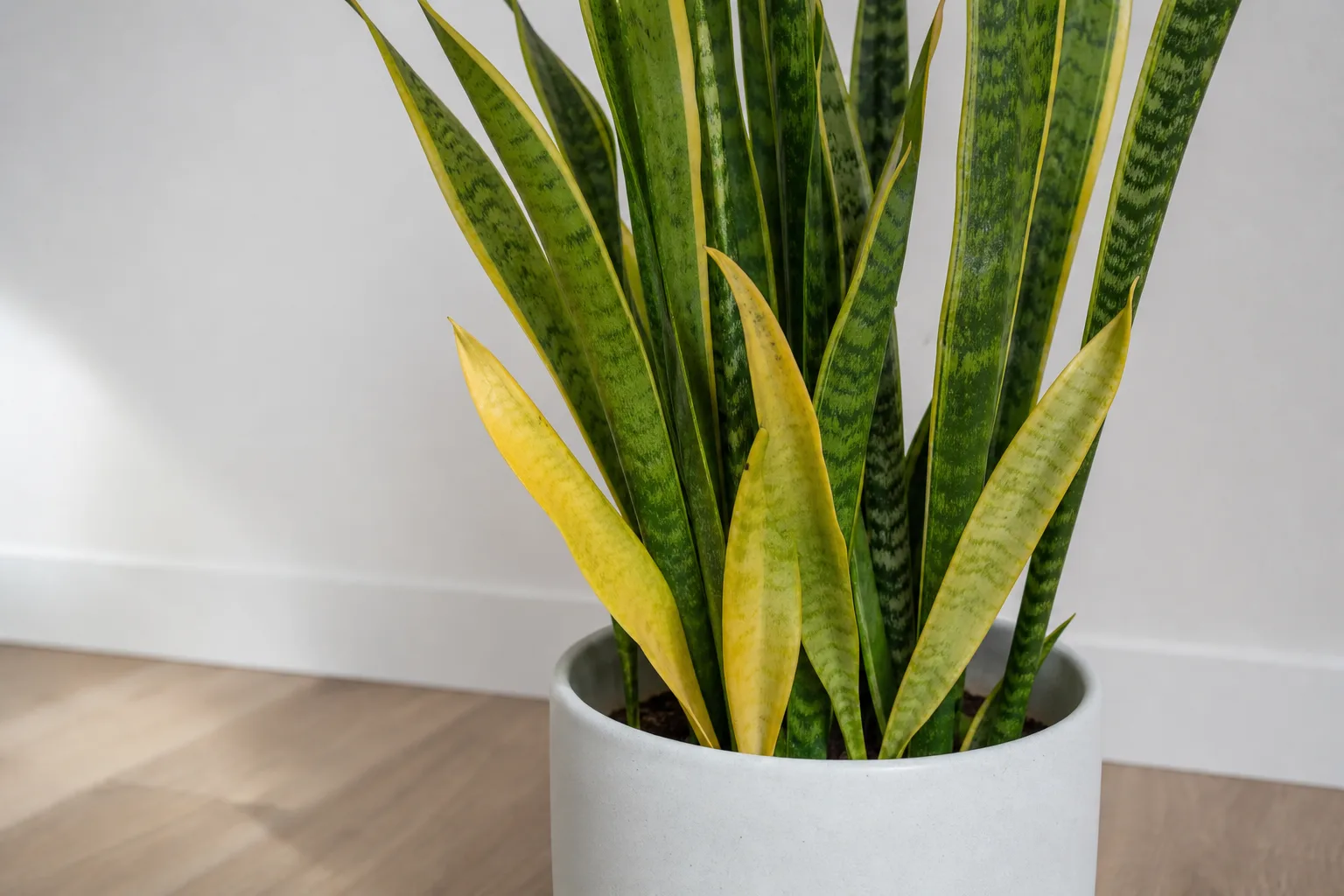
Yellow leaves on Snake Plant usually mean the roots have been sitting too wet. Overwatering is the primary cause - excess water causes leaves to yellow and soften from the base upward. First step: stop watering, let the soil dry completely, and confirm drainage holes are not blocked.
Yellow Leaves on Snake Plant: Causes, Checks & Fixes
This guide covers yellow leaves on Snake Plant. See also the general Yellow Leaves guide, watering, and light pages for this plant.
Yellow Leaves on Snake Plant: Causes, Checks & Fixes
Quick answer
Yellow leaves on Snake Plant usually mean the roots have been sitting too wet. Overwatering is the primary cause - excess water causes leaves to yellow and soften from the base upward. First step: stop watering, let the soil dry completely, and confirm drainage holes are not blocked.
Snake Plant (Dracaena trifasciata) is built for dry spells, not frequent watering. It stores water in stiff, upright leaves and thick rhizomes evolved in dry West African conditions, so the most common yellow-leaf pattern is not sudden disease but a root zone that has stayed damp too long. Before you prune, repot, or fertilize, check whether the pot is heavy, the soil smells off, and yellowing is climbing from the oldest leaves upward.
Pet households: Snake plant contains saponins toxic to cats and dogs. Yellow leaves chewed off the floor are a veterinary concern, not just a care mistake - call your veterinarian or the ASPCA Animal Poison Control Center at (888) 426-4435 if you suspect ingestion.
Why Snake Plant gets yellow leaves
Overwatering may be the biggest disease threat on this species. Snake Plant evolved in dry tropical climates and tolerates drought far better than wet soil. When the mix stays saturated, roots lose oxygen, stop taking up water and nutrients, and stressed foliage turns yellow and soft. Clemson Extension notes that watering too frequently leads to root rot and soggy leaves on snake plants.
Dense or slow-draining soil makes the problem worse. A standard peat-heavy potting mix in a large container can hold moisture for weeks in low light, which is long enough to damage roots on a plant that prefers to dry out between waterings. Penn State Extension recommends a cactus potting mix or perlite blend and warns that you can kill snake plant by overwatering.
Low light plus routine watering
Snake Plant uses CAM photosynthesis - opening stomata at night to conserve water in arid habitats. That adaptation helps drought tolerance but does not remove the need for light. In dim corners, transpiration drops, so a summer watering rhythm can leave roots wet all winter even though you have not increased frequency. The compound failure looks like yellow lower leaves with a heavy pot - see not enough light on snake plant when dry-down speed is the clue, and overwatering when the mix stays soggy.
Other causes worth ruling out
- Natural aging - the oldest, lowest sword-shaped leaf yellowing slowly while the rest of the plant stays firm
- Severe underwatering - wrinkled, dry leaves with brown crispy tips rather than soft yellow tissue; compare with underwatering
- Cold drafts or temperatures below 10°C (50°F) - root function slows and older leaves may fade
- Salt or fluoride buildup - pale bands and crispy tips more than whole-blade yellow; white crust on soil points to salt build-up
- Root rot already underway - yellow leaves with mushy bases and sour-smelling soil; escalate to the root rot guide
Because Snake Plant grows slowly, problems often build across several waterings before the first yellow leaf appears. The care mistake happened earlier; the leaf color change is the visible result.
What yellow leaves look like on Snake Plant
On Snake Plant, yellowing usually starts on older, lower leaves in the rosette - not scattered randomly across the newest growth. The leaf may turn pale green-yellow along the margins or evenly across the whole blade. In overwatering cases, the leaf feels soft or limp at the base even when the tip still looks stiff.
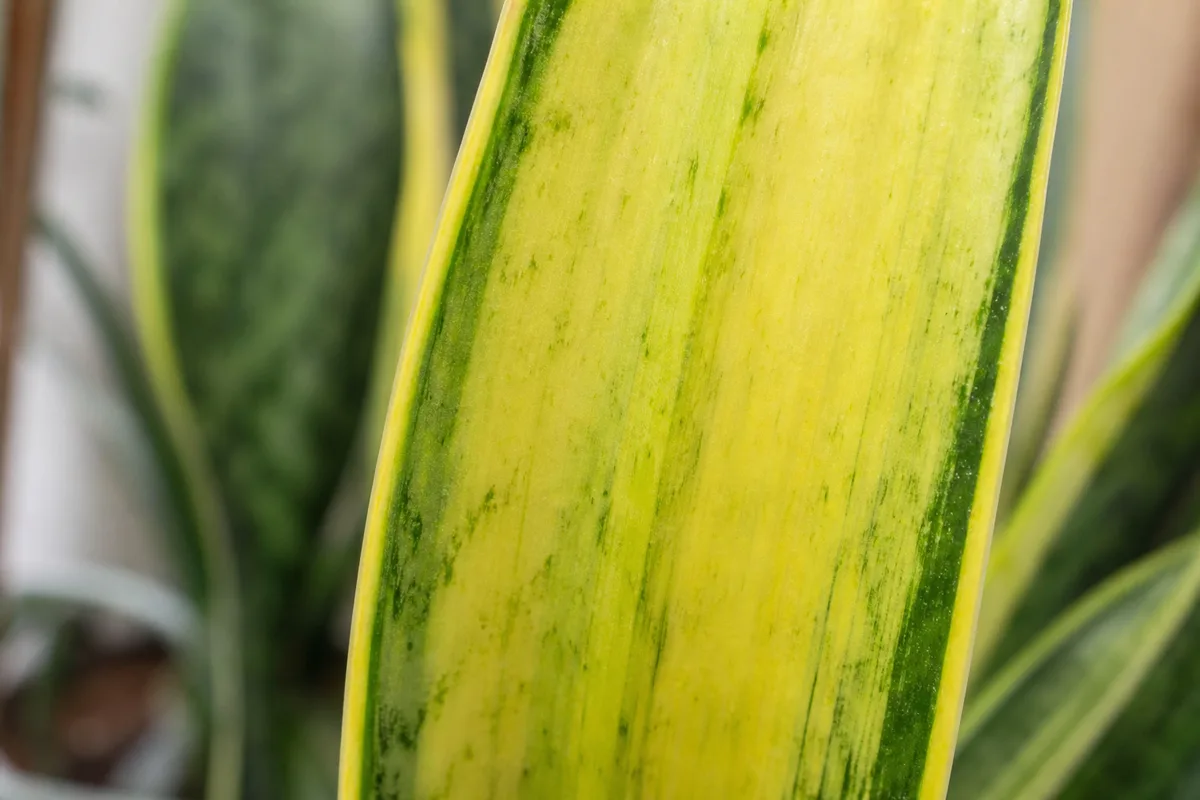
Yellow Leaves symptoms on Snake Plant - compare with healthy tissue on the same plant.
Healthy Snake Plant leaves are thick, leathery, and upright, with flat blades up to several feet long on mature plants. North Carolina Extension Gardener Plant Toolbox describes the foliage as stiff, upright, and succulent. When overwatered, that firm texture disappears first at the soil line.
Symptom comparison table
| Pattern | Likely cause |
|---|---|
| Bottom leaves yellow first, soft at base, wet soil | Overwatering / early root stress |
| One old leaf fades slowly, rest of plant firm | Normal aging |
| Wrinkled leaves, dry pot, brown crispy tips | Underwatering |
| New growth pale, pot still heavy | Ongoing moisture stress or low light |
| Yellow leaves with mushy base and foul soil smell | Advanced root rot |
| Stable yellow leaf margins only on variegated cultivar | Normal Laurentii coloring |
Laurentii variegation vs. stress yellowing
Variegated cultivars such as Laurentii show yellow margins as part of their normal coloring - do not confuse that stable edge band with a problem leaf turning yellow from tip to base. Stress yellowing usually involves the whole blade or climbs from the oldest leaves upward while the pot stays wet.
How to confirm the cause
Work through these checks in order before changing more than one variable.
1. Pot weight and soil moisture. Lift the pot after watering and again several days later. A healthy Snake Plant in dry soil feels noticeably lighter. Push your finger to the bottom of the pot if you can, or use a bamboo skewer - it should come out clean and dry before the next watering. North Carolina Extension advises allowing the soil to dry between waterings and warns that roots will rot if you overwater.
2. Drainage path. Confirm drainage holes are open and no pebble layer is blocking exit flow. Empty the saucer after every watering. Terracotta pots dry faster than glazed ceramic, which matters for a plant that needs excellent drainage.
3. Leaf sequence. Note whether yellowing began on the lowest leaves and is moving up. Overwatering typically hits oldest leaves first because the plant sheds tissue it can no longer support when roots are damaged.
4. Smell and stem firmness. Sniff the soil surface. A sour, swampy odor suggests anaerobic wet soil. Press the leaf bases gently - mushiness at the crown is more serious than a single yellow tip.
5. Recent care changes. Snake Plant repotting guide into heavy mix, moving to a darker room, or increasing watering in winter are common triggers. Snake Plant needs dramatically reduced watering in autumn and winter when growth slows - align with the watering guide rather than a summer calendar.
If soil is wet, stems are soft, and several leaves are yellowing together, treat it as moisture stress or rot - not a fertilizer deficiency.
First fix for Snake Plant
Allow the soil to dry completely; check drainage holes are not blocked.
Stop watering immediately and do not resume until the mix is bone dry throughout - often two to four weeks or longer in cool weather. Move the pot to Snake Plant light guide so the soil dries faster, but avoid hot direct sun that can scorch leaves. Clemson Extension recommends bright, indirect light and watering every two to four weeks during the growing season, cutting back to every four to six weeks in fall and winter.
If water pools in the saucer or the mix still feels wet after a week, tilt the pot slightly to check that holes are clear. Do not pour water into the center of the leaf rosette.
Make this one correction first. Stacking repotting, leaf removal, and fertilizer on the same day makes it harder to see what helped and adds stress to roots that already need to dry out.
Step-by-step recovery
Once the soil has dried and drainage is confirmed:
- Remove only fully yellow or mushy leaves at the base with clean scissors. Leave partially green leaves in place unless the base is rotting.
- Keep the plant in bright indirect light and stable room temperatures between 18–27°C (65–80°F).
- Resume watering only when the pot is light and the skewer test shows dry soil deep in the container. Water thoroughly until excess drains out, then discard saucer water.
- If soil stays wet for more than seven to ten days after one watering, unpot and inspect roots. Trim mushy, brown roots with sterile shears, let cut surfaces callus for a day, and repot into dry cactus and succulent mix. Wait another one to two weeks before the first post-repot drink. Full salvage steps are on the root rot guide.
- Watch new growth for four to six weeks. Recovery is working when yellowing stops and the next leaf emerges firm and green.
Snake Plant is slow-growing, so expect gradual improvement rather than overnight change.
Recovery timeline
Existing yellow leaves will not return to deep green. That is normal - chlorophyll loss in a mature leaf is permanent. Success means the pattern stops spreading and the plant produces healthy new blades.
Mild overwatering with firm roots often stabilizes within one to two dry-down cycles. If several leaves softened and the soil smelled sour, recovery can take four to eight weeks and may require repotting after root cleanup. Severe crown rot is not always reversible; focus on saving firm rhizome tissue and healthy offsets.
What not to do
Do not fertilize a yellowing Snake Plant to “green it up” while soil is still wet. Salts can burn stressed roots and the problem is moisture, not hunger. Penn State Extension suggests feeding monthly at half strength only during active growth on healthy plants.
Do not keep watering on a calendar if the pot is already heavy. Do not repot repeatedly into progressively larger containers - extra soil holds extra water. Do not assume every yellow leaf needs immediate removal; wait until you have corrected moisture and the blade is fully dry and brown-yellow.
Do not place the plant in a dark corner to “rest” without improving dry-down - low light slows water use and can keep soil damp longer.
Causes to rule out
Underwatering shows wrinkled, puckered leaves and a very light pot, usually with brown crispy tips rather than soft yellow tissue. Normal aging affects one or two bottom leaves over months on an otherwise upright plant. Pests such as spider mites or mealybugs cause speckling, sticky residue, or deformed new growth before uniform yellowing. Cold damage after a window draft can bleach or yellow leaves suddenly, but soil will be dry and stems still firm.
Salt buildup from tap water fluoride or excess fertilizer more often produces tip burn and white soil crust than uniform yellow blades - flush or repot per the salt build-up guide if crust or banded tip necrosis appears alongside pale lower leaves.
If newest leaves yellow while veins stay green, look at light and moisture together before assuming a nutrient problem. Snake Plants in the same pot for years without repotting can show pale lower leaves, but on this species wet soil is still the more common root cause.
Lookalike symptoms
Yellow leaves from overwatering can resemble underwatering stress because both are root-related - the difference is moisture. Wet roots: heavy pot, soft yellow bases, possible sour smell. Dry roots: light pot, wrinkled blades, crispy margins.
Root rot is the advanced form of the same mistake. If yellow leaves appear alongside wilting despite wet soil and mushy roots when you unpot, switch to the root rot guide and treat the root zone as urgent.
Leggy, pale new growth in a dim room is a light problem more than a watering disease, but weak light plus routine watering still produces yellow lower leaves because the mix never dries - cross-check not enough light before adding more water.
Yellowing within two weeks of repotting may be repotting stress rather than chronic overwatering; compare timing with whether the new mix drains and whether you watered before the root ball dried.
Snake Plant care cross-check
Align your routine with how this species actually grows indoors:
- Watering: Only when soil is completely dry - roughly every 2–6 weeks depending on season, pot size, and light; details on the watering guide
- Soil: Fast-draining, gritty mix; cactus and succulent blend with perlite or coarse sand
- Light: Bright indirect light; tolerates lower light but uses less water there
- Container: Pot with drainage holes; terracotta helps dry-down
- Winter: Reduce watering sharply when growth slows
Snake Plant stores water in leaves, stems, and rhizomes, so overcare is more dangerous than a dry spell. If you recently moved the plant, changed pot size, and increased watering at the same time, roll back to one fix - usually drying the soil - before doing more.
How to prevent yellow leaves next time
Water from dryness, not habit. Check the pot every time before you pour. In most homes that means every two to four weeks in spring and summer and every four to six weeks in fall and winter, but a cool room or shaded shelf can stretch that further.
Use a mix that drains in seconds when you water, not one that stays muddy. Keep the plant where bright indirect light helps the pot dry predictably. Avoid letting holiday watering routines carry into winter unchanged.
When repotting, choose a container only slightly larger than the root mass. Refresh soil every two to three years so old peat does not compact and hold water against thick rhizomes.
When to worry
Escalate quickly if:
- Multiple leaves yellow within a week
- Leaf bases are mushy or collapse at soil level
- Soil smells rotten even after you stop watering
- New growth turns pale or soft while the mix stays wet
- The plant topples because roots no longer anchor
A single lower leaf slowly yellowing on an otherwise firm Snake Plant is lower urgency and may be normal shedding. Medium severity means act within days, not months, once soft yellow tissue appears.
Yellow-leaf inspection checklist
For Snake Plant yellow leaves, work in this order: pot weight and deep soil moisture first, then drainage holes and saucer water, then leaf sequence from oldest to newest, then stem firmness and soil smell, then light level and recent repotting or watering changes. Treat as urgent when more than two leaves yellow at once, tissue is soft at the base, or soil has stayed wet for over a week. Unpot and inspect roots if yellowing continues after two weeks of full dry-down, bases stay mushy, or new leaves emerge yellow on an otherwise wet schedule.
Related Snake Plant problems
- Snake Plant overview
- Snake Plant watering
- Overwatering
- Root rot
- Underwatering
- Salt build-up
- Not enough light
- Repotting stress
- All Snake Plant problems
Conclusion
Yellow leaves on Snake Plant are usually a watering and drainage problem, not a mystery disease. Confirm whether the mix has stayed wet, let it dry completely, and restore a dry-down rhythm matched to your light and season. Remove only fully spent leaves, watch for firm new growth, and treat spreading softness or sour soil as a root-zone emergency - follow the root rot guide when bases turn mushy. On this drought-tolerant species, less water is almost always the safer first move.
When to use this page vs other Snake Plant guides
- Snake Plant watering guide - Use for routine moisture checks before assuming yellow leaves is the main issue.
- Snake Plant problems hub - Browse all 36 common issues on this species.
- Overwatering on Snake Plant - Different entry point when symptoms overlap with yellow leaves.
- Underwatering on Snake Plant - Different entry point when symptoms overlap with yellow leaves.
- Not Enough Light on Snake Plant - Different entry point when symptoms overlap with yellow leaves.