Salt Build Up on Snake Plant: Causes, Checks & Fixes
Quick answer
Salt build-up on snake plant comes from fluoride and minerals in tap water and fertilizer, showing as brown leaf tips with pale bands and white crust on soil. First step: stop fertilizing, flush the pot thoroughly with plain water, switch to filtered or rainwater, and trim irreversibly browned tips.
Salt Build Up on Snake Plant: Causes, Checks & Fixes
This guide covers salt build-up on Snake Plant. See also the general Salt Build-up guide, watering, and light pages for this plant.
Salt Build Up on Snake Plant: Causes, Checks & Fixes
Quick answer
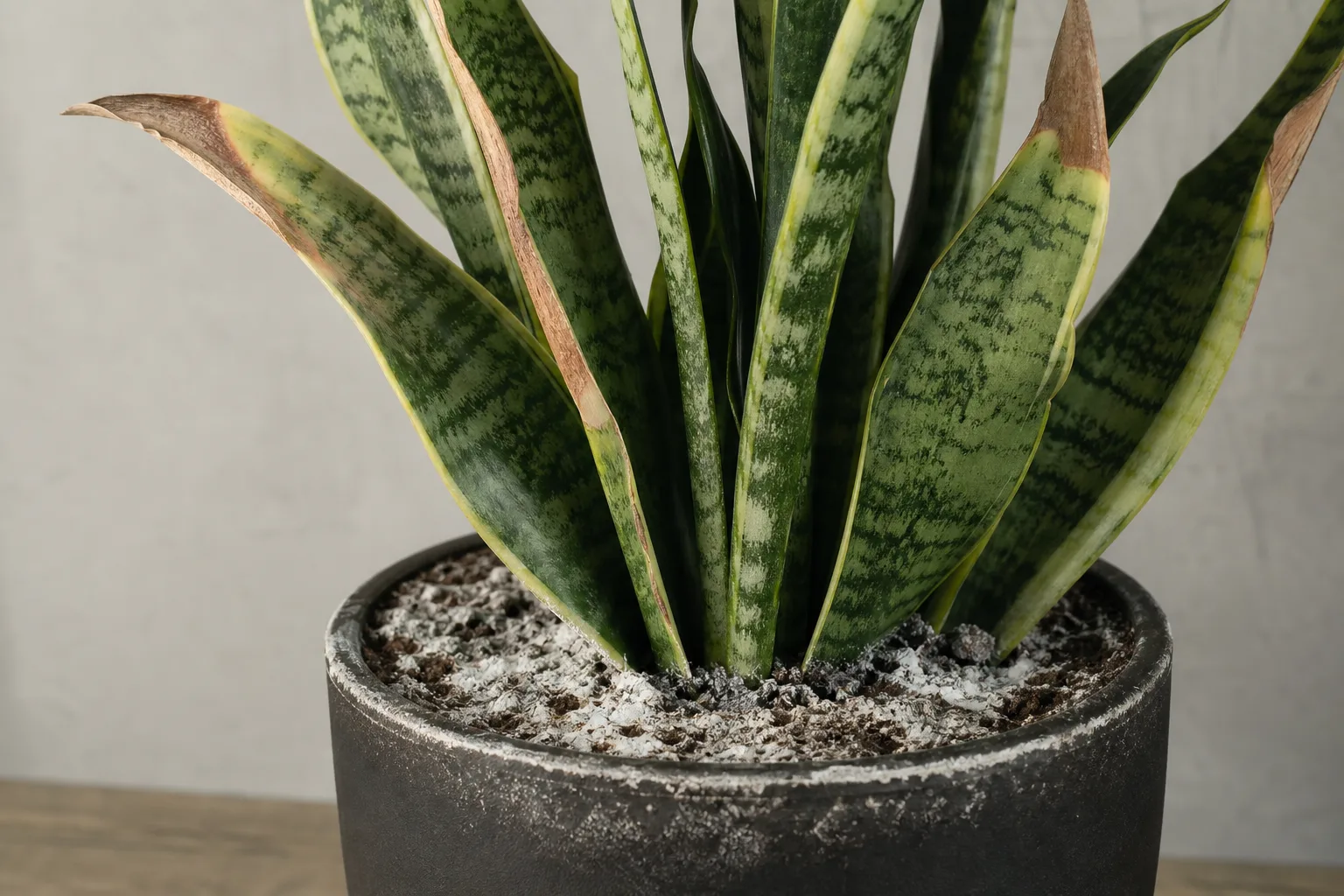
Salt build-up on snake plant (Dracaena trifasciata) is not just generic houseplant chemistry - Snake Plant overview sits in the Dracaena genus, a group of monocots more susceptible to fluoride toxicity than most foliage plants. Fluoride and dissolved minerals from tap water and fertilizer concentrate at leaf margins and on the soil surface, producing crisp brown tips, pale bands above the damage, and white crystalline crust.
First step: stop fertilizing, flush the pot thoroughly with plain water, switch to filtered or rainwater, and trim irreversibly browned tips. If you are unsure whether crust came from tap minerals or a recent feed, use the comparison table below before repotting.
Use this page when white soil crust and pale-banded tip burn point to accumulated salts and fluoride. For general brown tips without heavy crust - or when vent placement and dry winter air are suspects - start with brown tips on snake plant. For sudden tip damage right after fertilizing, see fertilizer burn.
Why snake plant accumulates salts and fluoride
Municipal tap water carries fluoride and dissolved minerals. Many city supplies add fluoride around 0.7 ppm - harmless to people but enough to accumulate in sensitive plants over months of repeated watering. MSU Extension lists dracaena among crops that develop fluoride toxicity from city water, with necrotic regions at leaf tips and margins.
Fertilizer adds soluble salts. Snake plant is a light feeder; excess nitrogen and potassium salts build up when feeding continues through winter or at full strength. Illinois Extension notes that fertilizer salts accumulate in potting mix and burn fine root hairs, which shows up as crispy leaf margins even when watering seems correct. Full feeding schedules and half-strength timing live on the snake plant fertilizer guide.
Evaporation concentrates salts at margins. As water moves through thick upright leaves, minerals deposit at tips and edges - the last points to dry. White crust on the soil surface forms when irrigation water evaporates from the top layer, leaving calcium and other minerals behind. University of Maryland Extension describes fertilizer salts accumulating as a white crust on potting media, especially when saucers hold runoff.
Low leaching in small pots accelerates buildup. Infrequent watering - correct for this drought-adapted species per the watering guide - means fewer natural flushes through the mix. Without occasional deep rinsing, salts remain in soil and re-enter roots with each drink. MSU Extension recommends monitoring soluble salts and leaching when salts run high on fluoride-sensitive crops.
Perlite and some fertilizers can contribute fluoride. Penn State Extension notes perlite and superphosphate among fluoride sources in potting media for sensitive Dracaena cultivars; consider pumice or coarse sand if tip burn persists despite water changes.
Well water is not automatically safe. MSU advises using well water or rainwater when possible, but high-mineral or naturally fluoridated well supplies can still accumulate - test before assuming rural water beats city tap.
What salt build-up looks like on snake plant
Typical patterns on Dracaena-family foliage:
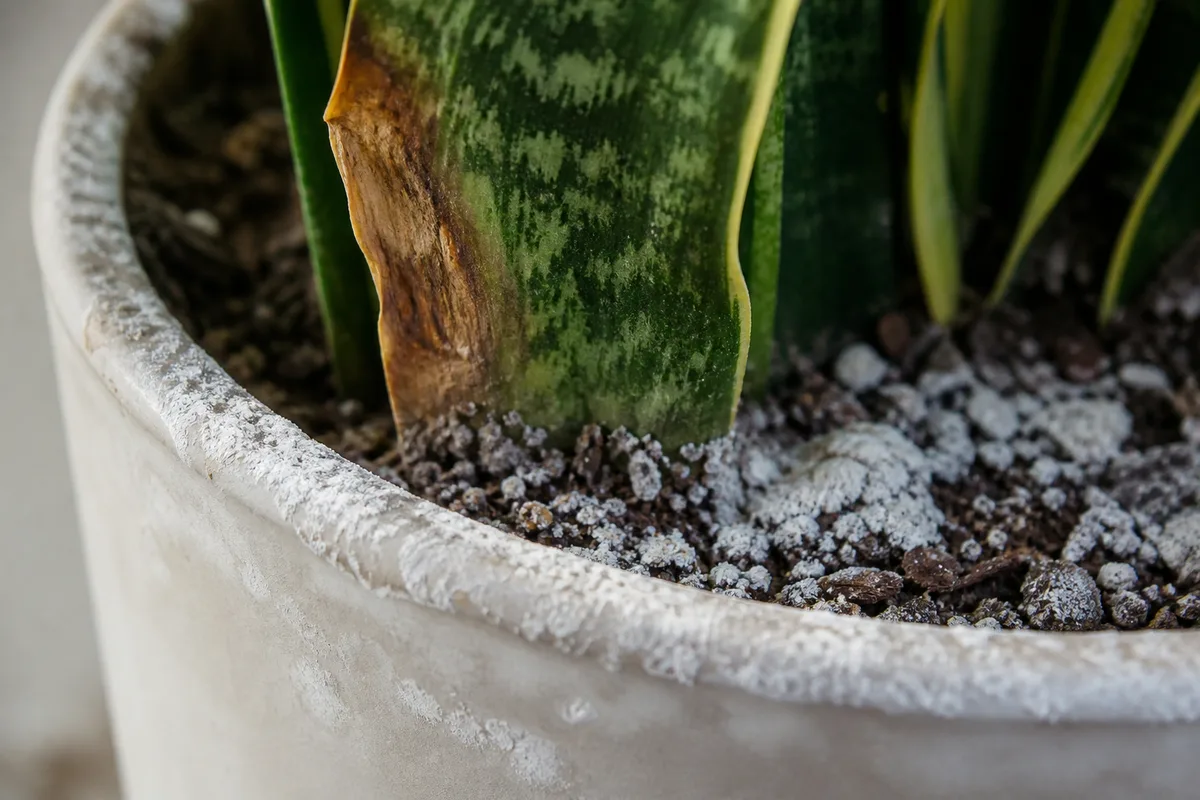
Salt Build-up symptoms on Snake Plant - compare with healthy tissue on the same plant.
- Crisp, dry brown tips on otherwise firm leaves
- Pale yellow or tan band between brown tip and healthy green tissue - a hallmark of fluoride toxicity on Dracaena
- Browning starts on oldest leaves and progresses to newer ones if the water source stays unchanged
- White or yellowish crystalline crust on soil surface, pot rim, or saucer
- Tips worsen after fertilizer applications despite adequate watering
- No mushiness, sour smell, or base softening - unlike rot
Low humidity and underwatering also brown tips, but salt burn usually pairs with crust on soil and a history of tap water plus fertilizer, while the pot still dries on a normal schedule and roots stay firm.
Salt build-up vs. brown tips vs. fertilizer burn vs. underwatering
| Symptom pattern | Salt / fluoride build-up | Fertilizer burn | Generic brown tips | Underwatering | Low humidity |
|---|---|---|---|---|---|
| Soil surface | White crystalline crust | White crust after recent feed | May have light crust | Dry, dusty top - no crystals | No crust |
| Tip texture | Dry, papery; pale band common | Dry; often sudden after feed | Dry margins; variable cause | Crispy tips; leaves may wrinkle | Dry margins near vents |
| Timeline | Months of tap watering | Days to 2 weeks post-feed | Gradual; multiple causes | After long dry spell | Winter near heat sources |
| Leaf base | Firm | Firm | Firm | Firm initially | Firm |
| First move | Flush + change water source | Stop feed + flush | Diagnose cause first | Deep soak per watering guide | Move from vents; may still need filtered water |
| Read next | This guide | Fertilizer burn | Brown tips | Underwatering | Low humidity |
How to confirm the cause
- Tip texture - Dry, papery brown tips suggest salt or fluoride; mushy tips suggest rot or overwatering on Snake Plant.
- Soil crust - White mineral deposits on the surface that reappear after drying confirm accumulation.
- Water and feed history - Months of straight tap water and regular fertilizer strongly support salt build-up.
- Root check - Firm roots and neutral-smelling soil with tip burn point to foliar salt injury, not root rot.
- Flush test - Run plain water through for several minutes; if crust dissolves and tips stop worsening on new growth over weeks, salts were the driver.
Lookalike symptoms to rule out
Underwatering causes wrinkled leaves and crispy tips with very light, dusty dry pots - not white crust. Overwatering softens bases with sour soil. Low humidity browns margins in winter near radiators without soil crust. Physical damage from handling can notch leaves - unrelated pattern. Confirm crust, water source, and tip banding before treating.
First fix for snake plant
Stop fertilizing immediately. Flush salts from the pot:
- Place the plant in a sink or outdoors. Dracaena is toxic to cats and dogs - keep pets away from flush runoff and trimmed leaf debris.
- Run lukewarm plain water through the mix for three to five minutes until water flows freely from drainage holes.
- Repeat once after the pot drains fully.
- Empty the saucer; do not let the plant sit in flush runoff or reabsorb concentrated salts from a cache pot.
Switch the ongoing water source to filtered, distilled, or collected rainwater. MSU Extension recommends rainwater or well water for fluoride-sensitive crops when possible. Letting tap water sit overnight removes chlorine but does not remove fluoride.
Trim browned tips diagonally with clean scissors to mimic the natural leaf angle - cosmetic only; trimmed tissue will not regrow.
Make one correction at a time: flush and change water before repotting or changing mix unless crust is severe throughout the root zone.
When to repot instead of flushing again
| Situation | Flush only | Repot into fresh mix |
|---|---|---|
| Light crust on soil surface | Yes - double flush, then filtered water | Not yet |
| Crust returns within 2–3 weeks after two flushes | Try a third flush | Consider if plant is root-bound |
| White crust through most of root ball on unpotting | Unlikely to clear with rinse alone | Yes - fresh fast-draining mix without perlite |
| Growth stalled; tips on newest leaves despite filtered water | Flush first, then reassess in 4 weeks | Repot if salts bound in old peat-heavy mix |
| Pot has sat in salty saucer runoff for months | Flush + saucer discipline | Repot if lower roots show salt damage |
Full repot technique, mix choices, and timing are on the snake plant repotting guide. Maintain soil pH near 6.0–6.5 when repotting if fluoride toxicity persists - Penn State Extension cites this range to reduce fluoride availability in Dracaena. Swap perlite for pumice or coarse sand in the mix if fluoride is in your tap supply.
Step-by-step recovery
- Week 1: Flush twice; stop all fertilizer; switch water source.
- Weeks 2–8: Water only when soil is bone dry per the watering guide; watch new leaves for clean tips.
- If crust returns quickly: Repot into fresh cactus-style mix without perlite if fluoride is suspected; use pumice or coarse sand for drainage instead.
- Resume feeding: Half-strength liquid fertilizer once in spring and once in midsummer only - RHS suggests monthly feeding April through September at most; snake plants tolerate less. See the fertilizer guide for species-specific intervals.
- Maintenance flush: Deep rinse every two to three months in hard-water areas. Illinois Extension recommends leaching houseplant pots every four to six months to limit salt buildup.
Let soil dry fully between waterings after a flush - this species is drought-adapted, and keeping mix wet to “wash” salts risks root rot.
Recovery timeline
Existing brown tips remain permanently. New growth should show clean margins within four to twelve weeks after water change and flushing if salts were the cause. Heavy crust cases needing repot may take a full growing season before consistent clean tips. Chronic municipal fluoride may require permanent filtered water - tips may continue slowly browning on tap water alone.
What not to do
- Do not increase watering to “wash” tips - wet soil risks rot on this drought-adapted species.
- Do not apply more fertilizer to “green up” tips - salts worsen burn.
- Do not assume brown tips always mean thirst - on Dracaena-family plants, fluoride and salts are common culprits.
- Do not mist heavily; RHS advises never mist sansevierias - surface moisture does not fix salt injury.
- Do not trim entire leaves unless most of the blade is dead; tip trim preserves photosynthetic area.
- Do not assume a Brita or standard pitcher filter removes fluoride - most carbon filters target chlorine and sediment, not fluoride ions. Use RO, distilled, or rainwater for a proven low-fluoride source.
How to prevent salt build-up next time
- Use low-mineral water long term - rainwater, reverse osmosis, or filtered sources that actually reduce fluoride.
- Fertilize lightly at half strength once or twice during active growth only - details on the fertilizer guide.
- Flush the pot every two to three months in hard-water regions.
- Repot with fresh mix every two to three years to remove bound salts - see repotting.
- Avoid fluoride-heavy amendments if tips recur; maintain pH 6.0–6.5 at repot when fluoride is in your tap supply.
- Empty saucers within 30 minutes of watering so the plant does not reabsorb concentrated salts.
Snake plant stores water in fleshy succulent leaves and needs infrequent watering - pair that rhythm with occasional deep flushing so salts do not accumulate silently.
When to worry
Salt build-up is rarely fatal. Escalate if growth stalls completely, more than roughly one-third of visible leaf area shows tip or margin burn, or repot reveals damaged roots - rare unless salts combined with chronic over-fertilization. Separate cosmetic tip burn from mushy bases or sour soil, which need root rot intervention.
If new leaves continue browning after water change and two flushes, test an alternative water source for four weeks before assuming another diagnosis.
What to do next
- Crust cleared but tips still cosmetic? Trim dead margins and wait for new growth - no further emergency action needed.
- Unsure if tap or fertilizer caused damage? Compare timelines with fertilizer burn and brown tips.
- Ready to fix ongoing care? Set filtered-water routine and dry-down checks on the watering guide; schedule light spring feed per the fertilizer guide.
- Heavy crust or bound roots? Follow the repotting guide with perlite-free, fast-draining mix.
About this guide
This guide was written by sai-ananth and reviewed by the LeafyPixels Review Board against MSU Extension fluoride toxicity guidance, Penn State Dracaena diseases, Illinois Extension houseplant leaching, University of Maryland Extension soluble salts, RHS sansevieria culture, and LeafyPixels snake plant care pages. The repot-vs-flush decision table and symptom comparison matrix are editorial diagnostics synthesized from extension leaching protocols and Dracaena fluoride biology - not a single published case study. Reviewed 2026-06-17.
When to use this page vs other Snake Plant guides
- Snake Plant watering guide - Use for routine moisture checks before assuming salt build-up is the main issue.
- Snake Plant problems hub - Browse all 36 common issues on this species.
- Fertilizer Burn on Snake Plant - Different entry point when symptoms overlap with salt build-up.
- Brown Tips on Snake Plant - Different entry point when symptoms overlap with salt build-up.