Philodendron Lemon Lime Light Needs: Best Window, Sun &
Philodendron Lemon Lime Light Needs: Best Window, Sun & Warning Signs
Philodendron Lemon Lime Light Needs: Best Window, Sun & Warning Signs
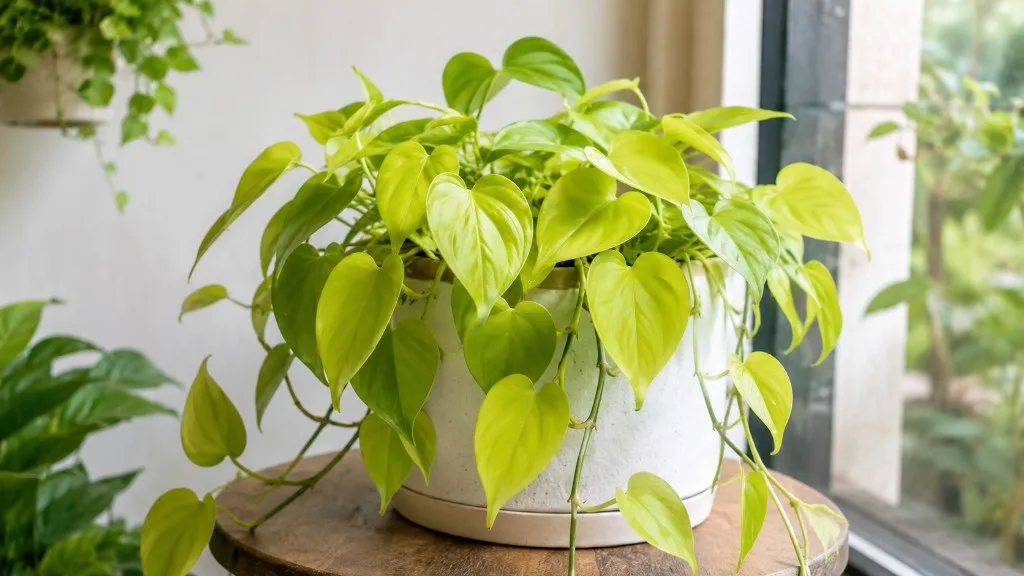
Philodendron Lemon Lime (Philodendron hederaceum ‘Lemon Lime’) is sold as a low-light philodendron - and then quietly disappoints the grower who parks it on a bookshelf three metres from the nearest window. The species P. hederaceum can survive remarkably dim rooms; the Lemon Lime cultivar exists for bright yellow to chartreuse foliage that fades toward plain green when photosynthesis cannot support the display color. The practical goal is not finding the darkest corner where the vine refuses to die. The goal is placing the pot where new leaves emerge firm, compact, and visibly chartreuse without scorch, bleaching, or the slow stretch that turns a glowing trailer into a leggy green heartleaf nobody bought on purpose.
NC State Extension lists ‘Lemon Lime’ among P. hederaceum cultivars with bright yellow to chartreuse foliage and notes the species refers medium light but will tolerate low light, with cultural ratings spanning deep shade through partial shade (2–6 hours direct sun). UF/IFAS Gardening Solutions recommends bright diffuse light for heartleaf philodendron while noting tolerance from diffused light to shade - with an explicit warning to avoid direct sunlight because it can burn leaves. Missouri Botanical Garden advises bright indirect light, warns against full sun, and notes that while the vine is tolerant of shade, stems become spindly when conditions are too dark. Iowa State Extension adds the cultivar-specific rule many generic pages skip: varieties with brightly colored foliage generally need moderate to bright indirect light indoors, even when the base species tolerates lower levels.
This guide covers window placement by direction, distance-from-glass rules, direct-sun acclimation, honest low-light limits, grow-light setup when windows fail, a Lemon Lime vs. Brasil comparison, structured warning signs, and the new-growth color test that separates placement problems from watering mistakes. For low-light diagnosis after color has already faded, see the dedicated not enough light guide. For the full species picture, start with the Lemon Lime overview.
Why Lemon Lime Chartreuse Needs Brighter Light Than Generic Low-Light Labels
Retail tags group Lemon Lime with “low-light philodendrons” because P. hederaceum roots evolved under tropical forest understory and can survive for long periods in extremely low light, per NC State Extension. Survival and display are different outcomes. A solid-green heartleaf in a dim hallway may look acceptable for months because the entire leaf surface carries functional chlorophyll. Lemon Lime’s value is uniform chartreuse color across the whole leaf blade - a look that demands more usable photons than a deep-green heartleaf needs to merely persist.
When light drops, Lemon Lime does not usually die quickly. It stretches, slows, and greens. New leaves emerge smaller, yellower-green instead of neon chartreuse, and internodes lengthen as the vine reaches toward the brightest vector in the room. Old leaves that formed in better light keep their prior color; they do not magically re-chartreuse after you move the pot. That asymmetry confuses growers who see mixed green and chartreuse on one plant and assume the whole vine will recover uniformly. It will not - only new growth reflects today’s placement.
Species Shade Tolerance vs. Cultivar Display Needs
The species-level label “tolerates low light” describes physiological persistence, not cultivar aesthetics. NC State Extension simultaneously lists deep shade tolerance and partial shade preference - the same plant can hang on in a dark room yet grow far better with brighter ambient exposure. Lemon Lime sits on the demanding end of that range because the feature you paid for is leaf color, not merely leaf count.
Low light also changes the rest of the care system. A dim Lemon Lime uses water slowly, dries its pot slowly, and becomes more vulnerable to root rot when a bright-window watering rhythm continues in a dark corner. Light is the upstream variable that controls color, growth speed, and how often you should water. Fix placement before chasing fertilizer or Philodendron Lemon Lime repotting guide.
Quick-Reference Light Checklist
Before moving your Lemon Lime again, run this checklist in order:
- New-growth color: Are the newest leaves chartreuse enough to match why you bought the plant?
- Internode length: Are stems compact, or stretching with small leaves far apart?
- Hand-shadow test: On a clear day, does a soft readable shadow fall on the foliage at leaf level?
- Distance from glass: Is the pot within roughly 30–90 cm of useful window light, not just in a bright-looking room?
- Hanging height: If in a basket, is the leafy canopy at window height - or a metre below the sill where light drops sharply?
- Seasonal angle: Did winter sun angle or summer heat change a placement that worked in spring?
- Watering speed: Does the pot dry slower than it did last season? Dim light may be the cause, not “lazy roots.”
If two or more items fail, improve light before changing soil, fertilizer, or pot size.
Best Light for Philodendron Lemon Lime
The target for Lemon Lime indoors is medium to bright indirect light - strong plant-facing brightness without prolonged harsh direct beams on the leaf surface. UF/IFAS frames this as bright diffuse light with tolerance down to shade. Missouri Botanical Garden translates the same idea as bright indirect light for indoor culture. For Lemon Lime specifically, read “medium to bright” as enough intensity to keep new leaves chartreuse, not the minimum the species can survive.
In measurable terms - useful as a reference, not a requirement - many foliage houseplants perform well around 200–400 foot-candles (roughly 2,000–4,000 lux) at the leaf surface. That is bright enough to read comfortably without a lamp, with a clearly defined but soft shadow when you hold your hand near the foliage. Below roughly 100 foot-candles, Lemon Lime often persists but greens and stretches. Direct summer sun through south or west glass can exceed 2,000+ foot-candles at the pane - enough to bleach thin chartreuse leaves without acclimation.
What Bright Indirect Light Means for Chartreuse Foliage
“Bright indirect light” fails when treated as room aesthetics. Human eyes adapt to dim interiors; plants do not. A living room that feels adequately lit to you may deliver insufficient photons at the shelf where the pot actually sits. Translate brightness with two field tests. First, the hand-shadow test: on a clear day, hold your hand between the window and the plant. A soft, readable shadow with defined edges usually indicates bright indirect range. A faint or absent shadow means low light - survivable for the species, disappointing for Lemon Lime color. Second, the new-growth test: judge placement by the newest leaf pair, not by whether older chartreuse leaves remain on the vine.
Duration matters as much as a moment of sunbeams. Lemon Lime benefits from roughly 8–10 hours of useful ambient brightness across the day. An east window that delivers gentle morning direct sun plus bright indirect light for the rest of the day often outperforms a west exposure that blasts harsh afternoon rays alone. Re-check placement in late winter if growth stalls without any other care changes - lower sun angle and shorter days can downgrade a summer-perfect spot into a dim one.
Best Window Placement (East, North, West, South)
Window direction is a starting point, not the whole answer. Outdoor tree shade, building obstructions, sheer curtains, pot distance, and hanging height all change the light that reaches the leaf surface. Still, compass orientation gives a reliable first guess in the northern hemisphere.
Place Lemon Lime where leaves receive strong plant-facing light for most of the day, not where the room looks bright. Rotate the pot a quarter turn every two to three weeks if growth leans toward the glass. Leaning is normal directional growth; rotation keeps the cascade symmetrical.
Distance From the Glass by Window Direction
An east-facing window is the default sweet spot for many Lemon Lime plants. Morning sun tends to be bright but cooler than late-day sun. A practical starting point is 30–60 cm (12–24 inches) from an unobstructed east pane, or on the sill if morning rays are gentle and leaves show no bleaching after two weeks. East delivers the bright indirect range where chartreuse color holds and scorch risk stays low.
A north-facing window provides gentle indirect light all day but often lands in the moderate to low range, especially in winter. Place the pot as close to the glass as practical - often 15–45 cm - and expect slower winter growth. North can maintain a healthy green vine but may not sustain the strongest chartreuse without supplemental light. Reduce watering frequency to match slower metabolism.
A south-facing window delivers the highest total daily light. Treat it as an asset with distance or diffusion. Start 90–150 cm (3–5 feet) back from unobstructed south glass, or use a sheer curtain to soften direct beams. In summer, watch for bleached or crisp patches on leaves facing the pane - pull back or filter if leaf surfaces feel hot within an hour of sun contact.
A west-facing window can work in spring and fall and become risky in midsummer when late-afternoon sun carries heat through the glass. Use west like south with extra caution: 60–120 cm back from the pane or filtered through fabric, and monitor leaf temperature during heat waves. Never move a low-light store plant directly onto an unfiltered west sill in July without acclimation.
Hanging-Basket Height and the Light Trap
Lemon Lime is often grown in hanging baskets where the pot hooks high but the leafy canopy hangs 60–120 cm below the window sill. Light intensity drops sharply with distance and as vines cascade away from the glass. The room looks bright at eye level; the lowest leaves live in a dimmer zone. This is one of the most common reasons chartreuse fades on otherwise “well-placed” baskets.
Fix the trap by shortening hangers so the densest foliage sits near window height, pruning overly long bare stems, or supplementing with a grow light aimed at the canopy rather than the ceiling. If only the top of the vine stays chartreuse while new growth at the bottom greens, you are seeing a height gradient, not a mysterious cultivar reversion.
Direct Sun: Tolerance, Acclimation, and Bleaching Risks
Lemon Lime can handle some direct sun when acclimated and when exposure matches heartleaf tolerance. NC State Extension rates P. hederaceum for partial shade - direct sunlight only part of the day, 2–6 hours. UF/IFAS still warns to avoid direct sunlight indoors because it burns leaves - the practical synthesis is gentle morning direct sun or filtered direct, not harsh unfiltered afternoon baking.
Problems start when intensity jumps faster than the plant adjusts. A Lemon Lime grown under greenhouse shade cloth and then placed on an unfiltered south sill may develop permanent bleached patches within days. Chartreuse leaves show damage faster than dark-green heartleaves because pale tissue has less masking pigment. Iowa State Extension notes that too much light can cause leaves to turn yellow on philodendrons - on Lemon Lime, read that as yellowing, bleaching, or crisping depending on heat load.
Morning Sun vs. Harsh Afternoon Rays
Morning direct sun through east glass differs from afternoon direct sun through west or south glass in both intensity and heat load. East exposure gives Lemon Lime a manageable direct period followed by bright indirect day length. Afternoon sun can exceed what the same plant tolerates, especially when outdoor temperatures are high and the pot sits on a heat-radiating sill. If you want direct sun benefits - slightly faster extension in some homes - east morning sun is the safest entry point.
Acclimate gradually when moving brighter: shift the pot closer to the window over 7–14 days, watch the newest leaves, and retreat one step if you see bleaching, curling, or sudden leaf collapse. Sunburn on philodendron leaves is permanent; damaged tissue does not re-green. Trim severely bleached leaves only after the plant stabilizes in softer light.
Low-Light Limits and Chartreuse Fade
Lemon Lime can tolerate lower light in the species sense - NC State Extension notes P. hederaceum can survive for long periods in extremely low light - but the cultivar loses the reason it exists. In dim rooms, expect smaller new leaves, longer internodes, yellow-green or plain green new growth, and slower drying of the pot. Missouri Botanical Garden warns that too-dark conditions produce spindly stems - the structural version of the same problem.
Old leaves do not re-chartreuse after you move to brighter light. Only new growth reflects improved placement. If a long green section bothers you, prune just above a node after the plant produces two or three chartreuse leaf pairs in the better spot - see pruning guidance for trailing vines. If color fade is already advanced, the not enough light problem page walks through confirmation checks and recovery timing.
Low light plus routine watering is a quiet risk multiplier. A dim plant uses less water; soil that stayed appropriately moist near a bright east window may stay wet too long in a hallway, inviting root problems. When you cannot brighten a spot, water less often and check dry-down by pot weight, not by calendar.
Grow Lights When Windows Fall Short
When the only available spot is more than 2 metres from meaningful window light - or north winter exposure cannot sustain chartreuse - a full-spectrum LED grow light is a better fix than hoping the species’ shade tolerance will preserve cultivar color. Oregon State University Extension notes that fluorescent grow-lights attempt to imitate sunlight with mixed wavelengths suitable for leafy growth - modern full-spectrum LEDs serve the same role with less heat.
Duration, Distance, and What to Watch
For foliage houseplants like trailing philodendrons, a practical supplemental schedule is 10–14 hours daily on a timer, aligned roughly with normal waking hours. Oregon State University Extension seed-starting guidance recommends leaving artificial lights on 12 to 16 hours a day for young plants under lamps - mature foliage vines typically perform well toward the lower half of that range when combined with some ambient room light.
Distance depends on fixture output. For common 15–40 watt LED grow bulbs or strip lights, start 30–45 cm (12–18 inches) above the top of the canopy and adjust by plant response. If new growth stretches toward the lamp, move it closer or extend duration. If leaves pale, yellow, or feel warm to touch, raise the fixture or reduce hours. The goal is steady plant-facing brightness, not heat stress. Aim the lamp at the leaf canopy, especially on hanging baskets where the pot is high but vines hang low.
Grow lights should supplement or replace weak window light - not compete with harsh direct sun at the same leaf. Pick one primary light source per placement change, wait two to three weeks, and read the newest leaves before stacking additional changes to water or fertilizer.
Lemon Lime vs. Brasil and Solid-Green Heartleaf
All three are Philodendron hederaceum selections, but light economics differ because variegation pattern changes how color loss looks.
| Cultivar | Leaf pattern | Low-light visual effect | Typical indoor placement |
|---|---|---|---|
| Lemon Lime | Uniform chartreuse across whole leaf | Entire new leaves green or yellow-green; dramatic loss of cultivar identity | Brighter end of indirect range; east window or filtered south |
| Brasil | Sector variegation - yellow-green center stripe, dark green margins | Partial greening; some chartreuse sectors may remain on new leaves | Moderate to bright indirect; slightly more forgiving than Lemon Lime |
| Solid-green heartleaf | Deep green throughout | Slower growth, smaller leaves, but less obvious “color failure” | Tolerates dimmer north rooms better while staying attractive |
NC State Extension describes ‘Brasil’ as leaves with a variegated center stripe of yellow to light green and dark green borders, and ‘Lemon Lime’ as bright yellow to chartreuse foliage across the blade. The Brasil pattern retains functional green margins when light dips; Lemon Lime has no green backup sector on uniformly pale leaves, so low light shows faster and looks worse.
Does Lemon Lime need materially more light than Brasil? In most homes, yes - not because the species biology differs, but because whole-leaf chartreuse demands higher photosynthetic output to maintain the display color. Brasil may still look interesting in moderate light with partial sector fade; Lemon Lime in the same spot often becomes a plain green trailer. If you own both, give Lemon Lime the brighter station near the glass.
Warning Signs: Too Much vs. Too Little Light
| Signal | Too little light | Too much light or heat |
|---|---|---|
| New leaf color | Yellow-green or plain green; dull chartreuse | Bleached white-yellow patches; washed-out pale leaves |
| Leaf texture | Smaller, thin but not crisp | Crisp, papery, or brown sun-facing zones |
| Stem habit | Long internodes; vine leans hard toward window | Stalled or twisted new growth after sudden move |
| Growth speed | Very slow; few new leaves | Sudden leaf collapse or burn after bright move |
| Soil dry-down | Pot stays wet unusually long | Pot dries very fast; may pair with heat stress |
| Old vs. new leaves | Old chartreuse leaves remain; only new ones green | Sun damage on exposed faces; interior leaves may look fine |
Too little light is usually a slow burn - the plant persists while losing color over weeks. Too much sun after a sudden move is a fast crisis - bleached patches appear within days and do not heal. Judge any placement change by new growth after two to three weeks, not by old scars from a previous location.
Photobleaching on Lemon Lime is especially frustrating because it destroys the entire aesthetic feature on exposed leaves. Low light, by contrast, lets the plant live while quietly becoming the wrong plant. Neither outcome is acceptable if you bought Lemon Lime for chartreuse impact.
Practical Checks and Care Links
Light is the upstream control for Lemon Lime performance. When placement is wrong, watering and soil fixes rarely restore color on their own.
New-Growth Test and Watering Coupling
Rule one: judge light by the newest leaf or shoot, not by older chartreuse leaves that formed elsewhere. Rule two: every light change changes water use. Brighter placement usually means faster dry-down - check moisture more often. Dimmer placement means slower dry-down - let the top 3–5 cm dry longer before soaking, even if your summer calendar says weekly.
If the same stress pattern repeats - green new growth, wet soil, stretching stems - compare this page with the watering guide, soil guide, and not enough light diagnosis before changing several variables at once. For multiplying a well-lit vine later, see propagation.
Grower note: Lemon Lime is a trailing heartleaf cultivar, not a self-heading floor philodendron and not a velvet species with special humidity demands beyond normal indoor ranges. Its thin chartreuse leaves show every brown mark and every light mistake quickly - which is actually useful. The plant tells you fast when placement fails.
Conclusion
Philodendron Lemon Lime rewards one clear decision: place the pot where new leaves stay chartreuse, not where the species merely survives. East windows and bright north exposures within 30–60 cm of the glass are the safest defaults; south and west work with distance, sheer fabric, and seasonal adjustment. Direct sun is a tool for acclimated plants, not a default for store-fresh vines. When windows fail, a full-spectrum grow light at 10–14 hours daily, starting 30–45 cm above the canopy, preserves color better than accepting a slow green fade.
Watch new growth, not old leaves. Link every light change to watering checks. Use the not enough light guide when fade is already advanced. Get placement right and Lemon Lime becomes the dense, glowing trailer it was bred to be - easy to read, fast to correct, and worth the brighter spot near the glass.
When to use this page vs other Philodendron Lemon Lime guides
- Philodendron Lemon Lime overview - Start here for whole-plant context before deep-diving this topic.
- Philodendron Lemon Lime problems hub - Jump to symptom-specific fix guides when this care topic does not resolve the issue.
- Leggy Growth on Philodendron Lemon Lime - Escalate here when light adjustments are not enough.
- Leaf Drop on Philodendron Lemon Lime - Escalate here when light adjustments are not enough.
Related Philodendron Lemon Lime guides
- Philodendron Lemon Lime overview
- Philodendron Lemon Lime watering
- Philodendron Lemon Lime soil
- Philodendron Lemon Lime propagation
- Philodendron Lemon Lime fertilizer
- Philodendron Lemon Lime repotting
- Leggy Growth on Philodendron Lemon Lime
- Leaf Drop on Philodendron Lemon Lime
- Philodendron Lemon Lime problems