Philodendron Lemon Lime Fertilizer: When, How & Mistakes
Philodendron Lemon Lime Fertilizer: When, How & Mistakes
Philodendron Lemon Lime Fertilizer: When, How & Mistakes
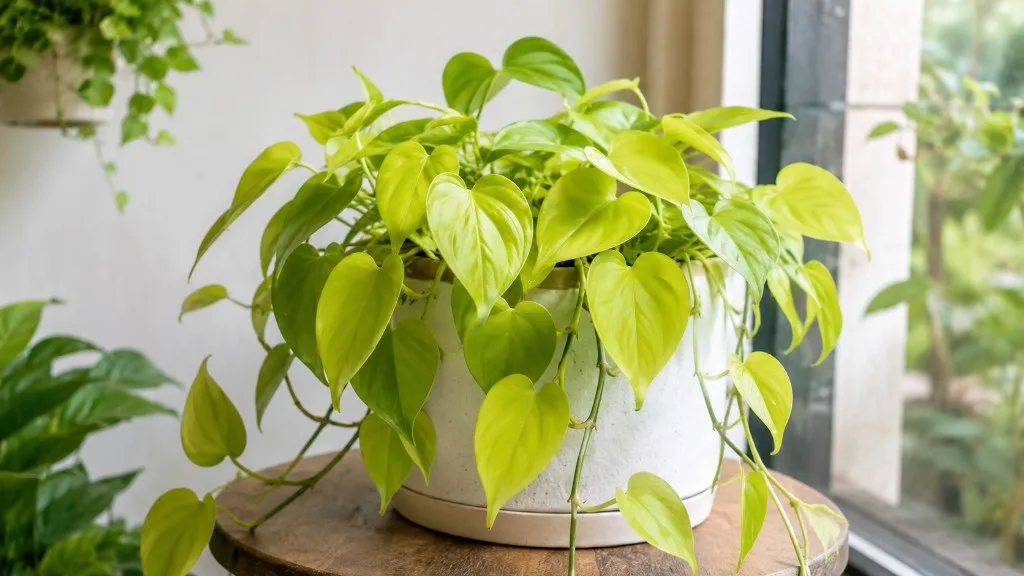
Philodendron Lemon Lime fertilizer is not a name-swap heartleaf routine. Philodendron hederaceum ‘Lemon Lime’ is a uniform chartreuse cultivar - NC State lists it as bright yellow to chartreuse foliage on a rapid-growth trailing vine - and that combination changes how feeding mistakes show up. Excess nitrogen can push new leaves toward darker green while the plant still looks “healthy.” Too little light fades chartreuse long before a deficiency shows. Fast summer growth in a hanging basket pulls nutrients quickly but also concentrates salts in a small root zone. The goal is not maximum feed; it is balanced half-strength nutrition during verified active growth so lime color stays vivid without Brown Tips on Philodendron Lemon Lime or white crust on the soil rim.
This guide covers when to feed, what NPK to use, dilution math, a reconciled frequency table, chartreuse-specific burn and color diagnostics, flush recovery, seasonal adjustments, and links across the Philodendron Lemon Lime care cluster.
Why Fertilizer Matters for Chartreuse Philodendron ‘Lemon Lime’
Container-grown philodendrons cannot replenish nutrients indefinitely. Each watering carries dissolved minerals out of the mix, and trailing vines in active growth consume nitrogen, phosphorus, and potassium to build new chartreuse leaves and adventitious roots along stems. Iowa State Extension advises light fertilization once or twice monthly during spring and summer active growth with a balanced all-purpose fertilizer. SDSU Extension notes philodendrons are fast-growing and benefit from monthly balanced fertilizer during growth, with reduced feeding in dormant winter months.
For Lemon Lime, fertilizer supports leaf size and vine extension when light and soil are already correct - it does not fix a dim corner, soggy mix, or a freshly repotted plant. Because this cultivar is grown specifically for uniform lime color, feeding errors are often misread: growers chase fertilizer when low light is dulling chartreuse, or they increase nitrogen when new leaves turn greener - a signal that feed strength may already be too high, not too low.
Clemson HGIC states that at least 200 foot-candles for 12 hours daily is necessary before foliage plants show much benefit from fertilization. On Lemon Lime, that means confirm window placement before increasing feed strength - pale chartreuse on moist soil in a dim room is usually a light problem, not a nutrient deficit.
Quick-Reference Feeding Card
| Situation | What to do |
|---|---|
| Active growth (new chartreuse leaves opening, bright indirect light) | Balanced liquid 10-10-10 or 20-20-20 at half label strength; monthly for fast trailers in bright light; every 6–8 weeks for conservative growers or dimmer rooms |
| Moist-soil rule | Water with plain water first if top mix is dry; never feed dry roots (Iowa State warns dry-soil application increases burn risk) |
| Monthly maintenance | One plain-water flush through drainage holes to limit salt buildup |
| Fall taper | Skip last 1–2 feeds as growth slows; pause by late autumn |
| Winter | No fertilizer unless grow lights sustain obvious active growth |
| After repot / propagation / stress | Withhold 4+ weeks until new growth resumes |
| Salt crust or brown tips | Stop feeding; flush per UMD protocol; wait 4–6 weeks before resuming |
| Color priority | Balanced NPK - watch newest leaf color after any formula change |
When to Fertilize: Active Growth vs. Rest
Philodendron Lemon Lime needs nutrients only when roots and leaves are visibly working - not on a calendar divorced from the plant’s state. UF/IFAS recommends fertilizing heartleaf philodendron every 3–4 months at a basic level, while Iowa State and SDSU support more frequent light feeding during active growth. The table below reconciles those ranges into grower-choice heuristics for this fast cultivar.
Spring and Summer Window
From early spring through late summer - when day length increases, temperatures stay in the comfort band (roughly 18–29 °C / 65–85 °F per NC State cultural range), and new chartreuse leaves open regularly - feed at half strength on the schedule in the feeding card. Reconcile monthly vs. 6–8 weeks explicitly: use monthly half-strength for a fast trailing Lemon Lime in bright indirect light pushing multiple nodes per month; stretch to every 6–8 weeks for a compact shelf plant in moderate light or for growers who prefer a leaner salt profile.
Worked example - 15 cm hanging basket, bright east window, summer: Week 0: thorough plain-water soak until drainage runs clear. Week 1: top 3–5 cm dry; mix ½ tsp balanced 10-10-10 per gallon of water (half the label’s 1 tsp/gal rate) and apply over moist mix until a small amount drains. Week 4: plain-water flush equal to pot volume. Week 8: repeat half-strength feed if new lime leaves continue opening. Week 10: white salt rim appears on the pot → skip feed, flush twice over 48 hours per UMD guidance, pause 4–6 weeks, resume at 6–8 week cadence.
Fall Taper and Winter Pause
As growth slows in late summer and autumn, drop from monthly to every 6–8 weeks, then stop entirely by late autumn unless you run grow lights 10–12 hours daily and still see active leaves. Clemson HGIC states that during short winter days, many indoor plants enter a resting stage and should not receive fertilizer. Resume in early spring when new chartreuse growth is obvious - ramp back over 2–3 weeks at half strength rather than doubling the first dose.
Best Fertilizer Type and NPK for Philodendron Lemon Lime
Use a balanced water-soluble fertilizer - 10-10-10 or 20-20-20 - where nitrogen, phosphorus, and potassium are roughly equal. Clemson HGIC recommends balanced fertilizers such as 20-20-20 for foliage plants and notes that diluted water-soluble forms reduce burn risk compared with full-strength applications. Iowa State similarly advises a balanced all-purpose fertilizer at light rates.
Do not default to high-nitrogen “lush foliage” formulas on Lemon Lime. Nitrogen drives chlorophyll production - useful when you want greener leaves, but counterproductive when the cultivar’s value is chartreuse uniformity. Balanced feeding supports roots and overall vigor without signaling the plant to maximize green tissue on every new leaf.
Avoid slow-release pellets in small hanging baskets - release is uneven, hard to reverse if salts climb, and Iowa State fertilizing guidance notes slow-release materials can be difficult to calibrate in containers. Skip foliar feeding on heartleaf philodendron; leaves are not structured for meaningful nutrient uptake through the blade surface, and fertilizer residue on thin chartreuse tissue can cause localized burn. Avoid fertilizer–pesticide combo products unless a label explicitly targets your pest and species.
How Much and How Often
Half strength means half the label’s recommended concentration per gallon, not half the volume poured onto the pot. A common houseplant label specifies 1 teaspoon per gallon of balanced 20-20-20; for Lemon Lime, use ½ teaspoon per gallon. Apply until a small amount drains from the bottom - enough to wet the root zone, not flood a cache tray.
| Grower profile | Frequency (active growth) | Strength | Notes |
|---|---|---|---|
| Standard (Iowa State aligned) | Once or twice monthly | Half label | Matches Iowa State “once or twice a month” during active growth |
| Monthly default | Every 4 weeks | Half label | Matches SDSU monthly guidance for fast philodendrons |
| Conservative / dimmer light | Every 6–8 weeks | Half label | Safer when light is moderate or winter lingers |
| UF/IFAS baseline | Every 3–4 months | Label rate or lighter | Minimum maintenance per UF/IFAS; adequate for survival, not peak chartreuse vigor |
Pick one row and stay consistent for a full season before changing. If salt crust or tip burn appears, move down one tier (monthly → 6–8 weeks) and flush.
Step-by-Step: How to Feed Philodendron Lemon Lime Safely
Step 1 - Confirm timing. Feed only during active growth in spring and summer (or under grow lights with visible new leaves). Skip if the plant was recently repotted, is drought-stressed, or shows salt crust.
Step 2 - Check soil moisture. If the top 3–5 cm is dry, water with plain water first and feed the next day or when the surface is evenly moist. Iowa State warns that applying fertilizer to dry soil increases foliage burn risk.
Step 3 - Mix at half strength. Measure precisely with a ½ tsp or 1 ml syringe - guessing concentrates cause more burn than under-feeding.
Step 4 - Apply to moist soil. Pour slowly near the stem base, not over chartreuse leaves. Stop when drainage appears.
Step 5 - Empty the saucer. Never let fertilizer solution sit in standing water - salts wick back into the mix.
Step 6 - Log the date. Trailing vines in summer may need the faster row in the frequency table; winter always means zero feeds unless grow lights sustain growth.
Signs Your Philodendron Lemon Lime Is Getting Enough Nutrition
Healthy Lemon Lime shows firm new chartreuse leaves opening at a steady pace for your light level, sturdy stems without excessive internode stretch, and no white crust on the soil surface or pot rim. Older leaves naturally age to a slightly deeper lime-green; that is not deficiency. Success on this cultivar means color uniformity on new growth, not “deep green” - a diagnostic that fits dark heartleaf types but misleads Lemon Lime growers.
Slow growth with uniformly pale chartreuse on moist soil in a dim room usually means increase light first, then reconsider feed interval. Slow growth with small leaves and no salt crust in bright light may justify staying on monthly half-strength or moving from 6–8 weeks to monthly - but only after watering rhythm is confirmed.
Signs of Over-Fertilizing and Chartreuse Burn
UF/IFAS notes that too much fertilizer causes brown and curled leaf tips on heartleaf philodendron. University of Maryland Extension lists browning or dieback of leaf tips and margins, reduced growth, lower leaf drop, and white crust on potting media as soluble-salt injury symptoms. On Lemon Lime’s thin chartreuse blades, tip burn shows early as crisp brown points on uniform lime tissue - often before whole leaves yellow - because pale foliage has less masking pigment than dark green heartleaf types.
Other overfeed signals: sudden leaf drop after a heavy dose, sour-smelling soil, wilting despite moist mix (damaged roots), and salt deposits on the outside of clay pots. If several signs appear together, stop feeding immediately and move to the flush protocol below.
Chartreuse Color Shift: When Excess Nitrogen Darkens New Growth
Two different pale-or-green changes get confused on Lemon Lime:
Light-driven fade: In low light, entire new leaves emerge paler chartreuse or slightly greener because the plant produces more chlorophyll to capture scarce photons - consistent with LeafyPixels grower notes that low light makes colour greener. Soil is typically moist on schedule; stems may stretch toward the window. Fix light before increasing fertilizer.
Nitrogen-driven green shift: After a recent feed or formula upgrade, the newest leaf alone opens noticeably darker green while older lime leaves remain bright. Internodes may stay compact and light is adequate. That pattern suggests excess nitrogen rather than deficiency - UConn Extension reversion guidance and chimera research on light-colored cultivars show nitrogen availability shifts foliage toward greener, more chlorophyll-rich tissue. On uniform chartreuse Lemon Lime (not sector-variegated like ‘Brasil’), the shift can appear across the whole new blade.
If nitrogen green-shift appears, do not feed again until the next two leaves stabilize in color. Resume at half strength on a 6–8 week cadence, or hold balanced feed and flush if tips are also browning.
How to Flush Philodendron Lemon Lime After Over-Feeding
University of Maryland Extension recommends leaching large pots by irrigating with clear water, allowing it to run out the bottom, and repeating several times with a volume at least equal to the pot size. For smaller hanging baskets where salts are severe, replacing the top third of mix after flushing may help if crust is thick.
Flush protocol: Water slowly with plain room-temperature water until drainage runs freely. Wait 30 minutes; repeat two to three more times over 24–48 hours. Empty saucers between passes. Pause fertilizer 4–6 weeks. The next healthy chartreuse leaf is the clearest recovery signal; burned tips on old leaves will not green up again.
Seasonal and Situational Adjustments
After repotting: Withhold feed at least 4 weeks while roots establish in fresh soil. New mix often contains starter nutrients; extra liquid feed on damaged roots causes burn.
After propagation: Stem cuttings in water or fresh mix lack the root mass to use fertilizer - wait until new leaves and roots are obvious.
Hard water: Mineral-rich tap water adds calcium and magnesium salts atop fertilizer salts. If crust appears despite conservative feeding, use filtered or distilled water for one monthly flush.
Hanging Baskets vs. Shelf Pots
Fast-trailing Lemon Lime in a small hanging basket dries quickly in bright light and can use monthly half-strength feeds during peak summer - but the limited soil volume also means salts concentrate faster than in a wider shelf pot with the same vine length. Hanging baskets benefit from more frequent plain-water flushes (monthly) and the conservative 6–8 week row if white rim crust appears early. Shelf pots with slower dry-down often suit 6–8 week feeding unless growth is visibly rapid.
Fertilizer and Other Philodendron Lemon Lime Care
Fertilizer is the last lever, not the first. Missouri Botanical Garden notes P. hederaceum needs bright indirect light - too dark and stems become spindly regardless of feed. Pair nutrition with:
- Light: Medium to bright indirect for vivid chartreuse; dim rooms dull color before fertilizer helps.
- Watering: Moist but not soggy; dry-soil feeding burns roots.
- Soil: Well-draining aroid mix; waterlogged roots cannot uptake nutrients.
- Overview: Whole-plant context for fast trailing growth habit.
Common Philodendron Lemon Lime Fertilizer Mistakes
Feeding every watering. Constant low-dose fertilizer builds salts faster than trailing vines use them, especially in 6-inch pots. Use a clear schedule and plain water between feeds.
Chasing color with nitrogen. Darker new leaves after feeding mean back off, not double down.
Ignoring salt crust. White rim deposits mean flush now - Clemson HGIC links crust to root damage and brown tips.
Winter feeding by habit. Dormant vines cannot metabolize nutrients; salts accumulate with no growth to dilute them.
Foliar sprays on chartreuse leaves. Residue burns thin lime tissue; heartleaf philodendron does not need leaf feeding.
Pet and Child Safety Note
Philodendron Lemon Lime contains insoluble calcium oxalate crystals if chewed or ingested. NC State and the ASPCA heartleaf philodendron listing report oral irritation, drooling, vomiting, and difficulty swallowing in pets. Fertilizer does not make the plant safe - keep pots out of reach of pets and children, and contact your vet if symptoms appear after ingestion.
Conclusion
Philodendron Lemon Lime responds best when feeding follows verified active growth, not a rigid calendar divorced from light and roots. Use balanced 10-10-10 or 20-20-20 at half label strength during spring and summer - monthly for fast trailers in bright light, every 6–8 weeks if you prefer a leaner profile or see early salt crust - then pause through winter. Before every feed, confirm moist soil and adequate light; on this chartreuse cultivar, watch newest leaf color as closely as tip health. When in doubt, less is more - Lemon Lime tolerates a slower feed cadence far better than recovering from salt burn on pale lime leaves.
When to use this page vs other Philodendron Lemon Lime guides
- Philodendron Lemon Lime overview - Start here for whole-plant context before deep-diving this topic.
- Philodendron Lemon Lime problems hub - Jump to symptom-specific fix guides when this care topic does not resolve the issue.