Mold on Soil on Petunia: Causes, Checks & Fixes
Quick answer
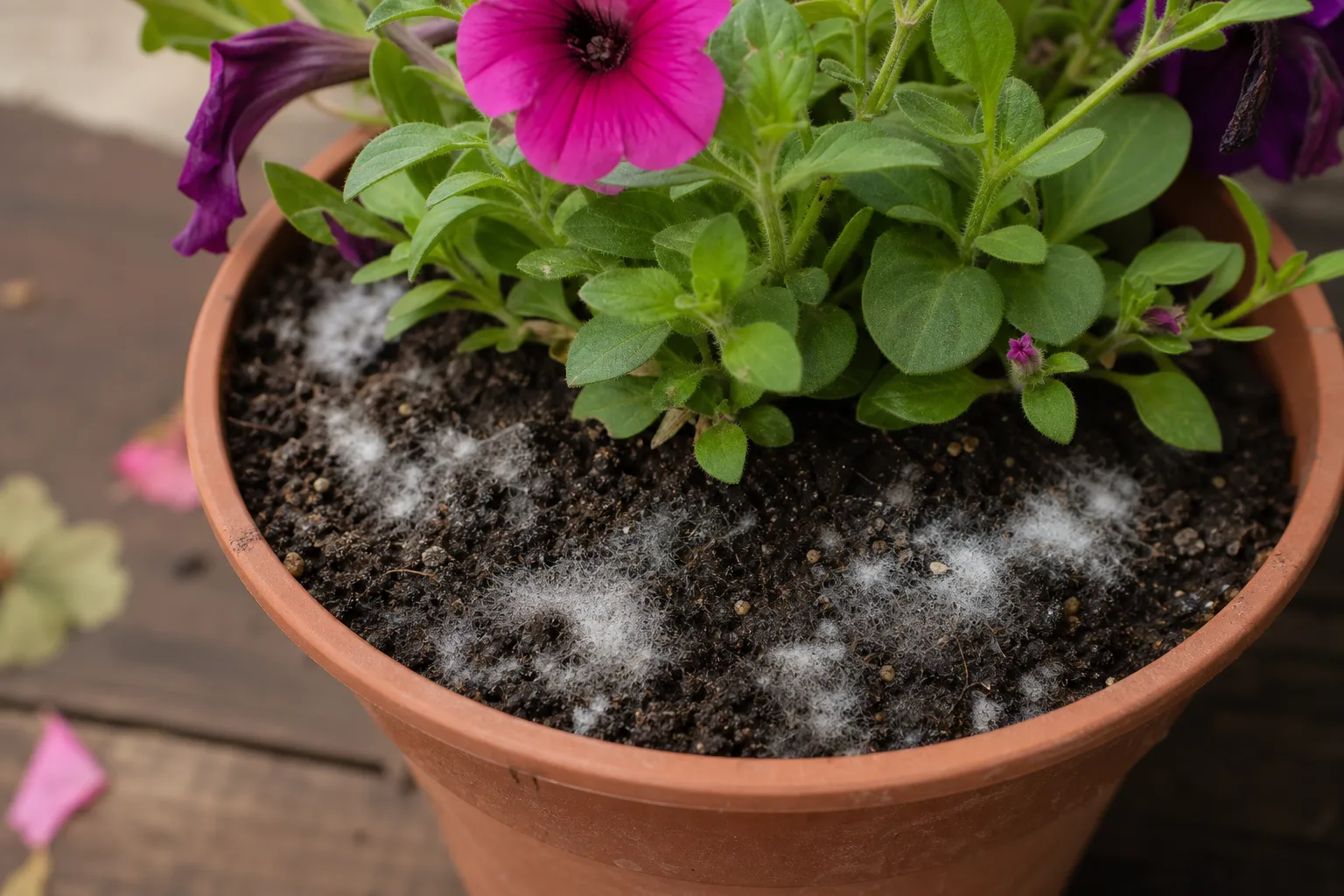
White or gray fuzz on petunia potting soil is usually harmless saprophytic fungus feeding on damp organic matter-not a disease attacking living roots. First step: stop watering until the top 2–3 cm of mix feels dry, then scrape off the moldy surface layer and clear spent petals or leaf debris.
Mold on Soil on Petunia: Causes, Checks & Fixes
This guide covers mold on soil on Petunia. See also the general Mold on Soil guide, watering, and light pages for this plant.
Mold on Soil on Petunia: Causes, Checks & Fixes
Quick answer
Your petunia can be covered in open blooms while white fuzz carpets the soil in a hanging basket on a covered porch-that mismatch is common and usually not an emergency. The fuzz is typically saprophytic fungus breaking down dead organic matter in a surface layer that never dries, not a pathogen eating living roots.
First step: stop watering until the top 2–3 cm of potting mix feels dry to the touch. Once the surface dries, scrape off the moldy top layer, discard it, and pick up any spent petals or fallen leaves sitting on the soil. That single moisture correction fixes most cases without fungicide.
Why Petunia soil grows mold
Garden petunias (Petunia × atkinsiana) are warm-season annuals built for full sun and a wet-dry watering rhythm. They transpire heavily in hanging baskets and window boxes-especially spreading Wave and Surfinia types that trail two feet or more-yet many growers keep a summer watering schedule on a shaded porch where the mix never dries at the rim.
Several petunia-specific habits make surface mold common:
Hanging baskets on covered porches. A trailing petunia in a 25–30 cm basket may bloom beautifully while the soil surface under dense foliage stays damp for days. Rain splash, overhead watering, and a full saucer recreate the same saturated top layer saprophytic fungi colonize.
Spent blooms and leaf litter on the soil. Petunias need regular deadheading. Petals that drop into the pot or sit on the soil surface decompose quickly and feed surface fungi-especially in crowded baskets where faded flowers land on mix instead of the ground below.
Calendar watering in partial shade. Petunias need at least 5–6 hours of good sunlight to bloom and use water efficiently. A basket pushed into a dim corner dries slowly, so mold persists even when you water less often than in full sun. Container plants in shade need moisture checks before every drink-not a fixed weekly schedule.
Peat-heavy mix without perlite. Organic potting blends hold surface moisture. Pure peat tops without coarse perlite stay wet at the rim while lower roots may still be acceptable-a pattern that masks stress until yellowing starts.
Wave types vs upright bedding types. Spreading petunias cover more soil surface and transpire heavily; they need more frequent watering in sun but also dry faster when placed correctly. A mounding grandiflora in a small pot on a hot balcony may dry in a day; a Wave basket under an eave may stay surface-wet for a week on the same calendar.
Seedlings vs established baskets. Young petunias in shallow nursery packs or 10 cm pots have a thin root zone and small soil volume that stays wet longer after each soak. Surface mold on seedlings is more often a sign you are watering before the top layer dries-not a separate disease. Established trailing baskets with deep roots tolerate brief surface wetness better, but a dense canopy over a large pot can still trap moisture at the rim while stems look fine.
Surface mold and deeper trouble often share one root cause-too much moisture-but the mold itself is usually a warning sign, not the killer.
What mold on soil looks like on Petunia
Typical harmless surface mold:
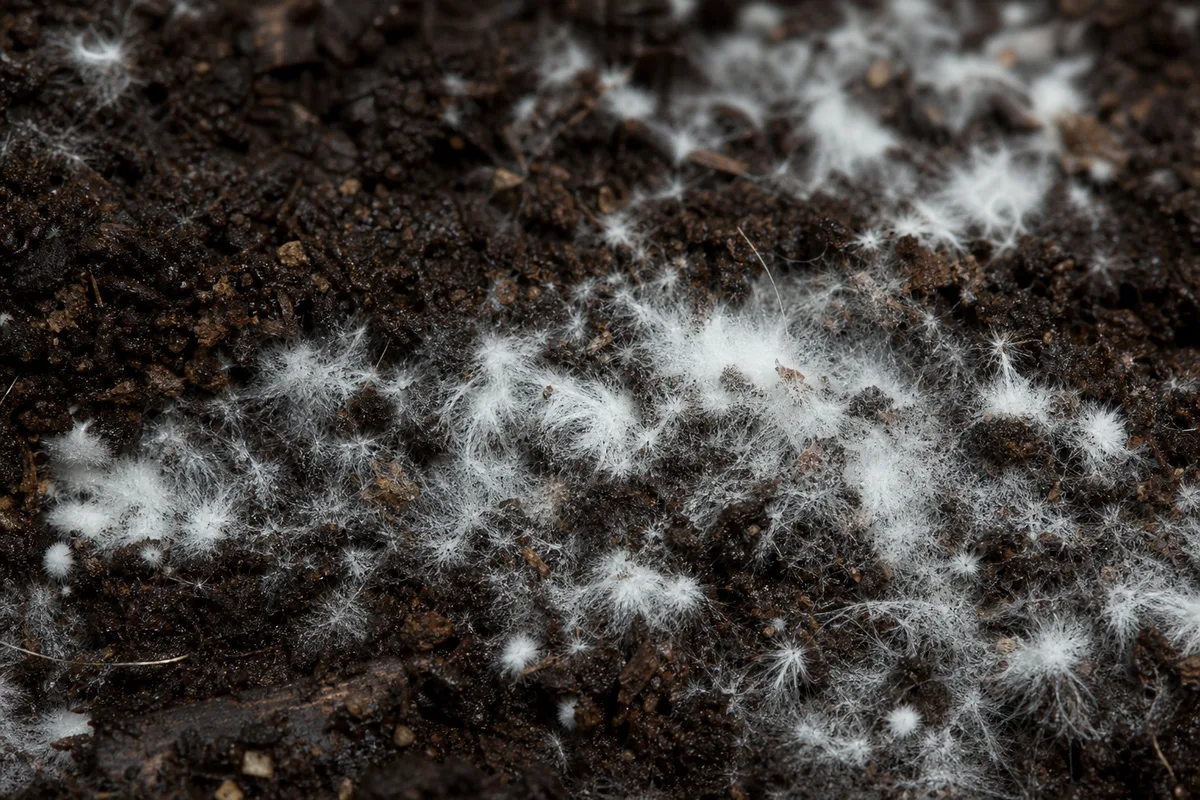
Mold on Soil symptoms on Petunia - compare with healthy tissue on the same plant.
- White, gray, or occasionally green fuzzy patches on the top of the potting mix
- Thread-like mycelium visible when you scrape the surface
- Soil that feels cool and damp several days after watering
- Plant stems still firm; blooms may continue on an otherwise healthy plant
- Often paired with fungus gnats hovering when you disturb the pot
Patterns that suggest you also have a deeper moisture problem:
- Musty or sour smell when you dig into the top layer
- Soil surface stays wet even when lower leaves yellow
- Green algae film alongside white fuzz, usually in a dim spot
- Wilting mid-morning on a heavy, wet basket
Not the same as botrytis gray mold on flowers. Botrytis appears as gray, fuzzy growth on spent flowers, petals, and damp leaf tissue-not as a uniform mat on bare soil. It thrives in cool, moist weather with poor air circulation. Soil surface fuzz with firm green stems and clean living flowers is a different diagnosis path.
How to confirm the cause
Work through these checks before you repot or spray:
- Finger test - Push your finger into the top 2–3 cm. If it feels wet or cool and clings to your skin, the surface has not dried enough. Follow the petunia watering guide dry-down test, not a fixed calendar.
- Pot weight - Lift the hanging basket or container. A heavy pot days after watering confirms slow drying; a light pot with surface mold may mean you recently watered a mix that drains poorly at the top.
- Stem firmness - Pinch the lowest inch of main stems. Firm, green tissue supports a surface-mold diagnosis. Soft, dark, or hollow stems mean investigate root rot on petunia, not just scrape mold.
- Debris scan - Look for matted petals, fallen leaves, or decorative moss on the soil. Remove them and recheck in a week-if mold appeared only where debris sat, the cause is localized organic matter plus moisture.
- Gnat test - Tap the pot rim. A cloud of tiny flies confirms the same wet-soil environment that grows surface fungi. Persistent gnats after drying the surface point to the fungus gnats problem guide.
- Root spot-check (only if stems feel soft or the plant wilts on wet soil) - Slide the petunia partly out of the pot. Healthy roots are white or tan and firm. Brown, mushy roots with sour-smelling mix mean overwatering and root decline-the mold was a clue, not the whole story.
If stems are firm, roots smell neutral, and only the surface is fuzzy, you can treat this as cosmetic mold and fix watering first.
Recovery example (editorial observation)
July 2025, covered north-facing porch vs west-facing balcony: Two 28 cm Wave petunia hanging baskets-same mix, same watering day-showed white fuzz on the soil surface after a week of daily summer checks. Stems were firm and blooms open on both. The porch basket’s top 2–3 cm stayed cool and damp four days after the last soak; lifting it felt roughly twice as heavy as the balcony basket, where the same depth dried in about 24 hours. After scraping the moldy top centimeter, clearing spent petals, and pausing water until the finger test read dry, the porch pot needed six days to reach dry-down; the balcony pot needed one. Mold did not return on either once watering resumed on pot-weight cues, not calendar days. The lesson: placement and canopy shade change dry-down speed more than plant variety alone.
First fix for Petunia
Stop watering until the top 2–3 cm of potting mix is dry to the touch.
Do not add fungicide, cinnamon, or a heavy top-dressing on day one. The mold is a moisture signal. Letting the surface dry breaks the fungus’s habitat faster than any spray.
After the surface dries:
- Scrape off roughly the top 1 cm of moldy mix with a spoon and discard it in the trash-not the compost pile.
- Remove all spent petals, fallen leaves, and visible debris from the pot surface.
- Empty any water sitting in the saucer-do not let the pot sit in standing water.
Hold off on the next full watering until your finger test says the top layer is dry again. For a hanging basket in full summer sun, that pause may take one day; on a covered porch it may take several-follow the pot, not the clock.
Step-by-step recovery
Once the first dry-down and scrape are done, work through these steps in order if mold persists:
Mild case (surface fuzz, firm stems)
- Switch to base watering - Soak at the pot rim until water runs from drainage holes, then discard saucer runoff within 30 minutes. Avoid flooding the soil surface repeatedly while flowers stay dry.
- Improve airflow - Space crowded baskets, trim trailing stems that block rim evaporation, or move the pot toward brighter exposure per the petunia light guide.
- Refresh the top layer - Replace scraped soil with a thin layer of dry, fast-draining mix matching your usual perlite-heavy blend. Do not pack it down.
Mold returns within a week
- Audit your watering rhythm - Compare basket placement to in-ground beds. Containers need more frequent checks; shade slows dry-down. Re-read overwatering signs if yellow leaves join the fuzz.
- Set yellow sticky traps - If gnats appeared with the mold, traps catch adults while drying soil breaks the larval cycle in the top inch of mix.
Chronic case (repeated fuzz, yellowing, fungus gnats)
- Repot only when mold returns weekly despite dry surface habits - Move to fresh, better-draining mix per the petunia repotting guide if the old media is compacted, smells sour, or the container is oversized for the root ball. Trim only mushy roots; leave firm roots intact. Skip repotting on day one unless roots are already rotting-a stable blooming petunia with surface mold rarely needs that disruption mid-season.
Recovery timeline and warning signs
Surface mold should stop reappearing within one to two weeks once the top layer consistently dries between waterings and debris stays cleared. You may see a faint stain on old mix-that is cosmetic.
Signs you are on track:
- No new fuzz after two dry-down cycles
- Firm stems and new blooms opening normally
- Fewer or no fungus gnats when you disturb the pot
- Pot weight drops predictably before you water again
Signs the problem is deeper:
- Mold returns within two days of every watering
- Lower leaves yellow in clusters while the mix stays wet
- Wilting that does not recover overnight even after you watered yesterday
- Blackening at the crown or stem base
Petunias do not “heal” old moldy soil-they outgrow the problem when conditions change. Judge recovery by new growth and stable stems, not by whether a faint scar remains on the surface.
Lookalike symptoms to rule out
| What you see | Where it appears | Likely cause | Urgency | First action |
|---|---|---|---|---|
| White/gray fuzzy mat | Soil surface only | Saprophytic mold on wet organic mix | Low | Dry top 2–3 cm, scrape surface |
| Gray fuzzy spores on petals | Spent or living flowers, damp leaves | Botrytis blight | Medium | Remove infected tissue, improve airflow |
| Slimy green film | Soil surface in very low light | Green algae | Low | Dry surface, increase sun |
| Small yellow mushrooms | Wet organic mix | Saprotrophic fungi in damp potting soil | Low | Scrape for appearance; fix moisture |
| Wilting on wet soil, mushy roots | Root zone | Root rot from chronic overwatering | High | See root rot guide |
| Dry white powder on leaves | Leaf surfaces, not soil | Powdery mildew | Medium | Different fungus-see powdery mildew page |
What not to do
Do not blanket-spray fungicide on soil for cosmetic mold before fixing water-runoff marks petunia petals and leaves easily, and sprays do not fix overwatering.
Do not cover soil with decorative moss or undecomposed organic top-dress that holds surface moisture.
Do not keep watering a shaded basket on the same schedule as a full-sun balcony pot. Test the top 2–3 cm instead.
Do not confuse soil fuzz with botrytis on petals and assume both need the same scrape-and-wait approach. Inspect flowers and leaf axils separately.
Do not repot a healthy mid-season petunia into a much larger container hoping to “give it room.” Excess wet mix around small root systems is a common mold trigger.
Petunia care cross-check
If mold keeps returning, verify the basics that govern how fast your pot dries:
- Light - At least 5–6 hours of direct sun daily for strong bloom; hanging baskets on covered porches need corrected watering, not just less volume. See the petunia light guide.
- Mix - Fast-draining potting blend with perlite; never heavy garden soil in containers. See the petunia soil guide.
- Drainage - Open drainage holes and no standing saucer water.
- Watering rhythm - Daily checks for baskets in peak summer sun may mean every 1–2 days; a shaded porch may need longer dry-down between soaks. See the petunia watering guide.
- Deadheading - Remove faded blooms before petals fall into the pot.
When those align, surface mold usually disappears without heroic intervention.
How to prevent mold on Petunia soil next time
Deadhead regularly and brush debris off the soil after windy days on the balcony. Water when the top 2–3 cm dries, then drain completely. Use pots sized to the root ball-slight restriction encourages branching on many cultivars.
Empty saucers after every watering. If you bottom-water, lift the pot out of the tray once the mix has absorbed enough; do not leave it soaking. Bottom-watering trays can keep the top centimeter persistently damp in hanging baskets where the rim never sees sun-switch to watering at the base of the stem at the pot edge or water from above at the soil line only, then let the surface dry before the next fill.
Keep baskets where air moves-especially under eaves and on crowded plant shelves. Pair that with strong light so the plant uses water at a steady rate.
Watch for fungus gnats early. They share the same damp-soil habitat as surface mold; letting the surface soil dry between waterings prevents both.
When to worry
Escalate beyond scrape-and-dry when:
- The stem base feels soft, black, or hollow
- The plant wilts while the mix is still wet
- Lower leaves yellow rapidly and fall in groups
- Mold returns within 48 hours despite a visibly dry surface and clean debris-compact or sour-smelling mix may need repotting per the repotting guide
- Gray fuzzy growth spreads onto living flowers and leaves in a cool, humid room-treat as possible botrytis, not soil mold alone
A firm, blooming petunia with isolated soil fuzz is not an emergency. A collapsing crown with sour soil is. If chronic wet culture and advancing root decline persist after corrected care, contact your local extension office for hands-on diagnosis.
Conclusion
Surface mold on petunia soil is a moisture signal, not a death sentence for a blooming basket. Scrape, dry the top 2–3 cm, and clear spent blooms first-most cases stop there. Escalate to repot only when mold returns weekly on a dry surface, the mix smells sour, or stems soften-follow the repotting and root rot guides rather than repeating surface scrapes on rotting roots. Judge success by firm stems and new blooms, not by whether a faint stain remains on old mix.
Frequently asked questions
Why does mold keep coming back on my petunia hanging basket?
Covered porches and dense trailing canopies slow surface drying even when you water less often. The basket rim may feel dry while the center stays wet, or spent blooms decaying on the soil feed fungi. Fix drainage, move toward more sun if possible, and water only when the top 2–3 cm is dry-not on a fixed calendar.
Should I repot my petunia when I see surface mold?
Not on day one if stems are firm, blooms continue, and only the soil surface is fuzzy. Scrape, dry the top layer, and correct watering first. Repot when mold returns weekly despite dry surface habits, the mix smells sour, or you find mushy roots-see the repotting and root rot guides for that escalation path.
Is the gray fuzz on my petunia flowers the same as mold on the soil?
No. Gray fuzzy growth on spent petals and damp leaf tissue is usually botrytis blight-a different problem from white soil-surface mold. Soil fuzz with firm green stems and clean living flowers points to a moisture culture fix, not flower disease spray.
Will surface mold harm my blooming petunia?
Harmless saprophytic mold rarely damages established petunias by itself. It signals conditions-shade, overwatering, poor drainage-that can lead to root decline if ignored. Judge risk by stem firmness and whether yellowing follows chronic wetness, not by the fuzz alone.
How do I prevent mold on petunia soil next season?
Deadhead before petals fall into the pot, use perlite-heavy mix, water at the base when the top 2–3 cm dries, and empty saucers after every soak. Give hanging baskets enough sun-petunias need at least 5–6 hours of direct light daily to use water efficiently.
When to use this page vs other Petunia guides
- Petunia watering guide - Use for routine moisture checks before assuming mold on soil is the main issue.
- Petunia problems hub - Browse all 40 common issues on this species.
- Fungus Gnats on Petunia - Different entry point when symptoms overlap with mold on soil.
- Overwatering on Petunia - Different entry point when symptoms overlap with mold on soil.
- Root Rot on Petunia - Different entry point when symptoms overlap with mold on soil.