Heat Stress on Petunia: Causes, Checks & Fixes
Quick answer
Petunias fade and wilt in peak summer heat above about 35°C even when soil is moist. Water deeply at dawn, provide afternoon shade during heat waves, and trim back heat-damaged stems after temperatures drop.
Heat Stress on Petunia: Causes, Checks & Fixes
This guide covers heat stress on Petunia. See also the general Heat Stress guide, watering, and light pages for this plant.
Heat Stress on Petunia: Causes, Checks & Fixes
Quick answer
Heat stress on petunia shows when extreme summer temperatures outpace what shallow container roots can supply-even if the mix feels moist. Leaves wilt mid-afternoon, flowers fade fast, and new buds pause during sustained hot spells above about 35°C (95°F). Petunias are full-sun annuals that still hit a ceiling in peak heat.
First step: water deeply at dawn before heat builds, then give afternoon shade only during heat-wave spikes-not full-day shade. Petunias need sun to bloom; moving them to deep shade fixes wilt temporarily but stops flowers within weeks.
Why Petunia gets heat stress
Petunias evolved as fast-growing bloomers for bright, open conditions. They transpire heavily when receiving at least five or six hours of direct sun-the same exposure that produces the best flower show. In a heat wave, leaf water loss can exceed what fibrous, shallow container roots absorb, even when soil holds reasonable moisture.
Petunia-specific heat triggers:
- Small hanging baskets with limited soil volume heat up and dry at the surface while deeper mix stays damp-roots cannot keep pace with afternoon demand.
- Dark-colored pots and railings that radiate heat into the root zone during late afternoon.
- Wind-exposed baskets that lose moisture through leaves faster than calm sites.
- Dense trailing canopies-Wave and Supertunia types cover the soil and trap heat at the basket center.
- Reflected heat from south-facing walls, decking, or pavement that pushes air and pot temperatures above the plant’s comfort range of roughly 15°C to 28°C (60–82°F).
Heat stress is not the same as underwatering on Petunia. Underwatered petunias have dry, light pots and wilt because roots lack water. Heat-stressed petunias often wilt with moderate pot weight-the problem is transpiration exceeding uptake, not empty soil.
Cultivar matters. Grandiflora types with large flowers struggle more in hot, humid summers than spreading Wave, Easy Wave, or Supertunia series bred for heat tolerance.
What heat stress looks like on Petunia
Heat stress on container petunias follows a recognizable pattern:
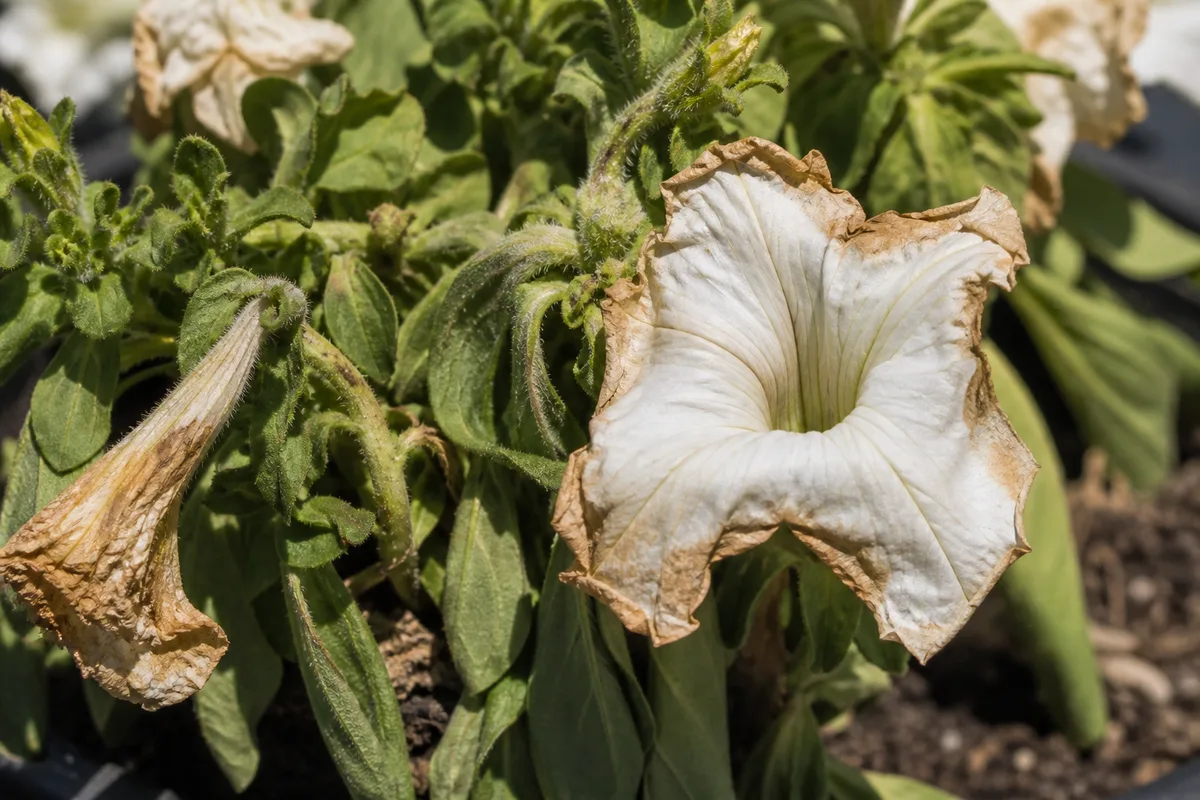
Heat Stress symptoms on Petunia - compare with healthy tissue on the same plant.
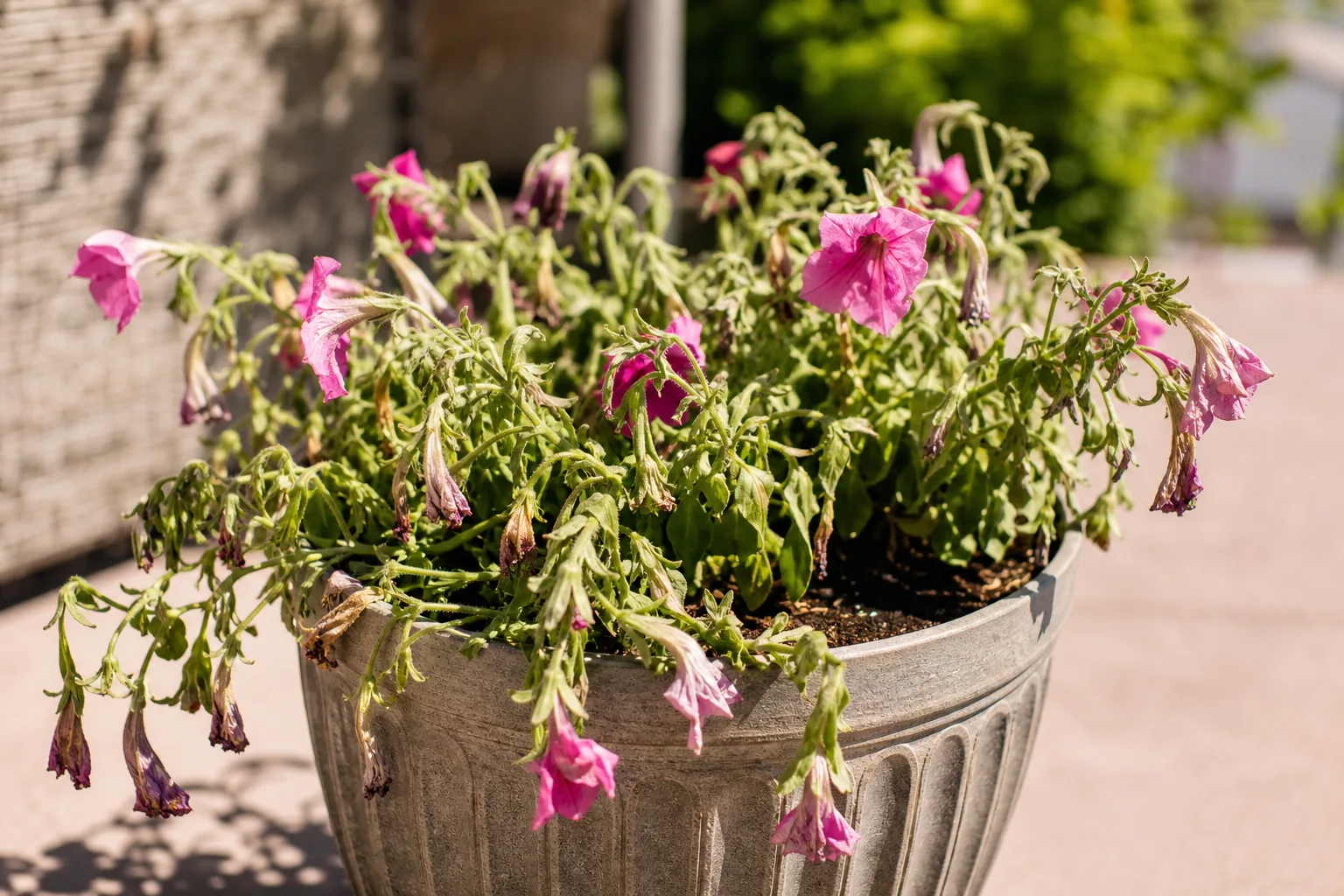
- Mid-afternoon wilting on Petunia on sunny days while the top 2 cm of mix is still moist-not bone dry.
- Flowers bleaching or fading within a day of opening instead of holding color for several days.
- Crispy brown margins on leaves, often on the wind-exposed or sunniest side of the basket first.
- Slow or paused bud formation during hot weeks; the plant conserves energy until nights cool.
- Overnight recovery-stems firm and leaves perk by morning, then wilt returns the next hot afternoon.
- Leggy, tired appearance by midsummer as heat and bloom cycles exhaust the plant without a trim.
Compare with underwatering: drought-stressed petunias have light pots, dry mix throughout, and wilt that does not resolve until a deep soak. Compare with root rot on Petunia: yellow lower leaves, sour smell, and wilt on constantly wet mix that does not recover overnight.
How to confirm the cause
Work through these checks in order:
- Soil moisture at 2–3 cm. Moist or cool soil with afternoon wilt points toward heat stress. Dusty, dry soil points toward underwatering.
- Pot weight. Moderate weight with afternoon wilt fits heat transpiration. Very light weight fits drought.
- Time pattern. Heat stress wilts peak mid-afternoon to early evening and improves by morning. Root rot wilts persist into cool mornings on wet mix.
- Flower behavior. Blooms that bleach or collapse within twenty-four hours during hot spells often follow heat stress, not just missed watering.
- Temperature context. Sustained days above about 32–35°C (90–95°F) with Petunia light guide on containers strongly support heat stress when soil is not dry.
- Recovery test. Deep water at dawn. Heat-stressed petunias may still wilt later that afternoon-that is expected. Underwatered plants should firm within two to four hours of soaking if roots are healthy.
If soil is soggy, stems smell sour, or lower leaves yellow while wilt persists, inspect roots for rot before treating heat stress.
First fix for Petunia
Water deeply at dawn-not a midday splash when leaves are already stressed.
Soak at the base until water runs from drainage holes, then empty saucers so roots are not left in stale runoff. Morning irrigation gives roots a full reservoir before peak transpiration. Container and hanging basket plants need more frequent watering than in-ground beds, and heat waves can push that to daily checks or twice-daily monitoring on small baskets.
During temperature spikes only, provide afternoon shade from roughly 2–4 p.m.-a sheer curtain, movable umbrella, or temporary relocation to bright shade-not a permanent move to deep shade. Petunias moved to full shade lose bloom within weeks.
Do not fertilize, repot, or heavily prune on the hottest day. Stabilize water and shade first; trim heat-damaged tissue after the wave passes.
Step-by-step recovery
Once dawn watering and selective afternoon shade are in place:
- Check baskets morning and late afternoon during heat waves-note whether wilt returns despite moist soil.
- Upgrade water delivery if mix repels water after repeated dry cycles. Submerge the basket ten to thirty minutes to rehydrate hydrophobic peat, then resume dawn soaks.
- Trim crispy leaves and spent bleached flowers so the plant does not support dead tissue through the next hot week.
- Cut back tired trailing stems by one-third above a leaf node after the heat wave-midsummer trimming spurs fresh growth and rebloom on heat-tolerant Supertunia types.
- Apply balanced liquid feed three to seven days after the plant looks turgid again-not while stems are limp from active stress.
- Move dark pots off hot surfaces or slide them a few inches from radiating walls if root zones overheat every afternoon.
Spreading petunias in ten-inch baskets on west-facing rails often need larger pots or drip irrigation timers for consistent dawn delivery-surface hand-watering may not reach trailing roots at the basket bottom.
Recovery timeline
Expect afternoon wilt to continue on the hottest days even with good care-that is transpiration, not necessarily failure. Look for firm stems each morning and new buds forming within five to ten days after temperatures drop below about 30°C (86°F).
Crispy leaf margins stay brown permanently. Fresh growth from trimmed stems should emerge clean within one to two weeks after a mid-season cutback plus feeding.
If petunias dry out and wilt repeatedly, flowering can shut off for up to two weeks even after correction-avoid letting heat stress slide into drought cycles.
Worsening signs: wilt that persists through cool mornings on moist soil with soft stems at the base, spreading yellow leaves, or no new buds for more than two weeks after heat breaks-inspect for root rot or disease.
Lookalike symptoms
Normal midday droop in extreme heat. Slight softening at peak sun with moderate pot weight and full recovery by morning may need no extra water-only afternoon shade during spikes.
Underwatering. Light pot, dry mix throughout, wilt that resolves within hours of a deep soak. Most common lookalike-always check moisture first.
Root rot wilt. Yellow lower leaves, sour smell, wet heavy pot, wilt that does not recover overnight. Adding water worsens Phytophthora damage in saturated mix.
Spider mites in hot dry baskets. Stippled yellow leaves, fine webbing on undersides-often co-occurs with heat but needs rinsing and pest checks, not just shade.
Transplant shock. Newly planted petunias wilt for several days after moving from greenhouse to harsh sun. Shade for a few days and even moisture-not bone dry-until new growth appears.
What not to do
Do not move petunias to full shade to stop afternoon wilt-they need direct sun for blooms and will stretch and stop flowering.
Do not water every hour at midday on moist soil-that keeps mix soggy overnight and invites root rot without fixing transpiration loss.
Do not mist foliage instead of watering roots-petunias need root-zone moisture; wet leaves in heat can promote Botrytis on flowers.
Do not fertilize heavily during active heat wilt-wait until stems are firm again.
Do not assume all wilt is drought-check soil moisture before soaking a plant that may already sit wet.
Do not ignore midsummer scraggly growth-a one-third trim after heat breaks often restores bloom on trailing types.
Causes to rule out
| Pattern | Likely cause | First step |
|---|---|---|
| Afternoon wilt, moist moderate pot | Heat stress | Dawn deep soak + afternoon shade |
| Mid-morning wilt, dry light pot | Underwatering | Deep base soak |
| All-day wilt, heavy wet pot | overwatering on Petunia / root rot | Stop watering; inspect roots |
| Stippling, webbing, dusty leaves | Spider mites | Rinse undersides; improve airflow |
| Grey mold on wet petals | High humidity / Botrytis | Remove flowers; dry blooms |
| Wilt after transplant only | Transplant shock | Shade briefly; even moisture |
Petunia care cross-check
Heat stress prevention aligns with normal petunia culture:
- Light: Five to six hours of direct sun minimum; afternoon shade only during heat spikes, not as permanent placement.
- Water: When top 2 cm is dry; in heat that may mean checking every day-sometimes twice on small baskets.
- Soil: Lightweight mix with perlite so water penetrates but roots have enough volume between soaks.
- Temperature: Best performance roughly 15°C to 28°C; expect decline when sustained highs exceed about 35°C despite good care.
- Placement: Dark pots, west-facing walls, and enclosed hot patios accelerate stress-adjust shade and pot size, not just the calendar.
Heat-tolerant cultivars such as Wave, Easy Wave, and Supertunia series outperform grandiflora types in humid southern summers.
How to prevent it next time
Choose larger baskets or window boxes on hot sites so soil volume buffers afternoon demand. Midsummer baskets often need more water than spring because plants are larger and temperatures are higher.
Water at dawn as routine when forecasts show several days above 30°C (86°F). Check moisture at 2 cm depth-not on a fixed weekly schedule.
Use light-colored pots or insulate dark containers with secondary cachepots to reduce root-zone heating.
Provide movable afternoon shade-sheer fabric, umbrella, or rolling carts-only during heat waves.
Plan a midsummer cutback and feed before the worst heat if trailing petunias look tired-proactive trimming beats waiting for collapse.
Select heat-tolerant series for southern and container-heavy gardens; save large-flowered grandiflora types for cooler spring windows or partly shaded sites.
Group pots to reduce radiant heat from bare decking, but leave air space between baskets so humidity does not trap Botrytis on wet flowers.
When to worry
Heat stress becomes urgent when:
- Wilt persists through cool mornings despite moist soil and softening stems at the base.
- Flowers drop in clusters and no new buds appear for more than two weeks after temperatures normalize.
- Chronic afternoon wilt on wet mix leads to yellow lower leaves and sour pot smell-root rot may be complicating heat stress.
- The basket fully collapses over a multi-day heat wave without overnight recovery.
For occasional afternoon wilt that resolves each morning with firm stems and ongoing buds, petunias usually ride out the heat with dawn watering and selective shade. They are annuals-replacing exhausted plants in late summer is sometimes more practical than fighting peak-season decline on a small basket.
When to use this page vs other Petunia guides
- Petunia watering guide - Use for routine moisture checks before assuming heat stress is the main issue.
- Petunia problems hub - Browse all 40 common issues on this species.
- Wilting on Petunia - Different entry point when symptoms overlap with heat stress.
- Drooping Leaves on Petunia - Different entry point when symptoms overlap with heat stress.