Root Rot on Norfolk Island Pine: Causes, Checks & Fixes
Quick answer
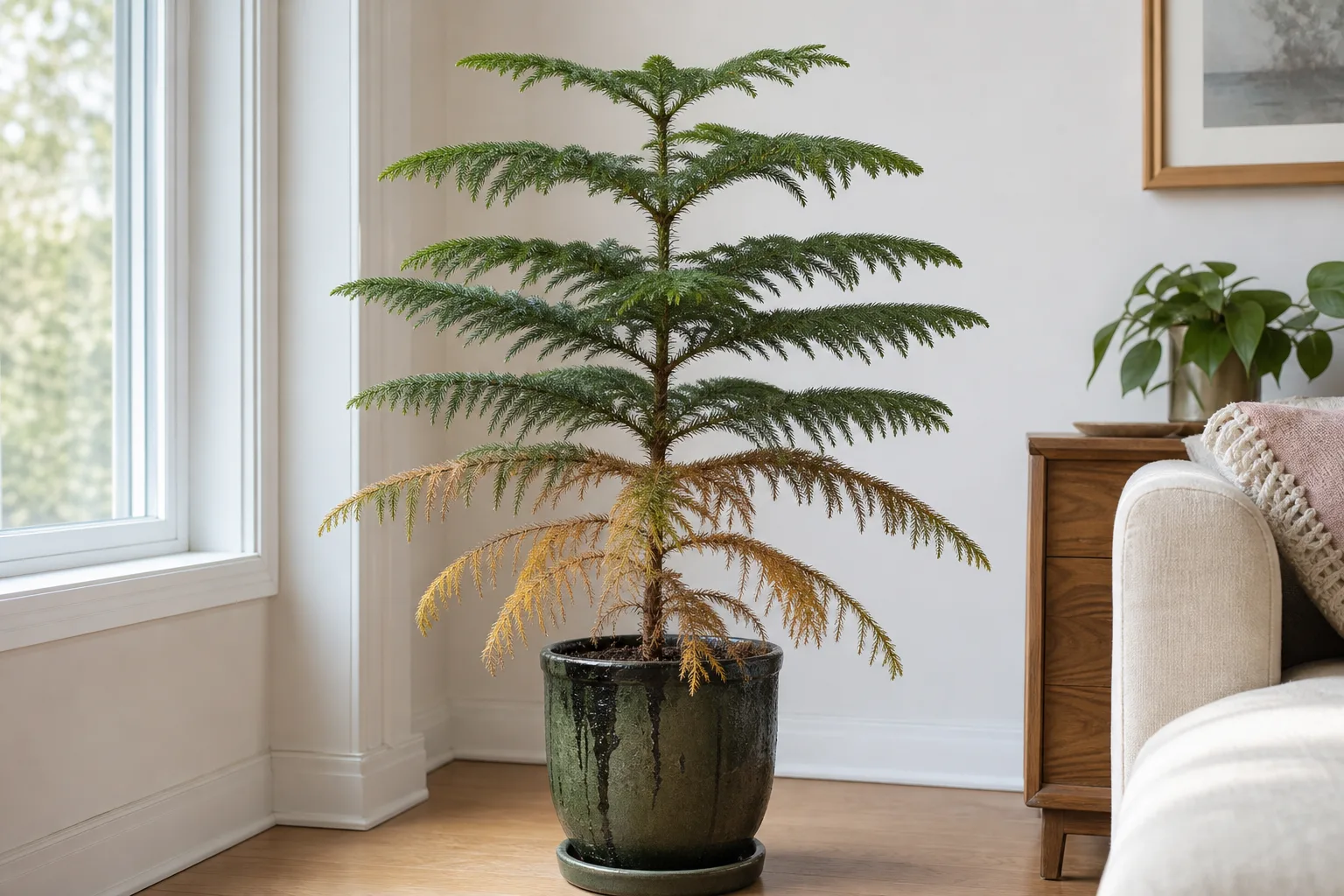
Root rot on Norfolk Island pine means waterlogged mix has suffocated roots on this upright subtropical conifer. First step: stop watering immediately, confirm the top inch is still wet and the pot feels heavy, then check whether lower branch tiers are browning while soil stays damp-that wet-soil decline pattern means damaged roots, not thirst. Unpot only if branch loss continues after a dry-down pause.
Root Rot on Norfolk Island Pine: Causes, Checks & Fixes
This guide covers root rot on Norfolk Island Pine. See also the general Root Rot guide, watering, and light pages for this plant.
Root Rot on Norfolk Island Pine: Causes, Checks & Fixes
Quick answer
Root rot on Norfolk Island pine (Araucaria heterophylla) is not a mysterious fungus attacking at random-it is almost always roots suffocating in soil that stayed too wet too long. On this upright Araucariaceae conifer with whorled horizontal branch tiers, damage climbs from the bottom up: lower branches brown and die, needles soften or yellow on wet soil, the pot stays heavy for weeks, and mix at the drainage hole may smell sour or musty.
First step: stop watering immediately. Do not repot, fertilize, or mist on day one. Confirm the top inch of mix is still wet and lift the pot-if it feels heavy while lower branch tiers droop despite moisture, you are in the decline-on-wet-soil trap, not a drought emergency. Let the upper root zone dry, remove any holiday foil wrap trapping runoff, empty saucers completely, and stabilize Norfolk Island Pine light guide before unpotting.
This page covers confirmed and suspected root rot on Norfolk Island pine-the numbered rescue workflow, when lower tier loss is permanent, and prevention aligned with the Norfolk Island pine watering guide. For early overwatering before roots collapse, see overwatering on Norfolk Island pine. For mix and drainage failures that cause rot, see the soil guide.
Root rot vs. other Norfolk Island pine problems - why wet soil with dying branches matters
The diagnostic that separates root rot from almost every lookalike on Araucaria heterophylla is this: lower branch tiers browning or drooping while soil at depth stays wet. Healthy roots move water to needles; rotting roots cannot, so the plant declines from the bottom even when the top whorls still look green for a while. Owners see brown needles and pour more water-the fastest way to convert recoverable stress into full rot.
Illinois Extension warns that overwatering can lead to branch loss on Norfolk Island pines-the same outward symptom as severe drought, which is why guessing from needle color alone fails. Root rot is the end stage of chronic wet-soil failure: poor drainage, foil wraps, oversized pots, or calendar watering in a cool dim winter room come first; sour mix, mushy roots, and permanent lower-tier death follow if the wet cycle never breaks.
What root rot looks like on Norfolk Island Pine
Root rot on Norfolk Island pine presents on whorled branch tiers and needles, not on a compact rosette of broad leaves. Symptoms cluster around the root zone and the lowest branches, which depend on those roots first.
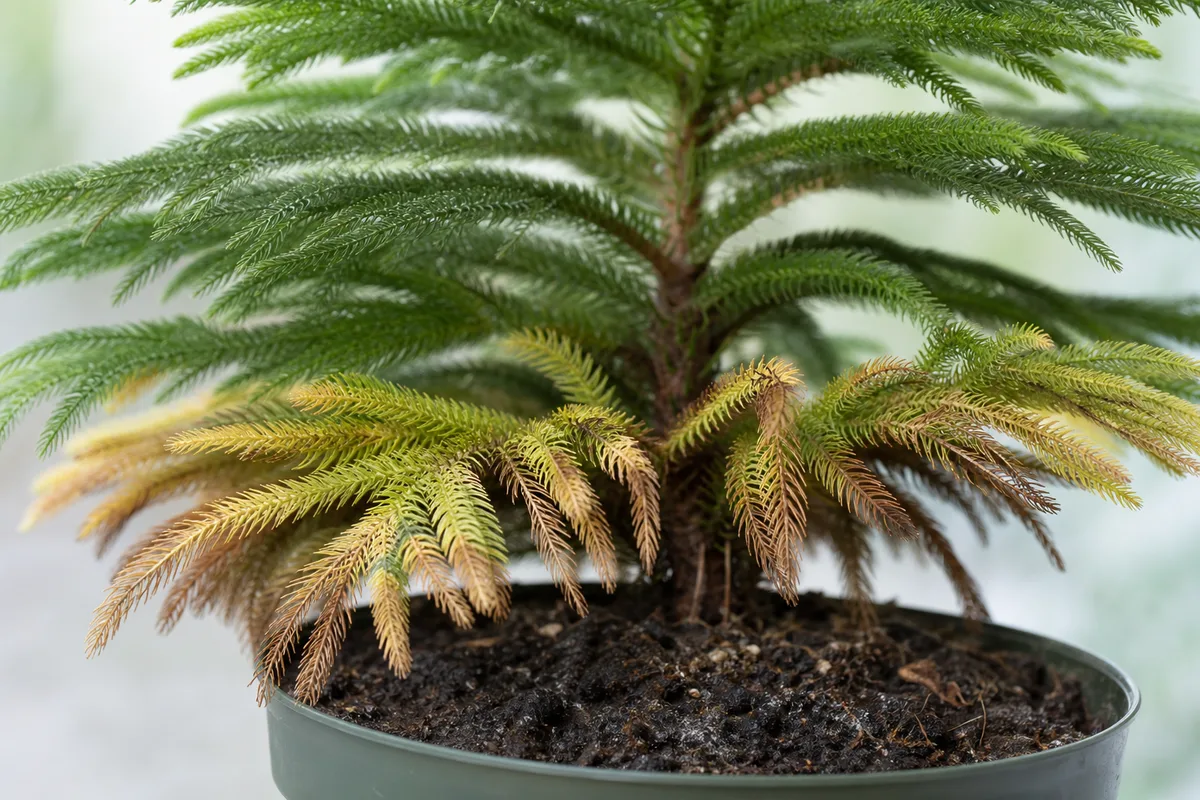
Root Rot symptoms on Norfolk Island Pine - compare with healthy tissue on the same plant.
Early signs
- Lower branch tiers browning or drooping while upper whorls still look relatively intact-classic bottom-up failure on this conifer
- Soft or yellowing needles on the lowest branches despite damp mix at depth
- Heavy pot that never lightens between waterings-the skewer comes up muddy two to three inches down
- Sour, musty, or fermented smell from drainage holes or when you lift the nursery pot from a cachepot
- Fungus gnats hovering near the soil surface-wet mix for weeks invites larvae
- Surface mold or algae on mix that stays dark and cool for many days
Advanced signs
- Mushy brown or black roots - translucent, slimy, or falling away when touched; healthy roots are firm and pale tan or white
- Whole lower whorls turning brown and brittle - needles dry to a crisp on branches that feel limp, not firm
- Trunk softness at the soil line on a constantly wet pot - crown involvement is urgent
- Continued branch death after you have already paused water - decline is active, not stabilizing
What root rot usually is not: gradual brown needle tips only on otherwise firm branches when soil is dry or merely normally moist (low humidity or drought-see underwatering and the watering guide’s humidity section); a single interior needle shed on an old branch (normal aging); or sudden tip browning after a heat vent blast without chronic wet soil.
Why Norfolk Island Pine gets root rot
Norfolk Island pine evolved on a humid South Pacific island where rainfall drains through porous, slightly acidic substrate-not waterlogged peat in a sealed decorative pot. Indoors we often recreate the worst part: permanently damp mix in a holiday gift wrap with no exit for stale water. Root rot kills more Norfolk Island pines than occasional missed waterings.
Subtropical conifer roots and oxygen starvation
Araucaria heterophylla is a subtropical conifer, not a temperate true pine. Its roots expect steady moisture with oxygen between drinks-Missouri Botanical Garden describes indoor culture in fertile, porous, sandy, peaty, slightly acidic, well-drained soils and warns against extremes of wet and dry. When mix stays saturated, air spaces fill with water, root respiration slows, and pathogens gain a foothold. Penn State Extension lists root rot on Norfolk Island pine with small brown to black soft rotting roots associated with organisms such as Cylindrocladium or Pythium when drainage fails.
Holiday pots, foil wrap, and cool winter evaporation
Post-holiday failure is predictable: a Norfolk Island pine arrives soaked from the shop, still wearing a foil or plastic decorative wrap that traps every watering’s runoff. Illinois Extension notes that holiday paint on needles can block sunlight absorption. Decorative foil wraps trap moisture and block proper drying. Meanwhile, cool winter rooms slow evaporation even as furnace heat dries the air-owners keep a generous watering rhythm from November while the root zone takes up water more slowly, so mix stays wet at the center for weeks.
Oversized pots, blocked drainage holes, dense compacted peat, and saucers left full complete the usual setup. A floor tree in a fourteen-inch pot with sparse roots cannot drink the extra soil volume-the center stays anaerobic while the owner waters because needle tips browned and they assumed thirst.
Lookalikes: underwatering vs. low humidity needle browning
Norfolk Island pine needle damage is not always root rot. Misreading the pattern causes the wrong fix-especially adding water to a rotting plant.
| What you find | Most likely cause | First action |
|---|---|---|
| Heavy wet pot, lower tier death, sour smell | Root rot / advanced overwatering | Stop water; dry-down pause; inspect roots |
| Light dry pot, dusty mix at depth, crisp brown tips | Underwatering | Thorough soak; see underwatering |
| Firm branches, brown tips only, soil moisture normal, RH below 40% | Low humidity / dry air | Humidifier; see watering guide humidity section |
| Wet surface 10+ days, limp needles, dim north room | Low light + slow uptake | Brighten; see not enough light |
| Branch loss after repot with soggy new mix | Rescue shock + poor drainage | Trim rot; repot into airy acidic mix per soil guide |
Ask Extension notes that low relative humidity or dry soil conditions may cause browning of branch tips and lead to loss of lower branches-so humidity and drought can mimic rot’s branch-loss endpoint. Always pair pot weight and top-inch moisture with the symptom pattern before you repot.
How to confirm the cause
Work through these checks before trimming roots or choosing a new pot.
- Pot weight - Heavy and hard to tilt with drooping lower tiers and no recent soak suggests chronic wetness. Light with crisp needle tips points away from rot.
- Top-inch probe - Insert your finger or a skewer one inch down along the pot wall. Cool clinging soil on a heavy pot with sour smell raises rot suspicion. Illinois Extension recommends allowing soil to dry out some between waterings-if the top inch never dries for two weeks in a warm room, drainage has failed.
- Smell and drainage - Sour mix or water pooling in saucers confirms anaerobic conditions. Confirm holes are open and foil wrap is removed.
- Branch tier pattern - Whole lower whorls dying on wet soil cluster toward rot. Tip browning only on firm branches with dry or normally cycling soil clusters toward humidity or drought.
- Trunk base - Soft mushy tissue at the soil line on wet mix is urgent; firm trunk above dry soil is less alarming.
- Unpot inspection - Knock the plant gently from its container. Firm pale roots mean look elsewhere; brown slimy roots with sour mix confirm rot.
First fix for Norfolk Island Pine
Your first action is one clear step: stop watering while you confirm wet-soil decline versus dry-soil thirst. Do not stack repot, prune branches, and fertilizer on the same day.
Step 1 - Stop watering and remove drainage traps
Pause all watering until the top inch of mix dries and the pot lightens noticeably. Remove holiday foil wrap or punch drainage holes through it. Empty saucers and cachepots within 15–20 minutes after any prior watering-discard drained water so roots are not sitting in stale runoff. Move the tree to bright indirect light so remaining healthy roots can recover uptake; dim corners keep mix wet longer. Do not mist as a substitute for fixing drainage.
Wait five to seven days after the top inch dries before deciding whether unpotting is necessary. Mild root stress sometimes stabilizes once oxygen returns without immediate repotting.
Step 2 - Inspect, trim, air-dry, and repot
If lower branches keep dying after a dry-down cycle, unpot and inspect:
- Knock the plant gently from the pot and shake excess mix from roots without tearing firm tissue.
- Identify rotted roots - brown, black, slimy, or hollow sections. Healthy tissue is firm and pale.
- Trim all mushy roots with clean, sharp shears or pruners. Sterilize blades between cuts with rubbing alcohol if rot is extensive.
- Let cut root surfaces air-dry two to four hours on newspaper in bright indirect light-do not leave roots in direct sun or blasting AC.
- Repot into fresh acidic well-drained mix - roughly equal parts peat, perlite, and pine bark, or about 20% perlite by volume in a peat-based blend, per the soil guide and Missouri Botanical Garden’s porous, slightly acidic indoor recommendation. Use a pot sized to the trimmed root mass, not the canopy height-move up only one size. Drainage holes are non-negotiable.
- Water lightly once after repotting so mix settles, then wait until the top inch dries before the next full soak. See the repotting guide for seasonal timing.
Do not fertilize for four to six weeks after rescue repotting. Rot-stressed roots cannot handle salts.
Step 3 - When lower branch loss limits salvage
Accept a hard limit: dead lower branch tiers do not regrow on Norfolk Island pine. Ask Extension is explicit that new growth will not develop in bare areas-the same structural loss applies when tiers die from rot-driven decline. If three or more lower whorls are brown and brittle, the trunk is soft at the base, or more than roughly two-thirds of the root mass is mushy on inspection, the specimen is unlikely to recover an attractive shape even if the apex pushes soft new growth. In that case, prioritize learning prevention for the next tree rather than escalating pot size and water volume on a bare trunk.
Recovery timeline
Mild rot caught early-some mushy roots trimmed, most firm roots intact, only one lower tier affected-may stabilize within two to four weeks after repot and corrected watering. Judge progress by stopped branch death, a pot that cycles from heavy after watering to lighter within seven to ten days in active growth, and firm new needles at the apex whorl, not by saving every browned branch below.
Moderate rot with multiple trimmed roots and two dead lower tiers may take six to ten weeks before new top growth looks confident. Expect some needle shed during stabilization.
Severe rot with crown softness, pervasive mushy roots, or four-plus dead whorls rarely produces a salvageable indoor tree. Recovery is measured in whether decline stops, not whether the plant returns to a full symmetrical holiday silhouette.
What not to do
- Do not keep watering because needles look dry when soil is already wet - wet-soil decline means roots cannot absorb water; more water deepens rot.
- Do not repot into a larger pot to “help drying” or give roots room-that creates a wet dead zone around sparse roots.
- Do not use dense garden soil, pure peat without perlite, or a pot without drainage holes.
- Do not fertilize a rotting or freshly trimmed plant-salts stress recovering roots.
- Do not assume lower branches will fill in later - protect tiers proactively because bare trunk sections stay bare.
- Do not leave holiday foil wraps intact through January watering-remove or drain them immediately.
How to prevent root rot next time
Prevention on Norfolk Island pine is drainage plus the top-inch dry-down rule, not surface appearance alone.
Water when the top 1 inch (2–3 cm) of mix feels dry, then soak until runoff exits drainage holes and empty the saucer within 15–20 minutes-the same rhythm documented in Illinois Extension guidance and detailed in the watering guide. Use a slightly acidic, perlite-amended mix (target pH roughly 4.5–6.0) that drains within minutes but holds even moisture, not mud. Match pot size to the root ball; gift-size trees in 4-inch pots dry faster than floor specimens in 10-inch containers-check weight, not the calendar.
In cool winter rooms, stretch intervals between soaks as growth slows, but verify the top inch still cycles-permanently wet centers in oversized pots are a winter rot trap. Keep relative humidity around 50% or higher when heating dries air, because humidity work and watering work together on this species-but humidity never replaces drainage.
Remove foil wraps after the holidays, never let cachepots hold overnight runoff, and link early wet-soil triage to overwatering before roots collapse. Full species context: Norfolk Island pine overview.
Conclusion
Root rot on Norfolk Island pine is a waterlogging and drainage failure expressed through bottom-up branch tier death, sour mix, and mushy roots-not a random disease. Stop watering first, remove foil and standing runoff, confirm wet-soil decline versus drought or humidity stress, then trim, air-dry, and repot into acidic airy mix only when decline continues. Judge recovery by firm apex growth and stable roots, accept that lost lower whorls never refoliate, and prevent recurrence with the top-inch dry-down rule, open drainage, and right-sized pots aligned with the watering and soil guides.
When to use this page vs other Norfolk Island Pine guides
- Norfolk Island Pine watering guide - Use for routine moisture checks before assuming root rot is the main issue.
- Norfolk Island Pine problems hub - Browse all 4 common issues on this species.
- Yellow Leaves on Norfolk Island Pine - Different entry point when symptoms overlap with root rot.