Best Soil for Norfolk Island Pine: Mix & Drainage
Best Soil for Norfolk Island Pine: Mix & Drainage
Best Soil for Norfolk Island Pine: Mix & Drainage
Why Soil Determines Needle Health and Root Survival
Norfolk Island pine (Araucaria heterophylla) is sold as a living Christmas tree, a tabletop conifer, and a long-lived indoor architectural plant with symmetrical whorled branches. Most growers focus on light, watering, and humidity because needle browning feels like an above-ground problem. The root zone is where those choices actually succeed or fail. Soil decides how fast water moves through the pot, how much oxygen reaches fine lateral roots, how acidic the environment stays, and how quickly a slow-growing conifer recovers after a missed drink or an overenthusiastic pour.
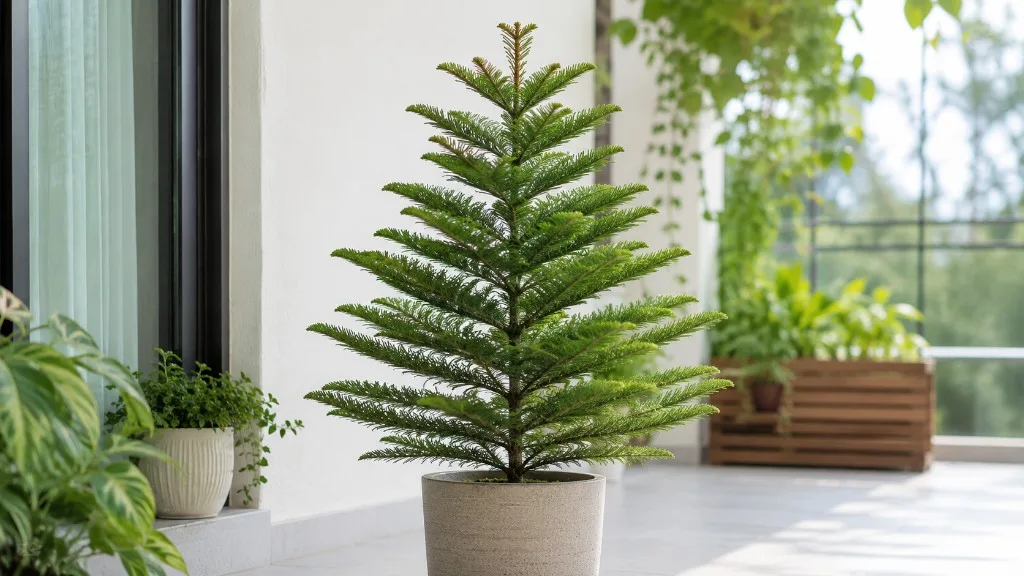
Araucaria heterophylla is an acid-loving conifer in the Araucariaceae family, native to Norfolk Island, where it grows on basalt-derived silicate substrate in a subtropical maritime climate. Indoors, you compress that habitat into a small container. The best soil for Norfolk Island pine must be slightly acidic, porous, and well-draining while holding enough moisture that fine roots do not desiccate between waterings.
If your tree develops brown needle tips, lower branch dieback, or a pot that stays heavy for days, inspect mix texture and pH tendency before changing light or fertilizer. A well-built soil system makes every other care decision easier to read and prevents the slow root decline that shows up as needle damage weeks later. Norfolk Island pine is not dramatic when roots struggle - it declines gradually, which is why soil problems hide behind humidity and watering debates for months before anyone checks the pot.
What Araucaria heterophylla Needs From Its Root Zone
Araucaria heterophylla is winter hardy outdoors only in USDA Zones 10–11, but widely grown as a houseplant elsewhere, typically reaching 3 to 8 feet indoors over many years. Missouri Botanical Garden notes outdoor preference for deep, porous, moderately fertile, reasonably moist soils, seed sown in moist, sandy, peaty soils, and indoor culture in fertile, porous, sandy, peaty, slightly acidic, well-drained soils.
That combination - acidic, airy, moist but not soggy - defines container mix design. Heavy garden soil, unamended all-purpose potting mix in oversized plastic pots, alkaline clay-based blends, and collapsed two-year-old indoor mixes all work against the plant. The goal is consistently moist, well-aerated, slightly acidic soil that dries gradually at the surface while staying lightly damp at depth.
Native Substrate on Norfolk Island
On Norfolk Island, the species grows from sea level to roughly 120 meters on basalt-derived silicate substrate, with about 1,350 mm of annual rainfall. Native ground is mineral-rich and free-draining - not heavy alkaline clay in a sealed indoor pot. Your container mix should mimic that function: acidic organic matter for moisture and pH buffering, coarse amendments for air pockets, and a pot sized to the root mass so no large unused wet zone sits at the bottom.
Four Jobs Your Mix Must Do
Every ingredient should serve at least one of four jobs. First, slight acidity at pH roughly 4.5 to 6.0 so micronutrients stay available (NC State Extension). Second, drainage and aeration so excess water exits within minutes and roots can breathe. Third, moderate moisture retention - brief dry surface layers are tolerable; perpetual wet feet are not. Fourth, structure over time so the medium resists collapsing into an anaerobic block within 12 to 24 months.
Failed mixes produce progressive needle browning, branch droop, or lower-whorl loss after normal watering - symptoms that overlap with low humidity and irregular watering, which is why checking how soil actually behaves matters. Sticky sap on stems, sparse new whorl growth, and a crown that looks full while lower branches thin out are additional clues that the root zone has been wet, compacted, or alkaline too long. Because Norfolk Island pine shows stress slowly, soil correction pays off even when needle damage already visible will not fully reverse.
Signs Your Current Norfolk Island Pine Soil Is Wrong
Soil problems often announce themselves indirectly because Norfolk Island pine does not wilt dramatically. Water sits on the surface after pouring, the pot stays heavy for days while the top inch looks merely damp, lower branches brown and drop while upper growth stays green, or a sour smell rises from the drainage hole. Brown needle tips paired with soil that never dries at depth often trace to chronically wet lower roots, not dry winter air alone.
Missouri Botanical Garden warns that soils kept too wet or too dry damage indoor specimens, and mushroom root rot on Norfolk Island Pine may occur when drainage fails. If you gently unpot and see dark, mushy roots or a root ball that is solid and rock-hard, the soil has failed in opposite ways - too wet or too compacted - but both require a fresh, airier, more acidic mix rather than more frequent watering.
If you adjust watering, humidity, and light and the same symptoms return within three to four weeks, inspect mix texture, pot size, and drainage before stacking more changes. Norfolk Island pine responds slowly when the root zone is corrected, but further decline stops once oxygen and acidity return.
Best Soil Mix for Norfolk Island Pine
The best soil for Norfolk Island pine is a slightly acidic, well-draining potting mix built from peat-based organic matter, perlite, and pine bark or coarse sand. Missouri Botanical Garden recommends porous, sandy, peaty, slightly acidic, well-drained indoor mix. A practical equal-parts blend is one part peat, one part pine bark, and one part perlite.
Aim for a medium that feels light and crumbly when moist - not sticky mud, pure grit, or dense clay. A tight ball that will not break apart means too much fine organic matter or clay; instant runoff with drought stress means the mix is too coarse for your humidity and pot size.
The Quick-Answer Recipe
A dependable Norfolk Island pine soil mix you can blend at home:
| Ingredient | Proportion | Role |
|---|---|---|
| Quality peat-based potting soil or sphagnum peat moss | 40% | Acidic organic base, moisture, structure |
| Perlite (coarse grade) | 30% | Drainage channels, non-decomposing air space |
| Pine bark fines or orchid bark | 30% | Structural air pockets, slow acidity, longevity |
An alternative equal-parts recipe that also performs well indoors: 1 part peat moss, 1 part perlite, 1 part pine bark. For a plant that dries too slowly in a plastic indoor pot, shift to 35% peat base, 40% perlite, 25% pine bark. For a large specimen in terracotta near a sunny window that dries every week, use 45% peat base, 25% perlite, 30% pine bark to slow dry-down slightly while keeping drainage strong.
Moisten dry peat slightly before blending so ingredients combine evenly. Dry peat can repel the first watering after Norfolk Island Pine repotting guide, creating the false impression of good drainage while the center of the root ball stays dry - a common reason Norfolk Island pine looks stressed immediately after transplant even when you watered thoroughly. Pre-moistened mix also settles more evenly around roots without leaving air pockets that later collapse and hold water unevenly.
Core Ingredients Explained
Understanding what each component does helps you adjust the recipe without starting from scratch every time a plant behaves differently in your home, office, or holiday display corner.
Peat Moss and Acidic Organic Matter
Sphagnum peat moss is the classic foundation: lightweight, moisture-retentive, and naturally slightly acidic. Peat buffers against gradual alkalinity from hard tap water and supports the iron and manganese availability Norfolk Island pine needs for healthy needle color. The downside is compaction and hydrophobicity within 12 to 24 months in a heated indoor room - a hidden cause of root stress when the bottom of the pot turns dense and oxygen-poor while the surface looks acceptable. That is why peat should never be the entire mix; it needs perlite and bark partners to keep pore space open.
Coconut coir is the leading peat alternative, typically pH 5.5 to 6.5. Use rinsed horticultural coir and pair it with generous perlite. Coir rewets more easily than aged peat but can stay wet too long in cool, dim rooms. Either peat- or coir-based potting soil works as the 40% foundation when perlite and pine bark are added substantially.
Perlite, Pine Bark, and Drainage Amendments
Perlite creates non-decomposing air space and drainage channels that do not collapse when you water. Use coarse perlite rather than fine dust-grade material; larger particles resist packing through years of indoor care. Perlite is the single most important amendment for preventing waterlogging in plastic pots where evaporation is slow and roots have nowhere to spread beyond the container walls.
Pine bark fines or orchid bark add structural air pockets that last longer than peat alone and contribute to the slightly acidic environment. Bark mimics the forest-floor organic layer on Norfolk Island more closely than straight peat-perlite alone. Coarse sand can substitute for part of the bark fraction (Missouri Botanical Garden) and adds weight that helps stabilize a top-heavy holiday tree in a light plastic pot. Avoid vermiculite as the main drainage amendment in cool winter rooms, and avoid garden soil, topsoil, or clay-based blends entirely in containers - they compact, shift pH unpredictably, and rarely drain predictably over multiple indoor seasons.
Why Heavy Clay and Alkaline Mixes Fail Indoors
University of Florida IFAS Extension lists Norfolk Island pine as tolerant of clay, sand, loam, alkaline, and acidic soils in landscape plantings with good drainage. That outdoor tolerance often misleads growers into using heavy clay, alkaline garden soil, or unamended dense potting mix in containers. Landscape tolerance and container success are not the same problem.
In a pot, clay and alkaline mixes fail because pore space collapses, drainage physics change (water must exit one hole, not spread laterally), and pH drifts above 7.0, locking up iron and manganese. Norfolk Island pine prefers indoor pH in the 4.5 to 6.0 range. Above that range, especially with hard alkaline tap water, needle color and growth rate deteriorate even when watering appears correct.
Outdoors on Norfolk Island, roots spread through mineral soil that never behaves like a sealed bucket. Indoors, heavy clay is the wrong tool even if UF IFAS lists clay tolerance for landscape trees in Florida. For container culture, prioritize acidic, well-draining peat-perlite-bark mixes and treat outdoor soil tolerance as irrelevant to your potting decision. If a previous owner repotted into garden soil or a dense “moisture control” blend, assume the root zone needs a full refresh into acidic structure, not a larger pot of the same material.
pH, Tap Water, and Mineral Salts
NC State Extension classifies Norfolk Island pine as acid-loving with slightly acidic, well-drained potting soil indoors. Most peat-perlite-bark recipes fall into 4.5 to 6.0 without adjustment. Hard alkaline tap water gradually pushes container pH upward and leaves mineral salts in the root zone. White crust, worsening brown needle tips after feeding, or stalled growth suggest flushing or repotting into fresh acidic mix.
Flush every six to eight weeks in active growth by running plain water through two or three times, then empty the saucer. If tap water is very hard, use rainwater or filtered water for a few months after repotting.
Drainage Speed and Moisture Retention Balance
Drainage does not mean “dry.” It means excess water leaves quickly while the mix retains even moisture. Missouri Botanical Garden advises keeping soil reasonably moist without extremes of wet or dry, with excess water draining from the bottom. After watering, water should exit the hole within minutes.
Use a one-minute drainage check: pour until water runs from the hole; excess should stop within 30 to 60 seconds. Empty saucers and cachepots within 15 minutes. Water when the top 2 to 3 cm feels barely dry - not bone dry throughout, not cool-wet on top with a saturated bottom.
Adjust the recipe by how fast the pot dries, not by calendar. If mix stays wet at depth after 10 to 14 days, increase perlite by 10% at the next repot. In winter, the same mix stays wet longer - water less and hold major repotting until spring unless the mix is clearly failing. In summer, brighter light and air movement dry the pot faster; check the top inch more often without assuming the whole root ball dried evenly. Humidity below 40% browns needle tips regardless of soil quality, but wet roots in a dry room create a double stress load that good drainage alone cannot fix.
| Observation | Likely soil issue | First adjustment |
|---|---|---|
| Top dry, bottom wet for days | Dense, clay-heavy, or degraded mix; oversized pot | Repot with peat-perlite-bark recipe; reduce pot size |
| Water beads on surface | Hydrophobic aged peat | Bottom-water once, repot, or pre-moisten mix |
| Lower branches brown with wet soil | Root stress or rot from past overwatering | Inspect roots, repot into rescue mix |
| Needle tips brown with hard dry soil | Underwatering or compacted mix | Rehydrate thoroughly; refresh mix |
| White crust on surface | Mineral/fertilizer buildup in alkaline mix | Flush or repot; use acidic fresh medium |
Pot Choice and Container Drainage
The same mix behaves differently by container. Plastic and glazed ceramic retain moisture longer. Terracotta speeds dry-down - helpful for overwaterers, risky in dry heated winter air. Cachepots work only if the inner pot drains freely and runoff never accumulates.
Every long-term indoor pot needs at least one clear drainage hole (Missouri Botanical Garden). Gravel at the bottom does not fix poor mix; it reduces usable root volume and can create a perched water table that keeps the lower root zone wetter, not drier. Match pot size to the root ball, not only the height of the symmetrical crown. Norfolk Island pine is a slow to moderate grower indoors and can live in the same container for years when soil structure stays sound.
When repotting, move up only 2.5 to 5 cm (1 to 2 inches) in diameter. Oversized pots leave unused wet mix around slow-growing roots. For tall holiday specimens, a heavier pot (terracotta, ceramic, or weighted plastic) prevents tipping. Remove or puncture holiday foil wraps so water never pools at the drainage hole - one of the most common post-holiday failures on living Christmas trees.
Commercial Mixes vs. DIY Blends
Commercial peat-based potting soils work as the 40% foundation if you add 30% perlite and 30% pine bark. Read the label: a good bag contains visible perlite, feels springy, and does not clump into a brick when moistened. Unamended store mix in plastic often stays wet too long - repot into an acidic peat-perlite-bark blend within the first month at home rather than waiting for lower branch loss.
Can you use regular potting soil without amendment? Only temporarily, and only if you watch dry-down closely. Cactus mix alone is too fast-draining and often too alkaline; blend 50/50 with peat-enriched potting soil and add bark. Orchid bark mixes make excellent amendment material blended 50/50 with potting soil plus extra perlite until the one-minute drainage test passes. DIY mixing lets you tune aeration for your room; commercial mixes save time but require diluted feeding after the first month because Norfolk Island pine shows salt stress on needle tips quickly.
When to Refresh or Replace Soil
Peat-based mixes compact within 18 to 36 months indoors. Plan to refresh every 2 to 3 years, or sooner when roots circle the bottom, water runs straight through collapsed mix, the soil smells sour, salt crust persists, or you discover clay-heavy old medium. Spring is the safest repot window; avoid winter repotting unless rescuing root rot or severe compaction from a failed holiday-display soil block.
Top-dress the upper 3 to 4 cm between major repots if the plant is not yet root-bound. Even if the symmetrical crown still fits the room, soil age alone justifies refresh on a long-lived indoor conifer. Old mix loses pore space, holds water unevenly, drifts alkaline, and accumulates minerals from tap water and fertilizer.
Repotting into Fresh Mix: Step-by-Step
Repotting is when soil theory becomes root health. Water lightly the day before so the root ball holds together. Choose a clean pot one size up with a drainage hole. Prepare fresh Norfolk Island pine soil mix and moisten it slightly. Slide the plant out and inspect roots: healthy roots are pale, firm, and white to tan; trim dark, mushy tissue with sterilized scissors.
Loosen only the outer 2 to 3 cm of the root ball - do not bare-root unless treating severe rot. Fine lateral roots tear easily. Set the trunk at the same depth as before (never bury lower whorl attachment points), fill with fresh mix, tap gently to settle without compacting, and water lightly until drainage runs. Place in Norfolk Island Pine light guide with morning sun for two to three weeks and hold fertilizer for four to six weeks. Minor needle drop on inner lower branches is normal; persistent widespread browning after a month suggests the pot is too large, the mix is too wet, or clay-heavy old medium remains in the center.
For rot rescue after clay or dense soil, use 30% peat-based potting soil, 50% perlite, 20% pine bark in a pot only slightly larger than the trimmed root mass. Keep humidity moderate and avoid stacking relocation, feeding, and pruning in the same week.
Soil Mistakes That Damage Norfolk Island Pine Roots
Root decline is almost always prevention failure, not bad luck. The top errors: unamended dense potting soil or heavy clay in oversized plastic pots, no drainage hole or plugged holiday foil, gravel layers, reusing compacted alkaline mix, and burying the trunk deeper at repotting. Dense mix stays wet at the bottom while the surface looks acceptable, so growers water again on schedule and compound the problem.
Cachepots that hold stale water cause the same anaerobic stress as swampy mix. Garden soil and clay loam in pots compact within months under indoor watering. Alkaline lime-amended “premium” mixes push pH away from the acidic range Norfolk Island Pine overview needs indoors, even when labeled for houseplants generally.
If you suspect rot, unpot immediately, trim affected roots, repot into airy acidic mix in a correctly sized pot, and adjust watering to the top-layer dry-down rule. Do not fertilize until new tip growth stabilizes. Needle damage already present will not fully reverse, but clean soil stops the cycle and lets the symmetrical form recover over subsequent whorls.
Conclusion
The best soil for Norfolk Island pine balances steady, slightly acidic moisture with fast drainage and root oxygen. Build around 40% peat-based organic matter, 30% perlite, and 30% pine bark, or equal parts peat, perlite, and pine bark, then adjust perlite based on how your pot dries. Keep pH near 4.5 to 6.0, use a drainage hole and correctly sized pot, and refresh every 2 to 3 years.
Do not use heavy clay, alkaline garden soil, or unamended dense commercial mix in containers. Good soil makes watering readable, reduces root rot risk, and gives this long-lived indoor tree a stable foundation - but it still needs bright indirect light, consistent watering, moderate humidity, and light feeding. When in doubt, check the mix first. The fix is usually fresher, more acidic, and better drained.
When to use this page vs other Norfolk Island Pine guides
- Norfolk Island Pine overview - Start here for whole-plant context before deep-diving this topic.
- Norfolk Island Pine problems hub - Jump to symptom-specific fix guides when this care topic does not resolve the issue.
- Root Rot on Norfolk Island Pine - Escalate here when soil adjustments are not enough.
Related Norfolk Island Pine guides
- Norfolk Island Pine overview
- Norfolk Island Pine watering
- Norfolk Island Pine light
- Norfolk Island Pine propagation
- Norfolk Island Pine fertilizer
- Norfolk Island Pine repotting
- Root Rot on Norfolk Island Pine
- Norfolk Island Pine problems
Related tool
Try the Soil Mix Calculator with norfolk-island-pine pre-selected to estimate needs for your setup.