Norfolk Island Pine Light Needs: Best Window, Sun & Warning
Norfolk Island Pine Light Needs: Best Window, Sun & Warning Signs
Norfolk Island Pine Light Needs: Best Window, Sun & Warning Signs
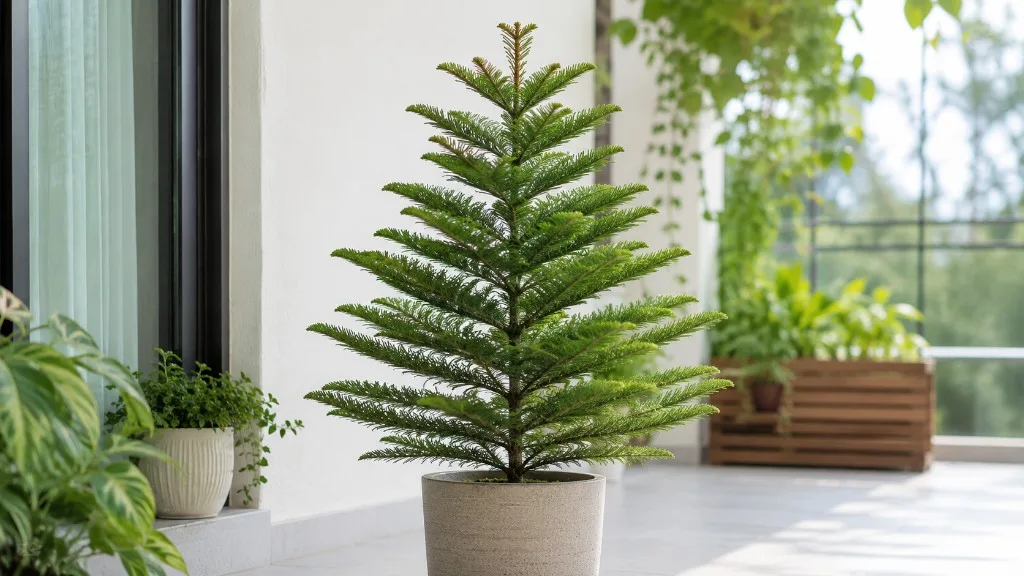
Norfolk Island pine looks like a miniature Christmas tree - symmetrical tiers, soft needles, upright poise - which makes it easy to treat as a decorative accent you can park anywhere the room looks balanced. That instinct fails quickly. Araucaria heterophylla is a subtropical evergreen from bright coastal Pacific islands, not a shade-tolerant parlor fern, and indoors it needs bright indirect light with some direct sun, ideally a few hours of gentle morning sun, to hold its whorled branch structure. Give it a dim corner and the tree does not merely grow slowly; lower branches weaken, droop, and drop, leaving a bare trunk that will not fill back in.
Light is the variable that decides whether your Norfolk Island pine stays a dense, tiered specimen or becomes a lopsided stick with a tuft on top. University of Missouri Integrated Pest Management classifies it in the high-light houseplant group, preferring roughly 500 to 1,000 foot-candles - several hours of strong brightness daily, with direct sun desirable though bright indirect alone can sustain acceptable growth when the total daily dose is high enough. (University of Missouri IPM) Clemson HGIC lists Araucaria heterophylla among indoor plants in that same high-light band. (Clemson HGIC) The practical takeaway is not a vague “medium light” label: place the pot where the canopy receives strong ambient brightness for most of the day, add filtered morning rays when possible, rotate the pot regularly so all sides share exposure, and treat chronic low light as the primary cause of branch drop - not a cosmetic setback you can prune away later.
This guide covers how much light Norfolk Island pine actually needs, why it outgrows dim rooms faster than its slow growth rate suggests, window-by-window placement, direct sun acclimation, the mechanics of low-light branch loss, rotation for even growth, grow-light fallbacks, seasonal adjustments, and the warning signs that tell you to move the pot before structural damage becomes permanent.
How Much Light Norfolk Island Pine Actually Needs
Norfolk Island pine evolved on Norfolk Island and nearby South Pacific outcrops, where coastal winds, humidity, and open bright sky shape a conical tree that can exceed 200 feet in habitat but grows far slower indoors. Illinois Extension notes that as a houseplant it typically adds only three to six inches per year - which makes light mistakes feel invisible until branches fail all at once. (University of Illinois Extension) Slow growth does not mean low demand. It means the plant has little margin to recover from months of insufficient photons.
The usable indoor target is bright indirect light for most of the day, supplemented by some direct sun - commonly one to three hours of early-morning sun through an east window or filtered south/west exposure. Missouri Botanical Garden’s Plant Finder notes that full sun normally produces the most compact, symmetrical indoor growth, though light afternoon shade may be needed to prevent foliage bleach on sensitive specimens. (Missouri Botanical Garden) That phrasing matters: the species wants intensity first, then protection from the harshest midday and afternoon heat load magnified by window glass.
Translating foot-candles into home placement without a meter: put the pot within 12 to 24 inches (30 to 60 cm) of the brightest suitable window, not on a console across the room where your eyes see daylight but the needles receive little usable flux. A spot that reads “bright” to human vision may still fall below the 150 to 1,000 ft-c high-light band Clemson associates with Norfolk Island pine and similar species. (Clemson HGIC) If new whorls form with five to six branches per tier as Missouri IPM describes for healthy specimens, light is likely adequate; if whorls arrive thin or branches droop at the tips, intensity is probably still short. (University of Missouri IPM)
Light also sets the pace for water use, humidity stress, and fertilizer response. A tree in correct bright light dries its pot faster, metabolizes steadily, and tolerates normal indoor humidity better than the same tree starving for photons in a back bedroom. Treat brightness as the throttle for the whole care system - not an isolated aesthetic preference.
The Short Answer for Busy Growers
If you only remember four rules, use these. Default placement: brightest east window, or filtered south/west window with the pot close to glass - bright indirect plus morning sun is the safest starting band. Minimum daily dose: aim for the equivalent of several hours of strong filtered light; chronic dim conditions cause drooping branches and eventual branch drop, especially on lower tiers. Rotate: turn the pot one quarter every one to two weeks so the tree does not lean hard toward one pane. Acclimate: increase exposure gradually over 7 to 14 days when moving from a nursery dim shelf or post-holiday dark corner to a real window - Illinois Extension warns that without acclimation, entire branches may yellow and die after a sudden light drop, and low light produces long, droopy branches with slowed growth. (University of Illinois Extension)
Judge success by new growth, not old damage. Needles that browned last month will not green up again, but fresh whorls should look firm, evenly spaced, and appropriately green for the species within two weeks of corrected placement.
Why Norfolk Island Pine Demands More Light Than It Looks Like
Norfolk Island pine sells as a forgiving holiday living tree - small, cute, temporarily decorated - which creates a false expectation that it behaves like other seasonal décor you can set on a buffet away from windows. Once the tinsel comes off, the same plant is a long-lived subtropical tree with a structural growth habit that depends on consistent light flux to maintain whorled tiers around the trunk. When light is insufficient, the plant does not simply pause; it reallocates energy, weakens branch attachments, and stretches toward the brightest vector in the room.
Missouri IPM describes a telling failure mode in poor light: terminal growth may slow or stop while lateral branches continue, producing a short, broad, asymmetrical plant with weakened tips that droop. (University of Missouri IPM) That morphology is the indoor version of a forest plant reaching for a light gap - except indoors the gap may never arrive, and the tree keeps sacrificing lower tiers that receive the least light.
Subtropical Evergreen, Not a True Pine
Despite the name, Norfolk Island pine is not a Pinaceae pine. It belongs to Araucariaceae, an ancient Southern Hemisphere conifer family. Morphological similarity to northern pines fooled early explorers; care similarity does not follow. True outdoor pines tolerate wide light and cold regimes Norfolk Island pine cannot touch indoors. Your indoor specimen is a container-grown subtropical evergreen that expects bright coastal exposure, stable warmth, and humidity - light is the habitat variable most homes undersupply.
The whorled architecture is the visual feature you bought. Each node should produce a ring of horizontal branches; light fuels that pattern. Lose the pattern on lower tiers and you lose the “mini tree” silhouette permanently, because dormant buds on bare trunk sections do not sprout new whorls the way many broadleaf houseplants back-bud after pruning. Prevention beats rescue.
Holiday placement amplifies the problem. Trees staged as centerpieces far from windows survive on stored reserves through December, then decline in January when reserves exhaust and light remains poor. Illinois Extension also notes that holiday paint on needles blocks photosynthesis and should be removed when possible - a light-limiting insult stacked on an already dim location. (University of Illinois Extension)
Best Window Placement Indoors
Compass labels are starting guesses, not verdicts. A “south window” shaded by a porch roof may deliver less usable light than an open east window. Success means canopy-level brightness for enough hours daily, with protection from hot afternoon glass in summer.
Place the pot so needles, not just the pot rim, sit in the light pool. Norfolk Island pine’s vertical habit means the top whorl often hogs window proximity while lower tiers shade themselves - another reason rotation and sufficient distance from obstructions matter. Avoid blocking the window with sheer furniture, tinted film, or heavy curtains drawn most of the day unless you compensate with grow lights.
Keep the tree away from cold winter glass contact and hot radiator drafts; temperature stress plus light stress compound needle drop. Light quality matters, but a freezing sill or blasting heat vent can mimic scorch and droop even when foot-candles look adequate on paper.
East, South, West, and North Exposures Compared
An east-facing window is the most reliable default for Norfolk Island pine indoors. Morning sun delivers bright, cooler direct rays for one to three hours, then transitions to strong indirect light for the rest of the day - matching the “some direct sun, mostly bright indirect” band without the afternoon heat spike that bleaches needles on west and south glass.
A south-facing window provides the strongest winter sun in the northern hemisphere and is excellent from fall through spring when you keep the pot one to two feet (30 to 60 cm) from the pane. In summer, south glass can overheat needles and bleach the sun-facing side; use a sheer curtain or pull the pot slightly back when crisp tips appear. South works well paired with a supplemental LED in winter when day length shortens.
A west-facing window throws intense afternoon direct sun - high risk for scorch unless filtered by trees, awnings, or curtains. If west is your brightest option, treat late-day rays as optional, not required: bright indirect all day plus morning-only direct elsewhere in the home often outperforms harsh west exposure.
A north-facing window rarely sustains dense tiered growth long-term without supplementation. North may maintain survival green in summer at high latitudes with a very large unobstructed pane, but expect slow whorl development, pale needles, progressive lower-branch weakness, and lean toward any brighter vector. Treat north as grow-light territory unless you measure adequate foot-candles at the canopy.
Morning Sun and Filtered Afternoon Light
The best indoor pattern mirrors outdoor recommendations from Illinois Extension for summer transitions: bright shade with protection from afternoon sun when moved outside, and indoors, morning direct plus filtered afternoon brightness. (University of Illinois Extension) Morning rays build intensity without the combined heat + low-angle glare west panes deliver at the end of the day.
If your home only offers strong afternoon sun, diffuse peak hours rather than eliminating light entirely. A sheer curtain, translucent blind, or positioning the tree where outdoor deciduous shade cuts late rays preserves photon totals while reducing bleach risk. Missouri Botanical Garden’s note on afternoon shade preventing yellow bleach tints is the same principle applied indoors through glass. (Missouri Botanical Garden)
Distance from glass trades intensity for safety. One to two feet back on south/west in summer often yields better net growth than needles pressed against hot pane all day. Move closer in winter when sun angle drops and glass heat moderates.
Direct Sun Tolerance and Acclimation
Norfolk Island pine can handle direct sun indoors when the exposure is gentle, gradual, and matched to acclimated foliage - especially east-window morning sun and filtered south/west exposures. Unacclimated plants moved suddenly from nursery shade or a dim holiday table to harsh midday pane contact will show bleached, crisp, or browning needle faces within days.
Direct sun tolerance is not binary. Specimens grown under strong store lighting or greenhouse shade have soft, light-adapted needles that burn faster than plants hardened slowly over weeks. Juvenile indoor trees often accept more direct morning sun than large specimens abruptly shifted from office fluorescents to a south sill in July.
Outdoor summer placement follows the same logic: Illinois Extension recommends moving plants outdoors after lows stay in the 50s °F, transitioning slowly to bright shade and protecting from afternoon sun - not jumping to all-day patio exposure. (University of Illinois Extension) Reverse that acclimation in fall before cold returns; outdoor-hardened foliage still needs a bright indoor window, not a hallway.
How to Move a Norfolk Island Pine to Brighter Light Safely
Increase exposure in steps over 7 to 14 days, watching new whorls after each step. A practical sequence for a tree coming from a dim spot:
Start at bright indirect only close to the target window but outside direct beam path for three to four days. Introduce one hour of early direct sun - east window or south/west with sheer curtain - and hold if needles remain clean. Add another hour every three to four days until you reach the desired morning direct band or stable filtered all-day brightness. If bleaching or crisp tips appear, hold at the previous level or increase diffusion for a week before advancing again.
Do not simultaneously repot, fertilize heavily, or overhaul watering the week you move light. Stack one variable at a time so droop, yellow, and brown tips remain diagnosable. Light increases usually raise water use - check moisture more often as brightness climbs, but resist the urge to “reward” a moved tree with extra feed before new growth confirms the placement works.
If the tree leans toward the window mid-acclimation, rotate a quarter turn at each watering rather than chasing lean by moving the pot farther from light - lean signals uneven delivery, not excess intensity on the bright side alone.
Low Light Limits and Branch Drop
Low light is the primary long-term failure mode for Norfolk Island pine indoors - worse than occasional underwatering for structural damage because lost lower whorls do not regenerate. The plant may survive in a north room or interior shelf for months, looking merely sparse, until lower branches yellow, droop, and detach, leaving a permanent bare trunk.
Illinois Extension states plainly that in low light conditions, branches become long and droopy and growth slows, and that if plants are not acclimated to lower light after previously brighter conditions, entire branches may yellow and die. (University of Illinois Extension) Missouri IPM adds that in poor light, branch tips weaken and droop, and if fewer than five to six branches develop per whorl, additional light should be provided to restore shape. (University of Missouri IPM)
Low light also couples dangerously with overwatering. A dim tree transpires less, soil stays wet longer, roots stress, and branch loss plus yellowing can look like drought when the mix is actually soggy. Always pair light diagnosis with a root-zone moisture check before assuming underwatering.
Why Lower Branches Drop First in Dim Rooms
Lower whorls receive the least light on a vertical tree - shaded by their own upper tiers and often by furniture, window sills, or adjacent plants. In chronic deficit, the plant sheds expensive-to-maintain tissue it cannot photosynthetically support. Lower branches lose turgor first (droop), then needles yellow or brown, then the branch abscises entirely.
This pattern differs from normal older-needle shed on inner faces, which is lighter and does not remove whole horizontal tiers. Low-light branch drop is structural: entire whorls go missing, the silhouette stair-steps upward, and the classic conical Christmas-tree profile collapses into a pole with a canopy pom-pom.
Recovery has limits. Improving light preserves remaining whorls and supports healthier new top growth, but bare trunk sections stay bare. No amount of fertilizer or pruning summons replacement branches from dormant buds the way a ficus might back-bud. If multiple lower tiers are already gone, your goal shifts from restoration to salvaging upper symmetry - and honestly evaluating whether a younger replacement plant in a brighter window is the better display.
Rotating Your Norfolk Island Pine for Even Growth
Norfolk Island pine grows toward the brightest vector unless light arrives evenly from all sides - rare indoors with single-window rooms. Without rotation, one face develops dense, dark green needles while the opposite side thins; the trunk leans, upper whorls cock off-center, and the holiday-tree symmetry you wanted tilts permanently unless corrected early.
Rotate the pot one quarter turn clockwise or counterclockwise every one to two weeks - at a consistent event like watering day so you do not forget. Quarter turns beat half turns weekly for gradual balance; large 180° spins can shock the previously shaded face with sudden intense light and cause one-sided bleach. The goal is incremental sharing, not instant equality.
Rotation complements - does not replace - sufficient total light. Spinning a tree in a dim hallway still produces a symmetrically sparse plant. Fix intensity first, then use rotation to maintain tier geometry.
If lean is already pronounced, stake loosely only after light improves and rotation runs for several cycles. Staking in ongoing dim light props up structurally weak branches without solving energy deficit. Combine rotation with occasional dusting of needle surfaces; indoor dust cuts photosynthetic efficiency measurably on broad surfaces and fine needles alike, effectively lowering light another few percent.
Grow Lights When Windows Fall Short
When the brightest window still cannot deliver enough daily flux - common in north exposures, winter at mid and high latitudes, office cubicles, and post-holiday interior placements - a full-spectrum LED grow light is the most reliable upgrade. Norfolk Island pine responds well to artificial supplementation when spectrum and duration mimic long tropical days.
Clemson HGIC notes that about 100 foot-candles for 12 hours maintains basic quality for a year, but at least 200 foot-candles for 12 hours is necessary before foliage plants show benefit from fertilization - underscoring that “survival dim” is not “growth bright.” (Clemson HGIC) Norfolk Island pine sits at the high end of that table, so supplementation targets the 500+ ft-c band at the canopy when windows fall short, not a dim desk lamp for ambiance.
Fixture Height, Hours, and Spectrum
A workable starting setup:
Position a horticultural full-spectrum white LED 12 to 24 inches (30 to 60 cm) above the top whorl - close enough for intensity, far enough to avoid leaf heat on small tabletop trees. Run the lamp 12 to 14 hours daily on a timer to approximate consistent tropical day length through dark winters. Choose 5000–6500 K white full-spectrum fixtures rather than decorative warm bulbs optimized for human lumens, not photosynthesis.
Combine overhead LED with the brightest window available when possible so the tree receives multidirectional light and does not lean exclusively toward either source. If lean persists toward the window, slightly raise lamp intensity or lower fixture height on the window-opposite side rather than abandoning rotation.
Adjust using new whorl quality after two weeks. If internodes stretch and new needles pale, lower the fixture 2 inches (5 cm) or add one hour to the timer - not both simultaneously. If sun-facing needle tips bleach only under the lamp, raise the fixture 2 to 3 inches or reduce hours slightly. Enclosed shelves heat faster than open rooms; place your hand at canopy level mid-cycle to catch excess warmth early.
Missouri IPM notes Norfolk Island pine makes an excellent living Christmas tree but warns against hot incandescent light strings that burn needles - LED holiday lights stay cool and add negligible usable PAR compared to a real grow fixture. (University of Missouri IPM) Treat decorative strings as ornamentation, not light therapy.
Seasonal Light Changes Indoors and Out
Indoor light is not static. Winter drops sun angle, day length, and window intensity even on south panes; summer magnifies heat through glass. Norfolk Island pine does not hibernate visibly - Illinois Extension notes limited winter growth and reduced fertilizer need - but light deficit in dark months still drives droop and branch weakness if you leave the tree in the same distant summer position.
From late fall through early spring, move the pot closer to the glass on the brightest legal window, remove obstructions, clean the pane, and start or extend grow-light hours before whorl thinning begins - not after bare trunk appears. A south window that was too hot six inches from the glass in August may be perfect four inches away in February.
In summer, watch for heat stress on south and west sills: bleach, sudden crisp tips, and midday wilt on moist soil signal leaf temperature load, not always thirst. Pull back slightly, diffuse afternoon rays, or shift to east if scorch repeats despite adequate watering.
Outdoor summer vacations for the tree are optional, not required. If you move pots outside after frost risk passes, follow Illinois Extension: slow transition, bright shade, afternoon protection, and return indoors before lows drift into the 50s °F again. (University of Illinois Extension) Outdoor shade still exceeds many indoor rooms - but direct outdoor afternoon sun without acclimation burns faster than the same orientation through filtered glass.
Warning Signs Your Norfolk Island Pine Has the Wrong Light
Norfolk Island pine reports light problems on new whorls and branch attachment strength before older needle cosmetic issues resolve. Make one placement change, then wait 10 to 14 days before also changing water, fertilizer, or pot size - overlapping edits make droop, yellow, and brown tips impossible to assign correctly.
Too Little Light - Stretch, Lean, and Branch Loss
Hard lean toward one window or lamp means directional starvation - rotate and increase total flux, not just stake. Long, droopy branch arms with increased space between whorls match Illinois Extension and Missouri IPM descriptions of low-light morphology. (University of Illinois Extension) Thin whorls with fewer than five branches signal insufficient energy for normal tier construction. Pale, soft new needles on the top whorl while lower branches yellow and drop indicate chronic deficit progressing upward. Extremely slow or stalled vertical growth in a young tree often traces to dim rooms misread as “slow species.” Yellowing entire branches after a sudden move to darker location without acclimation is light shock - restore brightness gradually rather than accepting loss as normal shed.
Fixes: move closer to glass, shift to east or filtered south/west, add or intensify grow lights, rotate quarterly habits into weekly quarter turns, and stop expecting lost lower whorls to return. If soil stays wet in the same dim spot, reduce watering frequency in tandem with any light fix.
Too Much Light - Scorched Needles and Brown Tips
Bleached yellow-white patches on sun-facing needle surfaces indicate photobleach - reduce intensity before reducing total day length when possible. Crisp brown tips appearing suddenly after a move to unfiltered south/west suggest scorch or heat, especially in summer. One-sided damage only on the pane-facing side confirms directional excess, not root disease. Midday curling or droop on moist soil during peak sun can signal leaf heat load at glass contact. Sudden widespread browning after outdoor placement in full afternoon sun is acclimation failure - retreat to bright shade and harden slowly.
Fixes: sheer curtain, pull pot back from hot glass, favor east over west, avoid dark containers on radiant sills, and acclimate over 7–14 days when increasing exposure. Remove holiday paint if present so needles can use corrected light. (University of Illinois Extension)
Conclusion
Norfolk Island pine light needs boil down to a band, not a buzzword: bright indirect light with some direct sun indoors, best delivered as gentle morning rays plus strong ambient brightness through the rest of the day. The species belongs in the high-light houseplant class - roughly 500 to 1,000 foot-candles at the canopy - and punishes dim rooms with drooping branches, thin whorls, and irreversible lower-tier drop long before the plant actually dies. Rotate the pot a quarter turn every one to two weeks so symmetrical tier structure survives single-window geometry, and acclimate any major exposure change over 7 to 14 days to avoid yellowing whole branches or scorching soft needles.
Read new whorls, not nostalgia for last year’s silhouette. Move intensity in steps, pair brighter light with adjusted watering checks, and add a 12–14 hour full-spectrum LED when north windows or winter photoperiod cannot carry the tree. Get the light band right and Norfolk Island pine remains one of the most architectural indoor evergreens you can grow - a slow, steady conical tree that earns its floor space for years. Miss the band and even perfect soil and humidity produce a leaning pole with missing branches that no fertilizer will reconstruct.
When to use this page vs other Norfolk Island Pine guides
- Norfolk Island Pine overview - Start here for whole-plant context before deep-diving this topic.
- Norfolk Island Pine problems hub - Jump to symptom-specific fix guides when this care topic does not resolve the issue.
- Leggy Growth on Norfolk Island Pine - Escalate here when light adjustments are not enough.
Related Norfolk Island Pine guides
- Norfolk Island Pine overview
- Norfolk Island Pine watering
- Norfolk Island Pine soil
- Norfolk Island Pine propagation
- Norfolk Island Pine fertilizer
- Norfolk Island Pine repotting
- Leggy Growth on Norfolk Island Pine
- Norfolk Island Pine problems
Related tool
Try the Plant Problem Diagnosis Tool with norfolk-island-pine pre-selected to estimate needs for your setup.