Overfertilization on Mint: Causes, Checks & Fixes
Quick answer
If mint turns dark, soft, and less aromatic after feeding, assume overfertilization first. Flush the pot deeply, discard runoff, and pause fertilizer until healthy new growth returns.
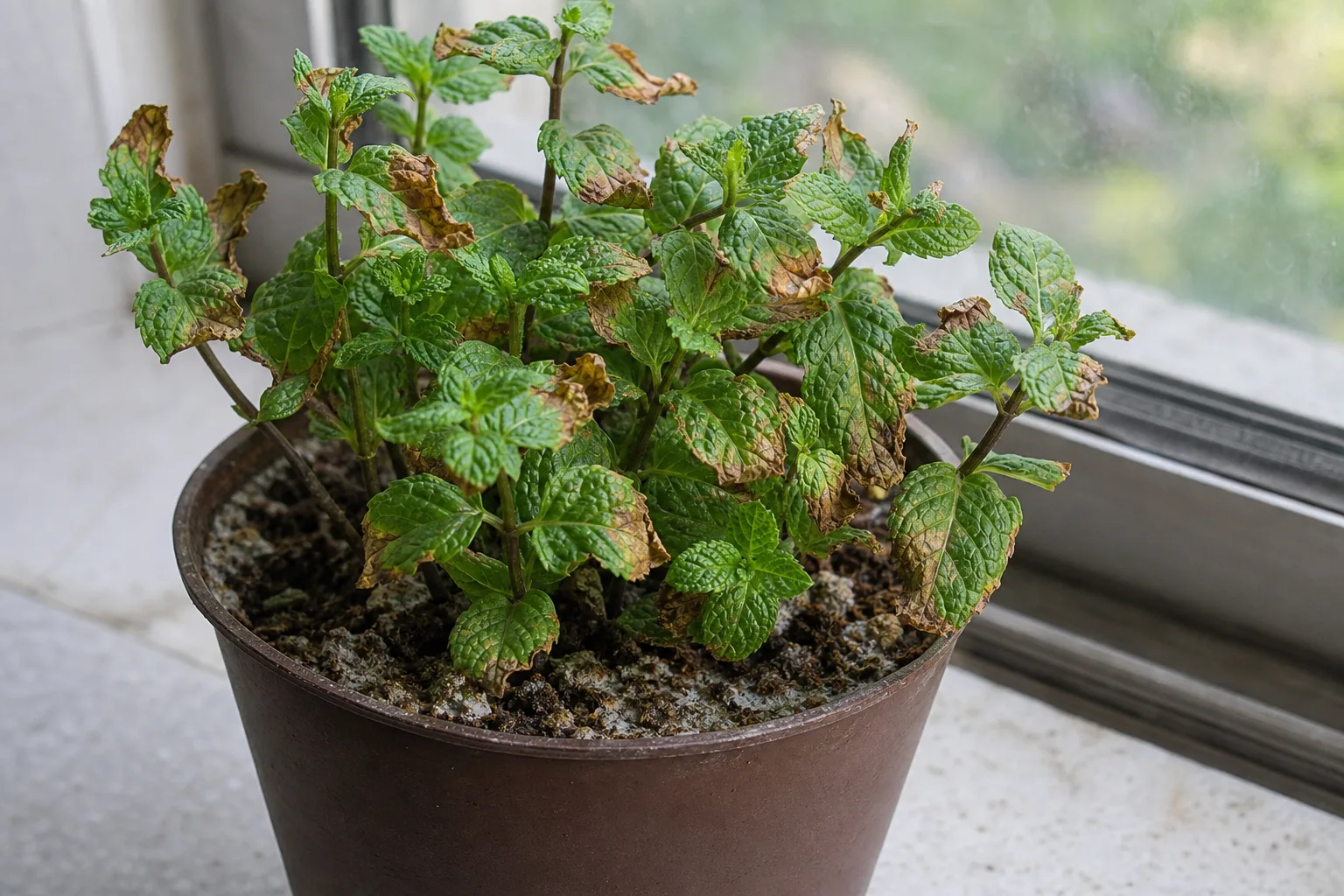
Overfertilization on Mint: Causes, Checks & Fixes
This guide covers overfertilization on Mint. See also the general Overfertilization guide, watering, and light pages for this plant.
Overfertilization on Mint: Causes, Checks & Fixes
Quick answer
If mint turns dark, soft, and less aromatic after feeding, treat overfertilization as the likely cause first. Excess fertilizer salts can injure roots and make water uptake harder in containers, especially in small pots that dry and concentrate salts quickly (Penn State Extension). First step: flush the pot deeply with plain water and stop fertilizer until healthy new growth returns.
Mint (Mentha spp.) is a vigorous culinary herb, but that does not mean it benefits from heavy feeding. Too much nitrogen can push soft growth that is less resilient and more disease-prone (RHS).
What overfertilization looks like on mint
Typical mint overfeeding signs:
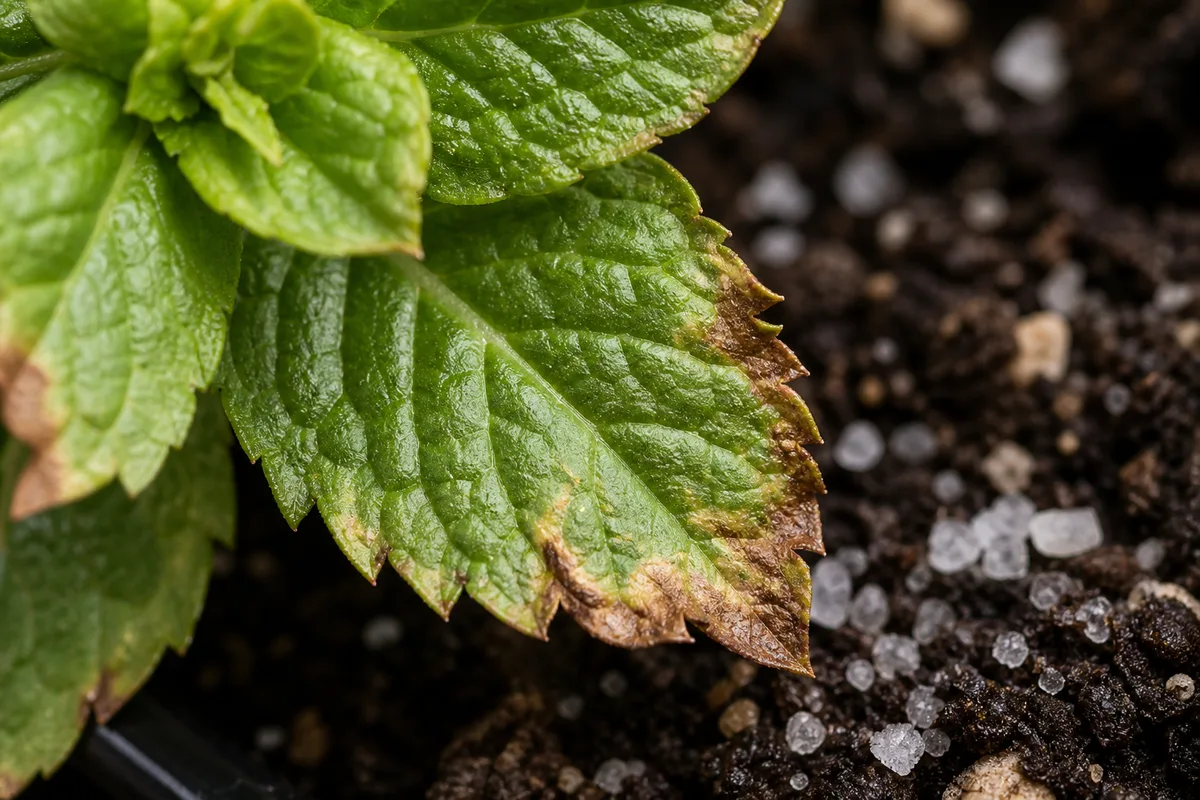
Overfertilization symptoms on Mint - compare with healthy tissue on the same plant.
- very dark, soft, fast leafy growth with weaker scent or flavor
- brown or crispy leaf tips and margins
- white or tan crust on potting mix surface or pot rim
- wilt despite moist mix (salt-stressed roots cannot pull water efficiently)
- slower, smaller new shoots after a fertilizer spike
Salt burn symptoms overlap with other mint problems, so use a diagnosis sequence before taking more action.
Why mint gets overfertilized
1) Full-strength feeding in small containers
Container herbs are commonly fed too strongly or too often. Extension guidance for herbs recommends diluted liquid feeding, not heavy doses (UMN Extension).
2) Double-feeding (slow-release + liquid fertilizer)
Combining release types can stack salts faster than mint can use nutrients, especially indoors or in low-light periods (Penn State Extension).
3) Frequent watering without intentional leaching
Every watering leaves some dissolved minerals and fertilizer salts behind after evaporation. If pots are watered lightly and never flushed, salts accumulate in root zones (UC ANR).
4) Fertilizing stressed mint
Feeding mint that is root-bound, waterlogged, heat-stressed, or recently transplanted can worsen injury rather than boost growth.
How to confirm the cause (step-by-step)
- Check timing first. Symptoms that began within days of feeding strongly support overfertilization.
- Review what you applied. Note concentration, frequency, and whether a slow-release product is already in the mix.
- Inspect surface clues. White or tan crust on soil or pot edge points to salt accumulation (Washington State University Hortsense).
- Check moisture pattern. Wilt on wet mix after recent feeding suggests root salt stress, not just underwatering on Mint.
- Inspect roots if symptoms are severe. Healthy roots are firm and pale; fertilizer-burned tips often look brown and weak.
- Rule out the nearest lookalikes. Nitrogen deficiency usually causes paler older leaves first, while overfeeding often creates darker, softer top growth before edge burn.
First fix to try
Flush the pot thoroughly with plain water until generous runoff exits the drainage holes, discard runoff, then repeat once after a short interval to remove more salts (Penn State Extension). If there is visible crust, remove the top layer before flushing (UC ANR).
Then pause fertilizer until:
- new growth is normal in color and texture
- no new tip burn appears
- scent strength improves on fresh leaves
Step-by-step recovery by severity
Mild case: edge burn but active growth continues
- Flush as above.
- Remove only fully dead tissue.
- Keep bright light and stable moisture.
- Reassess in 10-14 days before feeding.
Moderate case: weak scent + soft, floppy growth
- Flush twice as described.
- Increase light quality and airflow.
- Harvest lightly to rebalance top growth.
- Resume fertilizer only at half strength, and only in active growth windows (UMN Extension).
Severe case: wilt on moist mix, heavy crust, root damage
- Flush immediately.
- If decline continues, repot into fresh mix with no additional fertilizer.
- Trim clearly dead roots and stems.
- Hold fertilizer for 3-4 weeks, then restart gently if recovery begins.
Recovery timeline
- First 3-5 days: wilting should ease if salt load drops.
- 1-2 weeks: symptom spread should stop; new tips begin cleaner.
- 2-4 weeks: aroma and flavor on new leaves should improve.
- Old burned tissue: usually stays damaged; judge recovery by new growth, not old margins.
Lookalikes to rule out
| Problem | Typical clue | Key difference from overfertilization |
|---|---|---|
| Nitrogen deficiency | Older leaves turn pale first | Overfeeding often starts with dark soft growth and later tip burn |
| Drought stress | Dry, lightweight pot and crisp wilt | Salt injury can wilt even when mix is moist |
| root rot on Mint | Wet, sour mix and collapsing stems | Overfert can coexist, but root rot has persistent waterlogging pattern |
| Sun scorch | Localized bleached patches after strong sun | Fertilizer injury follows feeding history and salt residue |
If your main signs are pale lower leaves without a feeding spike, review /plants/mint/plant-problems/nitrogen-deficiency/. If roots are failing in wet mix, check /plants/mint/plant-problems/root-rot/. For overlapping tip-burn patterns, compare /plants/mint/plant-problems/brown-tips/.
What not to do
- Do not add more fertilizer to “correct” stress.
- Do not use lawn fertilizer on edible container mint.
- Do not keep the pot sitting in drained runoff after flushing.
- Do not assume old burned edges will green up.
Mint care cross-check after recovery
Once growth normalizes:
- keep regular harvest/pinching instead of chasing fast soft growth with nitrogen
- feed only when actively growing and only at reduced concentration
- water thoroughly, then let excess drain
- periodically leach containers to reduce salt carryover (UC ANR)
For routine feeding guidance, see /plants/mint/fertilizer/ and the main plant page /plants/mint/.
How to prevent repeat overfertilization
Use a conservative schedule: half-strength liquid fertilizer every few weeks during active growth, then reduce or stop in low-light slow-growth periods (UMN Extension). Prefer stable moisture, pot drainage, and regular harvest over aggressive feeding for flavor-focused mint.
When to worry
Escalate quickly if:
- mint keeps wilting 48 hours after flushing
- roots are extensively brown/mushy
- stems blacken at the base
- no healthy new shoots appear after 2-3 weeks
At that point, propagation from healthy tips or replacement can be faster than prolonged rescue.
Harvest and food-safety note
Avoid consuming leaves from plants exposed to non-edible or lawn fertilizers. On edible-safe fertilizer programs, discard badly burned tissue and harvest only healthy new growth once the plant stabilizes. Prioritize recovery quality over immediate heavy harvest.
When to use this page vs other Mint guides
- Mint watering guide - Use for routine moisture checks before assuming overfertilization is the main issue.
- Mint problems hub - Browse all 40 common issues on this species.
- Brown Tips on Mint - Different entry point when symptoms overlap with overfertilization.
- Root Rot on Mint - Different entry point when symptoms overlap with overfertilization.