Yellow Leaves on Hoya: Causes, Checks & Fixes
Quick answer
Yellow leaves on Hoya are a symptom, not a diagnosis. On wet mix, soft yellow lower leaves usually mean overwatered epiphytic roots-not drought. First step: stop watering, check moisture at the top half of the mix, and lift the pot. One fading leaf at an old proximal node on an otherwise firm vine is often normal senescence.
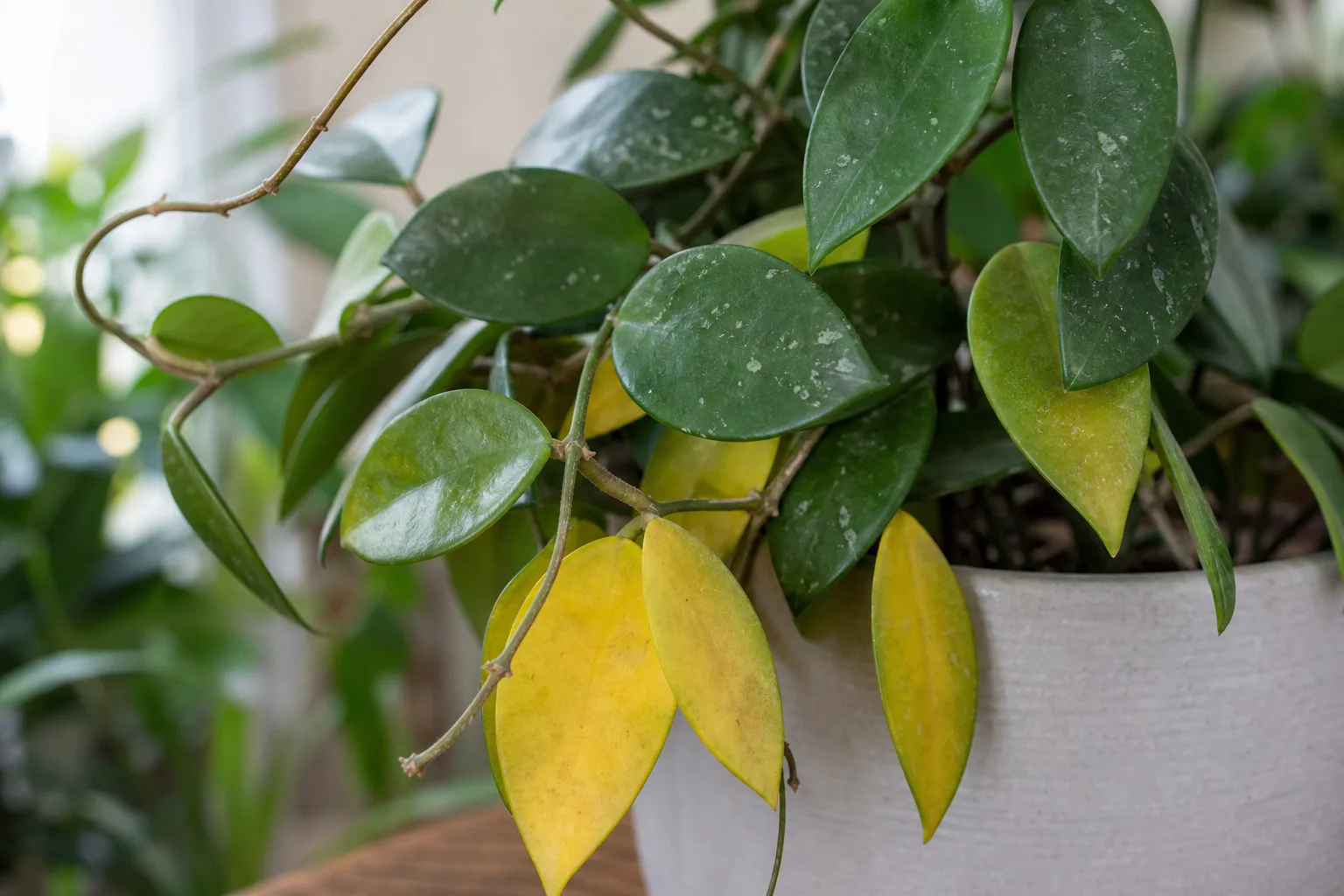
Yellow Leaves on Hoya: Causes, Checks & Fixes
This guide covers yellow leaves on Hoya. See also the general Yellow Leaves guide, watering, and light pages for this plant.
Yellow Leaves on Hoya: Causes, Checks & Fixes
Quick answer
Yellow leaves on Hoya (Hoya spp., wax plant) are a symptom, not a diagnosis. On a vining epiphyte with thick waxy foliage, yellowing usually traces to how moisture, light, and root health interact-not a single missing nutrient.
The two patterns owners confuse most:
- Stress yellowing: multiple soft yellow leaves on persistently wet mix, often with limp waxy foliage, stalled growth, or dropped buds
- Normal aging: one or two oldest leaves at proximal nodes along a long trailing vine fading over months while apical nodes keep pushing new leaves on moderately dry, firm soil
First step: stop watering and confirm moisture at depth. Lift the pot (heavy and staying heavy is a red flag), push a finger or skewer into the top half of the mix, and note whether soil clings cool and dark for many days. Do not water because leaves look thirsty on wet soil-that is the classic wilt-on-wet-soil trap on epiphytic roots. If only one basal leaf on a firm vine is fading slowly, remove it once fully yellow and watch new nodes-not the old leaf color.
For the full wet-dry rhythm, see the Hoya watering guide. To separate rot from drought, see overwatering on Hoya and underwatering on Hoya.
What yellow leaves look like on Hoya
Hoya stores water in thick, waxy leaves along vining stems with paired leaves at each node. Yellowing shows up in patterns along the vine, not as a uniform rosette fade from the bottom crown.
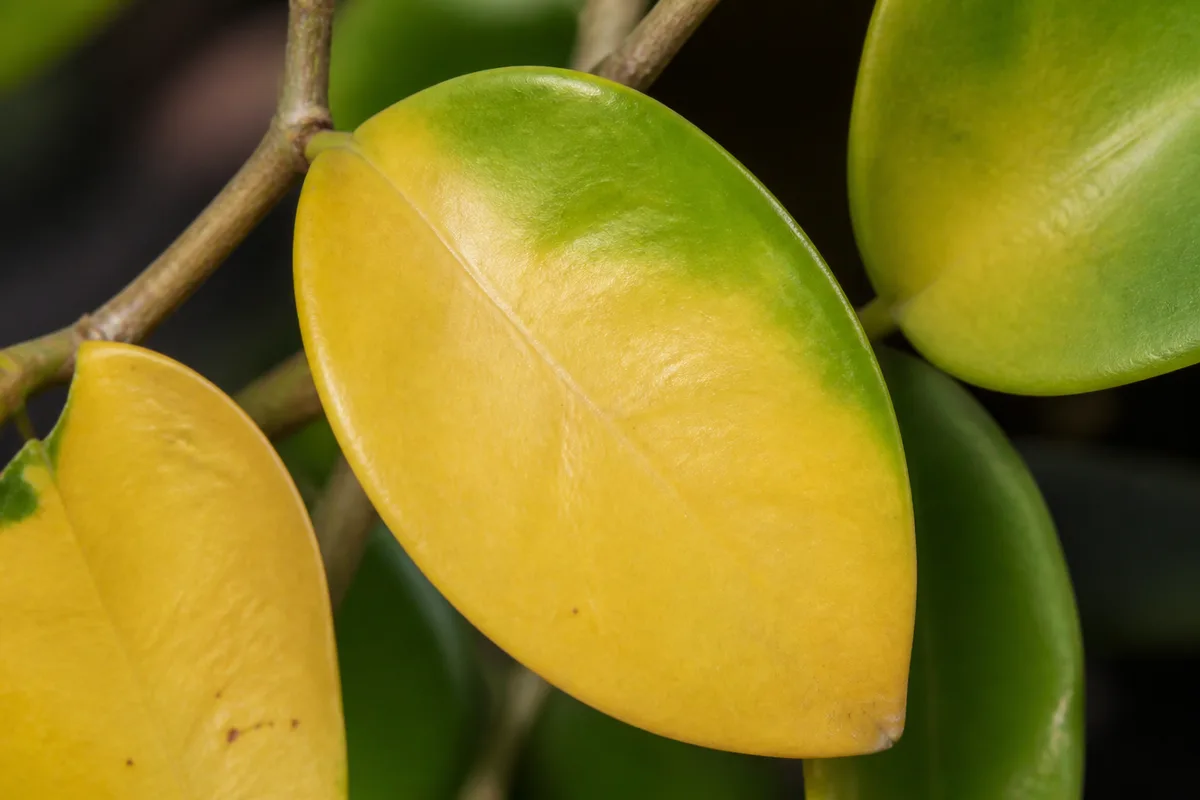
Yellow Leaves symptoms on Hoya - compare with healthy tissue on the same plant.
Normal vine-node aging vs. stress yellowing
On a mature trailing specimen, the oldest leaf pair at a proximal node-often near the soil line or at the base of a long bare whip-may yellow uniformly over weeks to months, then drop cleanly. Apical nodes and newer sections along the same vine stay green and firm. Soil dries appropriately between drinks. That one-leaf or two-leaf pattern at an old node is normal senescence on a long-lived wax plant.
Stress yellowing looks different: multiple leaves yellow at once, often starting on lower or inner sections of the cascade while the mix stays damp. Leaves feel soft and limp rather than papery-crisp. New growth may stall. Flower buds may yellow and fall before opening. The vine can look dehydrated while the pot feels heavy-because damaged roots cannot move water even when surrounded by moisture.
Overwatering, low light, and underwatering patterns
| Pattern | Soil and pot | Leaf feel and placement | Likely cause |
|---|---|---|---|
| Multiple soft yellow lower leaves; limp waxy foliage; bud blast | Heavy pot; top half stays cool and damp for days | Soft, not crispy; lower and inner leaves first | Overwatering / root stress |
| Pale yellow upper leaves; long bare internodes; no flowers for years | Moderate moisture; slow dry-down in dim room | Firm but light green or faded; stretch toward window | Insufficient light |
| Thin, wrinkled leaves; one or two yellow leaves at a time | Light pot; dusty dry mix throughout | Papery or rubbery; not mushy | Underwatering |
| One yellow leaf at old proximal node; firm vine otherwise | Normal dry-down; pot weight moderate | Uniform yellow on a single aged leaf pair | Normal node senescence |
Variegated cultivars such as Hoya carnosa ‘Krimson Queen’ show stress sooner-white sections lack chlorophyll, so the plant has less photosynthetic surface and yellows faster when roots or light fail.
Why Hoya gets yellow leaves
Epiphytic wet-dry cycle and root stress
In the wild, many hoyas grow as epiphytes on tree branches across tropical Asia, Australia, and the Pacific-roots anchor to bark, absorb rain in bursts, then dry in open air. Indoor culture fails when that rhythm breaks: dense peat-heavy mix, oversized pots, cachepots holding runoff, or calendar watering while the core of the mix stays wet.
Iowa State Extension identifies overwatering in poorly drained potting soil as the quickest path to root decline. Epiphytic roots need oxygen in the pore spaces. Constant saturation suffocates feeder roots, stops nutrient and water uptake, and triggers chlorophyll loss-yellow leaves follow. The cruel paradox: an overwatered Hoya often presents exactly like a thirsty one, with limp, puckered, or wrinkled foliage on wet soil, because dead roots cannot transport water upward.
Thick succulent-style leaves buffer drought-so owners miss early root failure until several lower leaves yellow in a cluster or buds abort.
Low light, cold drafts, and winter slowdown
Hoya in dim placement uses water slowly. The same watering schedule that worked in a bright window leaves soil wet for two weeks or more, setting up the same yellowing pattern as literal overwatering. Low light produces pale, stretched growth and poor flowering; paired with wet mix, lower leaves yellow in groups.
Winter compounds the problem. Cooler temperatures and shorter days reduce transpiration. Owners who keep summer frequency in a heated but dim room create cold, soggy roots-lower foliage yellows in clusters, peduncles may abort, and new growth waits for spring. This is cultural stress, not a mysterious seasonal disease.
Species variation matters at the margins: H. carnosa and H. obovata with thick leaves mask thirst longer; H. linearis and other thin-leaf types show yellowing and wilting sooner on both wet and dry extremes.
How to confirm the cause
Work through these checks in order before changing fertilizer, Hoya repotting guide, or pruning vines:
- Wet-soil vs. dry-soil pairing - Push a skewer into the top half of the mix. Cool, clinging soil that never dries plus soft yellow leaves points to overwatering. Dusty dry mix throughout plus thin wrinkled leaves points to underwatering.
- Pot weight test - Lift the pot after watering once to learn heavy; compare daily. A pot that stays heavy ten or more days after one drink on a moderate-sized vine signals slow evaporation or excess retention.
- Leaf count and position - One yellow leaf at an old proximal node on a firm vine with appropriate dry-down = aging. Five or more yellow leaves on damp mix = urgent root stress.
- Apical growth - New leaves and nodes still emerging at vine tips while one basal leaf fades supports aging. Widespread yellowing with stalled apical buds supports root or light failure.
- Light at the canopy - Hold your hand at the top of the vine on a bright day. Faint shadow plus pale upper leaves and long internodes implicate insufficient light overlapping with slow dry-down.
- Stem base and smell - Soft, darkening tissue where vines meet soil, or a sour odor when you slide the plant out, escalates beyond yellow leaves alone-inspect roots the same day.
- Bud and peduncle history - Recent bud yellowing and drop after heavy winter watering or a cachepot shift confirms moisture stress tied to roots.
Top-half dry check, pot weight, and root inspection
When wet soil pairs with multiple yellow leaves, unpot and inspect roots before the next watering. Healthy Hoya roots are firm and pale cream or white. Brown, black, slimy, or hollow tissue means advancing decline-see root rot on Hoya for trim-and-repot protocol.
If roots are still mostly firm with only minor discoloration, a dry-down pause may suffice: stop watering, move to brighter indirect light if the plant was dim, empty cachepot water, and let the mix approach dry throughout before one cautious deep soak.
The first fix to try
Stop watering and confirm whether the mix is actually wet at depth-not just whether leaves look thirsty.
That single pause breaks the overwatering feedback loop where owners see limp waxy foliage and add more water to an already saturated epiphytic root zone. Lift the pot, check the top half of the mix, and read the leaf-soil pair together:
- Wet mix + soft yellow leaves → dry-down pause first; inspect roots if yellowing spreads or stems soften
- Dry mix + wrinkled firm leaves → one thorough soak, then resume top-half dry-down per the watering guide
- One aging leaf on firm vine + appropriate dry-down → remove the spent leaf; no watering change needed
- Pale upper leaves + long internodes + slow dry-down → correct light as the primary fix per not enough light; adjust water after placement stabilizes
Do not fertilize, repot, or prune peduncles on the same day you diagnose yellow leaves. Nutrients and relocation stack stress on roots that may already be oxygen-starved.
Cause-specific branches
Overwatering branch: After dry-down, resume watering only when the top half of the mix has dried-often letting the entire root zone approach dry in plastic pots or winter rest. Clemson Extension recommends allowing soil to dry completely between waterings and using the pot weight test to learn the difference between wet and dry.
Low-light branch: Move to Hoya light guide within one to three feet of an east window or filtered south or west exposure-or add supplemental LED-then hold placement stable fourteen days before judging new growth.
Aging-only branch: Snap off fully yellow spent leaves at the node to reduce pest hiding spots. Watch apical nodes for new leaves over the next month.
Recovery timeline and what to watch
Fully yellow leaves do not re-green-they drop or are removed. Judge recovery by new growth at apical nodes, firm waxy foliage on corrected care, and stable dry-down rhythm within two to three weeks after the stressor is fixed during active spring or summer growth.
Improving signs:
- New leaves emerging along vines within fourteen to twenty-one days after dry-down or light correction
- Pot weight cycling predictably between heavy-after-soak and light-before-next-drink
- Yellowing stops spreading; only the oldest proximal leaf still fading
Worsening signs:
- Additional leaves yellowing daily while mix stays wet
- Stems softening at the soil line
- Sour smell or mushy roots on inspection
- Apical buds shriveling after a brief pause
Winter corrections may stall until longer days return-patience beats repeated watering or relocation.
Mistakes to avoid
Do not water because leaves wrinkle on wet soil-that deepens root failure on epiphytic vines. Do not assume yellow leaves need fertilizer; salt buildup from overfeeding in dim, wet conditions can also yellow foliage, and stressed roots cannot use nutrients safely.
Avoid surface-only moisture checks on thick-leaf Hoya in deep pots-the top may look dry while the core stays cold and damp. Do not repot on day one unless roots are clearly mushy; dry-down alone resolves mild cases. Never prune peduncles because the plant looks stressed-those spurs rebloom for years.
Do not confuse one basal yellow leaf on a long healthy vine with cluster yellowing on a heavy wet pot-the first is often normal senescence at a proximal node; the second is urgent root stress.
How to prevent yellow leaves next time
Run the epiphytic cycle from the Hoya watering guide: let the mix dry down, verify with touch and pot weight, water deeply, drain completely, repeat. Use chunky mix with orchid bark and perlite in a pot with open drainage-wax plants prefer fast-draining substrate that does not stay waterlogged.
Keep bright indirect light so the vine transpires between drinks; dim corners slow dry-down and invite the same yellowing as literal overwatering. In winter, stretch intervals and check moisture at depth. Remove spent proximal leaves promptly. Treat early wet-soil warnings on the overwatering page before rot is confirmed.
When to worry
Act the same day if:
- Multiple leaves yellowing rapidly while mix stays wet
- Stems soften or darken at the soil line
- Roots are mostly mushy when you unpot
- Sour smell from the mix
- Leaves stay limp seventy-two hours after you stopped watering on wet soil
Those patterns point to advancing root decline-not a single aging leaf at an old node. See root rot on Hoya for rescue steps. For genus biology and long-term care context, see the Hoya overview.
Conclusion
Yellow leaves on Hoya separate into two very different stories. One fading leaf at an old proximal node on a firm trailing vine with healthy dry-down is often normal wax-plant senescence. Multiple soft yellow leaves on heavy wet mix-especially with limp waxy foliage that looks thirsty-is usually epiphytic root stress, not drought. The first fix is always the same: read the soil at depth, stop watering when wet, and do not fertilize stressed roots. Correct light if the vine stretches in a dim corner, inspect roots when cluster yellowing persists, and measure recovery by new apical growth-not old leaf color. Get the wet-dry cycle and brightness right, and a Hoya sheds spent nodes quietly while new waxy leaves keep climbing.
Related guides: watering, overwatering, underwatering, root rot, not enough light, wilting, drooping leaves, overview.
When to use this page vs other Hoya guides
- Hoya watering guide - Use for routine moisture checks before assuming yellow leaves is the main issue.
- Hoya problems hub - Browse all 17 common issues on this species.
- Overwatering on Hoya - Different entry point when symptoms overlap with yellow leaves.
- Underwatering on Hoya - Different entry point when symptoms overlap with yellow leaves.
- Not Enough Light on Hoya - Different entry point when symptoms overlap with yellow leaves.