Root Rot on Geranium: Causes, Checks & Fixes
Quick answer
Root rot on geranium (Pelargonium) usually starts when soggy mix suffocates drought-adapted roots-leaves wilt on wet soil while the stem base softens or blackens. First step: stop watering, lift the pot, and check whether the top inch is still damp and the crown feels firm before you repot.
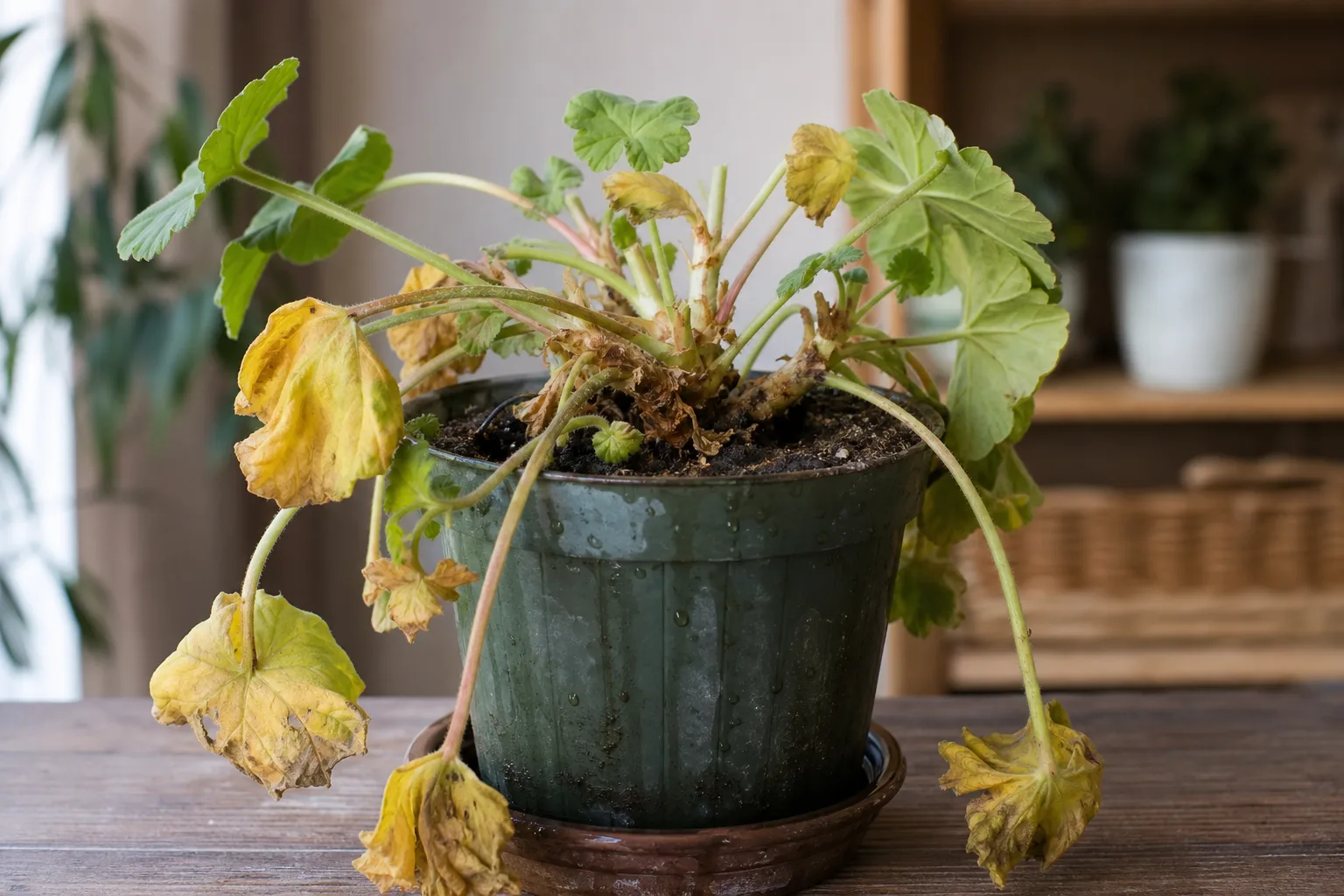
Root Rot on Geranium: Causes, Checks & Fixes
This guide covers root rot on Geranium. See also the general Root Rot guide, watering, and light pages for this plant.
Root Rot on Geranium: Causes, Checks & Fixes
Quick answer
Root rot on geranium-botanically Pelargonium-is almost always a watering and drainage failure, not a random fungus attacking a healthy plant. These South African semi-succulents want a full soak followed by a real dry-down; when mix stays damp for days, roots lose oxygen, Pythium invades, and you get the paradox that confuses every owner: limp leaves on soil that still feels cool and heavy.
First step: stop watering immediately. Lift the pot, push your finger into the top inch of mix, and press gently on the stem base where woody tissue meets soil. Dry surface with a light pot and firm crown may need only a measured soak-not emergency surgery. Wet heavy mix with soft or blackening stem tissue means confirmed trouble: unpot, inspect roots, and follow the numbered rescue below.
For prevention rhythm and daily checks, see the geranium watering guide. For fast whole-plant collapse without rot, see wilting on geranium.
Root rot vs. other geranium problems - why wilt on wet soil matters
Pelargoniums store water in thick woody stems and tolerate brief dryness better than constant moisture. That physiology is why wet-soil wilt is the signature rot clue: damaged roots cannot transport water, so petioles hang even though the pot never lightened.
Do not confuse this with:
- Drought limp - light pot, dry top inch, firm stems; perks after one thorough soak
- Afternoon heat wilt - temporary sag in full sun that recovers by evening without extra water
- Cold-draft stress - sudden droop after a night below about 55°F (13°C) near glass or HVAC vents
- Edema - corky water blisters on ivy-type leaves from fluctuating moisture in cool cloudy weather
If wilt persists overnight on heavy wet mix, treat root stress as the lead diagnosis-not thirst. Pouring more water accelerates crown rot and blackleg.
What root rot and blackleg look like on Pelargonium
Symptoms stack gradually on zonal (Pelargonium × hortorum), ivy (P. peltatum), and scented types, though ivy geraniums also show edema blisters when cool nights meet wet soil.
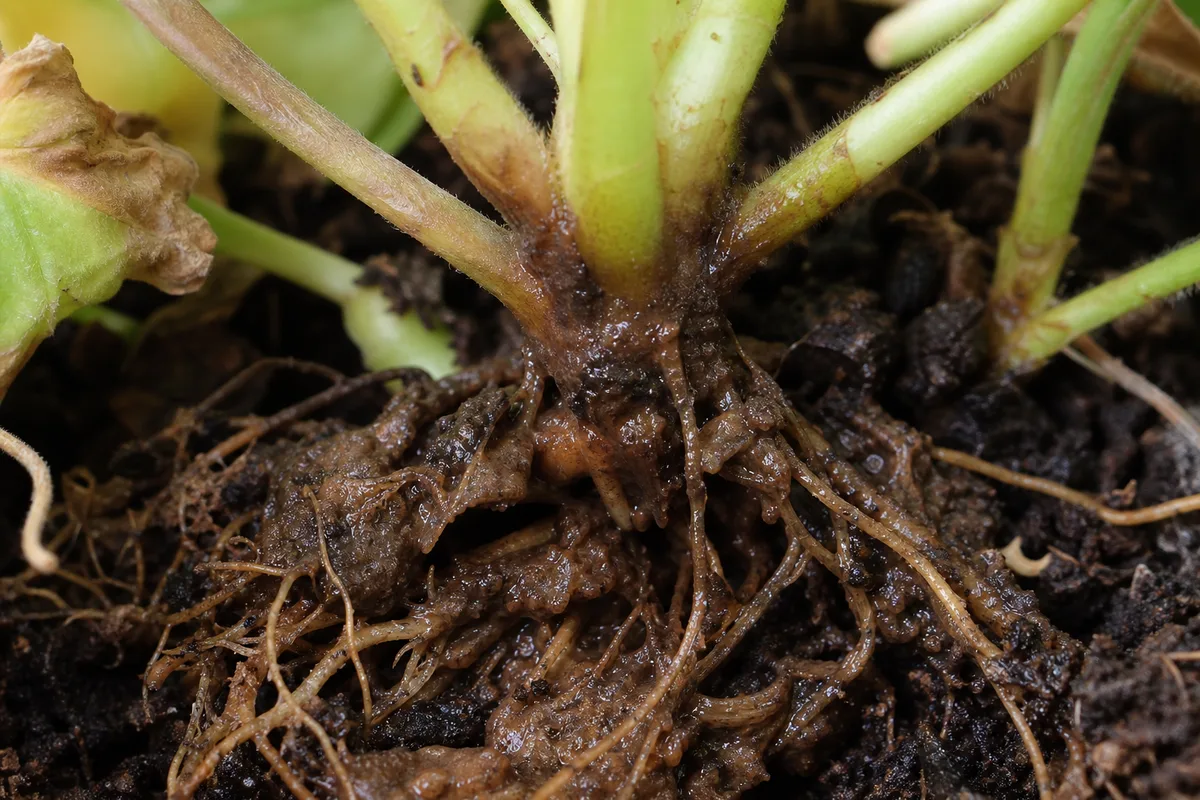
Root Rot symptoms on Geranium - compare with healthy tissue on the same plant.
Early signs
- Yellow lower leaves that drop while upper foliage still looks green-roots cannot support the full canopy
- Limp leaves despite moist mix, sometimes with cool heavy pot weight
- Sour or earthy-off smell from drainage holes or surface peat
- Fungus gnats hovering over chronically wet soil-the adults indicate sustained moisture even though gnats are not Pythium vectors
- Edema (corky spots on leaf undersides) on ivy types during cool overcast weeks with too-frequent watering
Advanced signs
- Brown water-soaked tissue at the stem base that darkens toward black-blackleg on Pelargonium
- Soft mushy crown where multiple stems emerge from soil; stems may collapse one at a time
- Mushy roots that are brown, translucent, or slip out of their outer layer when pulled
- Branch tips wilting while lower stems still feel firm-rot climbing from roots upward
Healthy geranium roots are firm and white to tan. Rotting roots feel slimy or hollow and may leave a bare vascular core when stripped.
Why Geranium gets root rot
Pelargoniums evolved in sunny, well-drained parts of Southern Africa. In pots, the same biology that makes them excellent patio plants makes them vulnerable when gardeners treat them like thirsty tropical foliage.
Overwatering, poor drainage, and container mistakes
The usual chain: calendar watering on already-wet mix, dense peaty soil that never dries indoors, blocked drainage holes, oversized decorative pots that hold water around a small root ball, or saucers left full so wicking keeps the bottom saturated. Clemson Cooperative Extension puts the core rule plainly: water regularly in season, but allow the soil to dry out between waterings. University of Minnesota Extension notes geraniums tolerate dry soil better than overly wet soil.
Winter overwintering traps
Cool dim rooms slow evaporation while owners keep a summer watering habit. Roots sit in wet mix for days while growth stops-the most common indoor blackleg scenario. During winter rest, water only when the top 2–3 cm (1 inch) are dry and the pot feels light; often every 10–14 days, not weekly kindness.
Drought-adapted roots suffocated by constant moisture
Saturated mix drives out oxygen. Pythium-the organism behind blackleg and Pythium root rot on Pelargonium-thrives in wet poorly drained substrate. Penn State Extension describes blackleg as a brown water-soaked rot at the base that turns coal black and kills stems rapidly; root rot shows translucent water-soaked root tips whose outer tissue strips off when pulled from soil.
How to confirm the cause
Work through these checks before repotting or cutting-order matters because unnecessary repotting adds shock.
Top-inch dry, pot weight, and drainage check
- Finger test - push to the second knuckle (~2–3 cm). Clinging cool soil means wait; crumbly dry surface supports the next step only if other signs align.
- Pot weight - compare to your mental “wet” reference after the last soak. Heavy weight plus wilt on wet soil points to root damage, not drought.
- Drainage holes - confirm they are open; probe with a skewer if mix compacts.
- Saucer and cachepot - discard standing water; outer decorative pots without drainage are a common rot source.
- Smell - sour or rotten odor from mix confirms anaerobic conditions.
Root and stem-base inspection
Knock the plant gently out of its pot. Rinse away wet soil to see root color and firmness. Press the stem base-firm woody tissue is salvageable; soft blackened crown is advanced.
Confirmed root rot / blackleg when two or more match: mushy roots, black or water-soaked stem base, wilt on wet heavy mix, sour smell.
Lookalike comparison
| Pattern | Pot weight | Top inch | Stem base | Likely cause |
|---|---|---|---|---|
| Wilting, yellow lower leaves | Heavy, cool | Wet | Firm for now | Early overwatering - stop water; see overwatering |
| Whole plant limp | Light | Dry | Firm | Underwatering - measured soak |
| Sudden sag after cold night | Variable | May be moist | Firm but darkened leaves | Cold stress below ~55°F |
| Corky leaf blisters, ivy type | Heavy | Wet | Firm | Edema - reduce water, improve light |
| Limp on wet soil, sour smell | Heavy | Wet | Soft or black | Root rot / blackleg - rescue below |
First fix for Geranium
Stop all watering until you complete inspection. Do not fertilize, mist heavily, or repot into fresh wet mix on day one without seeing roots.
Numbered rescue workflow
- Move to bright stable light - not a dark corner. Pelargoniums need strong light to recover; dim stress slows root regrowth.
- Unpot gently and rinse soil from roots with lukewarm water.
- Trim all mushy roots back to firm tissue with clean scissors or pruners. Sterilize blades between cuts (rubbing alcohol or flame).
- Inspect stems - if blackleg has climbed more than a few centimeters, cut above healthy green tissue or discard that stem.
- Air-dry trimmed roots and stem cuts 24–48 hours in bright indirect light so wounds callus.
- Repot into fresh fast-draining mix in a right-sized pot-slightly snug is safer than oversized. See geranium soil and repotting guides.
- Wait 7–10 days before the first light watering at the soil line; empty saucers immediately.
- Judge recovery by new glossy leaves at stem nodes, not by old yellow leaves re-greening.
When to try stem-cutting salvage
If most roots are gone but firm green stem tips remain above the rot zone, propagate rather than force the mother plant. Cut 10–15 cm (4–6 inch) sections from healthy tissue, remove lower leaves, let callus one to two days, then root in sterile gritty mix per the geranium propagation guide. Discard any cutting with black base rot-Pythium spreads through wet propagation media quickly.
When multiple nodes are mushy or the entire crown collapses, compost the plant and start fresh from cuttings or new stock.
Recovery timeline
Mild cases - firm crown, partial root loss, no black stem base - may stabilize within one to two dry-down cycles after trim and repot. Expect 2–4 weeks before obvious new branch-tip growth.
Moderate cases - significant root pruning, no crown mush - 4–8 weeks in bright light with careful sparse watering.
Severe blackleg - black climbing stems, soft crown - often fatal in place; shift timeline to stem-cutting propagation (3–6 weeks to rooted cuttings) rather than saving the original root ball.
Damaged lower leaves rarely re-green; success means firm stems, no spreading black tissue, and new leaves at tips.
What not to do
Do not keep watering because leaves look wilted when soil is already wet-that is the fastest way to turn early stress into crown mush.
Do not repot into dense garden soil, a pot without drainage, or an oversized container “to give roots room.”
Do not fertilize until new growth resumes; nitrogen on rotting roots worsens decline.
Do not overhead-water during rescue; keep water off the foliage and water at the soil line so the crown stays dry.
Do not assume fungicide replaces drainage fixes-cultural correction comes first on home Pelargonium pots.
How to prevent root rot next time
- Water when the top inch dries, then soak until excess drains-full protocol in the watering guide
- Use gritty well-drained mix and pots with open holes sized to the root mass
- Empty saucers within thirty minutes; never let pots sit in runoff
- Cut back sharply when overwintering indoors-cool rooms plus weekly watering equals rot by midwinter
- Check ivy hanging baskets at the center, not just the dry rim
- Inspect stem bases when you water-they should stay firm year-round
When to worry
Treat as urgent if the crown softens, stems blacken at soil level, most roots are mushy, or collapse spreads upward on wet mix despite stopping water.
Pet safety: Pelargonium is toxic to cats, dogs, and horses. Wear gloves when trimming rotted tissue and handling scented-leaf types; pick up fallen leaves indoors. Contact your veterinarian or the ASPCA Animal Poison Control Center at (888) 426-4435 if ingestion is suspected-this is not veterinary advice.
Related geranium guides
- Geranium overview - Pelargonium types, light, and overwintering
- Watering - dry-down checks, crown-rot prevention, wilt-on-wet-soil FAQ
- Overwatering - early wet-soil symptoms before crown failure
- Soil - gritty mix for fast drainage
- Repotting - right-sized pots after root trim
- Propagation - stem-cutting salvage workflow
- Wilting - fast collapse vs. rot
- Yellow leaves - lower leaf drop on wet roots