Not Enough Light on Dracaena: Causes, Checks & Fixes
Quick answer
Dracaena survives low light but stops thriving-new leaves shrink, canes stretch, and variegation fades. First step: move the pot within bright indirect range (a few feet of an east or west window) before changing fertilizer or watering more.
Not Enough Light on Dracaena: Causes, Checks & Fixes
This guide covers not enough light on Dracaena. See also the general Not Enough Light guide, watering, and light pages for this plant.
Not Enough Light on Dracaena: Causes, Checks & Fixes
Quick answer
Dracaena is marketed as low-light tolerant, and it will survive in a dim office or hallway-but survival is not the same as healthy growth. Without enough photosynthetic light, corn plants stretch their woody canes toward windows, produce smaller crown leaves, and lose stripe contrast on variegated forms like Lemon Lime or Warneckii.
First step: move the pot into Dracaena light guide-typically within a few feet of an east- or west-facing window, or several feet back from a filtered south window. Do this before Dracaena repotting guide, fertilizing, or watering more often. Leaves that look tired in low light are often paired with soil that stays wet too long, which invites the root problems Dracaena is already prone to in winter.
Why Dracaena runs out of light indoors
Dracaena fragrans evolved as an understory plant in tropical Africa, which makes it more shade-tolerant than succulents or crotons-but indoor “shade” still means measurable light, not a windowless corner. University of Maryland Extension classifies Dracaena among medium-bright houseplants that prefer roughly 100–500 foot-candles, best supplied by east- or west-facing windows rather than deep interior rooms.
Several home situations push Dracaena below that range:
- Decor-first placement - Tall cane plants look good in corners far from glass, but light intensity drops sharply with distance from the window.
- North-facing rooms - Lowest natural light in most homes; Dracaena may persist but growth nearly stalls.
- Winter daylight - Shorter days and lower sun angle reduce intensity even when the pot never moved.
- Obstructed glass - Heavy curtains, tinted windows, outdoor awnings, and dirty panes cut usable light more than owners expect.
- Competing overhead lighting - Ceiling fixtures rarely deliver the spectrum or duration plants need; they are not a substitute for window light or grow lamps.
Because Dracaena grows slowly even in good conditions, low-light stress builds gradually. Owners often blame watering or fertilizer first, when the plant has simply been reaching for photons for months.
What not enough light looks like on Dracaena
Dracaena shows light stress differently than compact rosette plants. Learn its cane architecture first: a bare lower trunk with a leafy crown is normal aging, not proof of low light. The warning signs appear in new growth and overall posture.
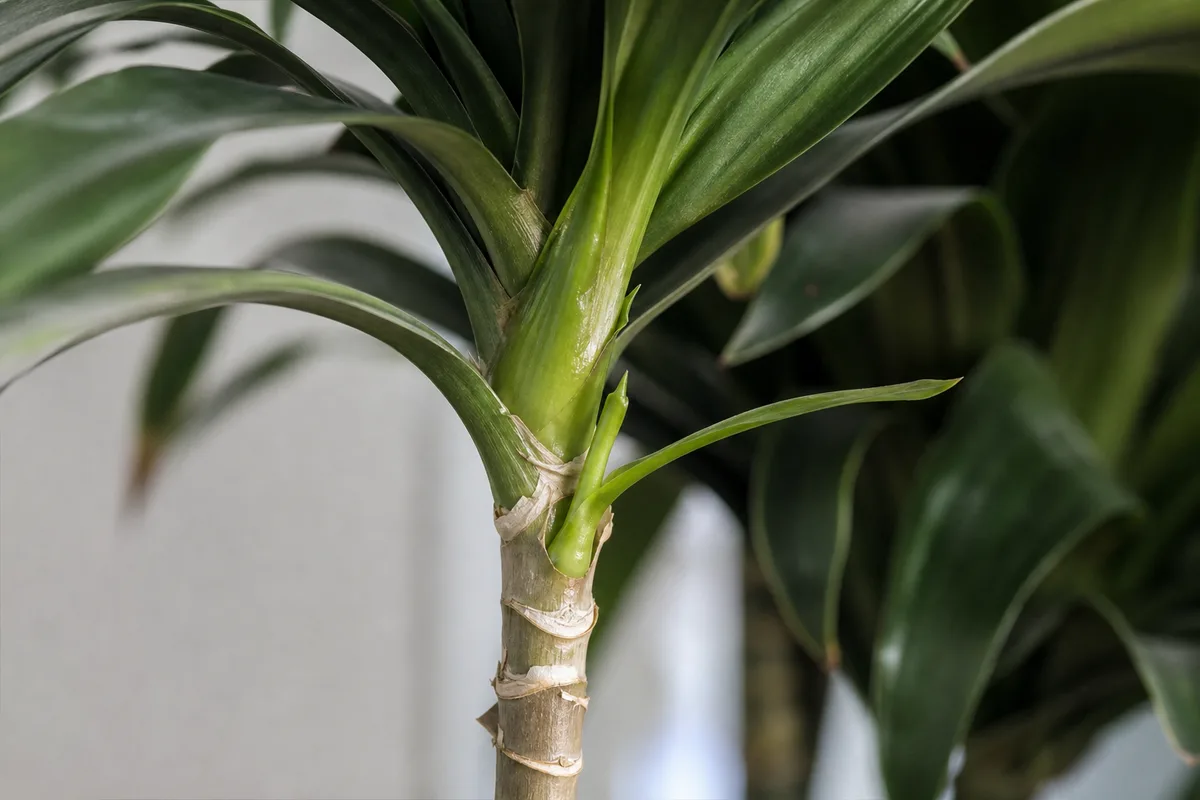
Stretched cane with small crown leaves and long gaps between leaf clusters - move within bright indirect range before changing fertilizer or watering.
Typical low-light symptoms on Dracaena:
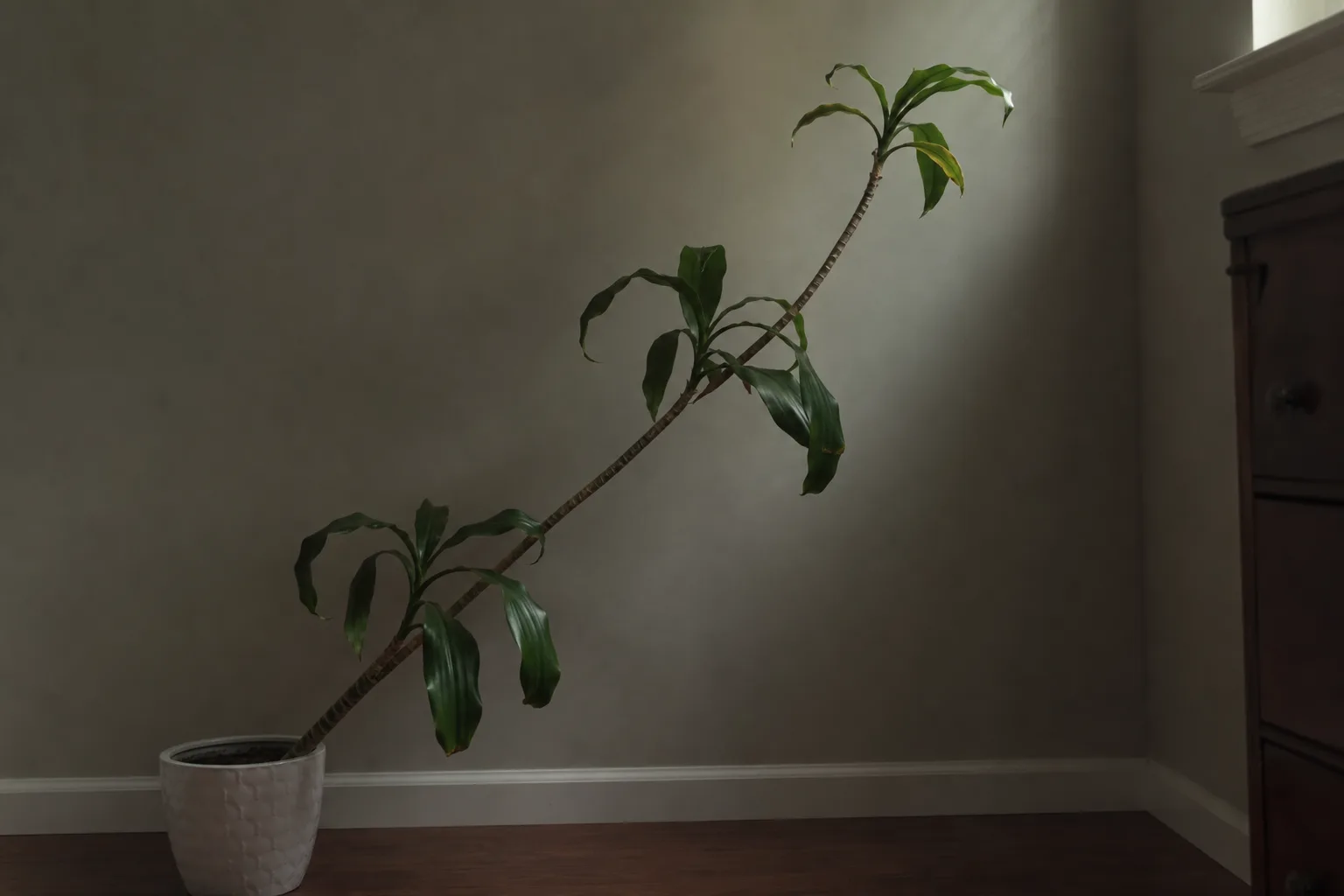
- Long, thin canes with wide gaps between leaf clusters as the plant stretches toward the brightest direction
- Leaning or one-sided growth - the crown points at the window; opposite leaves may look smaller
- Smaller new leaves at the top compared with older crown foliage
- Dull, dark green color - chlorophyll density increases in dim conditions, so leaves can look oddly deep green rather than pale
- Faded variegation - yellow or white stripes on cultivars like Warneckii or Lemon Lime lose contrast and may look mostly green
- Very slow or stalled crown growth - no new leaf unfurling for many weeks during what should be active season
- Soil that stays wet - low light reduces water use, so the top 2 inches may remain moist far longer than in a brighter spot
Not the same as low light:
- Lower leaves yellowing and dropping one at a time on an otherwise stable cane - often natural senescence on mature corn plants
- Brown dry tips - usually fluoride in tap water, low humidity, or salt buildup, not light alone
- Soft mushy cane at the soil line - overwatering on Dracaena or root rot on Dracaena, which low light can worsen but does not cause by itself
How to confirm the cause
Work through these checks before committing to a new location:
- Window distance and direction - Note how many feet the pot sits from glass and which way the window faces. East and west exposures usually give Dracaena the filtered brightness it uses best; deep north rooms or interior hallways rarely do.
- Shadow test at midday - Hold your hand between the plant and the window. A soft, diffuse shadow with recognizable edges suggests bright indirect light. A faint or absent shadow means the spot is too dim for active growth.
- New-growth comparison - Measure or photograph crown leaf size and internode spacing now. Move the plant closer to filtered window light for two to three weeks, then compare the next leaf flush.
- Soil dry-down speed - Push your finger 2 inches into the mix. In low light, Dracaena should still dry on roughly its normal winter or summer rhythm-but if soil stays wet for two weeks while leaves yellow, suspect overwatering compounding weak light.
- Season check - If symptoms appeared in late autumn, winter light reduction may be the trigger even though the pot never moved.
- Pest pass - Spider mites thrive in warm, dry, dim conditions. Inspect leaf undersides and wipe with a white cloth; stippling plus webbing is pest stress, not light alone.
Diagnosis is likely correct if: new crown leaves emerge closer together, look wider, and hold better stripe color within three weeks of brighter placement-without any other care overhaul.
Keep searching if: yellowing spreads quickly while soil is soggy (root issue), or you find active pests, scale, or mushy roots.
First fix for Dracaena
Move the pot to the brightest location that still avoids hot direct sun on the leaves.
For most homes that means:
- Within 3–6 feet of an east- or west-facing window, or
- Several feet back from a south-facing window filtered by a sheer curtain or the natural depth of the room
Increase exposure gradually over one to two weeks if the plant lived in a very dark spot for a long time-sudden harsh direct sun can scorch the wide strap leaves. Rotate the pot a quarter turn weekly so the cane grows upright instead of permanently leaning.
If no window spot reaches medium-bright levels, add a full-spectrum LED grow lamp 12–18 inches above the crown for 12–16 hours daily. Sixteen hours of light and eight hours of darkness work well for foliage houseplants when supplementing weak natural light.
Do not reach for fertilizer, extra water, or repotting as the first response. A stressed Dracaena in dim light cannot use nutrients efficiently, and wet soil in low light is a common path to root rot.
Step-by-step recovery
Once the plant is in brighter indirect light or under a grow lamp:
- Adjust watering immediately - Brighter light increases transpiration. Keep the rule of watering when the top 2 inches are dry, but expect that rhythm to shorten compared with the dark corner. A pot that took three weeks to dry may need checking every 10–14 days in summer.
- Remove only fully spent leaves - Pull or snip lower leaves that are completely yellow or brown. Do not strip healthy green foliage trying to “refresh” the plant.
- Dust the leaves - Large Dracaena leaves collect dust that blocks light. Wipe with a damp cloth so the plant uses the brighter spot efficiently.
- Wait for one full leaf cycle - The next two or three crown leaves tell you whether light is adequate. Wider blades and tighter spacing mean success.
- Optional cane pruning after stabilization - If the trunk is too tall and bare for your space, cut the cane at the desired height once new growth looks healthy. Dracaena usually sprouts new shoots from nodes below the cut, creating a bushier profile. Wait until the plant is clearly responding to light before pruning.
Recovery timeline
| Phase | What to expect |
|---|---|
| Week 1–2 | Leaning may slow; soil dries slightly faster; no dramatic leaf change yet |
| Week 3–4 | New crown leaf should look wider and closer to the previous node if light is sufficient |
| Month 2–3 | Steadier flush of crown growth; variegation may look sharper on striped cultivars |
| Long term | Old stretched cane remains long; permanent improvement shows in new tissue only |
Dracaena is a slow grower by nature. In adequate light it may add roughly 6–12 inches of cane per year depending on cultivar and conditions-so patience is normal. If no new crown leaf appears after four to six weeks in a clearly brighter spot, the location is still too dim or a secondary stressor (roots, pests) needs attention.
Lookalike symptoms
| What you see | More likely cause | How to tell apart |
|---|---|---|
| Yellow lower leaves only | Natural aging or overwatering | Aging is slow and isolated; overwatering pairs with wet soil and possibly soft cane base |
| Brown leaf tips | Fluoride, salts, low humidity | Tips brown while overall growth posture stays normal; switch to filtered water |
| Wilting with dry soil | underwatering on Dracaena | Pot feels light; leaves droop but do not show long-term stretch |
| Pale upper leaves + wet soil | Root rot starting | Mushy roots, sour smell; not fixed by light alone |
| Tiny dots + webbing | Spider mites | Pests visible on wipe test; may worsen in dim dry heat |
Low light and overwatering often overlap on Dracaena because dim spots slow water uptake. Fixing light without easing watering can accelerate root decline just when the plant starts photosynthesizing more.
Mistakes to avoid
- Assuming “low-light tolerant” means any dark corner - Dracaena endures shade; it does not grow well in it.
- Jumping to direct south-window sun - Wide leaves scorch quickly; filtered bright indirect is the target.
- Fertilizing a stretched, stagnant plant - Feed only after light is adequate and new growth looks normal.
- Watering on a calendar - Dark rooms need less frequent checks, brighter rooms more; always use the top-2-inch dryness test.
- Ignoring winter - The same window delivers less energy December through February; supplement or accept near-dormant growth.
- Judging recovery on old leaves - Stretched or faded mature leaves will not remodel; watch the crown.
Dracaena care cross-check
Light and watering move together on Dracaena overview. Dracaena prefers bright indirect light paired with a well-draining mix and a dry-down rhythm of roughly every 7–14 days in summer and 14–21 days in winter in typical indoor conditions-but those intervals assume reasonable light.
When you brighten placement:
- Shorten the interval between moisture checks.
- Keep using filtered or distilled water if fluoride brown tips were already an issue; better light does not remove fluoride sensitivity.
- Hold off on repotting until growth stabilizes unless roots are clearly failing.
Temperature comfort remains 65–80°F (18–27°C). Cold drafts near windows in winter can yellow leaves independently of light-do not place the pot against leaky window frames just to maximize photons.
How to prevent not enough light next time
- Choose the window before the corner - Decide placement based on foot-candles, not furniture layout.
- Rotate weekly - Prevents permanent lean and exposes all sides of the crown to light.
- Clean glass seasonally - More light passes through unobstructed panes.
- Supplement in winter - A timer-controlled LED grow lamp maintains medium-bright levels when days are short.
- Match expectations to the spot - In a genuinely low-light office, Dracaena may live for years with minimal new growth; that is tolerance, not thriving.
- Re-check after room changes - New shelves, blinds, or outdoor tree growth can shade a formerly adequate window.
When to worry
Low light alone is rarely an emergency, but these combinations need faster action:
- Rapid yellowing of many leaves with soggy soil - Inspect roots for rot; improve light and reduce watering.
- Cane softening at the base - Stem rot from chronic overwatering in a dim room; may require cutting away affected tissue and repotting into fresh gritty mix.
- No new growth for two or more months in spring and summer - The plant is surviving on reserves; increase light or accept decline.
- Repeated pest outbreaks - Spider mites on weak, dim-grown Dracaena often signal overall stress; treat pests after correcting light.
A corn plant with a tall bare trunk and a small leafy top can still be healthy if new crown leaves keep emerging with good color. The goal is active, proportional top growth-not a short bushy silhouette unless you prune for shape.
When to use this page vs other Dracaena guides
- Dracaena watering guide - Use for routine moisture checks before assuming not enough light is the main issue.
- Dracaena problems hub - Browse all 16 common issues on this species.
- Leggy Growth on Dracaena - Different entry point when symptoms overlap with not enough light.
- Slow Growth on Dracaena - Different entry point when symptoms overlap with not enough light.
- Yellow Leaves on Dracaena - Different entry point when symptoms overlap with not enough light.