Not Enough Light on Dieffenbachia Tropic Snow: Causes
Quick answer
Dieffenbachia Tropic Snow in too little light stretches its cane, drops lower leaves, and puts out small dull foliage. First step: move the pot to bright, filtered light within a few feet of an east window or a sheer-filtered south or west window-before changing water, fertilizer, or pot size.
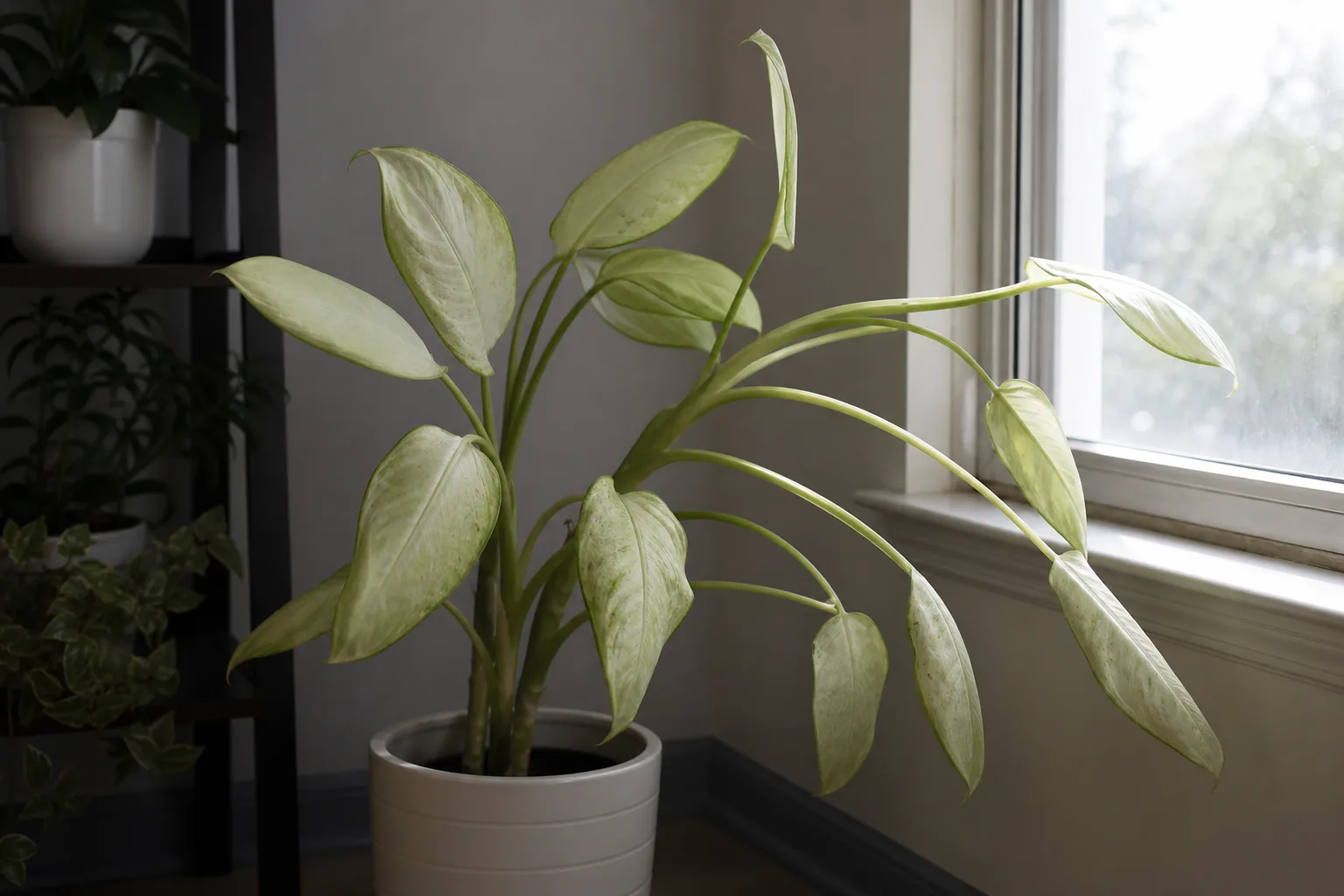
Not Enough Light on Dieffenbachia Tropic Snow: Causes, Checks & Fixes
This guide covers not enough light on Dieffenbachia Tropic Snow. See also the general Not Enough Light guide, watering, and light pages for this plant.
Not Enough Light on Dieffenbachia Tropic Snow: Causes, Checks & Fixes
Quick answer
Dieffenbachia Tropic Snow (Dieffenbachia amoena ‘Tropic Snow’) is sold as a tolerates-low-light floor plant, but it still needs steady filtered brightness to hold its mottled pattern and thick cane. In a dim corner, the stem leans toward the window, gaps between leaves widen, and new foliage comes in smaller and duller.
First step: move the pot to bright, filtered light-within a few feet of an east-facing window, or behind sheer curtains on a south or west window. Do that before you change watering, feed, or repot. Light is the engine; without enough of it, other fixes will not restore compact growth.
Page role: This URL is the diagnosis and first-fix guide when stretch, fade, or stall is already happening. For window-by-window placement, grow-light distance, and acclimation after you move the plant, see the Tropic Snow light guide. If the cane is already bare below the crown, read leggy growth after light improves.
What not enough light looks like on Dieffenbachia Tropic Snow
Tropic Snow is a large, upright cultivar with broad, yellow-green leaves and irregular olive margins. That mottling is the first thing to suffer when light is weak. Watch for these patterns:
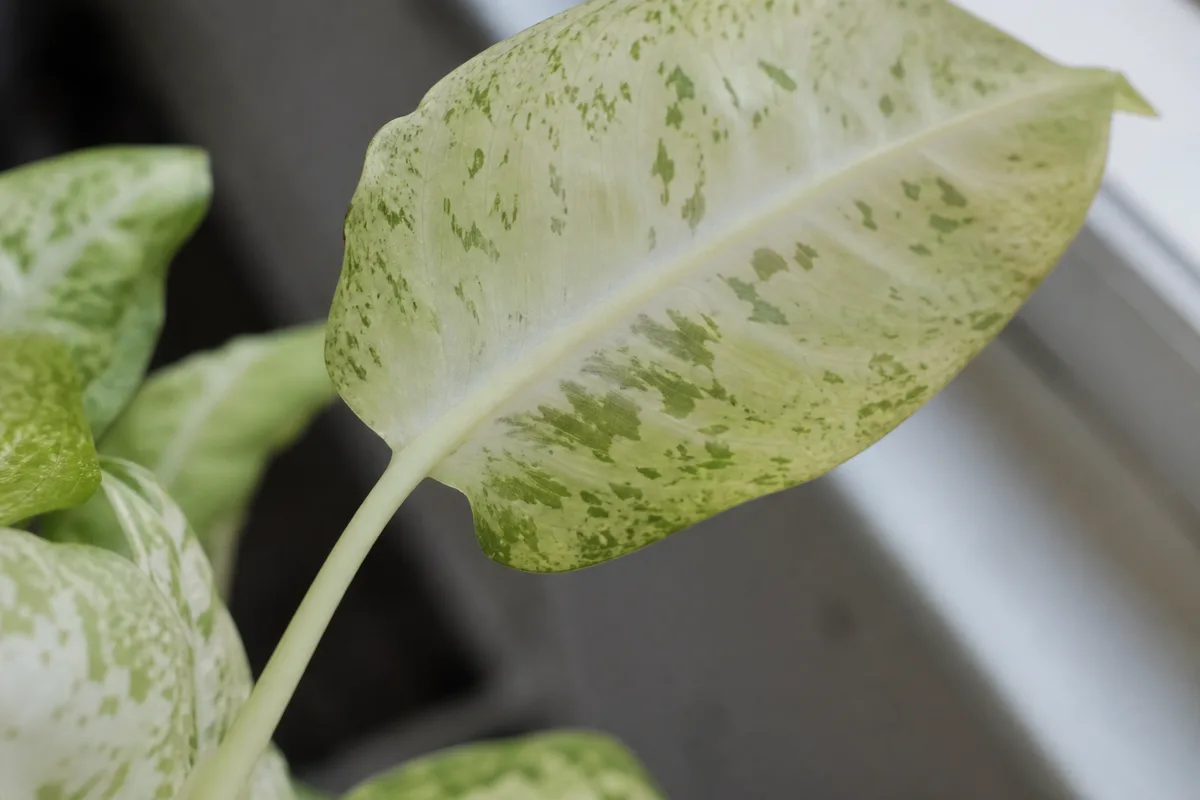
Not Enough Light symptoms on Dieffenbachia Tropic Snow - compare with healthy tissue on the same plant.
- Leaning or one-sided growth - the cane bends toward the brightest direction instead of staying upright
- Long petioles and wide leaf spacing - new leaves sit farther apart on the stem than they did when you bought the plant
- Smaller new leaves - the latest foliage is noticeably narrower or shorter than mature leaves lower on the cane
- Dull, dark green color - mottling fades so leaves look mostly solid green
- Lower leaf yellowing and drop - older leaves shed as the plant reallocates energy upward; this overlaps with normal aging but speeds up in deep shade, when the plant becomes leggy and loses lower leaves
- Slow or stalled growth - little new growth when light is insufficient during warm months
These signs differ from sun scorch, which shows bleached or crispy patches on leaves facing direct glass. Tropic Snow wants filtered brightness, not hot midday sun on the foliage.
A placement change that usually works
A floor Tropic Snow on an interior bookshelf about 2 m from a west window often shows the classic pattern: long bare lower cane, a small crown at the top, and newest leaves mostly green with weak olive mottling. After moving to a sheer-filtered south sill with a quarter turn every few days, the second new leaf-about 18 days later in a warm room-was the first reliable sign: shorter spacing between nodes, a wider blade, and clearer cream-and-olive mottling on fresh tissue. Old stretched internodes did not shrink; success showed only on that new growth.
Why Tropic Snow struggles in dim corners
Dieffenbachia evolved under dappled tropical canopy light. Indoors, that translates to bright, indirect exposure-not a back hallway, office alcove with only overhead fluorescents, or the far side of a living room. UF/IFAS notes that dieffenbachia prefers diffused sunlight or partial shade and will tolerate full shade as a houseplant, but tolerance is not the same as thriving.
Tropic Snow adds cultivar-specific wrinkles:
- Large leaf surface needs more photosynthetic light than a small tabletop plant to support a thick water-storing cane
- Variegated tissue has less chlorophyll per leaf area, so weak light hits twice-growth slows and pattern fades
- Floor placement often puts the pot six feet or more from glass, where intensity drops sharply with distance-and the top of a tall cane may sit in even dimmer air than the pot base
- Cool, dark corners plus wet soil are especially risky; when light is low, the pot dries slowly and roots sit in stale moisture, overlapping with overwatering and root rot symptoms
Winter short days, dirty windows, and curtained glass can push an otherwise acceptable spot into not enough light without you moving the plant at all.
Cultivar light tier
UF/IFAS commercial production guidelines place heavily variegated cultivars such as ‘Camille’ at roughly 150–250 foot-candles to stay attractive, while greener types such as ‘Star Bright’ and ‘Snow Flake’ remain acceptable near 50 foot-candles. (UF/IFAS EP137) Tropic Snow’s bold mottling puts it in the brighter variegated band-closer to Camille than to Snow Flake-not the darkest dumb-cane tier. Inappropriate low light causes foliar variegation reduction and excess stem elongation on dieffenbachia; that is the stretch-and-fade pattern Tropic Snow owners describe. For genus-wide context, see not enough light on Dieffenbachia.
How to confirm the cause
Work through these checks before treating anything else:
- Distance from the window - Stand where the pot sits. If you cannot see sky through glass without walking to the window, light is likely low for Tropic Snow. Medium-bright houseplant ranges often fall around 100–500 foot-candles near east or west glass; heavily variegated dumb cane usually needs the upper half of that band, not the bottom.
- Shadow test at midday - Soft, blurred shadows suggest usable indirect light. Hard, dark shadows on the leaves mean direct sun-brighter than you need, but only for part of the day.
- Growth direction - A cane that leans or puts all new leaves toward one window is actively seeking light.
- New leaf size - Compare the newest unfurling leaf to one from six months ago. Smaller size with wider spacing points to light, not fertilizer.
- Soil dry-down speed - Push a finger 3–5 cm into the mix. If it stays damp more than ten days after watering in a dark spot, low light may be reducing uptake (rule out oversized pots and heavy mix too).
- Two-week trial move - Shift the pot one meter closer to filtered window light. If the next leaf is larger and closer to the prior node, light was the limiter.
If the plant sits in direct hot sun and leaves show bleaching, you may have the opposite problem-pull back with a sheer curtain rather than moving closer to glass.
First fix for Dieffenbachia Tropic Snow
Move the pot to the brightest filtered spot you can offer-typically within 1–2 meters of an east window, or 1–2 meters back from a south or west window with sheer curtains.
Do this as a single change. Do not repot, prune the cane, or fertilize on the same day. Give the plant one to two weeks to respond before adjusting water or considering grow lights.
If no suitable window exists, add a full-spectrum LED grow light about 30–45 cm above the top leaves on a tall floor specimen (closer for compact plants) for 12–16 hours daily. Office rooms with only ceiling fluorescents usually need this supplement for variegated Tropic Snow. That is a second step after repositioning, not a substitute for checking natural light first.
Step-by-step recovery
Once the pot is in brighter filtered light:
- Rotate a quarter turn every few days so the cane does not lean back toward one side.
- Re-check watering - Tropic Snow uses more water in better light. Wait until the top 3–5 cm of mix feels dry before watering again; do not keep the old dark-corner schedule. Cross-check the watering guide if dry-down changed sharply.
- Hold fertilizer until you see one healthy new leaf. Extra nitrogen on a stressed, stretched plant does not fix etiolation.
- Trim only dead or fully yellow lower leaves - wear gloves when handling cut tissue because dieffenbachia sap irritates skin and the plant is toxic to dogs and cats if chewed. Keep Tropic Snow away from curious pets when you prune; ASPCA lists Tropic Snow among common dumb-cane names on its toxic-plant database.
- Consider cane pruning later - if the stem is very bare below a tuft of top leaves after several weeks of good light, you can cut the cane to force side shoots per the pruning guide. That is cosmetic shaping, not the first fix.
- Add supplemental light in winter if growth stalls again when days shorten-keep total daily light at or below about 16 hours.
Recovery timeline
Expect the next leaf to show improvement within two to three weeks after a meaningful light increase during active growth (roughly spring through early fall indoors).
Old stretched internodes do not shorten. Stretched growth does not revert; judge recovery on new leaves only. Success means:
- New leaves larger and closer together
- Mottling clearer on fresh foliage
- Cane stops leaning once you rotate regularly
- Soil drying on a predictable rhythm
If nothing improves after four to six weeks in a verified bright filtered spot, reassess for root issues, chronic overwatering in the old location, or pests-not more fertilizer. Yellow lower leaves with wet soil may need the yellow leaves and root rot guides.
Lookalike symptoms
| What you see | More likely cause if… | Where to read next |
|---|---|---|
| Long gaps, lean, dull mottling, small new leaves | Light too weak for variegated floor cane | This page + light guide |
| Bare cane below a top tuft after months of shade | Stretch already advanced | Leggy growth |
| Yellow lower leaves + soggy mix + soft cane base | Overwatering or rot in dim, slow-drying soil | Overwatering / root rot |
| One or two old bottom leaves yellow on upright plant in good light | Normal aging | Yellow leaves |
| Droopy leaves, very light pot, dry mix throughout | Underwatering-not long petioles | Underwatering |
| Crispy margins, normal spacing | Low humidity or fluoride-not shade alone | Brown tips |
| Bleached or brown patches on window-facing side | Direct sun scorch | Light guide - filter sun |
Tropic Snow care cross-check
Light and water move together on this plant. In too little light, the pot stays wet longer, which can trigger yellow lower leaves that mimic overwatering. After you brighten the spot, the same watering volume may dry faster-check the top 3–5 cm of soil before every drink instead of following a calendar.
Tropic Snow prefers moderate humidity (50–60%) and 18–27°C (65–80°F). Cold drafts below about 13°C (55°F) cause droop unrelated to light. Fix placement for brightness first, then address humidity if margins crisp.
What not to do
Do not blast the plant with direct south-window sun to fix stretch-acclimate with sheer curtains or move in stages over one to two weeks.
Do not fertilize heavily to force growth in a dark spot; insufficient light cannot be corrected with feed, extra water, or repotting alone.
Do not keep watering on a dark-corner schedule after moving to brighter light-that invites soggy mix.
Do not stake a leaning cane indefinitely without improving light angle and rotation-the stem will keep reaching.
Do not expect variegation to return on old leaves; read recovery on new growth only.
How to prevent low-light stress
Place Tropic Snow where bright, filtered light is realistic all day-not only where the pot looks best decoratively. East windows and sheer-filtered south or west exposures suit most homes; details and grow-light height for tall canopies are in the light guide.
- Rotate the pot regularly for even growth
- Clean windows and open blinds seasonally
- Move the plant closer to glass when winter shortens daylight
- Use a grow light in offices or north-facing rooms that stay below medium-bright levels
- Match watering to how fast the pot dries in the current light, not the old spot
When to worry
Escalate if the cane softens at the base, soil smells sour, or lower leaves drop weekly while the mix stays wet in low light-that pattern can precede root trouble. Follow the root rot guide before cosmetic fixes.
Pure stretch with firm cane tissue and stable soil is not an emergency-increase light gradually and watch the next leaves.
If the plant is more than 60 cm of bare cane with only a small top cluster after two months of good light, plan a cane cut for shape per leggy growth-not because the plant is dying.
Related Tropic Snow guides
- Tropic Snow overview - cultivar hub
- Light needs and window placement - ongoing placement after you fix low light
- Leggy growth - bare cane and when to top
- Yellow leaves - lower-leaf drop lookalikes
- Overwatering - wet soil in dim corners
- Root rot - soft base escalation
- Watering - dry-down after a light move
- Genus not enough light - multi-cultivar dumb cane foot-candle bands