How to Prune Dieffenbachia Tropic Snow: When, Where & What
How to Prune Dieffenbachia Tropic Snow: When, Where & What to Cut
How to Prune Dieffenbachia Tropic Snow: When, Where & What to Cut
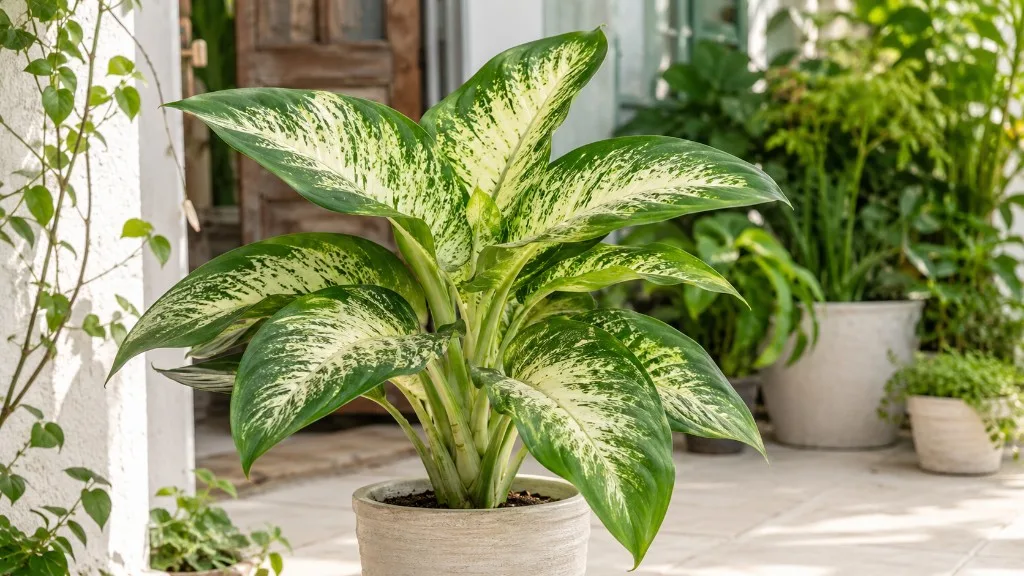
First, remove only dead, yellow, or clearly damaged leaves - cut each petiole at the base where it meets the cane, wearing waterproof gloves. Dieffenbachia Tropic Snow (Dieffenbachia amoena ‘Tropic Snow’) is a large floor-scale dumb cane with thick water-storing canes and broad mottled leaves. NC State Extension lists dieffenbachia as an upright Araceae foliage plant commonly grown in containers, with stem cuttings as a standard propagation method - the same node anatomy that roots cuttings also branches after pruning. Tropic Snow needs more physical space than smaller cultivars; crowded leaves crease and tear, and weak light produces the classic palm-tree silhouette - long bare cane, heavy crown, increasing lean.
Do not strip leaves merely because mottling looks uneven on older blades. Tropic Snow’s variegation is mottled rather than cream-centered, so individual leaves can look worn while the plant remains healthy. Remove leaves that are mostly yellow, soft, torn through the petiole, or pest-infested. Save cane topping and major reshaping until you have assessed cane firmness, Dieffenbachia Tropic Snow light guide, and how much healthy foliage you can afford to lose.
How Tropic Snow Grows - Canes, Nodes, and Mottled Leaves
Tropic Snow grows as upright structural canes with alternate leaves on thick stems. New shoots emerge from buds at nodes - the swollen rings where leaves attach - and from the terminal bud at the tip. Dieffenbachia does not sprout from bare internodes between nodes; a cut placed mid-stem leaves a dead stub with no bud to activate.
Clemson HGIC notes dieffenbachia tolerates low light but grows best in bright filtered indoor light. On a far wall or in a corner, internodes lengthen and the crown leans toward the window. Rotation helps balance the pot, but rotation alone will not fix chronic shade. If you plan to top a leggy cane, pair the cut with gradually brighter filtered light so new shoots stay compact rather than repeating the stretch.
Each Tropic Snow leaf is energetically costly because of its size. Pale mottled tissue still photosynthesizes, but removing healthy foliage to “tidy” the plant slows recovery after any hard cut.
What to Check Before You Cut
Run through a short inspection before structural pruning.
Cane firmness and lean: Press the lower cane with a gloved finger. Firm, plump tissue is safe to work with. Soft, wrinkled, or collapsing cane near soil level suggests rot or chronic overwatering on Dieffenbachia Tropic Snow - trace rot cuts back to firm tissue before topping for shape.
Yellow leaves vs normal mottling: Lower-leaf yellowing on an otherwise stable plant is often normal senescence. Wait until a leaf is mostly yellow before removal. Do not confuse uneven mottling on an aging leaf with failure - translucent patches or soft tissue are the warning signs, not uneven pattern alone.
Pest check: Inspect leaf undersides and petiole axils for mealybugs, spider mites, or sticky residue. Remove infested leaves into a sealed bag; sterilize tools between cuts if disease or pests are present.
When to Prune Tropic Snow
Year-round: remove dead, yellow, brown, or pest-damaged leaves at the petiole base. Minor brown tip trimming along the leaf contour is cosmetic only when the underlying cause - low humidity, fluoride, inconsistent watering - is already corrected.
Spring through early summer: cane topping, hard rejuvenation, and propagation harvest when latent buds activate most reliably. Expect new shoots within two to four weeks in warm, bright conditions.
Defer: major reshaping in autumn and winter when growth slows, or within two weeks of Dieffenbachia Tropic Snow repotting guide unless rot or breakage demands immediate action. Emergency rot removal overrides seasonal timing - cut back to firm cane regardless of month.
Tools, Sap Safety, and Sanitation
Use sharp bypass pruners for cane cuts and fine scissors for petioles. Wipe blades with 70% isopropyl alcohol between cuts on diseased or pest-infested tissue.
Large cane cuts on Tropic Snow release significant sap. Poison Control documents calcium oxalate raphides causing immediate pain and swelling on contact - the common name “dumb cane” reflects oral swelling that can temporarily inhibit speech if sap reaches mouth tissue. Wear waterproof gloves and safety glasses for overhead cuts on a tall specimen. The ASPCA lists Dieffenbachia as toxic to cats and dogs. Seal trimmings in a bag away from pets and children. If sap reaches eyes, flush with water and follow Missouri Poison Center guidance for exposure.
The First Cut to Make
After safety gear is on, cut the lowest fully yellow or damaged leaf petioles first - one at a time at the cane junction, not mid-blade. This opens visual access to the cane, reveals node positions, and removes tissue that will not recover. Only after failing leaves are cleared should you decide whether the cane needs topping or the plant needs light correction instead of more cuts.
Where to Cut on Canes and Petioles
Locate the swollen ring where each leaf attaches. For cane shortening, cut 5–10 mm above a healthy node at a slight angle, leaving firm cane above the bud.
Yellow or damaged leaf: sever the petiole at the base where it meets the cane.
Brown tips only: follow the natural leaf outline with scissors, trimming dead tissue only.
Leggy cane: cut the stem above a node where healthy leaves remain, or remove the top section as a tip cutting while shortening the base cane to a lower node.
Rot: cut back into firm white or green stem tissue. Discard mushy sections - never propagate soft cane.
Never cut through soft, rotting tissue without tracing back to clean cane first.
Step-by-Step Tropic Snow Pruning
- Inspect cane base, nodes, and leaf health with gloves on.
- Remove dead, yellow, and pest-damaged leaves at petiole bases.
- Decide whether legginess needs topping or better light - often both.
- If topping, select a node 15–30 cm (6–12 inches) above soil on a firm cane, or higher if healthy leaves remain below the intended cut.
- Make one clean angled cut 5–10 mm above the chosen node.
- Wipe sap from tools and skin; bag trimmings securely.
- Place the plant in stable bright indirect light and adjust watering to match reduced foliage.
Staged topping - one moderate cut, wait for new shoots, then reassess - beats a single cut to soil level on a stressed plant.
How Much Foliage Is Safe to Remove
Limit removal to one-third of total foliage per session on Tropic Snow. Each leaf is large and energetically costly. A plant with twelve leaves should lose at most four healthy ones at once. Dead and diseased tissue does not count toward that limit.
Spread major cane shortening across two sessions during active growth if multiple stems need correction or if the plant was recently stressed by repotting, pests, or inconsistent watering.
Topping Leggy Canes and Rejuvenation
When a Tropic Snow has become a tall bare cane topped by a heavy crown, topping breaks apical dominance from the terminal bud and activates lower nodes - often producing two or more shoots below the cut during active growth.
To rejuvenate a bare cane with a healthy upper cluster, you may cut the top below the lowest healthy leaves for a tip cutting while shortening the remaining base cane to a lower node. Full recovery takes six to eight weeks in warm, bright indirect light. Low light after topping produces weak, stretched regrowth that repeats the original problem.
Pruning redirects cane-forming growth but cannot fix chronic overwatering or a dark placement. Correct those conditions alongside any hard cut.
Using Pruned Canes for Propagation
Top sections with several nodes can root as stem cuttings after the cut end calluses for a day or two. Clemson HGIC describes cane sections laid horizontally or planted vertically in moist medium as a standard dumb cane propagation method. Label orientation - roots and shoots still follow gravity and node polarity.
Keep warmth and bright indirect light while the cutting roots. The rooted stump may sprout from lower nodes while the cutting roots, giving two plants from one prune when both succeed.
Aftercare and Recovery Timeline
After heavy pruning, maintain stable bright indirect light, water when the top 3–5 cm of soil dries, and hold fertilizer for two to three weeks until new growth appears. Watch cut sites and lower cane for softening - rot on thick canes spreads quickly if soil stays wet after canopy loss.
Signs pruning worked: firm cane tissue, new shoots emerging from nodes within two to four weeks in active season, and leaves opening at normal size rather than stunted.
Signs pruning was too aggressive or badly timed: continued cane softening, no bud break after six weeks in warm light, or new shoots that immediately stretch thin and pale.
Common Pruning Mistakes
Pruning without gloves on Tropic Snow - sap volume is high on large cane cuts.
Cutting mid-internode - no buds activate; dead stub remains.
Topping in a dark corner - repeat legginess on new shoots.
Overwatering after canopy loss - water-storing cane rots when roots sit in wet mix with fewer leaves transpiring.
Shearing healthy mottled leaves for symmetry - wastes the foliage pattern the cultivar is sold for.
Stacking repot, fertilize, and hard prune on one day - pick one stress event per month when possible.
Conclusion
Dieffenbachia Tropic Snow pruning starts with dead and damaged leaf removal at petiole bases, then - only if needed - tops leggy canes above nodes on firm tissue. Time structural work for spring and early summer, protect skin and pets from toxic sap, and pair every hard cut with brighter filtered light. Tropic Snow recovers well when roots, drainage, and placement support the reduced canopy. Scissors redirect growth; culture determines whether new mottled leaves stay compact on a balanced floor plant.
When to use this page vs other Dieffenbachia Tropic Snow guides
- Dieffenbachia Tropic Snow overview - Start here for whole-plant context before deep-diving this topic.
- Dieffenbachia Tropic Snow problems hub - Jump to symptom-specific fix guides when this care topic does not resolve the issue.
- Leggy Growth on Dieffenbachia Tropic Snow - Escalate here when pruning adjustments are not enough.
- Slow Growth on Dieffenbachia Tropic Snow - Escalate here when pruning adjustments are not enough.
- Brown Tips on Dieffenbachia Tropic Snow - Escalate here when pruning adjustments are not enough.
Related Dieffenbachia Tropic Snow guides
- Dieffenbachia Tropic Snow overview
- Dieffenbachia Tropic Snow watering
- Dieffenbachia Tropic Snow light
- Dieffenbachia Tropic Snow soil
- Dieffenbachia Tropic Snow propagation
- Dieffenbachia Tropic Snow fertilizer
- Leggy Growth on Dieffenbachia Tropic Snow
- Slow Growth on Dieffenbachia Tropic Snow
- Brown Tips on Dieffenbachia Tropic Snow
- Dieffenbachia Tropic Snow problems