Dieffenbachia Tropic Snow Repotting: When, How & Pot Size
Dieffenbachia Tropic Snow Repotting: When, How & Pot Size
Dieffenbachia Tropic Snow Repotting: When, How & Pot Size
Author: sai-ananth · Reviewed by: LeafyPixels Review Board (2026-06-17) · Methodology: Botanical and extension references plus practical indoor growing constraints before publication.
A Dieffenbachia Tropic Snow that suddenly wilts despite moist soil, pushes out smaller leaves than it used to, or sends water straight through the pot without absorbing it is rarely suffering from a mystery disease. More often, the roots have outgrown the container, the soil has broken down into a dense, airless mass, or both. Repotting is the reset that fixes those problems in a single afternoon - but only if you get the timing, pot size, and technique right. Jump to a pot that is too large, rip apart the root ball unnecessarily, or repot in the dead of winter, and you trade one problem for a worse one: weeks of transplant shock, yellowing leaves, and a plant that looks like it is giving up.
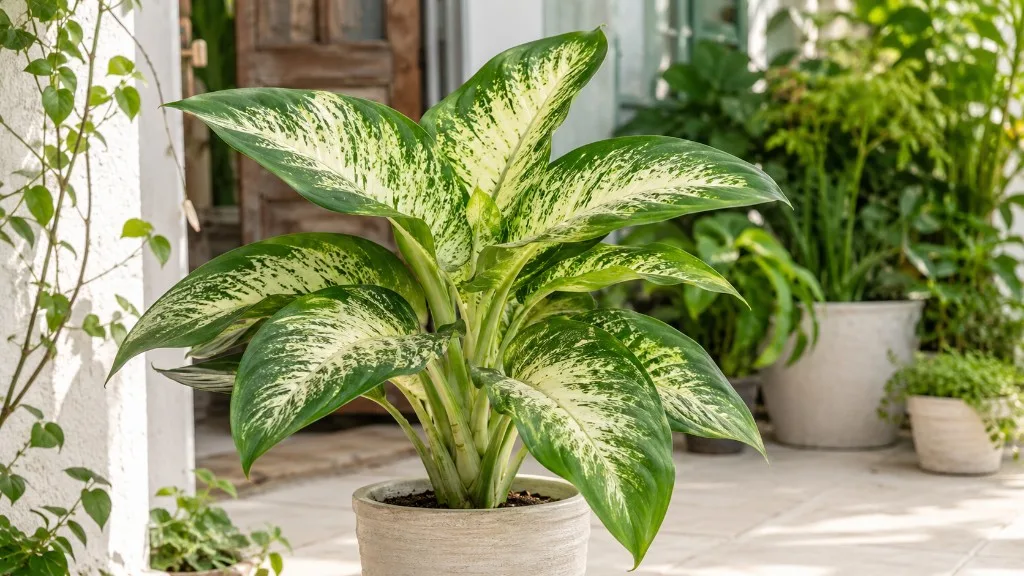
Dieffenbachia amoena ‘Tropic Snow’ - the silver-veined cultivar most people call dumb cane Tropic Snow - is an aroid in the Araceae family, native to the tropical forests of Central and South America. Missouri Botanical Garden’s Plant Finder describes the genus as preferring rich, well-drained, loamy soil in bright filtered light. NC State Extension lists ‘Tropic Snow’ at up to 6 feet with heavily variegated cream and green leaves. Tropic Snow is a bold, upright cultivar with dark green leaves marked by broad white and silver marbling, typically reaching 4 to 6 feet indoors in favorable conditions.
This guide covers the full repotting workflow: when to do it (spring timing and the exceptions), how to choose a pot that is exactly one size up, what soil mix to use, how to divide a multi-stem plant if you want to, and what to do for the six weeks after the move so your Tropic Snow comes back stronger rather than sicker.
What Repotting Means for Dieffenbachia Tropic Snow
In its native habitat, a dieffenbachia’s roots spread through loose, organic forest floor litter that drains fast and holds just enough moisture to keep the plant hydrated between rain events. Indoors, that same root system eventually hits a container wall. Over months and years, the potting mix compacts, peat and bark decompose into fine particles, and the drainage that felt crisp when you first brought the plant home turns sluggish. Repotting refreshes the air pockets around the roots, replaces degraded substrate with a mix that breathes again, and gives the plant a modest amount of new space to grow into.
This cultivar’s silver-veined foliage depends on healthy roots delivering water to large leaf panels. When soil breaks down, the plant sheds lower foliage or pushes out smaller, less boldly marked leaves. Repotting is also your best opportunity to inspect what is happening underground. You can see whether roots are white and firm or brown and mushy, whether circling roots need teasing apart, and whether a multi-stem plant has natural separation points where you could divide it into two or more individual plants. None of that is visible from above, which is why treating repotting as routine maintenance - not emergency surgery - gives you far better outcomes.
How Often Dieffenbachia Tropic Snow Needs Repotting
The practical answer for most indoor Tropic Snow plants: every 1 to 2 years. Clemson HGIC recommends repotting when roots crowd the container or emerge from drainage holes - a rhythm that fits dieffenbachias in general, with fast-growing specimens in smaller nursery pots needing attention sooner and slow, mature plants in larger containers stretching toward the two-year mark.
Calendar-based repotting is a starting point, not a rule. A Tropic Snow that has been in the same 6-inch pot for eighteen months and is pushing vigorous new growth from the crown probably needs a move. A plant that has sat in a 10-inch pot for two years, is not root-bound, and is growing steadily may be fine until next spring. The soil itself is often the limiting factor before space is: after two growing seasons, organic components begin breaking down, fine particles settle to the bottom, and a perched water table can form even if the plant has not yet circled the pot.
Young nursery plants often arrive in peat-heavy greenhouse mixes. If your Tropic Snow has been home three to four months and is actively growing, a spring repot into a better-draining aroid mix one size up is often the best upgrade you can make.
Calendar Cues vs. Root-Bound Signals
Use the calendar as a reminder to check, not as a command to repot. Once a year, ideally in late winter, slide the plant out and look at the root ball. If roots are white or light tan and do not wrap the outside in a dense mat, you can wait. If roots circle the bottom, protrude from drainage holes, or form a solid wall around the soil, the plant needs a new pot at the next suitable opportunity. The same inspection reveals degraded soil - sour smell, uneven drainage, or shrinkage away from pot walls - which causes the same symptoms as root-binding even before circling begins.
The Best Time to Repot: Why Spring Wins
Early spring through early summer is the best window for repotting Dieffenbachia Tropic Snow. This is when the plant is entering or already in its active growth phase - new leaves unfurl regularly, roots are producing fresh white tips, and the plant has the metabolic resources to repair any minor root damage from the move. NC State Extension lists stem cutting and division among recommended propagation strategies, making spring repotting a natural time to inspect whether multiple stems can be separated.
Spring repotting aligns with stable temperatures in the 65–80°F (18–27°C) range Tropic Snow prefers. A plant moved in March or April often shows new growth within two to four weeks. The same plant moved in December may sit dormant for six to eight weeks, and during that wait you are more likely to overwater out of concern - a particular risk with a large-leaved specimen that wilts dramatically when stressed.
Early Spring Through Early Summer Window
Aim for the period when you first notice new growth emerging - a fresh leaf unfurling, a slightly brighter green at the crown, or a stem that feels firmer than it did in winter. In most temperate-climate homes, that is March through June. Early spring is ideal because the plant has the entire growing season ahead to fill the new pot with roots. Early summer still works, though you should be more careful about heat stress if the plant sits near a west-facing window where afternoon sun can spike temperatures on large, dark green leaves.
If you missed spring and it is now late summer, consider waiting until the following spring unless the plant is clearly in trouble. Top-dressing - scraping out the top inch or two of old soil and replacing it with fresh mix - is often a better fall move than a full repot.
When Winter Repotting Is Still Warranted
Winter repotting is not ideal, but it is not always wrong. Repot immediately if the plant shows active root rot - mushy stems at the soil line, a sour smell, or black, slimy roots. Trim away all mushy roots, let cut surfaces dry for an hour, dust with ground cinnamon, and plant in fresh, barely moist mix in a pot one size down if you removed substantial root mass. Severe root-binding that causes daily wilting is a second exception. For every other situation, wait for spring.
Signs Your Tropic Snow Is Ready for a Bigger Pot
Dieffenbachia Tropic Snow does not send a calendar invitation when it needs a new pot. It sends physical signals. Learning to read them saves you from repotting too early (which disturbs roots for no gain) and too late (which leads to chronic wilting and salt buildup in a root mass that has consumed most of the soil).
The most reliable signs include:
- Roots circling the bottom of the pot or growing out of drainage holes
- Water running straight through the pot within seconds of watering, while the plant wilts shortly after
- Stalled growth despite adequate light and regular feeding during the growing season
- Soil that dries in hours because the root mass has displaced most of the substrate
- Yellowing lower leaves combined with soil that stays wet for days (a sign of degraded, compacted mix)
- Visible salt crust on the soil surface or pot rim, indicating years of fertilizer buildup in old medium
If two or more of these appear together, plan a repot at the next spring window - or immediately if root rot is involved. A single yellow leaf after a cold draft is not a repot signal. Persistent decline over several weeks, with roots visible at the pot bottom, is.
Root Circles, Drainage Failures, and Growth Stalls
Lift the pot and look underneath. Healthy Tropic Snow roots should be white or light tan and mostly hidden in soil. If you see a mat of roots pressed against the drainage holes or poking through them, the plant is root-bound. Slide the plant out and examine the bottom of the root ball: a solid disk of circling roots with almost no visible soil in the center is a clear call to action.
The drainage failure pattern is subtler: water exits the bottom within seconds, then lower leaves droop a day later while the center of the root ball stays moist. Water is channeling down the gap between the root ball and pot wall rather than penetrating the mass. Growth stalls follow the same logic - if new leaves stopped appearing despite good light and feeding, inspect the root zone first.
Choosing the Right Pot Size: One Size Up Only
The single most important pot decision for Dieffenbachia Tropic Snow: go one size up, not two. That means a new pot 1 to 2 inches (2.5 to 5 cm) wider in diameter than the current one. If your plant is in a 6-inch pot, move to a 7- or 8-inch pot. If it is in a 10-inch pot, move to an 11- or 12-inch pot. Clemson HGIC warns that oversized pots hold excess wet soil around roots and commonly trigger rot after repotting.
Depth matters too. Dieffenbachia roots spread outward more than they dive deep. A pot that is slightly wider but not dramatically deeper is ideal. A tall, narrow pot can create a deep wet zone at the bottom that the roots never reach, especially right after repotting when the root mass is still small relative to the container. For a tall, upright Tropic Snow, stability is another consideration - a pot that is only slightly wider but proportionally heavy at the base helps prevent tipping without oversizing the soil volume.
Every pot must have a drainage hole. No exceptions for long-term indoor growing. A cachepot without a hole is a display option only - the growing pot inside it must drain freely, and you must empty the cachepot after every watering.
Why Oversized Pots Cause Root Rot
An oversized pot holds soil that stays wet for days after watering. Tropic Snow roots only absorb moisture from the zone they occupy; the rest sits saturated and anaerobic. The plant shows yellow lower leaves and soft stems even if you water the same as always. One size up gives roots room without surrounding them in a swamp. This is the most common post-repot failure for dieffenbachias, and it is entirely preventable.
Terracotta vs. Plastic for Moisture Control
Plastic nursery pots retain moisture longer, which suits Tropic Snow in dry indoor air. They are lightweight and inexpensive - useful when dividing a multi-stem plant into several containers. Terracotta pots breathe through their walls and speed evaporation, making them a strong choice if you tend to overwater. Glazed ceramic pots retain moisture like plastic - use them as display cachepots around a draining nursery pot. For a floor-sized Tropic Snow, a heavy ceramic cachepot around a plastic growing pot gives visual weight without sacrificing drainage.
The Best Soil Mix for Dieffenbachia Tropic Snow
Dieffenbachia Tropic Snow is an aroid, and aroids need a soil that drains fast, holds moderate moisture, and stays open enough for roots to breathe. Missouri Botanical Garden describes the genus as preferring rich, well-drained, loamy soil with a mildly acidic pH around 6.1 to 6.5. A standard bag of indoor potting mix alone is often too dense and peat-heavy for long-term dieffenbachia health. Amending it with chunky drainage materials produces far better results.
A reliable DIY mix you can blend in ten minutes:
- 50% high-quality indoor or peat-based potting mix
- 25% perlite or pumice
- 15% medium-grade orchid bark
- 10% coco coir or fine horticultural charcoal
This blend drains in seconds when you water, holds moisture for three to five days in a typical indoor environment, and resists compaction far longer than straight peat. If your home is very dry and you underwater, increase the potting mix portion to 60% and reduce perlite to 20%. If you overwater or the plant sits in a humid room, increase perlite and bark to 30% each and reduce potting mix to 40%.
Avoid garden soil, vermiculite-heavy mixes (vermiculite holds too much water for aroids), and reused soil from other plants. Sterilize any pot you are reusing by scrubbing with a 10% bleach solution (one part bleach to nine parts water), then rinsing thoroughly and letting it dry before planting. For a large Tropic Snow, pre-moisten the entire batch of mix before planting so you are not trying to hydrate a dry peat core inside a heavy root ball after the fact.
Step-by-Step: How to Repot Dieffenbachia Tropic Snow
Repotting Tropic Snow is straightforward if you prepare properly and work gently. The entire process typically takes twenty to forty minutes depending on plant size. Wear gloves - dieffenbachia sap contains calcium oxalate crystals that irritate skin and mucous membranes, which is also why the plant is called dumb cane.
- Water lightly one day before. Moist soil holds the root ball together. Soggy soil falls apart; dust-dry soil crumbles. You want slightly damp, not wet.
- Gather supplies. New pot (one size up), fresh mix, sterilized scissors or pruning shears, gloves, newspaper or a tarp for the work surface, and a chopstick or pencil for settling soil.
- Remove the plant. Tip the pot on its side and slide the plant out. If it is stuck, run a butter knife around the inside rim to loosen the root ball. Never yank the stems - dieffenbachia petioles break easily and a snapped stem on a tall Tropic Snow leaves the plant lopsided for months.
- Inspect the roots. White or light tan roots are healthy. Trim any black, mushy, or foul-smelling roots with sterilized scissors. Tease apart circling roots at the bottom and sides with your fingers - do not bare-root the entire plant.
- Add mix to the new pot. Place enough fresh soil at the bottom so the top of the root ball will sit 1/2 to 1 inch below the pot rim.
- Position the plant. Center the root ball and fill around it with fresh mix. Use a chopstick to work soil into gaps without compacting it.
- Water lightly. Give enough water to settle the soil, then let excess drain fully. Do not soak the pot on day one.
- Place in recovery conditions. Bright indirect light, no direct sun, stable temperatures, and no fertilizer for four to six weeks.
Prep, Removal, and Root Inspection
The day-before watering step is not optional. A root ball that holds together lets you tease roots without destroying fine root hairs. For a large specimen, work on the floor with the pot on its side. During inspection, check the crown where stems meet soil - soft, dark tissue indicates crown rot, which is more serious than root binding. Trim no more than one-third of the root mass unless you are dealing with active rot.
Dividing Multi-Stem Tropic Snow Plants During Repotting
Many Dieffenbachia Tropic Snow plants grow with multiple stems in a single pot - a look nurseries create by planting several rooted cuttings together. Over time, the clump becomes crowded, stems compete for root space, and the plant looks less full because each cane is fighting for the same limited soil volume. Repotting is the natural moment to divide the plant into separate specimens, provided each section has its own stem and a reasonable share of roots. NC State Extension lists division among recommended propagation strategies when distinct crowns with healthy root systems can be separated.
Division is not mandatory. A multi-stem Tropic Snow that is healthy and not overcrowded can stay together in a pot one size up. Division makes sense when:
- The clump has three or more stems and looks crowded
- You want to create a second plant for another room or to give away
- One stem is significantly taller or leggier than the others and you want to manage them separately
- The root ball shows natural separation points where stems connect to distinct root clusters
To divide, remove the plant and gently brush away soil from the center of the root ball until you can see where each stem connects to roots. Look for natural gaps between stem groups. Gently tease the sections apart with your hands. If roots are tightly tangled, use sterilized shears to cut through the root mass between sections - each division should retain at least one stem and a fist-sized portion of healthy roots.
Plant each division in its own appropriately sized pot - often 4 to 6 inches for a single stem, or one size up from the current root mass for a larger division. Divisions may wilt more than an undivided repot because root mass is reduced. Group pots together for slightly higher humidity and resist overwatering wilting leaves. NC State Extension recommends division and stem cutting as standard propagation methods, making spring repotting the practical window for separating established offshoots.
When Division Makes Sense-and When to Skip It
Skip division if the plant has only one or two stems sharing a single dense root mass with no natural separation point. Tall, single-cane specimens are better managed through stem cuttings than forced division. Skip division if the plant is stressed from pests, rot, or cold damage, or if you are repotting in winter for non-emergency reasons. When division goes well, each section grows fuller individually than it did competing in one pot.
Aftercare: Watering, Light, and Fertilizer After Repotting
The first four to six weeks after repotting are a recovery window, not a growth push. Your Tropic Snow may show mild wilting, pause new leaf production, or drop one or two lower leaves. That is normal transplant shock, not a sign that the repot failed - provided the wilting resolves within two weeks and the crown stays firm.
Watering: Water lightly when the top inch of soil feels dry. Do not keep the soil constantly moist “to help the plant settle” - that is how post-repot root rot starts. In the first week, small amounts of water are better than one heavy soak. After two weeks, gradually return to your normal watering rhythm. For Tropic Snow, that usually means watering when the top 3–5 cm of soil has dried.
Light: Keep the plant in bright, indirect light. Tropic Snow tolerates more light than many dieffenbachia cultivars, but avoid direct sun on the leaves for at least two weeks after repotting - large dark green panels heat up quickly and scorch when the plant is stressed. Avoid moving the plant between rooms during recovery. Stability matters more than perfect light levels.
Fertilizer: Hold off for four to six weeks. Fresh roots need time to heal and establish before you ask them to absorb nutrients. Fertilizing too early can burn tender new root tips and set recovery back. Resume your normal monthly balanced fertilizer schedule once you see new growth - a fresh leaf unfurling is the clearest signal.
Mild shock clears in 1 to 2 weeks, full root establishment takes 4 to 6 weeks, and new leaves at normal size and silver-veined variegation mean the plant is back on track.
Common Repotting Mistakes and How to Fix Them
Jumping two or more pot sizes. The fix: if you already repotted into an oversized container, water sparingly, ensure maximum drainage in the mix, and consider removing the plant and replanting in a correctly sized pot if you see early yellowing within two weeks.
Bare-rooting the entire plant. Stripping all soil destroys fine root hairs. The fix on the next repot: tease only the outer and bottom circling roots, keep the center of the root ball intact.
Fertilizing immediately after repotting. The fix: flush the soil with plain water if you fertilized by mistake, then wait four weeks before feeding again.
Repotting into dry, powdery mix and then soaking it. Dry peat can repel water and leave the center of the root ball dry while the surface looks wet. The fix: pre-moisten your mix before planting so it is evenly damp, not dripping.
Dividing without enough roots per section. The fix: if a division is wilting severely after two weeks, check whether roots are present. Stem cuttings without roots need a different propagation approach - not a repot.
Ignoring sap safety. Dieffenbachia sap irritates skin and is toxic to pets and children if ingested. The ASPCA lists dieffenbachia as toxic to cats and dogs. Wear gloves, wash hands after handling, and keep divided plants out of reach during recovery when you may be handling them more often.
Conclusion
Dieffenbachia Tropic Snow repotting comes down to a handful of decisions that are simple once you understand the logic behind them. Repot in early spring through early summer when the plant is actively growing. Move to a pot that is one size up - 1 to 2 inches wider, with a drainage hole - and fill it with a chunky, well-draining aroid mix rather than straight peat. If your plant has multiple crowded stems and you can see natural separation points in the root ball, division during repotting is a legitimate way to refresh the clump or create new plants. If it is a single stem or the roots are one intertwined mass, skip division and just upgrade the pot.
Watch for the real signals - circling roots, water running straight through, stalled growth - rather than repotting on a rigid calendar. After the move, give the plant four to six weeks of gentle watering, no fertilizer, and stable bright indirect light before returning to normal care. Get those pieces right and Tropic Snow responds with firm white roots, new silver-veined leaves, and a stability that makes every other aspect of care - watering, light, feeding - easier to manage for the next year or two.
Related Dieffenbachia Tropic Snow guides
- Tropic Snow overview - cultivar hub
- Soil mix - blend used at repot (reconcile ratios here)
- Camille repotting - compact cream-centered sibling
- Genus Dieffenbachia repotting - shared dumb cane biology
How this guide was reviewed: Recommendations were checked against Clemson HGIC Dieffenbachia, NC State Extension Dieffenbachia seguine, Missouri Botanical Garden Dieffenbachia, and ASPCA Dieffenbachia toxicity. Cross-linked with LeafyPixels soil, watering, and overview guides.
Related tool
Try the Pot Size Calculator with dieffenbachia-tropic-snow pre-selected to estimate needs for your setup.