Dieffenbachia Tropic Snow Light Needs: Windows, Variegation
Dieffenbachia Tropic Snow Light Needs: Windows, Variegation & Sun
Dieffenbachia Tropic Snow Light Needs: Windows, Variegation & Sun
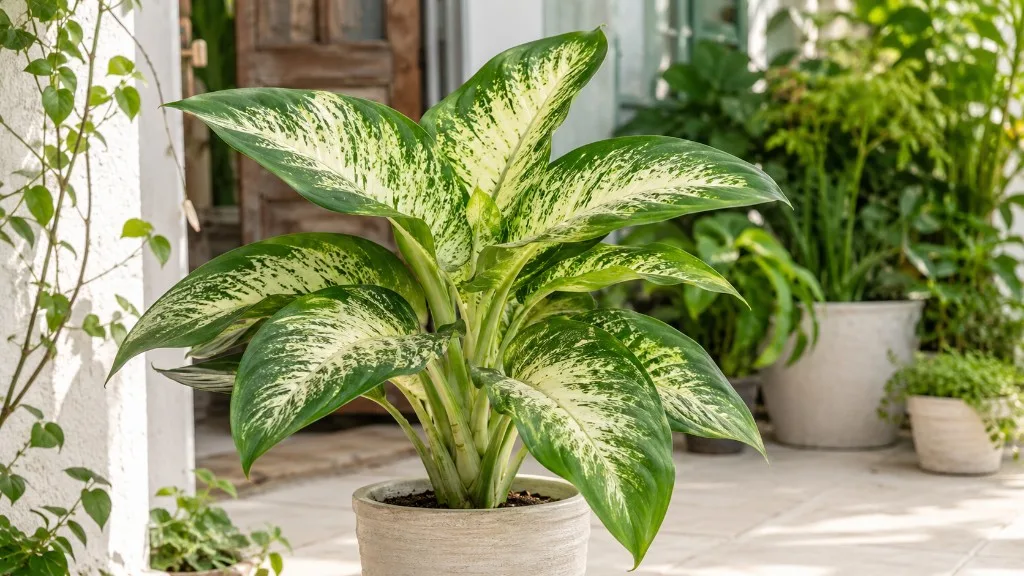
Dieffenbachia Tropic Snow is sold for its oversized, mottled leaves - broad green canvases splashed with creamy white and silver that read like tropical snowfall frozen mid-drift. That pattern is not paint applied for your living room. It is living tissue with uneven chlorophyll distribution, and uneven chlorophyll changes how the plant handles light at the cellular level. Give Tropic Snow the wrong exposure and you do not get a slow, dignified decline. You get faded contrast in dim corners or crispy brown scorch on the palest patches when afternoon sun hits unfiltered glass.
The practical target for Dieffenbachia amoena ‘Tropic Snow’ - also sold under Dieffenbachia seguine ‘Tropic Snow’ in some catalogs - is bright indirect light for most of the day. That means strong ambient brightness where rays reach the canopy without sitting in the direct sun path for harsh midday hours. NC State Extension lists dieffenbachia cultural needs as partial shade with high humidity indoors - a range Tropic Snow inherits through broad leaves, thick canes, and mottled variegation that trades photosynthetic area for display value.
How Much Light Dieffenbachia Tropic Snow Actually Needs
Dieffenbachia evolved as an understory aroid in the tropical Americas, where sunlight arrives filtered through canopy rather than as sustained direct beams. Care references describe the genus as suited to partial shade and indoor bright indirect light - a range Tropic Snow inherits through broad leaves, thick canes, and mottled variegation that trades photosynthetic area for display value. (Missouri Botanical Garden)
For home growers, translate “understory” into placement you can verify. Tropic Snow should live where the plant faces open sky brightness for roughly 6 to 10 hours daily, with direct rays limited to gentle morning exposure or heavily filtered afternoon light. Medium indirect light - the kind you get several feet back from a bright window or in a well-lit office - keeps many dumb canes alive, but Tropic Snow’s white variegation intensity usually softens there over time. The plant survives; the contrast that made you buy it does not.
Gardener’s Supply summarizes the genus signal growers should watch: if leaves become less vibrant and less variegated, with smaller new growth, the plant likely wants more light - while direct sun still risks scorch. Clemson HGIC notes that dieffenbachia prefer bright, indirect light and that direct sun can scorch leaves. That split diagnosis matters for Tropic Snow specifically because its failure modes are polar opposites. Too little light produces green drift and stretch; too much produces bleached and burned pale zones. The correct band is narrower than “anything but a closet.”
Light also sets the pace for everything else in the care system. A Tropic Snow in proper bright indirect light uses water faster, produces firmer new leaves, and maintains thicker canes than the same plant in a dim corner with wet soil - a combination that invites root stress. Treat light as the throttle, not a decorative detail you set once and forget.
The Short Answer for Busy Growers
If you only remember four rules, use these. Default placement: bright indirect light within 1 to 3 feet (30 to 90 cm) of an east-facing window, or a filtered south/west window where the plant sees sky but not a hard sun disk at midday. Variegation goal: prioritize brightness enough that new leaves keep crisp mottling; fading on old leaves alone is not the test. Direct sun rule: brief morning sun can work when acclimated; unfiltered afternoon sun on white patches is high risk for scorch. Diagnostic habit: judge light by the newest leaf or shoot after 10 to 14 days in a spot - old damage does not heal, only new growth tells the truth.
Do not change light, watering, and pot size in the same week. Move the plant, wait for a new leaf, then adjust water if dry-down speed changed.
Why Variegated Tropic Snow Is More Light-Sensitive Than Solid Green Dumb Cane
Not all dumb cane leaves respond to light the same way. A solid green Dieffenbachia has chlorophyll distributed across most of the lamina, which gives cells more capacity to absorb useful light and dissipate excess energy safely. Tropic Snow is different. Its beauty is mottled variegation - irregular islands of creamy white and pale green breaking across a darker green field - rather than the neat cream-centered pattern of cultivars like ‘Camille’. That mottling creates a patchwork of tissue types on a single leaf, and the palest patches are structurally disadvantaged in both low light and high light.
In low light, the plant cannot afford to maintain high-contrast variegation across large leaf area. It compensates by pushing more chlorophyll into newer growth, which reads as greener, duller, less snowy foliage. In high direct light, the same pale zones lack the pigment machinery to process sudden photon load, so they bleach, collapse, or necrose into crisp brown patches while greener sections may still look fine for a few days. Tropic Snow is therefore more demanding than a solid green cane even though both share the same genus label on a care tag.
How Pale Tissue Loses the Chlorophyll Buffer
Chlorophyll does more than make leaves green. It is the core photosynthetic machinery, and it participates in managing light energy flow through the leaf. In white and cream mottled zones, chlorophyll density is lower by design. Those cells reflect more light - which is why they look pale - but they also have less capacity to convert or safely dissipate excess energy when direct sun hits.
When strong direct rays land on pale tissue, energy can outpace the leaf’s protective chemistry. The result is photobleaching (a washed, translucent look), followed by necrosis (dry brown patches) on the most exposed zones. Green tissue on the same leaf may tolerate the exposure longer, which confuses growers who see “only part of the leaf burned” and assume disease rather than light geometry. On Tropic Snow, scorch often starts on the whitest islands and on the leaf section facing the window or sun path.
This is why generic advice to “give dieffenbachia bright light” without nuance fails for variegated types. Bright indirect light delivers energy without the sharp heat-and-UV spike of direct beams on pale cells. Direct sun on the same plant can destroy the very feature you bought it for.
Low-Light Fade vs Genetic Reversion
Low-light fade on Tropic Snow is usually a physiological response, not a permanent genetic switch. In dim conditions, the plant produces leaves with more green pigmentation and less white mottling because chlorophyll is the fastest path to more photosynthesis per square inch. Internodes may lengthen as the cane leans and stretches toward the brightest vector in the room. New leaves can emerge smaller, thinner, and paler overall - not because the plant lost its cultivar identity, but because it is rationing construction cost under weak light.
True genetic reversion is uncommon in healthy stock. Before assuming it, rule out months in a dim office or a pot too far from glass where the room looks bright but leaf-level flux is low. Move to brighter indirect light, acclimate over 7 to 14 days, and inspect the next two new leaves - returning mottling means fade, not reversion.
Bright Indirect Light and White Variegation Intensity
Bright indirect light is the phrase every dieffenbachia care sheet repeats, and it is also the phrase most growers misunderstand. It does not mean “any room that feels airy.” It means the plant receives strong, diffuse illumination - enough to cast a soft shadow at midday - without sustained direct sun on the leaf surface.
For Tropic Snow, bright indirect light supports three outcomes simultaneously. It supplies enough energy for upright, thick cane growth rather than a thin leaning stem. It maintains crisp mottled contrast on new foliage. And it keeps metabolism high enough that your Dieffenbachia Tropic Snow watering guide stays predictable - a dim plant in wet soil is a common silent killer for this genus.
Rotate weekly so large leaves do not hide one-sided scorch on the window-facing face. UF/IFAS Extension recommends placing dieffenbachia in bright, indirect light away from harsh direct sun.
What Bright Indirect Means in a Real Room
Use these room-level checks instead of guessing from ceiling brightness.
Shadow test: At midday, hold your hand between the plant and the window. A fuzzy, soft shadow with visible edges means useful indirect brightness. A sharp, dark shadow means direct sun is hitting the plane - fine for a few morning minutes if acclimated, risky for pale mottling at midday. No meaningful shadow means the spot is too dim for strong variegation long term.
Leaf-level test: Place the pot so light lands on the canopy, not just the floor beside it. Tropic Snow is often used as a statement floor plant beside a bright wall or near a window. “Near” should mean the top of the plant sees window sky, not that the pot sits in a corner while the window is three meters away.
Season test: Winter sun angle can pull rays onto a previously safe sill - add a sheer curtain or move back if pale patches bleach.
Reading New Leaves for Variegation Health
Old leaves are history. On Tropic Snow, judge light by the newest unfurling leaf and the youngest fully opened leaf at the top of the cane.
Healthy bright-indirect growth looks like this: the new leaf opens firm and flat without crisping at the pale zones; mottling is obvious within days of unfurling, with clear contrast between green fields and creamy islands; internodes stay relatively short, so the plant looks stacked rather than ladder-like; and the cane itself stays upright with only mild lean corrected by a quarter-turn rotation weekly.
Low-light new growth looks different: leaves emerge smaller than recent predecessors; mottling is faint or delayed, with more overall green wash; the petiole may elongate before the blade expands; and the whole shoot may angle sharply toward the brightest window. These are not cosmetic flaws - they are the plant reporting photon deficit.
High-light new growth failures show up as tan or brown dry patches on pale tissue during or right after unfurling, yellow halos around scorched zones, or curling and wilting on the window-facing margin even when soil moisture is correct. If scorch appears only on the whitest sections while green areas remain intact, you are almost certainly looking at direct sun or reflected heat, not root rot on Dieffenbachia Tropic Snow.
Best Window Placement for Dieffenbachia Tropic Snow
Window direction is a map, not a guarantee. A “south window” shaded by a porch roof may behave like east light, while an east window with no outdoor obstructions can deliver surprisingly strong morning rays. Still, compass orientation gives a reliable starting point for distance from glass and curtain strategy.
Tropic Snow performs best when it can live close enough to benefit from window brightness but protected from sustained direct beams on its palest tissue. For many homes, that means east exposure or offset placement from south and west glass - not pressed against unfiltered panes all afternoon.
Clemson HGIC notes that dieffenbachia often do well near east- or west-facing windows with bright indirect light, and that south or west exposures may need a sheer curtain between plant and direct sun. Tropic Snow follows that pattern with extra caution on west afternoon heat.
East, South, West, and North Windows Compared
An east-facing window is the most reliable default for Tropic Snow indoors. Morning sun is bright but relatively cool compared with afternoon rays, which helps wake the plant without instantly bleaching white mottling. Many growers can place Tropic Snow 1 to 3 feet (30 to 90 cm) from east glass without scorch, especially if morning exposure lasts only a few hours before shifting to pure indirect brightness.
A south-facing window delivers the strongest year-round sun in the northern hemisphere. In winter, south light can be excellent for Tropic Snow pulled slightly back from the pane or behind sheer fabric. In summer, south glass can magnify heat and push pale tissue into scorch within days. Use south windows when you can provide diffusion at peak hours or place the plant far enough back that it sees sky brightness without sitting in the sun disk.
A west-facing window is higher risk than east for variegated dumb cane. Afternoon sun carries more heat load, and Tropic Snow’s large leaves can heat faster than small houseplant foliage. West can work with 3 to 6 feet (90 to 180 cm) of setback, solar film, or a sheer curtain during peak hours - but treat west as a trial placement, not a default.
A north-facing window in the northern hemisphere usually provides low to moderate indirect light. Tropic Snow may survive here in summer at higher latitudes, especially if the room has white walls and open floor plan reflection, but variegation fade and leggy growth are likely without supplemental LED. North is a grow-light candidate if you want display-quality mottling, not just green survival.
Distance From the Glass and Seasonal Adjustments
Distance controls intensity more precisely than compass labels. Use distance as your fine dial after choosing the best available window.
East glass: start 1 to 3 feet (30 to 90 cm) from the window. Move closer if new leaves show low-light fade; move back if pale zones crisp on morning-facing leaves.
South glass: start 3 to 5 feet (90 to 150 cm) back or on the sill behind sheer curtain. Watch the window-facing leaf face daily for the first week after any move.
West glass: start 4 to 6 feet (120 to 180 cm) back unless curtained. Heat plus light kills pale tissue faster than light alone.
North glass: keep as close as possible to the brightest zone; add a full-spectrum grow light overhead if new leaves shrink or green out.
Seasonal shifts matter on Tropic Snow because leaf size is large and damage is visible. In winter, lower sun angle can suddenly put a previously safe sill into direct beam path - scorch appears on white patches even though “nothing changed” in your routine. In summer, longer days and higher heat may require pulling the pot back or adding diffusion even if winter placement was perfect.
Rotate the plant a quarter turn weekly so the next leaf does not inherit a permanent lean and so you detect one-sided scorch early.
Direct Sun and Scorched Pale Patches
Dieffenbachia as a genus is not a full-sun foliage plant. NC State Extension lists partial shade as the light preference, with direct sun flagged as a scorch risk for container specimens.
The answer, repeatedly, is that pale patches scorch first. Growers moving variegated dieffenbachia from nursery shade to a hot windowsill often see bleached white zones turn crispy brown within days, while greener areas still look normal. That asymmetry is diagnostic. Root disease rarely burns only the whitest islands on the window-facing half of a leaf.
Brief early-morning direct sun - especially in cool seasons - can be acceptable for acclimated plants, and some specimens show slightly tighter growth with a short morning ray. That is not an invitation to park Tropic Snow on an unfiltered south sill all day. The margin between “gentle morning” and “afternoon punishment” is narrow on large variegated leaves.
If you must increase light intensity, increase indirect brightness first - closer to a filtered window, reflector wall, or supplemental LED - before adding direct beam hours.
Afternoon Sun and Window-Heat Risk
Afternoon sun through west or south glass combines three stresses: higher photon intensity, elevated leaf temperature, and lower relative humidity near the pane. Tropic Snow leaves are broad, so they intercept more total energy than small leaves on a shelf plant. Pale tissue also heats differently because reflected light and thinner pigment content change local water loss.
Window-heat risk shows up as scorch even when the plant is not in the direct sun disk - reflected heat from glass, nearby radiators, or dark curtains can damage pale zones. Large floor pots also sit in warmer air layers near sunny glass. If you feel heat shimmer on the leaf surface, diffusion or setback is overdue.
When scorch happens, move immediately to bright indirect light. Prune fully brown sections later with clean tools - dieffenbachia sap is irritating, so wear gloves. Scorched white tissue does not re-variegate; only new leaves restore appearance.
Low-Light Limits and Leggy Growth
Tropic Snow is often marketed as an office plant or low-light-tolerant statement foliage piece, and the genus does tolerate lower light better than many variegated tropicals. Tolerance is not the same as quality performance. In dim conditions, Tropic Snow usually lives while white variegation fades, internodes stretch, and new leaves shrink - a slow downgrade that owners blame on watering because the pot still looks “fine” from across the room.
Clemson HGIC notes that too little light can produce yellowing and droop, while too much direct light causes complementary stress - a reminder that light mistakes mimic water mistakes on dumb cane. Always pair light diagnosis with a moisture check, but do not water your way out of a photon shortage.
Low light also changes dry-down speed. A dim Tropic Snow uses less water; if you keep the summer watering cadence from a bright window, soil stays wet too long and roots suffer - which then shows as yellow lower leaves and compounds the false “maybe it needs more water” loop.
When Dim Rooms Still Work - and When They Don’t
Dim rooms can work for Tropic Snow when your goal is basic survival and you accept muted variegation. A hallway with reflected office light, a north room with large white walls, or a spot several meters from a bright window may keep the plant upright for months if watering is conservative and humidity is reasonable.
Dim rooms fail Tropic Snow when you want crisp mottling, thick canes, and floor-plant presence. If the plant leans sharply, produces small greenish new leaves, or loses contrast on consecutive new leaves, the room is below the display threshold even if the plant is technically alive.
No fertilizer fix restores snow pattern without more light - relocate the plant, add a grow light, or accept muted variegation.
Grow Lights When Natural Light Is Not Enough
When window light cannot support crisp variegation - north rooms, deep floor plans, winter sun angle loss, or office cubicle constraints - a full-spectrum LED grow light is the cleanest fix. Grow lights do not replace the need for correct watering, but they restore photon budget without scorching pale tissue the way unfiltered south glass can.
Dieffenbachia respond well to supplemental light when natural brightness is weak. The goal is even canopy coverage at moderate intensity, not a spotlight that burns one leaf top.
Fixture Distance, Hours, and Spectrum
Start with a full-spectrum LED rated for houseplants, mounted 12 to 24 inches (30 to 60 cm) above the tallest leaf, and run it 10 to 12 hours daily on a timer to mimic a coherent day length. If new leaves green out or stretch toward the bulb, raise intensity gradually by lowering the fixture 2 inches (5 cm) at a time and waiting for one new leaf between changes. If pale zones show dry patches despite good watering, raise the fixture or shorten hours - you have overshot.
Use even top lighting across the canopy, and combine with modest window light when possible. Increase watering checks slightly after adding light, but do not change fertilizer at the same time.
Warning Signs Your Tropic Snow Has the Wrong Light
Light stress on Tropic Snow is readable if you separate too little from too much and ignore old leaves that only tell you where the plant used to live.
Too little light usually shows as leggy canes with long spaces between leaves; strong lean toward the brightest source; smaller new leaves than older ones; faded mottling that looks increasingly green overall; slow unfurling; and yellow lower leaves paired with soil that stays wet too long because metabolism dropped. If you see this cluster, increase indirect brightness first - closer to window with diffusion if needed, or add LED - rather than fertilizing.
Too much light usually shows as bleached white patches turning paper-thin and translucent before browning; crispy necrotic spots concentrated on pale mottling; yellow halos around damaged zones; curling or wilting on the window-facing leaf half during midday; and stalled new growth despite bright conditions because stress paused expansion. If damage is one-sided, rotate and reduce direct beam intensity immediately.
Mixed mistakes happen when a plant is moved from dim to harsh sun in one jump - a recipe for shock, leaf drop, and scorched pale tissue at once. Always bridge through bright indirect for a week before adding morning direct.
Use the two-leaf rule: one new leaf after a correction tells you direction; two consecutive new leaves confirm the placement works.
Conclusion
Dieffenbachia Tropic Snow rewards a specific light band: bright indirect strong enough to keep white mottling crisp on new leaves, without direct sun that cooks pale tissue faster than green. East and filtered bright windows are the practical starting map; south and west need distance, diffusion, or both; north usually needs LED if variegation is the goal. Low light does not kill Tropic Snow quickly - it fades the pattern, stretches the cane, and quietly complicates watering until the plant looks like a greener, thinner version of itself.
Place the pot where the canopy sees sky brightness, not where the room merely feels lit to you. Acclimate changes over 7 to 14 days, judge results on new growth, and adjust water when dry-down speed shifts. When windows fail, a full-spectrum grow light at sane distance restores contrast without the scorch lottery of hot glass. Get that band right and Tropic Snow stays the structural, snowy foliage plant it was bred to be - broad leaves, thick canes, and mottling that still reads from across the room.
When to use this page vs other Dieffenbachia Tropic Snow guides
- Dieffenbachia Tropic Snow overview - Start here for whole-plant context before deep-diving this topic.
- Dieffenbachia Tropic Snow problems hub - Jump to symptom-specific fix guides when this care topic does not resolve the issue.
- Not Enough Light on Dieffenbachia Tropic Snow - Escalate here when light adjustments are not enough.
- Leggy Growth on Dieffenbachia Tropic Snow - Escalate here when light adjustments are not enough.
Related Dieffenbachia Tropic Snow guides
- Dieffenbachia Tropic Snow overview
- Dieffenbachia Tropic Snow watering
- Dieffenbachia Tropic Snow soil
- Dieffenbachia Tropic Snow propagation
- Dieffenbachia Tropic Snow fertilizer
- Dieffenbachia Tropic Snow repotting
- Not Enough Light on Dieffenbachia Tropic Snow
- Leggy Growth on Dieffenbachia Tropic Snow
- Dieffenbachia Tropic Snow problems
Related tool
Try the Plant Problem Diagnosis Tool with dieffenbachia-tropic-snow pre-selected to estimate needs for your setup.