Drooping Leaves on Alocasia Polly: Causes, Checks & Fixes
Quick answer
Drooping on Alocasia Polly usually splits into wet-soil droop (overwatered corm, failing roots) or dry-soil droop (dehydrated corm, crispy edges)-not a single 'needs water' answer. First step: press your finger 1–2 inches into the mix, lift the pot, and feel the corm at the soil line before adding water.
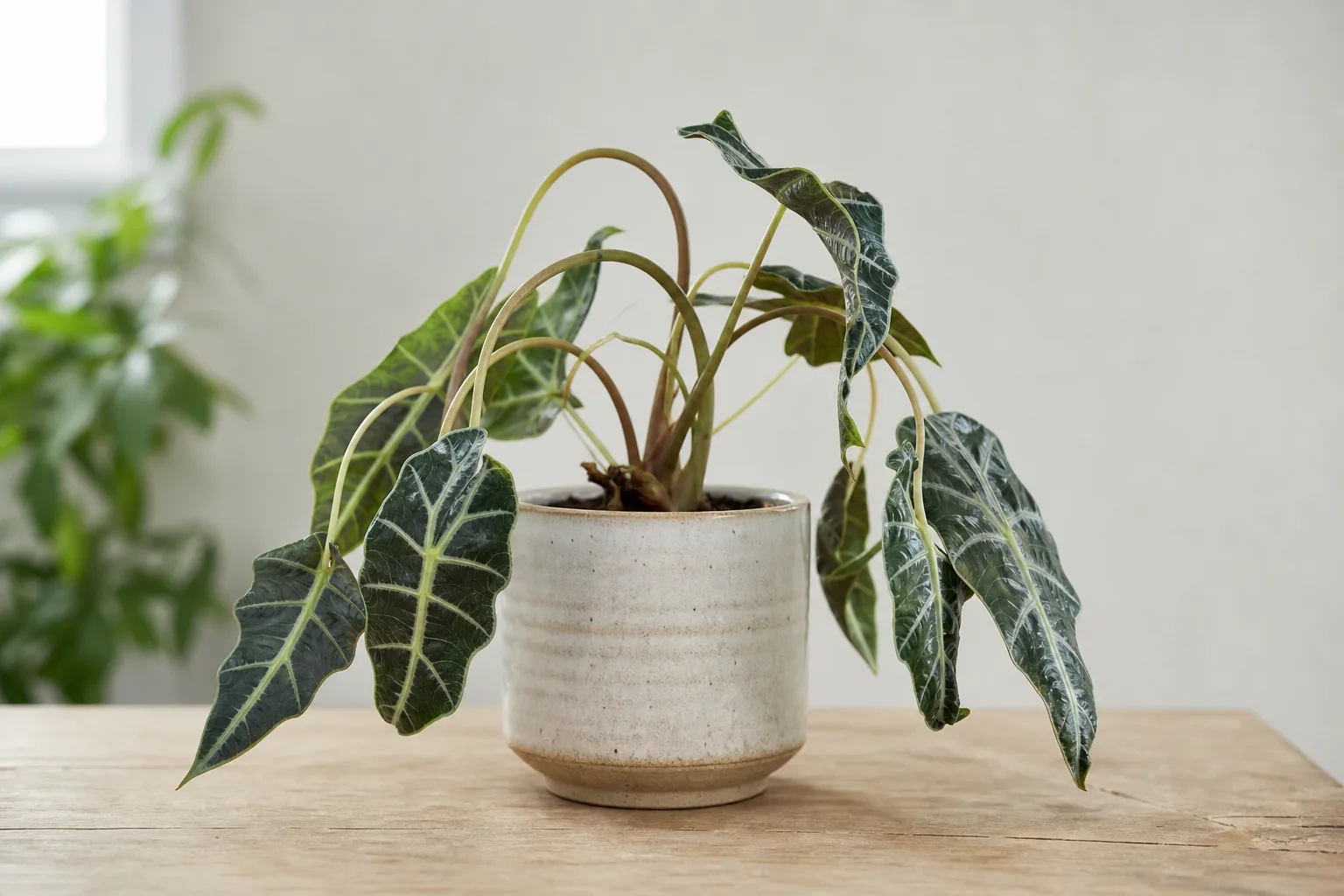
Drooping Leaves on Alocasia Polly: Causes, Checks & Fixes
This guide covers drooping leaves on Alocasia Polly. See also the general Drooping Leaves guide, watering, and light pages for this plant.
Drooping Leaves on Alocasia Polly: Causes, Checks & Fixes
Quick answer
Drooping leaves on Alocasia Polly (Alocasia × amazonica ‘Polly’) means arrow-shaped foliage hangs at a lower angle than usual-petioles bend downward while the plant still looks structurally intact. Unlike acute wilting, droop often develops over days and can come from opposite root-zone problems: a waterlogged corm suffocating in wet mix, or a dehydrated corm pulling moisture from leaves faster than roots can replace it.
First step: press your finger 1–2 inches into the mix, lift the pot, and feel the corm at the soil line before you water. Wet at that depth with a heavy pot and soft leaf tissue → stop watering and inspect the corm-damaged roots cannot move water upward even when soil is wet. Dry at that depth with a light pot and crispy leaf edges → underwatering is likely; one thorough soak-and-drain usually helps if the corm is still firm.
Polly is a corm-first plant. The underground storage organ holds reserves when leaves droop from a missed watering, but it rots quickly when soil stays saturated. That asymmetry is why wet-soil droop is almost never solved by watering again.
What drooping looks like on Alocasia Polly
Healthy Polly leaves hold a crisp upward angle on stiff petioles. Dark green blades with silver veins feel taut-not floppy. Drooping removes that lift.
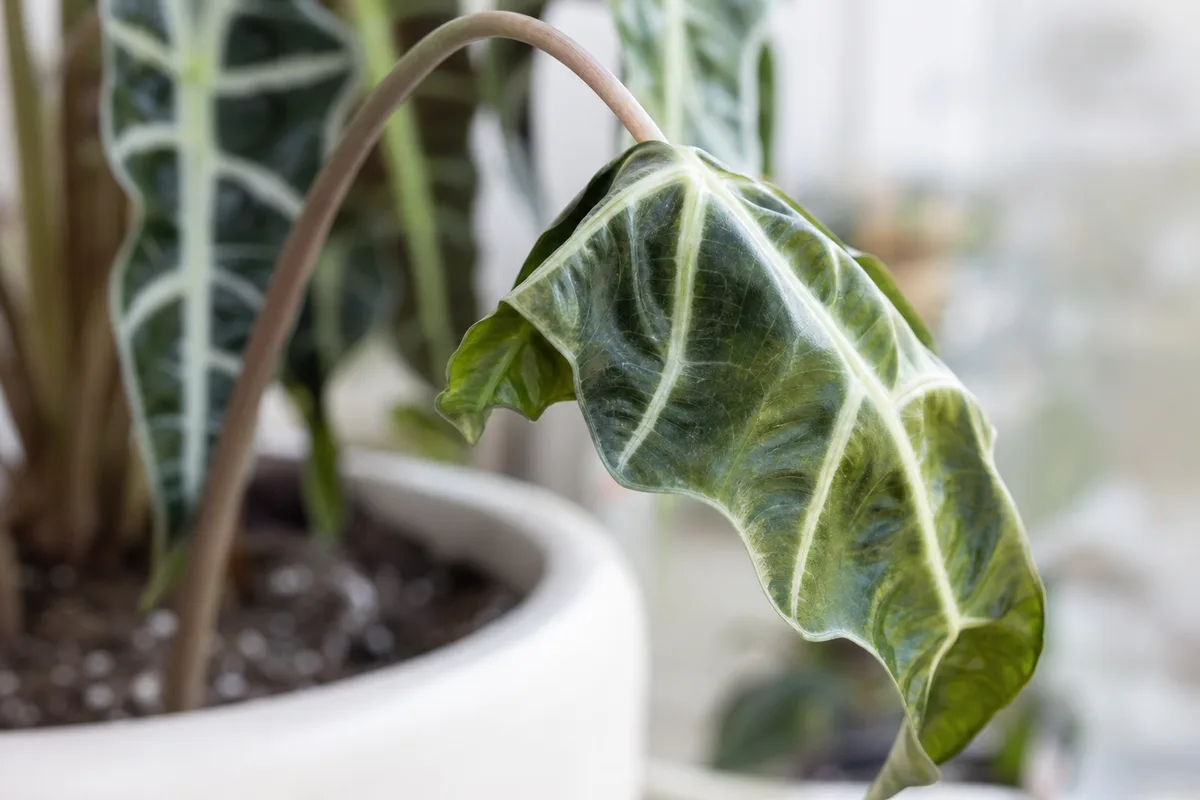
Drooping Leaves symptoms on Alocasia Polly - compare with healthy tissue on the same plant.
Wet-soil droop (overwatering / early root decline):
- Leaves angle downward while mix stays damp or soggy for many days
- Leaf tissue feels soft or thin, sometimes yellowing from the bottom up
- Pot stays heavy when lifted; surface may look dry while the center holds water
- Corm at the soil line may feel spongy on advanced cases
- Sour smell when you disturb the mix points toward root rot
Dry-soil droop (underwatering):
- Petioles bend; leaf edges turn crispy brown while tissue still feels relatively firm
- Top 1–2 inches of mix are dry; pot feels noticeably light
- Often follows a hot week, a missed watering, or hydrophobic mix that repels water
- Corm still firm when you brush soil away at the base-recovery is realistic
Low-humidity or heat-stress droop:
- Leaves droop on otherwise correct watering; margins crisp before whole leaves collapse
- Common near heaters, AC vents, or in winter rooms below 40% relative humidity
- New leaves may emerge smaller or struggle to unfurl
- Overlaps with low humidity and brown tips patterns
Cold-draft droop:
- Rapid downward angle on leaves near a winter window, door blast, or AC stream
- Often paired with darkened or blackened leaf patches on chilled tissue
- Mix may still be moist; chilled roots on wet soil droop faster than drought alone
- Air temperatures should not dip below 60°F (15°C) for Alocasia
Dormancy droop:
- Older leaves gradually droop and yellow in late fall or winter while the corm stays firm
- Growth stalls; new leaves stop emerging for weeks
- Follows shorter days and cooler room temperatures-not a call for summer watering frequency
Post-repot droop:
- Whole plant angles down within a week of repotting or nursery delivery
- Firm corm, no sour smell, and moist-not soggy-fresh mix point to transplant adjustment
- Usually stabilizes when light and watering stay consistent
Drooping vs. wilting on Alocasia Polly
Use this page when leaves gradually hang lower but petioles still feel fairly firm-a posture change over days. Use the wilting guide when foliage loses turgor quickly-soft, limp, collapsed leaves across the canopy within hours. Wet-soil droop and wet-soil wilt share the same root cause; the difference is speed and tissue texture. Acute collapse needs immediate moisture-direction checks; gradual droop still needs the same corm-first diagnosis before you water.
Why Alocasia Polly leaves droop
Alocasia Polly stores water and starch in a corm at or just below the soil surface-not in thick succulent leaves. Leaves transpire moisture; the corm replenishes them when roots work. When roots fail from saturation or drought, petioles lose tension and blades angle down.
Overwatering and root decline are the most common indoor cause. Dense or oversized pots keep the root zone oxygen-poor. Saturated mix drives out oxygen; fine roots die; the corm softens; leaves droop on wet soil-the classic wet-wilt paradox. Owners see hanging leaves and water again, which accelerates rot. Full escalation lives on overwatering and root rot.
Underwatering pulls moisture from leaves when the corm dehydrates. Polly wants consistently moist, organically rich, well-drained soils-not bone-dry cycles. A missed week in bright summer light or hydrophobic peat that sheds water can droop the whole rosette even though the plant looks “recently watered” at the surface. See underwatering when the pot is light and edges are crispy.
Low humidity and heat stress matter because Polly needs high humidity locations indoors. Thin leaves lose water fast in dry winter air. Drooping with crispy margins on otherwise correct soil moisture fits air stress-see the low humidity guide.
Cold below about 60°F (15°C) during active growth slows root function and damages leaf tissue. Drafts near glass in winter are a frequent trigger. The Royal Horticultural Society recommends keeping alocasias above 16°C (60°F) through the growing season and above 10°C (50°F) in winter dormancy.
Dormancy is normal. In cooler, drier winter conditions Polly sheds older leaves; drooping precedes drop while the firm corm rests. Overwatering dormant plants is one of the fastest ways to rot the corm.
Transplant shock temporarily reduces root uptake after repotting. A firm corm and no rot smell point to patience, not emergency repotting.
Wet-wilt vs. dry-wilt vs. dormancy vs. transplant shock
| Pattern | Soil / pot | Leaf texture | Corm | Likely cause | Read next |
|---|---|---|---|---|---|
| Gradual droop, yellow lowers, damp depth | Heavy, wet | Soft, thin | Firm → soft if advanced | Overwatering / root decline | Overwatering |
| Gradual droop, crispy edges, dry top 1–2 in | Light, dry | Firm but limp angle | Firm | Underwatering | Underwatering |
| Drooping on wet soil, sour smell, mushy base | Heavy, soggy | Soft, collapsing | Soft | Root rot | Root rot |
| Drooping with brown margins, correct soil moisture | Evenly moist | Crispy edges | Firm | Low humidity / heat | Low humidity |
| Older leaves droop, growth stops, cool room | Slower dry-down | Yellowing lowers | Firm | Dormancy | Watering guide (winter section) |
| Whole plant droops after repot, no sour smell | Fresh moist mix | Soft angle, not mush | Firm | Transplant shock | Repotting guide |
| Acute soft collapse within hours | Variable | Limp, deflated | Variable | Wilting / cold shock | Wilting |
How to confirm the cause
Work through these checks in order-each step narrows the fix before you change care:
Check 1: Soil moisture and pot weight
Push your finger 1–2 inches (2.5–5 cm) into the mix, or use a chopstick to the pot bottom. The Royal Horticultural Society recommends watering alocasias once the top 5 cm (2 in) of compost has dried during active growth. Lift the pot: light and dry fits underwatering; heavy and damp fits overwatering or winter calendar watering in a dim room.
Check 2: Leaf texture (soft vs. crispy)
Soft, thin, yellowing tissue on wet soil points to root-zone failure. Firm blades with crispy brown edges on dry soil point to drought. Crispy margins with evenly moist soil point to humidity or water-quality stress.
Check 3: Corm firmness at the soil line
Brush away a little top mix at the base of the petioles. A healthy Polly corm feels like a firm potato. Spongy or foul-smelling tissue means rot is advancing-stop watering and unpot immediately.
Check 4: Light, humidity, and temperature
Bright indirect light dries mix faster than a north corner; dim rooms keep soil wet too long. Note heaters, AC vents, and winter window glass within three feet of the pot. Below 60°F (15°C) at the root zone during active growth stresses Polly quickly.
Lookalikes: transplant shock, pests, normal dormancy
- Transplant shock - Firm corm, droop within two weeks of repotting, no sour smell
- Spider mites - Stippling and fine webbing under leaves; dry air worsens both-see spider mites
- Dormancy - Cool room, short days, older leaves only, firm corm
- Not enough light - Chronic droop with long petioles stretching toward a window-see not enough light
Do not water until wet vs. dry is clear. Wet-soil droop is rarely thirst.
First fix by cause
Press your finger 1–2 inches into the mix, lift the pot, and feel the corm-then act on what you find.
- If dry and light with a firm corm: Water thoroughly until water runs from drainage holes. Empty the saucer within 15 minutes. One deep drink rewets the root ball; repeated shallow sprinkles leave the corm dry while leaves stay drooped.
- If wet and heavy with a firm corm: Stop watering. Move to bright indirect light to speed safe dry-down, empty saucer water, and verify drainage holes are open. Re-check corm firmness in three days.
- If wet with a soft corm or sour smell: Do not water. Unpot, rinse roots, trim mushy tissue, and follow the root rot guide. A firm corm can regrow roots even when all foliage droops.
That single diagnostic step prevents the most common Polly mistake: watering a drooping plant in already-wet soil.
Do not fertilize, repot, or prune heavily on day one unless you have confirmed mushy roots or a clearly hydrophobic dry core.
Step-by-step recovery by cause
Overwatering / root rot starting
- Stop watering immediately.
- Move to bright indirect light and increase airflow around the pot-not direct sun on stressed leaves.
- If the corm is still firm after the mix dries partially, hold water until the top 1–2 inches are dry, then resume soak-and-drain watering per the watering guide.
- If the corm softens or roots smell sour, unpot and trim rot before repotting into chunky aroid mix.
Underwatering / hydrophobic soil
- Water deeply once; for repelling dry peat, water, wait 30 minutes, water again, then drain fully.
- Trim only leaves that stay fully crispy and brown; green drooped tissue often re-angles after hydration.
- Adjust rhythm: top 1–2 inches dry in active growth-roughly every 7–10 days in summer, much less in winter-not a fixed calendar.
Low humidity or cold draft
- Move the plant away from vents, radiators, and cold window glass.
- Raise humidity with a pebble tray, grouping plants, or a humidifier targeting 40–60% if possible.
- Keep soil evenly moist-not soggy-while leaves recover; dry air plus drought doubles stress.
Post-repot stress
- Keep bright indirect light and water when the top 1–2 inches dry-no extra drinks on wet fresh mix.
- Avoid moving the pot again for at least four weeks.
- Hold fertilizer until a new leaf unfurls firm and upright.
Recovery timeline on Alocasia Polly
Underwatering on a firm corm: Noticeable re-angling within 2–24 hours after a thorough drink; a new leaf may take one to three weeks to emerge.
Overwatering / early root stress: Days to two weeks after the root zone dries and oxygen returns. Judge by firm new growth from the center, not old yellow foliage.
Low humidity: One to three weeks after humidity improves; existing crispy edges do not heal-watch new leaves.
Cold draft: One to two weeks after placement stabilizes above 60°F (15°C) at the root zone.
Dormancy: Drooping leaves may drop; the corm rests until spring warmth. New shoots often appear within weeks once temperatures and light rise.
Repotting: Two to four weeks for posture to normalize; do not judge failure in the first week.
Collapsed older leaves rarely return to their original upright angle. Success means a firm corm and new upright foliage.
What not to do while leaves are drooping
Do not water every droop without checking soil depth-wilting on wet soil is not a call for more water; wet-soil droop needs drying and corm inspection instead.
Do not leave saucers full or cachepots holding standing water. Waterlogging displaces oxygen from soil pore spaces and anaerobic corms rot while leaves still look merely “tired.”
Do not move a drooping Polly into direct sun to dry it out. Glossy leaves burn quickly; heat adds stress on failing roots.
Do not fertilize collapsed foliage. Salt stress on damaged roots slows recovery.
Do not repot a dry, drooping Polly with a firm corm on day one-a deep watering usually fixes simple thirst.
Do not stack repot, prune, and pesticide on the same stressed plant in one afternoon.
Do not increase winter watering because leaves droop during dormancy-see the winter rhythm on the watering guide.
Prevent drooping next time
Water when the top 1–2 inches of mix are dry during active growth, using finger, chopstick, or pot weight-not the day of the week. Summer often lands near 7–10 days; winter may stretch to two to four weeks when growth slows.
Use airy aroid mix and a pot only slightly larger than the root mass, with open drainage holes. Empty saucers after every watering.
Keep Polly in bright indirect light and away from cold drafts. Target 65–80°F (18–27°C) during active growth and humidity around 40–60% when possible.
Match watering to light and season-dim winter rooms dry slowly; summer south windows dry fast.
Inspect weekly while problems are small: one drooping lower leaf on a firm corm is easier to fix than a whole rosette on rotten roots.
When to worry
Treat as urgent when:
- Leaves droop on soggy soil with sour smell or a soft corm at the soil line
- Drooping spreads to all leaves while mix stays wet for more than a week after you stopped watering
- The plant does not re-angle within 24 hours after confirmed dry-soil watering on a small to medium pot with a firm corm
- More than half the roots are mushy on inspection
Less urgent but worth fixing soon: mild droop on a dry pot after travel, one older leaf angling down on an otherwise firm plant, or temporary droop right after repotting with firm corm and no rot smell.
What to read next
- Alocasia Polly watering - corm biology, 7–10 day rhythm, and winter dormancy
- Overwatering - wet-soil droop and heavy pots
- Underwatering - light pot and crispy-edge droop
- Root rot - soft corm and sour mix escalation
- Low humidity - crispy margins with correct watering
- Wilting - acute soft collapse vs. gradual droop
- Alocasia Polly light - dim rooms that keep soil wet too long
When to use this page vs other Alocasia Polly guides
- Alocasia Polly watering guide - Use for routine moisture checks before assuming drooping leaves is the main issue.
- Alocasia Polly problems hub - Browse all 16 common issues on this species.
- Underwatering on Alocasia Polly - Different entry point when symptoms overlap with drooping leaves.
- Overwatering on Alocasia Polly - Different entry point when symptoms overlap with drooping leaves.
- Root Rot on Alocasia Polly - Different entry point when symptoms overlap with drooping leaves.