Low Humidity on Alocasia Polly: Causes, Checks & Fixes
Quick answer
Alocasia Polly needs medium to high humidity-aim for 50–60% minimum, ideally higher during active growth. Dry winter air near heat vents causes crispy brown leaf margins, curled edges, and stuck new leaves. First step: measure room RH with a hygrometer, then run a cool-mist humidifier near the plant (not directly on the foliage).
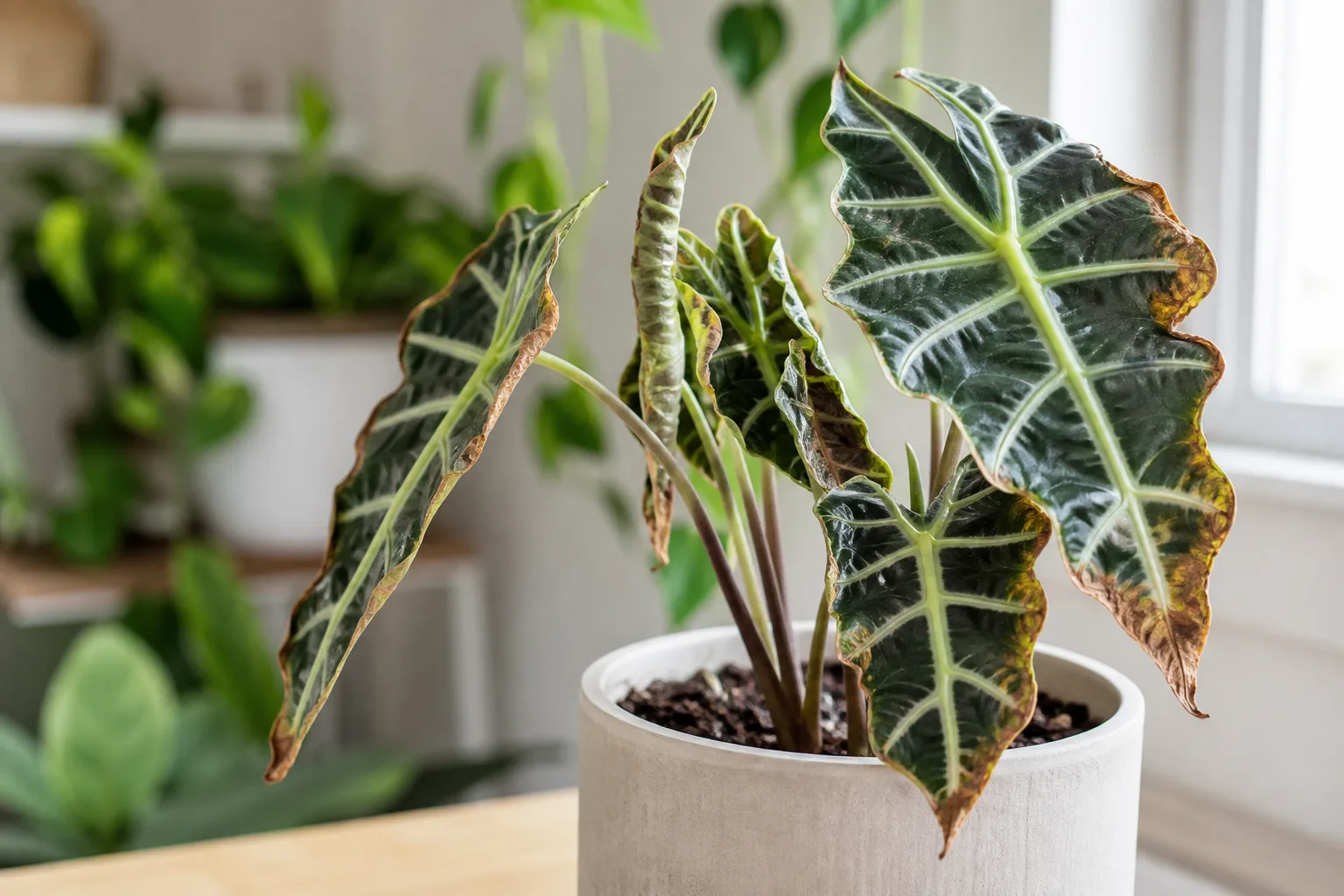
Low Humidity on Alocasia Polly: Causes, Checks & Fixes
This guide covers low humidity on Alocasia Polly. See also the general Low Humidity guide, watering, and light pages for this plant.
Low Humidity on Alocasia Polly: Causes, Checks & Fixes
Quick answer
Low humidity on Alocasia Polly (Alocasia × amazonica ‘Polly’) shows up as crispy brown leaf margins, curling or cupped edges, and new leaves that stall mid-unfurl-especially after winter heating kicks in or the pot sits beside a vent. This compact African mask plant evolved in tropical rainforest understory with constant moisture in the air; centrally heated living rooms often sit at 20–35% relative humidity (RH), far below what its large, thin-margined foliage prefers.
First step: measure ambient RH at leaf height with a digital hygrometer. If readings stay below 40–45% and the symptom pattern matches, run a cool-mist humidifier in the same room-close enough to help the microclimate but not blasting directly onto leaves. That single change addresses the most common Polly-specific cause before you stack pebble trays, grouping, or relocation.
For overlapping edge damage from tap water minerals, see brown tips on Alocasia Polly. For dry air that also triggered pests, check spider mites on Alocasia Polly.
What low humidity looks like on Alocasia Polly
On Polly, dry air damage usually starts at the leaf margins and tips-the thinnest tissue transpires fastest. You may see:
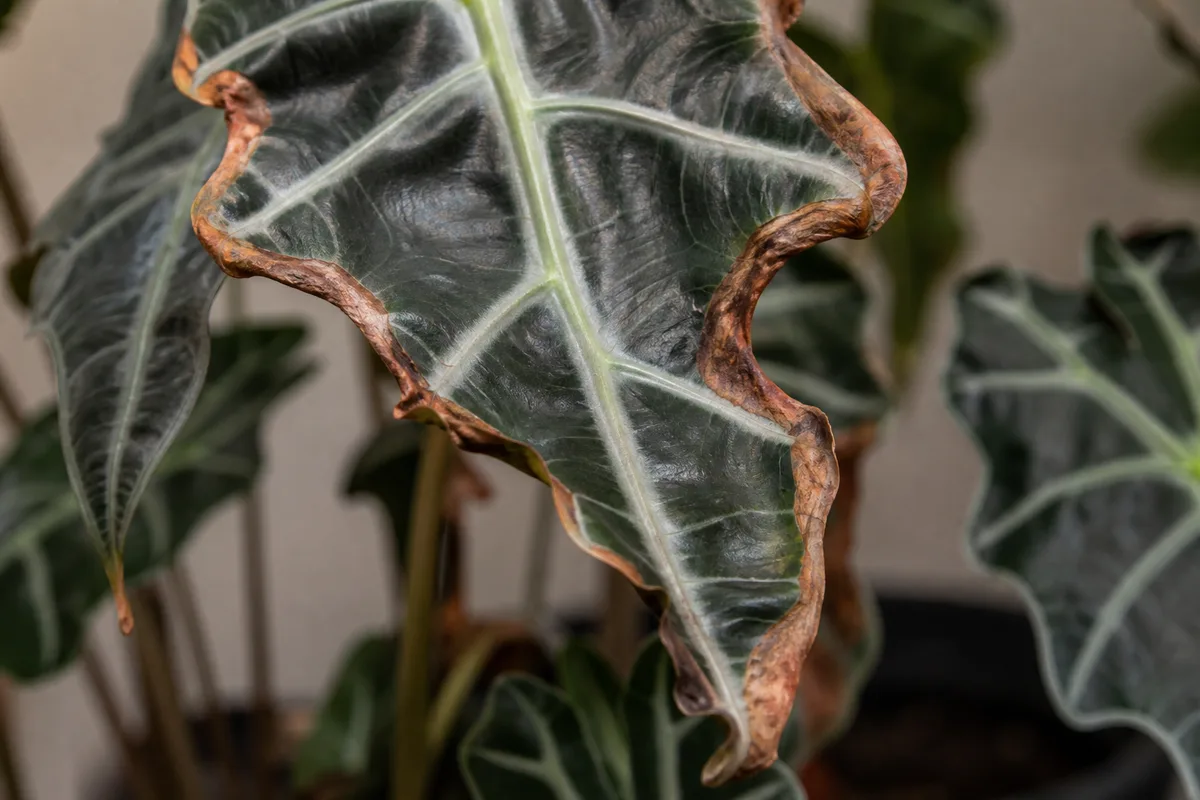
Low Humidity symptoms on Alocasia Polly - compare with healthy tissue on the same plant.
- Crispy brown edges on otherwise firm, dark green leaves with sharp silver veining intact
- Leaf curl or slight cupping as the plant reduces exposed surface area
- New leaves stuck while unfurling, with brown tips on the emerging blade
- Slowed growth during what should be active spring or summer months
- Increased spider mite risk-mites thrive in hot, dry air on large Alocasia leaves
Damage often appears first on the leaf closest to a heat vent, radiator, or drafty window before spreading to the rest of the plant. Older leaves may show margins while the newest leaf still looks acceptable-until RH drops further.
Polly’s compact size does not make it humidity-tolerant. The Missouri Botanical Garden notes that Alocasia are best grown in high humidity locations with consistently moist, well-drained soil-conditions that mimic their native warm, humid forest floor rather than a dry windowsill above a radiator.
Why Alocasia Polly struggles in dry indoor air
Tropical leaf biology
Alocasia Polly is a hybrid within the Alocasia × amazonica group-compact, upright, and sold widely as a houseplant for its dark, arrow-shaped leaves. Like other alocasias, it produces large leaf surfaces that lose water constantly through transpiration. When ambient humidity is low, the leaf margin dries faster than the plant can replace moisture from the roots-especially if the pot is near an active heat source accelerating evaporation.
The RHS Alocasia growing guide lists low humidity as a direct cause of browning on leaf edges and notes that dry air attracts red spider mites. Polly inherits that sensitivity despite its smaller stature.
Winter heating and HVAC
Cold outdoor air holds less moisture; heating it further drops RH. Penn State Extension explains that indoor relative humidity during the heating season can easily fall below 30%, while most indoor plants-including tropical aroids-benefit from levels higher than typical winter homes. North Dakota State University Extension notes homes can reach 10–20% RH in winter, against a general houseplant preference of 40–50%.
Placement near heat and drafts
Polly pots on mantels, radiator shelves, or directly under ceiling vents experience microclimates drier than the rest of the room. A hygrometer beside the pot often reads 10–15 percentage points lower than one in the room center-enough to crisp margins even when the overall house feels “fine.”
Dormancy overlap
In winter, Polly may slow growth or drop older leaves as part of normal dormancy. Low humidity plus reduced watering can look similar-limp petioles and brown edges-but dormancy usually follows cooler temperatures and shorter days, not just dry air alone. Do not increase watering to fix humidity stress; soggy soil on a semi-dormant corm is a fast path to root rot on Alocasia Polly.
How to confirm low humidity is the problem
Work through these checks in order:
- Hygrometer reading - Place a digital hygrometer at leaf height within 12 inches (30 cm) of the pot. RH consistently below 40% during active growth strongly supports dry-air stress. UNH Extension recommends 40–60% for most houseplants, with tropical species preferring the upper end.
- Symptom pattern - Crispy margins on firm leaves with no yellowing of whole leaves, no mushy petioles, and no webbing underneath fits humidity. Whole-leaf yellow with wet soil points to overwatering instead.
- Seasonal timing - Symptoms that appear or worsen within weeks of turning on heat, or after moving the pot closer to a vent, align with environmental RH drop.
- Soil moisture check - Stick a finger 2–3 cm into the mix. Dry air damage can occur with correct watering-do not assume crispy edges always mean underwatering on Alocasia Polly. Conversely, if soil is bone dry and the pot is light, review the Alocasia Polly watering guide before raising humidity alone.
- Pest inspection - Examine leaf undersides and vein axils with a magnifier. Fine webbing, stippling, or moving specks mean spider mites-often worsened by dry air but requiring pest treatment, not humidity alone.
- Water quality cross-check - Uniform tip browning on older leaves with good RH can overlap with fluoride or mineral sensitivity; see brown tips if filtered water does not change new growth.
Confirmed diagnosis requires both low RH readings and a matching symptom pattern-not guessing from brown edges alone.
First fix for Alocasia Polly
Run a cool-mist humidifier in the same room as your Polly, set to maintain roughly 50–60% RH, and keep it operating through the heating season.
Place the unit on a stable surface several feet from the plant so it raises room humidity rather than soaking one leaf. Pair it with the hygrometer and adjust output until readings at leaf height stay in target range for most of the day. UNH Extension notes humidifiers often need to run multiple hours daily in larger rooms to make a measurable difference-expect a few days before margins stop progressing on existing leaves.
This is the first fix because pebble trays and occasional misting rarely lift whole-room RH enough when furnaces hold readings in the 20s. Fix the ambient air first; add secondary methods once the humidifier is running.
Step-by-step recovery (after the humidifier)
Once RH is stable, layer these in order-one change at a time so you can read the plant’s response:
- Move away from heat paths - Shift the pot off radiator ledges and out of direct HVAC blow. Even good room humidity fails if a vent desiccates one side of the foliage daily.
- Group with other plants - NDSU Extension recommends grouping plants to raise local humidity through shared transpiration. A cluster of tropicals around Polly helps more than a single isolated pot.
- Add a pebble tray - Set the pot on pebbles with water below pot bottom level. Evaporation adds a small humidity boost near the leaves; top up water as it drops. Effective as support, not replacement for a humidifier in dry winters.
- Consider a brighter humid room - Bathrooms and kitchens can run higher RH if they offer adequate bright indirect light. Light still comes first-a dark bathroom will not save a Polly even with steam.
- Hold off on extra watering - Dry air is not fixed by keeping soil wetter. Maintain your normal dry-down rhythm from the watering guide.
- Trim only fully dead margins - Optional cosmetic trim on fully brown edges; leave partially green tissue until the next leaf proves conditions are stable.
Avoid misting heavily on Polly. A light occasional mist does not sustain RH, and water sitting on Alocasia foliage in cool, stagnant air can encourage foliar issues. Humidifier beats misting for Alocasia Polly overview.
Recovery timeline
Existing brown margins will not revert to green-that tissue is dead. Timeline benchmarks:
- 24–72 hours - Humidifier should stop new margin damage from spreading on the current leaf
- 1–3 weeks - Next emerging leaf should unfurl more cleanly if RH is truly in range
- 4–8 weeks - Two to three consecutive healthy new leaves confirm the fix; older crispy leaves can be removed for appearance
- Through winter - Keep humidifier running while heat is active; do not assume one week fixes a four-month dry season
If new leaves still burn after three weeks above 50% RH, revisit water quality (brown tips) or pest pressure before buying a second humidifier.
Lookalike symptoms and causes to rule out
| What you see | Likely cause | Quick check |
|---|---|---|
| Crispy brown margins, firm petioles, low hygrometer | Low humidity | RH below 40%; worse near vents |
| Whole-leaf yellow, wet soil, mushy base | Overwatering / root issue | Soil soggy; see overwatering |
| Dry crispy edges, light pot, soil pulled from sides | Underwatering | Pot light; mix dry deep down |
| Stippling + fine webbing on undersides | Spider mites | Magnifier check; dry air is a contributor |
| Tip browning only, good RH, tap water | Fluoride / minerals | Switch to filtered or rainwater |
| Bleached patches on window-facing side | Too much direct sun | See Alocasia Polly light guide |
Mistakes to avoid
Do not water more to compensate for dry air-Alocasia Polly’s corm rots quickly in soggy mix. Do not mist heavily twice daily instead of raising ambient RH; misting is temporary and can leave foliage wet too long. Do not place the humidifier nozzle directly against leaves-constant condensation invites spot problems.
Do not fertilize a Polly showing humidity stress until new growth opens cleanly; salts on stressed roots worsen margin burn. Do not repot and humidify on the same day-stacking stress makes it hard to read which change helped.
Do not assume pebble trays alone fix winter dryness in sub-30% RH homes-they are a supplement. Do not ignore spider mites because you raised humidity; treat pests if present.
How to keep humidity stable through winter and AC season
Build a maintenance routine rather than reacting after leaves crisp:
- Run a humidifier whenever central heat or space heaters are active; clean the unit weekly to prevent mold
- Check RH monthly at leaf height with the same hygrometer placement
- Keep Polly away from radiator shelves, fireplace mantels, and forced-air vents
- Group tropicals in the same bright room to share moisture
- Maintain bright indirect light so the plant uses water at a healthy rate-see the Alocasia Polly light guide
- Reduce watering appropriately in winter dormancy without letting the corm desiccate-details in the watering guide
During summer AC season, monitor RH again-air conditioning also dries indoor air. A portable humidifier or grouped plant zone may still be needed even when heat is off.
When to worry
Escalate if new leaves keep burning after four weeks above 50% RH, the crown or petiole bases soften while soil is wet, or mites spread despite humidity fixes. Those patterns point beyond simple dry air-inspect roots, review watering, and treat pests.
Low urgency: cosmetic margin brown on older leaves while the newest unfurl is clean and firm. Continue current humidity routine and trim old damage when convenient.
Conclusion
Alocasia Polly is unforgiving about dry indoor air because its large tropical leaves lose moisture faster than most succulents or hardy foliage plants. Confirm the problem with a hygrometer, fix ambient RH first with a humidifier, move the pot off heat paths, and judge recovery by clean new growth-not by old crispy edges greening up. Link humidity work to proper watering and light so you are not fighting environment with the wrong lever.
When to use this page vs other Alocasia Polly guides
- Alocasia Polly watering guide - Use for routine moisture checks before assuming low humidity is the main issue.
- Alocasia Polly problems hub - Browse all 16 common issues on this species.
- Brown Tips on Alocasia Polly - Different entry point when symptoms overlap with low humidity.