Alocasia Polly Light Guide: Windows, Foot-Candles, and Grow
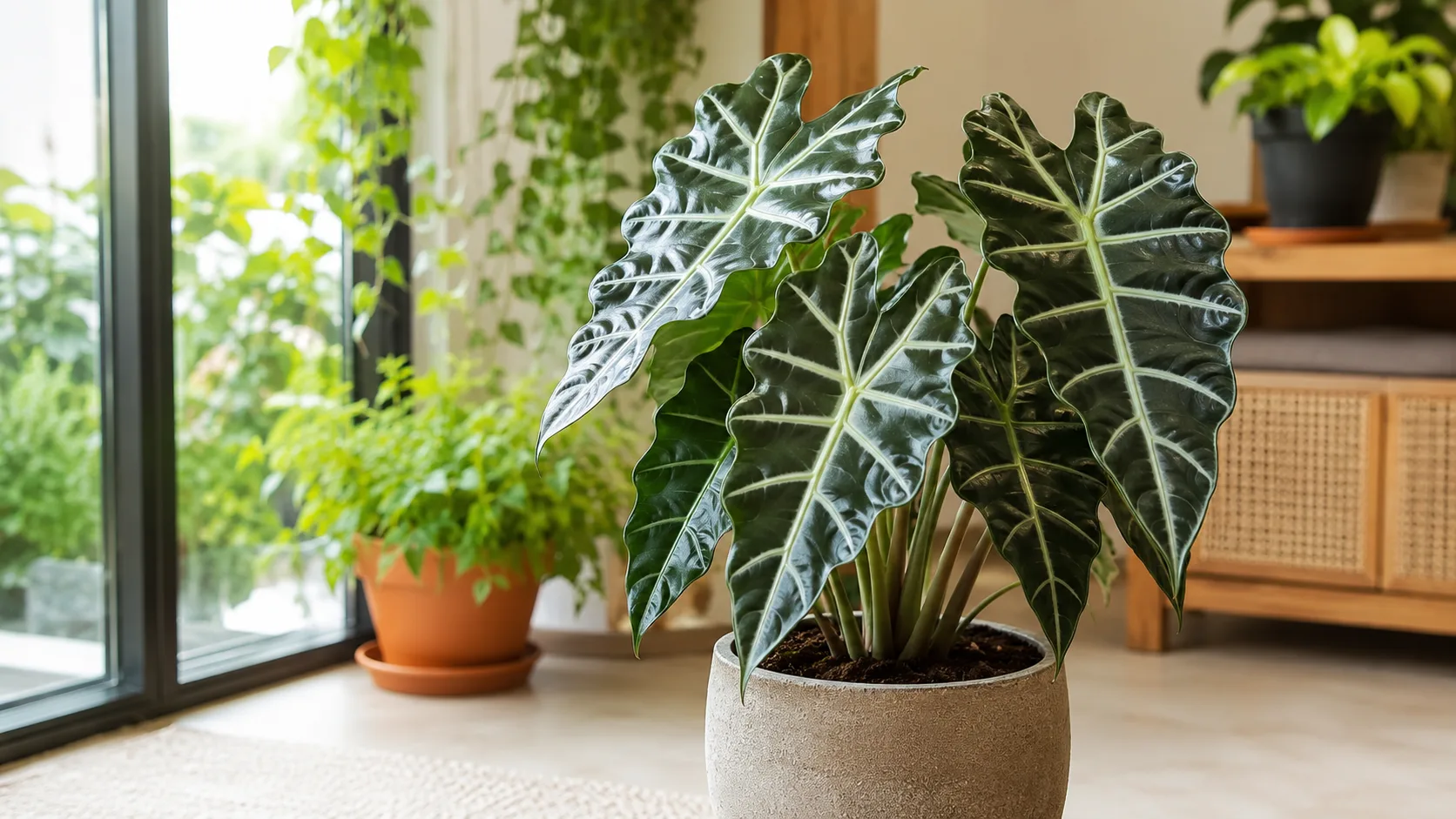
Alocasia Polly Light Guide: Windows, Foot-Candles, and Grow Lights
Alocasia Polly Light Guide: Windows, Foot-Candles, and Grow Lights
If you have ever bought an Alocasia Polly because the silver-veined leaves looked almost painted on, and then watched the new growth come in pale, stretched, or with the veins fading, light was almost certainly the missing ingredient. Alocasia Polly is sold as a beginner-friendly “African Mask Plant,” but in practice it is a tropical understory aroid that asks for a specific kind of light. This guide walks through exactly what that means, how to pick the best window in your home, how to recognize the difference between too little and too much light, and how to use a grow light when natural light is not enough.
Why Light Matters More Than Watering for Alocasia Polly
Most Alocasia Polly problems are blamed on watering, but light is the variable that quietly controls almost everything else. The Royal Horticultural Society’s Alocasia growing guide notes that alocasias “grow best in bright but indirect light” and that “strong sunlight can scorch the foliage,” and that “while they can survive in lower light, their growth will be much slower.” Light, in other words, sets the plant’s energy budget. Watering, humidity, and fertilizer all have to be scaled up or down to match it. A bright plant drinks faster and uses fertilizer efficiently. A dim plant sits in wet soil, struggles to push out new leaves, and is far more vulnerable to root rot on Alocasia Polly.
A second reason light matters is leaf quality. Alocasia Polly’s signature look - the dark, almost lacquered leaf surface with bright, contrasting veins - depends on the plant producing enough chlorophyll and maintaining tight internodes. Without enough light, the contrast dulls, the petioles stretch, and new leaves shrink. The plant still survives, but it stops looking like the plant you bought. Treat light as the foundation of care rather than one of several equal factors, and most other Alocasia Polly issues become much easier to manage.
What “Bright Indirect Light” Actually Means for an Alocasia
“Bright indirect light” is one of the most overused phrases in houseplant care, so it helps to translate it into something measurable. In practical terms, you are aiming for a spot where the plant receives strong ambient light for most of the day but the sun’s direct rays never actually touch the leaves for more than a few minutes. That usually translates to roughly 200 to 400 foot-candles (about 2,000 to 4,300 lux) at the leaf surface for most of the day, and on the more technical PPFD scale used by horticulturists, around 300 to 500 µmol/m²/s during the brightest hours, which works out to a Daily Light Integral of 13 to 21 mol/m²/day on a 12-hour photoperiod.
These numbers are not something you need to chase with a meter every week. The point is that “bright indirect” is a real, defined range, not a vague feeling. A room that feels comfortable and well-lit to you can easily fall below the 100-foot-candle floor that an Alocasia needs. A quick phone-based light meter app, or a cheap dedicated meter, will confirm what your eyes miss. The aroid community generally agrees that Alocasia amazonica types perform best near the top of that range, around 400 foot-candles, which is why east and bright north-facing placements almost always outperform a “bright” room corner that is actually 12 feet from the window.
Reading the Leaf vs. Reading the Room
A useful habit with Alocasia Polly is to stop judging the room and start judging the plant. Old damage will not heal, but the newest emerging leaf tells you almost everything about whether your current light is right. If new leaves are opening compact, dark, and with sharp white-silver veins, your light is in a healthy range. If new leaves are smaller than the older ones, paler, or coming in on noticeably longer petioles, the plant is asking for more light, even if the room looks fine to you.
This is also how you catch problems early. Sunburn shows up on the side of the plant that faces the light source, while low-light stress shows up uniformly as softer color, leggy petioles, and slow growth. A single yellowing leaf can be age, watering, or a dozen other things, but a pattern of paler, stretched, or smaller new growth is almost always a light story. Diagnose with the newest leaf first, then change one condition at a time.
Best Indoor Windows for Alocasia Polly
Window orientation is the single biggest lever you can pull. Each direction delivers a different intensity and duration of light, and the right one depends on where you live, what is outside the window, and how far the plant sits from the glass.
East-Facing Windows: The Default Best Choice
East windows are the most forgiving placement for Alocasia Polly in most homes. They deliver a few hours of direct morning sun, which is gentle enough that the leaves can handle it without scorching, and then transition into bright indirect light for the rest of the day. The Spruce, Soltech, and several aroid-focused growers all recommend east-facing placement as the default for Alocasia amazonica types for exactly this reason. The morning sun is bright enough to drive photosynthesis and keep the veins sharp, but the intensity is well below the 1,000+ foot-candle levels of a south-facing window at midday.
If you only have one east window and a crowded plant shelf, give the Alocasia the spot closest to the glass. Within 1 to 3 feet of the window, with no tree or building shading it, is the sweet spot. The plant should not be pressed against the glass in winter (cold drafts can shock the foliage), but it should be close enough that it actually receives the morning light rather than just the room’s reflected brightness.
North-Facing Windows: Bright Enough or Too Dim?
North windows are the trickiest case, and the honest answer is that it depends on your latitude and the room. In much of the Northern Hemisphere, a north-facing window in winter delivers only 50 to 100 foot-candles at typical indoor placement distances, which is well below the 200-foot-candle floor that Alocasia needs to sustain growth. In summer, with longer days and a higher sun angle, a north window can climb into a more usable 150 to 250 foot-candles. A bright north window in a sunny climate can genuinely work; a dim north window in a cloudy winter climate usually cannot.
If you want to make a north window work, treat the placement as conditional. Measure the light with a phone app at midday on a typical day. If you are consistently below 150 foot-candles, plan to add a grow light on a timer for 8 to 12 hours a day. If you are at 200 foot-candles or above for at least six hours, you can often grow a healthy Alocasia in a north window with no supplemental light, especially if you keep the plant within 1 to 2 feet of the glass.
South and West Windows: High Reward, High Risk
South and west windows are the high-intensity side of the spectrum. In the U.S. and similar latitudes, an unshaded south-facing window can deliver 600 to 1,000+ foot-candles at the glass during summer, and a west window piles on afternoon heat that compounds the stress. Direct sun through these windows, especially between 11 a.m. and 4 p.m., will scorch Alocasia Polly leaves within days if the plant is not acclimated.
That said, south and west windows are not off-limits. They just need management. The two most common approaches are to pull the plant 3 to 4 feet back from the glass so the light arrives filtered through the room, or to hang a sheer curtain that diffuses the direct beam into the bright indirect light the plant actually wants. A sheer curtain that cuts roughly 40 to 60 percent of incoming light typically turns a punishing south exposure into an ideal Alocasia spot. If you choose the “pulled back” approach, watch the leaves carefully during the first week: if the leaf edges curl inward during the brightest hours, the plant is still telling you the light is too direct.
How to Filter Direct Sun Without Starving the Plant
The point of filtering is to reduce peak intensity, not to dim the whole day. A common mistake is closing heavy curtains all day, which can drop usable light below 50 foot-candles. A sheer curtain, a light-filtering roller shade, or even a frosted window film is usually enough to soften the harshest part of the sun’s arc while still letting through the rest of the day’s light. The goal is for the plant to experience several hours of bright, even light rather than 30 minutes of punishing sun followed by gloom.
If you do not want to alter the window, distance works the same way. Light intensity falls off quickly with distance, so a south-facing plant that is 5 feet back from the glass and 6 feet off the floor will experience light closer to a north-facing window’s intensity. The trade-off is that you are also reducing total daily light, so the plant will use less water and may grow more slowly. That is fine in a small space; it is not a great solution if you want strong, steady growth.
Reading Foot-Candles, PPFD, and DLI in Plain English
Three units show up in light guides, and they each measure something slightly different. Foot-candles and lux are based on human vision, so they are easy to read with cheap meters but undercount the blue and red wavelengths plants use most. PPFD (photosynthetic photon flux density), measured in µmol/m²/s, counts the photons plants can actually use. DLI (Daily Light Integral) is the total usable photons a plant receives over an entire day, expressed in mol/m²/day.
For Alocasia Polly, the working targets are roughly: 200 to 400 foot-candles at the leaf for most of the day, 300 to 500 µmol/m²/s during the brightest hours, and a DLI of about 13 to 21 mol/m²/day during active growth. A useful shortcut: a foot-candle reading under a white LED can be multiplied by about 0.15 to 0.20 to estimate PPFD, per the House Plant Journal light requirement guide. None of this replaces watching the plant, but it gives you a way to compare two windows in your home or to decide whether a grow light is actually delivering useful intensity.
Signs Your Alocasia Polly Is Getting Too Little Light
Insufficient light rarely kills an Alocasia quickly, but it steadily degrades the plant. The two most diagnostic signs are loss of vein contrast and leggy petioles, but they often show up together.
Loss of Vein Contrast and Dull Leaf Color
Alocasia Polly is sold on the contrast between its near-black leaf blade and the bright silver-white veins. When light is inadequate, the new leaves come in with a flatter, more uniform green, and the veins lose their sharp white-silver tone. The whole leaf looks softer and “thinner” in color, even though the plant itself is technically still growing. If you compare two leaves from the same plant - an old one grown in a brighter location and a new one grown in a dimmer one - the difference is usually obvious.
Leggy Petioles, Drooping, and Smaller New Leaves
A more mechanical sign of low light is etiolation. Petioles (the stems the leaves attach to) stretch toward the nearest window, and the new leaves sit further apart on the plant. Internodes lengthen, leaves often end up smaller than the older ones, and the plant starts to look leggy and structurally weak. In extreme cases, the petioles can no longer support the leaves, and you end up with a droopy, top-heavy plant that cannot hold its own weight. This is a different visual from overwatering on Alocasia Polly droop: the soil will be appropriately dry and the stems will be visibly elongated, not soft and mushy at the base.
Signs Your Alocasia Polly Is Getting Too Much Light
Over-lit Alocasia Polly is less common indoors but more visually dramatic. It almost always shows up in two patterns: bleached patches on the most exposed leaf surfaces, and brown scorch on the margins.
Bleached Patches and Pale Wash-Out
When direct sun hits a leaf, the chlorophyll in those cells breaks down faster than the plant can replace it. The result is a bleached, papery patch, often slightly translucent, on the parts of the leaf that face the window. Unlike a fungal patch, bleached sunburn does not spread on its own - the damage is done in the moment and stays where it is. The plant may also wash out more generally if it has been in a slightly-too-bright spot for a long time, looking pale and tired rather than deeply colored. Newly acclimated plants are the most vulnerable to this.
Brown Scorch, Crispy Margins, and Leaf Curl
The more advanced form of sun damage is brown, crispy, often almost black scorch on the leaf edges or where two leaves shade each other unevenly. These spots are necrotic and will not recover - the leaf will carry the damage for the rest of its life. Leaf curl during the brightest hours of the day is a more subtle warning sign. If a plant’s leaves are flat and relaxed in the morning but curled inward at 2 p.m., the light is still too intense even if you are not yet seeing scorch. Move the plant back from the glass, add a sheer layer, or shift it to a more sheltered position before the damage becomes permanent.
Using Grow Lights Without Damaging the Foliage
A grow light is the cleanest fix for a dim room, a north-facing apartment, or a windowless bathroom where humidity is otherwise ideal. The two practical questions are which fixture and how far to mount it. For a single Alocasia Polly, a full-spectrum white LED bulb in a standard lamp or a small clip-on panel is usually enough. For a small collection, a T5 or T8 LED bar in the 4,000 to 6,500 K range gives even coverage at a lower cost. Commercial producers run Alocasia amazonica at 400 to 600 µmol/m²/s, but a home setup in the 200 to 400 µmol/m²/s range will sustain healthy growth in most cases.
Distance matters as much as output. For most quality LEDs, the working range is 10 to 18 inches (25 to 45 cm) from the top of the foliage. Closer than 8 inches and you risk bleaching the upper leaves, especially with high-output fixtures. Further than 24 inches and the usable intensity drops sharply. Run the light on a timer for 12 to 14 hours per day during the active growing season, which raises the daily light integral into a range that prevents the light-driven “winter dormancy” many growers blame on the plant itself. Watch the plant during the first week. Crispy new edges or fading leaf color mean the light is too close or too strong; leggy new growth after a week means the light is too weak or too far away.
Acclimating Alocasia Polly to a New Light Position
Alocasia Polly remembers where it has been. A plant grown in a dim spot has thinner, more shade-acclimated leaves. Moving it suddenly into a bright south window can scorch those leaves within a day, because the new light intensity is far beyond what the existing foliage can handle. The fix is a slow, planned step-up over two to three weeks.
A simple acclimation plan: keep the plant in its current spot for several days, then move it to an intermediate position (for example, halfway between its old spot and the brighter one) for another several days. From there, step it into the new spot and watch for any signs of bleaching, leaf curl, or sudden limpness on the brightest hours of the first few days. If those signs appear, pull it back one step and wait another week before trying again. The same approach works in reverse if you are moving a plant from a bright spot to a dimmer one, except the symptoms to watch for are slower growth and a softer leaf color rather than scorch.
A useful habit during acclimation is to make only one change at a time. Do not repot, fertilize, and move the plant in the same week. The newest leaf that emerges from the new position is your real confirmation that the move has worked.
Seasonal Light Shifts and How to Respond
Light is not constant across the year, and treating it as constant is one of the main reasons Alocasia Polly collapses every winter. In the Northern Hemisphere, a south-facing window in December delivers a small fraction of the usable light it delivered in June, and a north-facing window may drop below the survival floor entirely. As the available DLI falls, the plant slows down, often dropping a leaf or two, and many growers misread this as dormancy. In reality, alocasias do not have a true dormancy cycle in the way a temperate bulb does; the winter pause is a light-driven slowdown, as documented for Alocasia by Smart Garden Guide.
The practical response is to anticipate the shift rather than react to it. In late autumn, move the plant closer to your brightest window, or add a grow light on a 12-hour timer. Cut back on watering and stop feeding once growth visibly slows, because a dim plant in damp soil is the classic setup for root rot. In spring, gradually reintroduce brighter light and resume feeding only when you see active new growth emerging. A simple light meter check once per season is enough to keep you ahead of the change.
Conclusion: Building a Stable Light Routine for Alocasia Polly
Alocasia Polly is a tropical understory aroid that wants a steady, bright, indirect light, and it tells you clearly when it is not getting it. The right routine is built on three habits: pick a window where the plant actually receives strong ambient light for most of the day, watch the newest leaf for compact dark growth and sharp silver veins as your proof of good light, and adjust the rest of your care (water, fertilizer, humidity) up or down to match. East windows are the default; bright north windows can work with a light meter check; south and west windows need distance or a sheer curtain; grow lights fill the gap when natural light is genuinely insufficient.
The mistakes that hurt Alocasia Polly are nearly all on the extremes: a dim corner that starves the plant of energy, or a sudden move into unfiltered sun that bleaches the leaves it had spent months building. Stay in the middle, change placement slowly, and let the new growth be your scoreboard. Done that way, the silver veins stay sharp, the petioles stay short, and the plant looks recognizably like the one you brought home.
When to use this page vs other Alocasia Polly guides
- Alocasia Polly overview - Start here for whole-plant context before deep-diving this topic.
- Alocasia Polly problems hub - Jump to symptom-specific fix guides when this care topic does not resolve the issue.
- Not Enough Light on Alocasia Polly - Escalate here when light adjustments are not enough.
- Leggy Growth on Alocasia Polly - Escalate here when light adjustments are not enough.
Related Alocasia Polly guides
- Alocasia Polly overview
- Alocasia Polly watering
- Alocasia Polly soil
- Alocasia Polly propagation
- Alocasia Polly fertilizer
- Alocasia Polly repotting
- Not Enough Light on Alocasia Polly
- Leggy Growth on Alocasia Polly
- Alocasia Polly problems
Related tool
Try the Plant Problem Diagnosis Tool with alocasia-polly pre-selected to estimate needs for your setup.