Leggy Growth on Alocasia Polly: Causes, Checks & Fixes
Quick answer
Leggy growth on Alocasia Polly is etiolation-long petioles, faded silver veins, and smaller new leaves reaching toward light. First step: move the pot within 1–3 feet of your brightest east or filtered window, or add a full-spectrum grow light, and wait for one compact new leaf before removing the most stretched foliage.
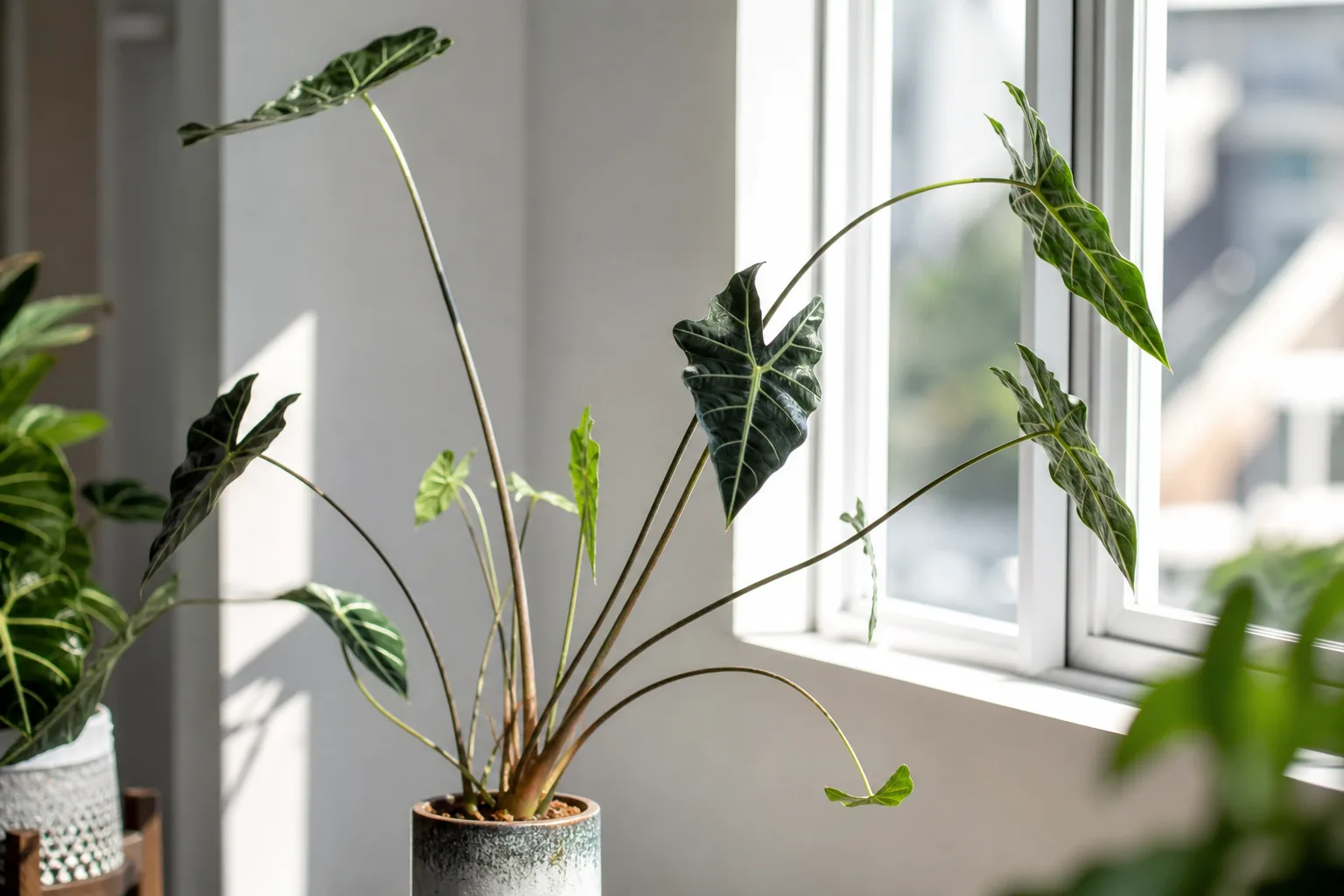
Leggy Growth on Alocasia Polly: Causes, Checks & Fixes
This guide covers leggy growth on Alocasia Polly. See also the general Leggy Growth guide, watering, and light pages for this plant.
Leggy Growth on Alocasia Polly: Causes, Checks & Fixes
Quick answer
Leggy growth on Alocasia Polly (Alocasia × amazonica ‘Polly’) means etiolation: the plant stretches its petioles toward available light, producing long leaf stems, smaller new blades, and faded silver-white veins while the rosette leans toward the brightest wall. It is not healthy vigorous growth-the lacquered “African Mask” look you bought the plant for disappears as contrast dulls and the structure goes top-heavy.
First step: move the pot within 1–3 feet of your brightest east-facing window, or mount a full-spectrum grow light 10–18 inches above the foliage on a 12-hour timer. Do not repot, fertilize, or prune heavily on the same day. Alocasia Polly in dim light uses water slowly; stacking fixes often turns a light problem into a rot problem.
Watch the newest emerging leaf over the next two to three weeks. One compact, dark leaf with sharp vein contrast confirms you found enough light. Only then remove the most stretched older foliage if you want a tidier silhouette.
For broader low-light symptoms-canopy thinning, wet soil in dark corners, and seasonal leaf drop-see the not enough light on Alocasia Polly guide. This page focuses on recognizing stretch, correcting etiolation, and pruning recovery after light improves.
What leggy growth looks like on Alocasia Polly
Read new growth first. Leggy Polly shows a recognizable pattern even when older leaves still look acceptable.
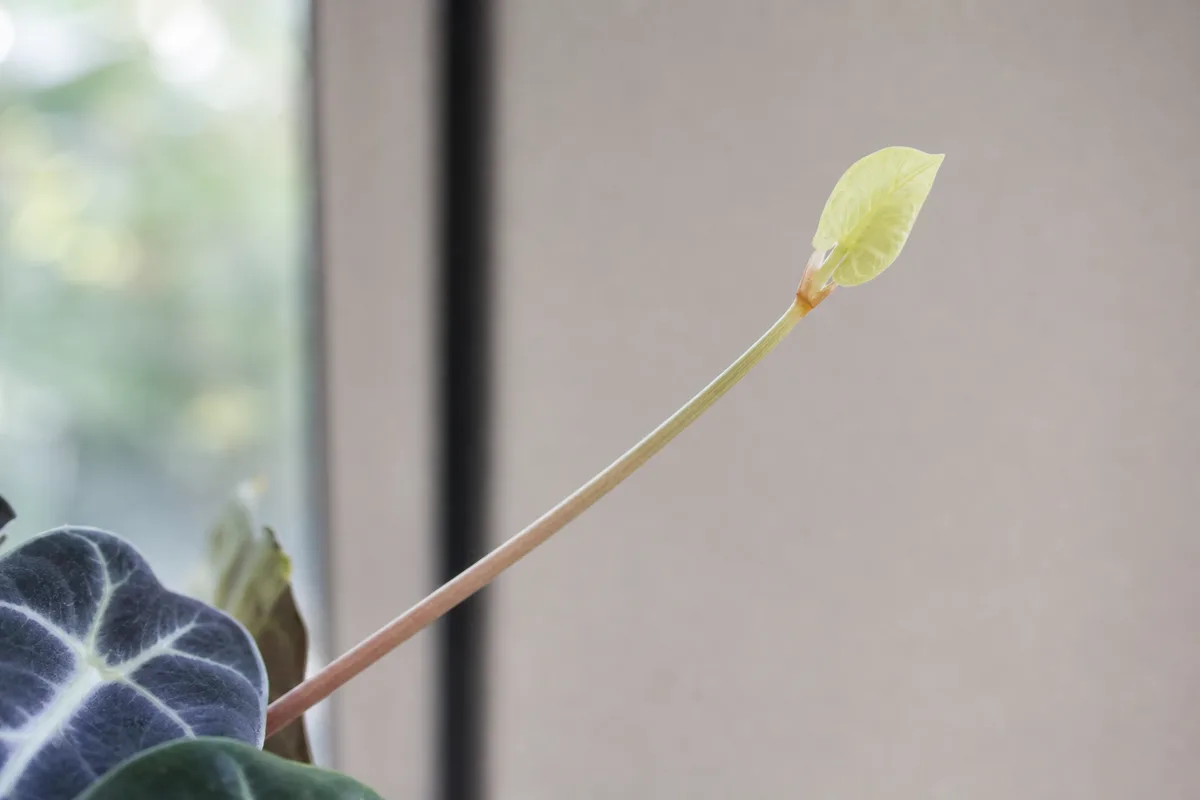
Leggy Growth symptoms on Alocasia Polly - compare with healthy tissue on the same plant.
Elongated petioles are the hallmark. Compare the stem length on the newest leaf to an older leaf from a brighter period. On a stretched plant, recent petioles are noticeably longer-sometimes twice the length of compact growth-and the whole rosette angles toward one light source. Indoor plants in too little light become spindly as they stretch toward brighter sources, and Alocasia Polly responds with long petioles before leaves shrink dramatically.
Faded silver-white veins often appear before stretch is obvious. The signature dark lacquered blade and sharp contrasting veins need a real photosynthetic budget. New leaves that come in softer green with blurred vein pattern signal etiolation starting-not a watering glitch on a single leaf.
Smaller new leaves follow as light stays low. Each emerging blade may be noticeably smaller than the one before it, leaving a sparse, top-heavy silhouette with weak petioles that struggle to hold leaf weight upright.
Pot lean is common when the rosette tracks the brightest direction for weeks without rotation. One-sided stretch makes the plant look lopsided even before individual petioles look extreme.
Leggy growth develops gradually over weeks to months. Sudden mass leaf drop within days of a move fits relocation shock more than chronic stretch-though both can coexist if a recently moved Polly sits in deep shade.
Why Alocasia Polly gets leggy
Alocasia Polly is a tropical understory aroid sold as an easy “African Mask Plant.” In the wild it evolved large leaves to capture filtered light under a forest canopy-not to live on a bookshelf six feet from glass. Indoors it behaves like a bright-indirect plant. When daily brightness falls below what the corm can use, the plant extends petioles toward the nearest photon source-classic etiolation.
Several home conditions push Polly into stretch:
- Distance from windows - light intensity drops quickly as you move away from glass; a spot that feels bright to human eyes can read below 150 foot-candles at leaf height
- North-facing or heavily shaded windows - especially in winter when day length and sun angle both fall
- Seasonal daylight loss - the same east window that worked in June may be marginal in December without a grow light
- Decor placement - hallways, bathroom corners, and shelves chosen for aesthetics rather than foot-candles
- Dirty or curtained glass - heavy drapes closed all day can starve the plant even near a window
Light also controls water use. A dim Polly uses less water and drinks slowly. Owners who keep a summer Alocasia Polly watering guide in a dark winter spot often see yellow leaves and soggy mix-then blame watering when light-driven etiolation was the root cause.
Lookalikes to rule out: limp petioles with soil wet for days (overwatering on Alocasia Polly in a dim spot), fine webbing on undersides (spider mites on weakened growth), or uniform pale new growth on a bright plant (possible nutrient issue-rare compared to stretch in dim corners).
How to confirm the cause
Work through these checks before moving the plant or reaching for shears:
- Newest leaf vs. older leaves - Are recent petioles longer, blades smaller, and veins duller? That pattern fits leggy etiolation.
- Distance and direction - Measure roughly how many feet the pot sits from the window. Within 1–3 feet of an east or bright north window is workable for many homes; deep into a room usually is not.
- Light meter spot-check - A phone app or cheap meter at leaf height at midday: below ~150 foot-candles during daylight hours is too dim for steady Alocasia growth; roughly 200–400 foot-candles is the working bright-indirect range.
- Lean and orientation - Does the rosette consistently face one direction? Etiolating plants track the brightest source.
- Soil moisture at the same time - Leggy growth with dry, appropriately timed soil supports a light diagnosis. Limp leaves with wet soil for days suggests overwatering instead.
- Two-week trial move - Shift the pot one step closer to filtered window light. If the next leaf opens darker and more compact with shorter petioles, light was the limiter.
Confirmed leggy growth: elongated petioles plus faded vein contrast on new growth, with soil drying on a reasonable schedule and no pest film on leaf undersides.
First fix for Alocasia Polly
Move the plant to bright, indirect light-or add a grow light-before pruning or changing anything else.
Option A: Better window placement
- Target east-facing glass first: gentle morning sun, then bright indirect for the rest of the day
- Bright north can work if a meter reads ~200+ foot-candles for several hours; dim north windows usually need supplementation
- For south or west windows, pull the pot 3–4 feet back or use a sheer curtain so direct midday rays do not scorch leaves
- Keep the pot 1–3 feet from the glass, not pressed against it in winter (cold drafts can shock foliage)
Option B: Grow light when windows are not enough
- Use a full-spectrum white LED (roughly 4,000–6,500 K)
- Mount 10–18 inches above the top of the foliage
- Run 12–14 hours daily on a timer through dark months
- Watch the first new leaf: bleached or crispy edges mean too close; continued legginess means too far or too weak
Acclimate in steps
Polly leaves grown in shade are thin and sun-sensitive. Step the plant toward brighter light over 7–14 days rather than jumping from a dark corner into unfiltered south-window sun. Sudden intense sun scorches the foliage within hours-that is a different problem from etiolation.
Do not increase watering or fertilizer to “compensate” for dim light. Wait until new compact growth shows the plant is actively photosynthesizing again.
When to prune after light improves
Once one or two compact new leaves confirm the fix, you may remove the most stretched older petioles for aesthetics. Cut 1–2 cm above the central crown with sterilized shears-Polly does not branch from old petioles, so each cut removes that leaf permanently. Remove one stretched leaf per session, spaced two to three weeks apart during active growth. See the Alocasia Polly pruning guide for crown-safe technique.
Recovery timeline and what improves
Etiolation damage is honest about what can heal:
- Silver vein contrast on new leaves - can return within one to two new leaves after light improves; often visible within 2–3 weeks in warm, humid conditions
- Growth speed - new leaves resume on a healthier rhythm once daily light integral is adequate
- Old stretched petioles - do not shorten; etiolated stems stay elongated permanently
- Old faded leaves - may remain dull until they age out; trim only after the plant is stable if they bother you aesthetically
- Post-prune regrowth - a new spear usually emerges from the crown within two to six weeks during the growing season after a single safe petiole removal
Judge recovery by the next leaf set, not by fixing every old blade. One compact, dark, well-veined new leaf with a proportionally short petiole is worth more than a dozen unchanged stretched ones.
Mistakes to avoid
- Pruning before light is corrected - removing stretched leaves without more photons leaves a weaker plant with fewer solar panels
- Blasting with direct south-window sun to fix legginess without acclimation - scorches Polly leaves fast
- Watering on the old schedule after a move to a dimmer spot - less light means less water use
- Fertilizing a pale, stretched plant before light is corrected - salts accumulate while growth is stalled
- Alocasia Polly repotting guide on day one - unnecessary unless roots are rotting from chronic wet soil in low light
- Judging success by old leaves - stretched petioles will not compact; only new growth tells the story
- Assuming the room is bright enough because it is comfortable for you - human vision is a poor light meter for tropical foliage
How to prevent leggy growth next time
- Place for foot-candles, not décor first - keep Polly in the brightest indirect spot you can sustain; see the Alocasia Polly light guide for window and grow-light targets
- Add a grow light before winter - do not wait for stretch and leaf drop to confirm daylight failed
- Rotate the pot weekly - even growth prevents one-sided lean and uneven fading
- Clean windows seasonally - grime and screens cut usable light more than owners expect
- Match watering to season and light - when growth slows in shorter days, let the top inch dry longer between drinks
- Re-check placement after room changes - new furniture, seasonal curtains, or a moved desk can drop light below threshold without you noticing
When to worry
Leggy growth alone is rarely fatal, but it sets up emergencies:
- Leaf drop plus constantly wet soil in a dark room - inspect roots; rot risk is high when photosynthesis and transpiration are both low
- Continued collapse after two to three weeks in corrected light - look for root rot on Alocasia Polly, pests, or cold drafts, not just more light
- Bleached or scorched patches after a sudden bright move - pull back and acclimate more slowly; sunburned tissue will not heal
If the plant produces one or two compact new leaves with sharp veins and proportionally short petioles after your fix, you are on track. If every new leaf stays smaller and paler despite a meter reading in the 200–400 foot-candle range, re-check whether a curtain, overhang, or grow-light distance is still limiting the plant.
Related Alocasia Polly guides
- Not enough light - broader low-light diagnosis, wet-soil overlap, and placement checks
- Light guide - window choices, foot-candle targets, and grow-light setup
- Pruning guide - crown-safe removal of stretched or spent petioles
- Slow growth - when stalled growth is light, dormancy, or root stress instead of visible stretch