Alocasia Amazonica Light Needs: Windows, Levels, and Grow
Alocasia Amazonica Light Needs: Windows, Levels, and Grow Lights
Alocasia Amazonica Light Needs: Windows, Levels, and Grow Lights
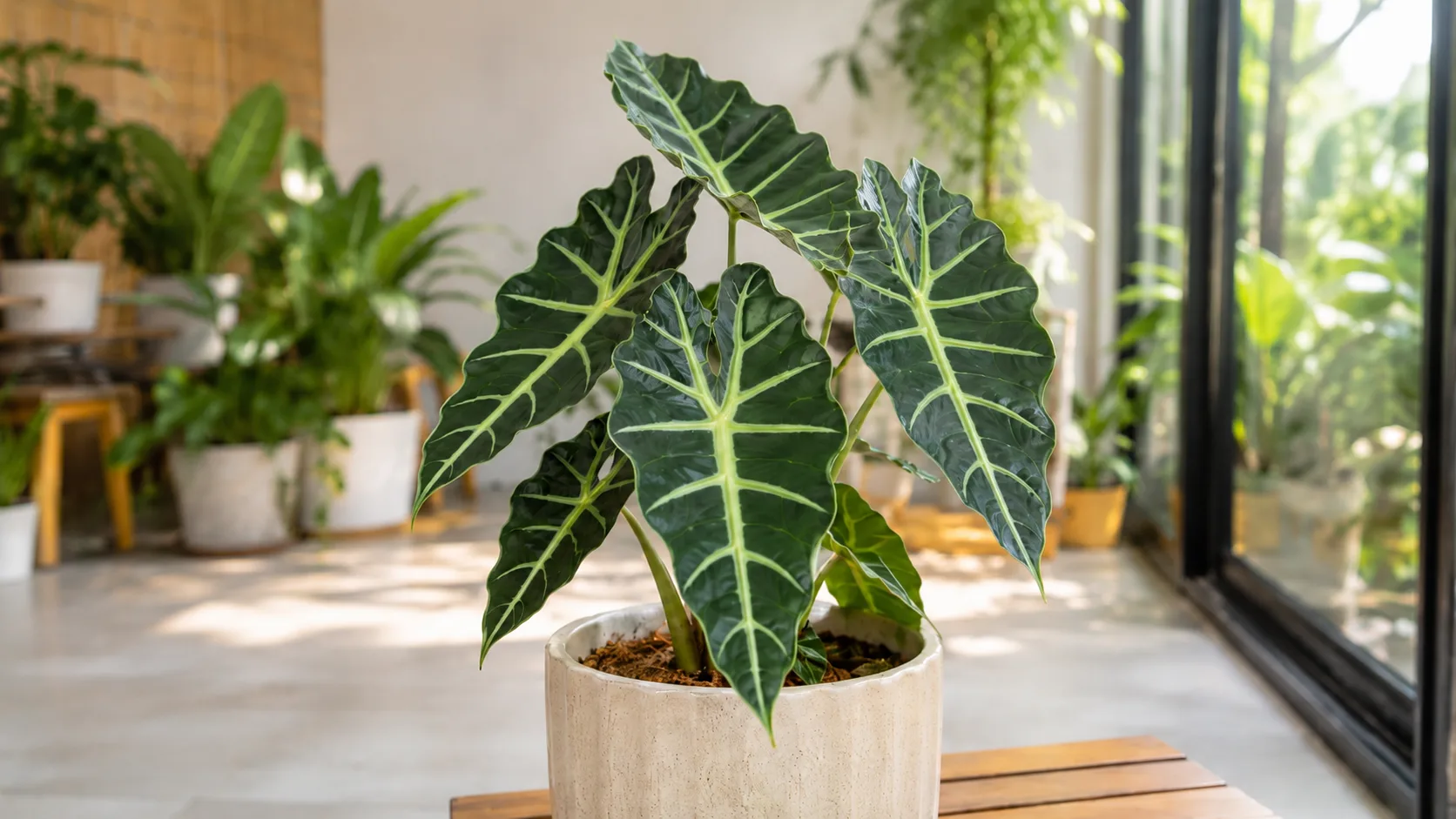
The fastest way to judge whether your Alocasia Amazonica is getting the right light is not a meter reading - it is the contrast between the dark leaf blade and the silvery-white veins. When light is correct, those veins look painted on. When light is too low, the contrast washes out, petioles stretch, and new leaves arrive smaller. When light is too strong, the same dark blades bleach on the sun-facing side and crisp at the margins. That vein pattern is your scoreboard, and this guide shows you how to keep it sharp.
Reviewed by the LeafyPixels Review Board. Recommendations are checked against botanical and extension references, LeafyPixels plant-care data, and practical indoor growing constraints before publication.
If you are new to this hybrid - also sold as African Mask Plant or Alocasia ‘Polly’ - start with the Alocasia Amazonica overview for naming, toxicity, and baseline care. This page is the proactive placement guide: where to put the pot, how bright the spot should be, and how to fix light before problems show up. For reactive diagnosis when leaves are already drooping or fading, see the not-enough-light guide.
Vein Contrast as Your Light Scoreboard
Alocasia × amazonica sits at the brighter end of the genus. Its glossy, arrowhead leaves carry more chlorophyll per square centimeter than velvet-leaved relatives like Alocasia baginda, which means it tolerates - and often needs - stronger ambient light to hold the dramatic white veining that makes the plant worth growing. A healthy specimen in the right window looks compact: stiff upright petioles, fully expanded blades, and veins that read almost metallic against the near-black green.
Too little light triggers the opposite trajectory. Petioles lengthen faster than the leaf blade widens, a process called etiolation. Veins lose their investment because the plant stops putting energy into expensive contrast tissue when photons are scarce. Growth slows, the soil stays wet longer than your watering rhythm expects, and the corm drifts toward winter dormancy earlier than it should. Light is not one variable among many for Amazonica - it is the variable that sets how fast the pot dries, how bold the foliage looks, and whether the plant stays in active growth through the dark months.
Pet and child placement note: Every part of Alocasia Amazonica is toxic to cats and dogs if chewed, with insoluble calcium oxalate crystals that irritate mouth tissue in pets and humans. A sunny south windowsill at pet height is a double risk - bright light plus easy access. Keep floor pots and low shelves out of reach; the overview toxicity section covers ASPCA guidance in full.
Natural Understory Habitat and Bright Indirect Indoors
Hybrid Origin and What the Forest Floor Teaches
Alocasia × amazonica is a man-made hybrid, not a wild Amazon species. The Missouri Botanical Garden Plant Finder notes that although the name suggests an Amazon connection, no Alocasia species are native to South America. The accepted horticultural entry at NC State Extension lists the plant as Alocasia × mortfontanensis - African Mask, Amazon Elephant’s Ear - with Southeast Asian parentage and the same cultural needs as other alocasias.
In the wild, alocasias grow in tropical forest understories where the canopy filters harsh midday sun but leaves plenty of ambient brightness. NC State Extension describes the light preference as dappled sunlight or partial shade - direct sun only part of the day, roughly two to six hours. The RHS Alocasia growing guide frames the same idea: alocasias evolved large leaves to capture filtered light under a high canopy, and indoors they need bright but indirect exposure. Strong direct sun scorches foliage; deep shade stalls growth.
Indoor bright indirect light recreates that forest-floor brightness without sunbeams on the leaf surface. Stand in the spot at noon: you should see a clear but soft shadow, not a sharp sunbeam tracking across the floor. The room should feel lit, not sunny. For Amazonica specifically, that usually means within about 30 cm (12 inches) of an east window, one to two meters back from a filtered south window, or a north window paired with supplemental LED light.
Measurable Light Targets for Amazonica
The phrase “bright indirect” becomes actionable once you attach numbers. You do not need expensive gear - a free phone lux app and a two-minute reading at the leaf surface will tell you more than guessing from across the room.
FC, Lux, PPFD, and DLI in Plain Language
Foot-candles (FC) and lux measure brightness at a point. Divide lux by 10.76 to get foot-candles, or multiply FC by 10.76 for lux. Photosynthetic photon flux density (PPFD) in µmol/m²/s counts the photons plants actually use for photosynthesis; a PAR meter reads this directly. Daily light integral (DLI) in mol/m²/day is the total photons delivered over a full photoperiod - the number that matters most for winter decisions.
Authoritative sources agree on the qualitative target - bright indirect, no harsh direct sun - even when they do not publish FC tables. The Missouri Botanical Garden recommends part shade, filtered sun, or bright indirect light in high humidity, and warns that direct sun causes leaf burn and pale foliage. The RHS states alocasias grow best in bright but indirect light, with strong sunlight scorching leaves, while lower light slows growth considerably. Proven Winners places indoor alocasias in bright indirect light at eastern or western exposures and notes that grow lights supplement darker months.
From extension guidance and practical indoor measurement, these targets work for Alocasia Amazonica:
| Level | Foot-candles | Lux (approx.) | PPFD at leaf (approx.) |
|---|---|---|---|
| Minimum for sustained growth | ~200 FC | ~2,000 lux | ~80 µmol/m²/s |
| Ideal active-growth band | 200–400 FC | 2,000–4,000 lux | 80–150 µmol/m²/s |
| Filtered maximum (acclimated) | up to ~1,000 FC | up to ~10,000 lux | up to ~300 µmol/m²/s |
Amazonica tolerates the upper half of the genus range - brighter than velvet-leaved alocasias - but unfiltered south-glass summer sun still exceeds what even a well-acclimated plant can use without bleaching.
Winter DLI Threshold and Supplemental Light Math
DLI explains why Amazonica drops leaves every December in temperate homes even when the thermostat stays warm. Active leaf production needs roughly 4–6 mol/m²/day minimum; comfortable growth sits closer to 6–10 mol/m²/day. A bright south window in a northern winter may deliver under 5 mol/m²/day from November through February. When DLI falls below the threshold, the plant enters the natural winter dormancy the RHS describes for alocasias: cooler, drier conditions, reduced watering, and foliage loss while the corm rests - not because the plant is dying, but because light and temperature no longer support a full canopy.
The math fix is straightforward. A full-spectrum LED delivering 80–150 µmol/m²/s at the leaf for 12–14 hours produces roughly 5–8 mol/m²/day, enough to hold many plants in active growth through winter. Without that supplement, reduce watering to barely moist per the watering guide, stop fertilizing, and wait for spring - the same dormancy rhythm described on the overview page.
Window-by-Window Placement Guide
Start with the window you have, not an ideal floor plan. Cardinal exposures behave differently, and the right answer is the spot where a phone reading at the leaf hits 200–400 FC at midday without direct sunbeams on the blade.
Northern Hemisphere Scorecard (N/E/S/W)
| Exposure | Typical midday FC at glass | Amazonica suitability | Default placement |
|---|---|---|---|
| East | 300–600 FC (morning sun, then indirect) | Best default - cool morning rays, strong indirect rest of day | Within 30 cm of glass; sheer only if summer morning sun is intense |
| West | 400–800+ FC (hot afternoon sun) | Good with diffusion - brighter than east, higher scorch risk | 1.5–3 m back or sheer curtain on afternoon sun |
| South | 600–1,000+ FC in summer | Excellent filtered - too intense unfiltered at glass | 1–1.5 m back or sheer; recheck at solstices |
| North | 50–200 FC in most homes | Supplement required for long-term growth | Pair with full-spectrum LED 10–12 h/day |
Southern Hemisphere readers should mirror the table: swap north and south seasonal intensity patterns while keeping east and west morning-vs-afternoon logic the same.
East and West Windows
East windows are the consensus favorite for Amazonica, and the biology backs the hobby wisdom. Morning sun arrives at a low, cool angle for two to four hours, then the exposure shifts to bright indirect light for the rest of the day. Proven Winners recommends eastern or western exposure with bright indirect light and warns that direct sun scorches alocasia leaves. Place the pot within about 30 cm of the glass. New leaves should unfurl deep green with sharp veins; petioles stay upright without stretching.
West windows deliver similar total hours but hotter, lower-angle afternoon sun. The light intensity per hour is higher and the leaf margins lose water faster. Direct west sun is a common cause of crispy brown edges. Set the plant back 1.5–3 m from the glass, or hang a sheer curtain that knocks 40–60% off peak intensity. With diffusion, west behaves like a slightly brighter east window.
South and North Windows
South glass peaks at 600–1,000+ FC in summer - above Amazonica’s comfort zone without intervention. Three strategies work: move the pot 1–1.5 m back, add a sheer curtain, or place it beside the window so it catches only the edge of the light cone. Filtered south light produces some of the densest, darkest foliage on a well-grown Amazonica because the plant can use the higher intensity when direct beams never touch the blade. Recheck placement at the solstices; a “filtered” summer position can become direct sun when the solar angle shifts.
North windows deliver the gentlest natural light. In a bright white-walled apartment, readings may reach 200 FC briefly. In most homes, north exposures sit at 50–150 FC - below the survival minimum for sustained growth. North works as a placement only with a supplemental LED running 10–12 hours daily. Without that, treat north as a holding zone, not a long-term home.
Measuring Light Without Guessing
Eyes adapt to dim rooms; meters do not. A reading at the leaf surface twice a year - once in June, once in January - catches seasonal drift before petioles stretch or veins fade.
Phone Lux Apps and PAR Meters
Free smartphone lux apps are accurate enough for placement decisions, though they can misread depending on camera sensor and whether the lens points at the window or the leaf. Treat phone readings as directional, not laboratory-precise. Hold the phone at the top of the foliage at the brightest time of day (usually 11 a.m. to 2 p.m.) and again at the dimmest.
Translate lux to foot-candles by dividing by 10.76. Targets for Amazonica: minimum 2,000 lux (~200 FC), comfortable band 2,000–4,000 lux (200–400 FC), filtered maximum near 10,000 lux (~1,000 FC). A PAR meter gives PPFD directly; aim for 80–150 µmol/m²/s for steady growth and up to 300 µmol/m²/s only on well-acclimated plants.
The Hand-Shadow Test
No phone? Hold your hand 30 cm above white paper in the candidate spot at midday. A sharp, dark shadow means direct sun - too harsh unless heavily filtered. A soft but clearly defined shadow means bright indirect - your target. A faint or absent shadow means low light; plan on a grow light or a different window. Recheck morning, midday, and late afternoon. The brightest moment the spot ever sees is the moment that determines scorch risk.
Warning Signs of Too Little Light
Low-light stress on Amazonica is subtle for weeks, then obvious overnight. The earliest diagnostic is the petiole: it should be stiff enough that the blade stands upright or arches gently. In insufficient light, petioles grow longer than the blade is wide, the angle between petiole and stem opens, and the plant becomes a “spider” of thin stems holding small leaves. Etiolation is irreversible on existing leaves - only new growth under better light will be compact again.
The second signal is vein fade. Healthy Amazonica leaves pack chlorophyll densely; at the right light level, contrast between dark blade and white veins sharpens. In dim corners, veins dull to a uniform dark green, new leaves arrive smaller, and growth stalls. Because a dim plant drinks slower, soil stays wet longer - the classic setup for root stress even when you follow the watering guide on schedule. If watering and humidity look reasonable but veins fade and petioles stretch, light is the fix - not more fertilizer. Increase light first; feeding a stretching plant in a dark corner wastes salts and can burn roots.
For a full symptom checklist including droop and seasonal light drops, use the not-enough-light page. This guide focuses on placement before those patterns set in.
What healthy vs stressed looks like (no photo needed to diagnose): A compact east-window Amazonica holds petioles shorter than the leaf blade is wide, with veins that catch room light. An etiolated north-corner plant shows petioles twice as long as the blade, dull veins, and leaves that splay horizontally to catch photons.
Warning Signs of Too Much Light
Too much light announces itself faster than too little, but the damage is permanent on affected tissue. Watch for three symptoms together: bleached patches on the sun-facing leaf surface (not the natural white veins), brown crispy margins where water loss outpaces root uptake, and inward leaf curl as the plant reduces exposed surface area. Damage is usually asymmetric - worst on the window-facing half, milder on the shaded side - which distinguishes sun stress from low humidity or fertilizer burn.
The RHS Alocasia growing guide flags that strong sunlight scorches alocasia foliage. NC State Extension notes direct sunlight can scorch leaves on this hybrid. Pull the plant back, add a sheer curtain, or shift exposure. Cut badly scorched blades to redirect energy into the next healthy leaf - the damaged tissue will not green up again.
Grow Light Setup: Spectrum, Distance, and Schedule
When natural windows cannot deliver 200–400 FC year-round, a grow light is not optional - it is the reliable fix. A single Amazonica is inexpensive to light: you need the right spectrum at the right distance for a stable photoperiod, not a tent-grade panel.
Choose a full-spectrum LED in the 4000–5000 K range that renders leaf color accurately. Avoid red-blue-only “blurple” fixtures; they grow tissue but wash out the white veining that defines this plant. Target the same numbers as a good window: 200–400 FC or 80–150 µmol/m²/s at the leaf.
Fixture Types Without the Brand Roundup
Three fixture categories cover most homes - examples below are types, not tested product endorsements:
- Screw-in grow bulbs in a desk or floor lamp - best for one plant on a stand; easy to raise as petioles lengthen.
- LED strip or tube fixtures over a shelf - best for several plants sharing one run; keep height even across the canopy.
- Panel or bar fixtures with adjustable hangers - best for a dedicated plant corner or when natural light is very weak.
Start the fixture 25–45 cm (10–18 inches) above the top of the foliage. Closer than 20 cm risks bleaching under higher-output panels; farther than 50 cm usually forces excessively long photoperiods. Run 10–14 hours daily on an outlet timer. Winter calls for the longer end (12–14 hours); summer with some window light often needs only 10–12 hours. Consistency matters more than exact hours.
Judge the setup by new growth: compact, dark, well-veined leaves mean the distance and duration are right. Stretched petioles under a running light mean increase intensity or lower the fixture. Pale patches on new leaves mean back the fixture off or shorten the photoperiod.
Acclimation: Three-Week Step-Up Protocol
Amazonica leaves are physiologically tuned to the light level they grew under. Moving a greenhouse-grown plant straight to intense south glass or a high-output panel is the most common cause of post-purchase leaf drop. Step light up over two to three weeks whether the move is to a brighter window or a new fixture.
Week one: Expose to the new source for two to three hours daily, or run the grow light on an eight-hour schedule at full distance. Week two: Extend window time to four to six hours, or raise the timer to 10–12 hours at full intensity. Week three: Settle into the permanent position with a 12–14 hour photoperiod. Do not repot, fertilize, or change the watering rhythm in the same week as a major light increase - stack one stress at a time. Keep humidity at 60% or higher while new leaves adapt.
Winter dormancy and light collapse deserve their own note because they overlap with acclimation timing. When DLI falls below threshold and room temperatures dip, Amazonica enters the natural winter dormancy described by the RHS and on the overview page: foliage yellows and drops, growth stops, and the corm rests until spring light returns. That pattern is normal on a firm corm with earthy-smelling soil. It is not normal on a soft corm in wet soil - that is rot, not dormancy. A winter grow light at 80–150 µmol/m²/s for 12–14 hours prevents dormancy if you want year-round leaves; without it, cut watering to barely moist and wait for March growth.
Light-water coupling example: A plant at 350 FC in a warm room may need water every seven to nine days when the top 2–3 cm of mix dry. The same pot at 120 FC in the same room may take fourteen to eighteen days to reach that dryness - and if you water on the seven-day calendar anyway, the corm sits in wet soil while light-starved. Match watering to how fast the pot dries in your light level, not a generic schedule.
Conclusion
Alocasia Amazonica rewards specific numbers, not vague “bright room” advice. Target 200–400 foot-candles (about 2,000–4,000 lux) at the leaf, with east windows as the safest default, west and south workable behind sheer fabric or distance, and north windows requiring supplemental LED light. Measure twice a year, use the hand-shadow test when you have no app, and step up brightness over three weeks after every major move. Watch vein contrast and petiole length - they tell you the truth before yellow leaves appear. Get light right and the bold, veined foliage that sold you on this plant stays dramatic year after year; pair that placement with the overview, watering guide, and not-enough-light troubleshooting when other stress signals show up.
When to use this page vs other Alocasia Amazonica guides
- Alocasia Amazonica overview - Start here for whole-plant context before deep-diving this topic.
- Alocasia Amazonica problems hub - Jump to symptom-specific fix guides when this care topic does not resolve the issue.
- Not Enough Light on Alocasia Amazonica - Escalate here when light adjustments are not enough.
- Leggy Growth on Alocasia Amazonica - Escalate here when light adjustments are not enough.