9 Types of Palm Plants to Grow Indoors: Care & Size
Compare 9 popular indoor palms and palm lookalikes by light, size, water needs, and pet safety so you can choose a plant that fits your actual room.
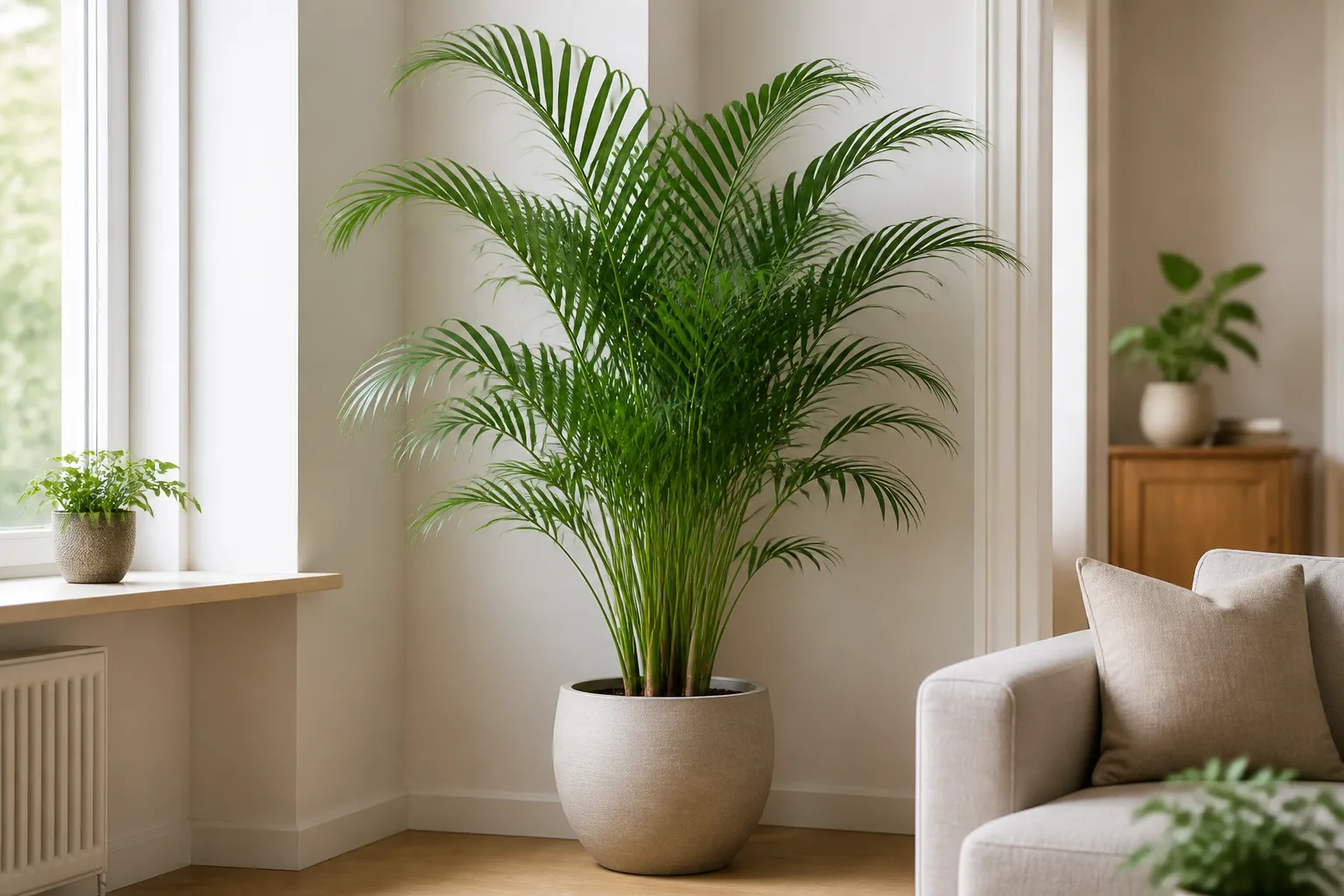
An indoor palm can be a compact tabletop plant, a slow-growing architectural specimen, or a leafy floor plant that eventually asks for more room than you planned. The name on the nursery tag does not tell you which one you are buying: “palm” is used for several unrelated plants, and their light, watering, and safety needs are not interchangeable.
For most beginners, the parlor palm is the easiest true palm to place in an ordinary home. A kentia palm suits a larger room and grows slowly; an areca palm makes a fuller screen if you can give it brighter light and regular moisture. Three familiar “palms” in this list—the ponytail, sago, and yucca—are not true palms at all. That distinction matters most for care and, in the sago palm’s case, safety.
The RHS notes that palms vary substantially: some tolerate lower indoor light, while others need stronger light, and even the more adaptable types can suffer in direct sun through glass. Use the profiles below to match a plant to the spot and routine you can provide, rather than choosing by the tropical look alone. (RHS guidance on growing palms indoors)
Choose by light, space, and care routine
Start with the window. A room that feels bright to you may still be dim several feet from the glass, especially in winter or behind sheer curtains. A parlor palm or kentia can tolerate less light than many palms, but “low-light tolerant” means it can persist with slower growth; it does not mean a plant can thrive in a windowless corner. If you have only a dark spot, choose a different plant or add a suitable grow light.
Then compare size and water habits. Areca and majesty palms can become substantial, and cascade palms take width as their clumps expand. A ponytail palm, yucca, or sago is a better candidate for a bright, drier room because each prefers a stronger light position and a drying interval between waterings. The trade-off is that ponytail and yucca plants can grow tall, while sago is unsafe around pets and children who might handle or ingest it.
If cats or dogs share the room, check the exact species name before buying. NC State Extension describes parlor palm as not hazardous to pets; ASPCA lists sago palm as toxic to cats and dogs, and the RHS lists yucca as harmful if eaten. Do not rely on a generic “palm” label for a safety decision. (NC State Extension parlor palm profile; ASPCA sago palm listing; RHS spineless yucca profile)
1. Parlor palm: the compact, forgiving choice
The parlor palm (Chamaedorea elegans) is a real palm, not a miniature tree that needs a greenhouse. It grows slowly, stays relatively compact indoors, and has fine, arching leaflets on slender stems. Garden centers often plant several seedlings together in one pot to create a fuller silhouette, so check the base: a crowded-looking pot may be a cluster of individual plants rather than one branching trunk.
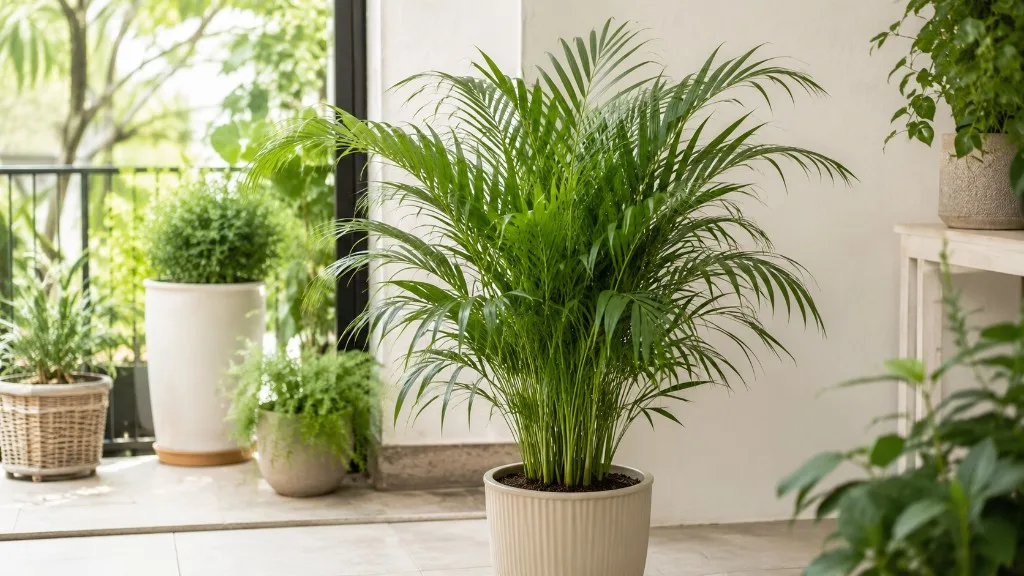
Place it in bright, indirect light near an east- or north-facing window. It tolerates lower light better than many palms, but growth slows and the plant may become sparse if the room is too dim. Keep it out of harsh afternoon sun through glass. NC State Extension describes it as an understory palm that handles dry indoor air and lower light, though it grows more lushly when the mix does not become bone-dry. (NC State Extension)
Water when the upper part of the potting mix has begun to dry, then let excess drain away. Do not keep the nursery pot sitting in a cachepot full of water; saturated roots are a more serious risk than a brief, slight dry-down. Use a pot with drainage and a general indoor mix that holds some moisture without turning dense and airless. Feed lightly during active spring and summer growth if the plant is producing new fronds; pause or reduce feeding in winter.
Parlor palm suits a desk or narrow stand where a large palm would dominate. Remove only fully dead fronds; cutting green ones will not keep it compact. It is not a fast-growing privacy screen or a plant for a truly dark room.
2. Kentia palm: a slow, graceful floor plant
The kentia palm (Howea forsteriana) has a cleaner, more open outline than a densely clustered areca. Its long, arching, feather-shaped fronds make it a good floor plant beside a sofa or in a bright office, while its slow growth gives you more time before it crowds the room. It is often sold with multiple young plants in one container, so inspect the pot and budget for a wider footprint as the fronds spread.
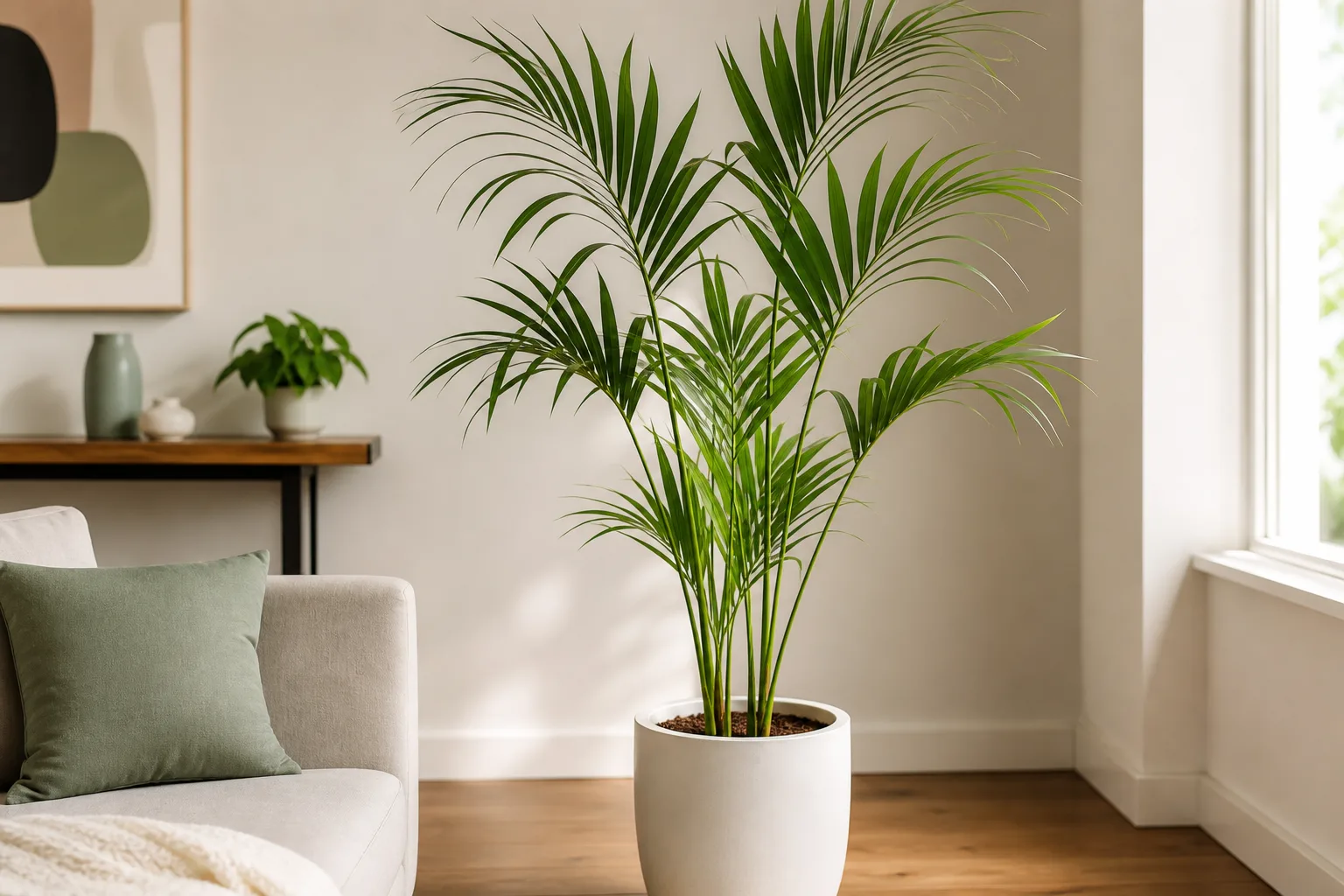
Give it bright, indirect light. Acclimate it gradually if moving a shaded shop plant to a stronger window. The RHS identifies kentia as tolerant of fairly low indoor light and ordinary indoor air, but it still needs usable daylight. (RHS indoor-palms guide)
Let the surface of the mix dry somewhat before watering, then soak the root ball thoroughly and empty the saucer. Do not water by a fixed weekly schedule: a large plant in a cool, dim room uses water more slowly than a smaller plant beside a warm window. A sandy or bark-amended, free-draining houseplant mix helps avoid the combination of wet soil and poor airflow that leads to root trouble. Gardening Know How also emphasizes avoiding overwatering and disturbing kentia’s roots only when repotting is genuinely needed. (Gardening Know How kentia guide)
Choose kentia for a slow-growing floor plant and allow room for its arching fronds. Pass if you want rapid growth or a plant you will move and repot often. If tips brown, check water, drafts, direct sun, and dry air before adding fertilizer.
3. Areca palm: a full, feathery statement plant
The areca palm is often sold as Dypsis lutescens; you may also encounter other botanical naming in plant references. Its yellow-green, ringed stems grow in a clump and carry soft, feathery fronds. That dense, multi-cane form creates the lushest screen in this group, but it also needs enough floor space for the leaves to spread without being pressed against a wall or walked through.
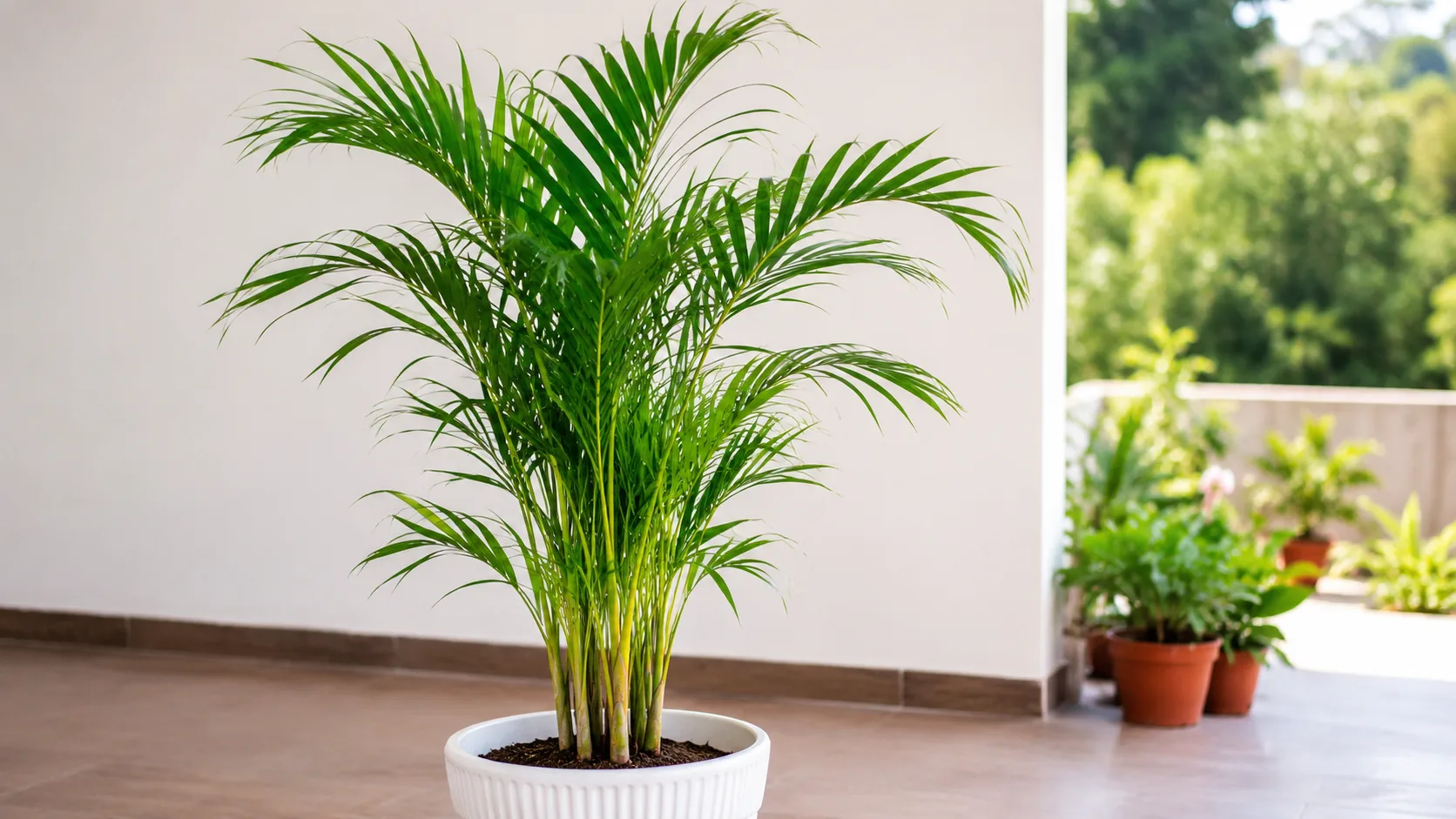
Choose bright filtered light. Acclimate a shaded nursery plant before giving it direct sun, and keep it away from cold drafts. This is not a palm for a dim corner or for someone who rarely checks soil moisture.
Keep the mix lightly and evenly moist during active growth, allowing the surface to dry a little before watering again. “Moist” is not the same as waterlogged: use a drainage hole, water until the root ball is evenly wetted, and empty standing runoff. Gardening Know How describes the areca as a plant that benefits from consistent moisture in spring and summer, with a slight dry-down between waterings in cooler months; it also notes that container size and brittle roots deserve care during repotting. (Gardening Know How areca-palm guide)
Measure the spot before buying. Several canes and arching fronds can fill a corner quickly. Areca is a strong choice for a bright room if you can check moisture regularly, but a poor fit for a small side table or a routine that leaves plants dry for long stretches.
4. Chinese fan palm: a sculptural palm for bright rooms
Chinese fan palm (Livistona chinensis) stands out through its rounded, fan-shaped leaves. That shape gives it a more architectural look than the narrow leaflets of parlor, kentia, or areca palms. It is a true palm, but its eventual scale makes it a more demanding indoor choice than its young nursery size suggests.

Place it near a bright window with filtered light. A young plant can tolerate some shade, but it is not suited to a dark hallway. Acclimate it gradually before moving outdoors in warm weather, and bring it back inside before temperatures drop.
Let the top layer of potting mix begin to dry before watering, then drain the container fully. Use a roomy, stable pot with an open drainage path, and avoid repotting just to give the plant a decorative oversized container. A pot that holds too much wet mix around a small root system can stay soggy for too long. The plant grows slowly, but it is not automatically a dwarf palm; plan around the mature leaves and height rather than expecting pruning to keep it tabletop-sized.
Choose Chinese fan palm for a bright room with high ceilings. Its broad leaves need space and can develop ragged tips when repeatedly rubbed against walls. It is not a compact, especially forgiving palm.
5. Majesty palm: lush, but demanding indoors
Majesty palm (Ravenea rivularis) is sold for its dramatic upright stems and large, feathered leaves. It can make an impressive statement while young, but a healthy specimen needs more room and steadier moisture than many first-time buyers expect. It is a true palm in the family Arecaceae; the RHS plant profile lists that family and confirms the botanical name. (RHS Ravenea rivularis profile)
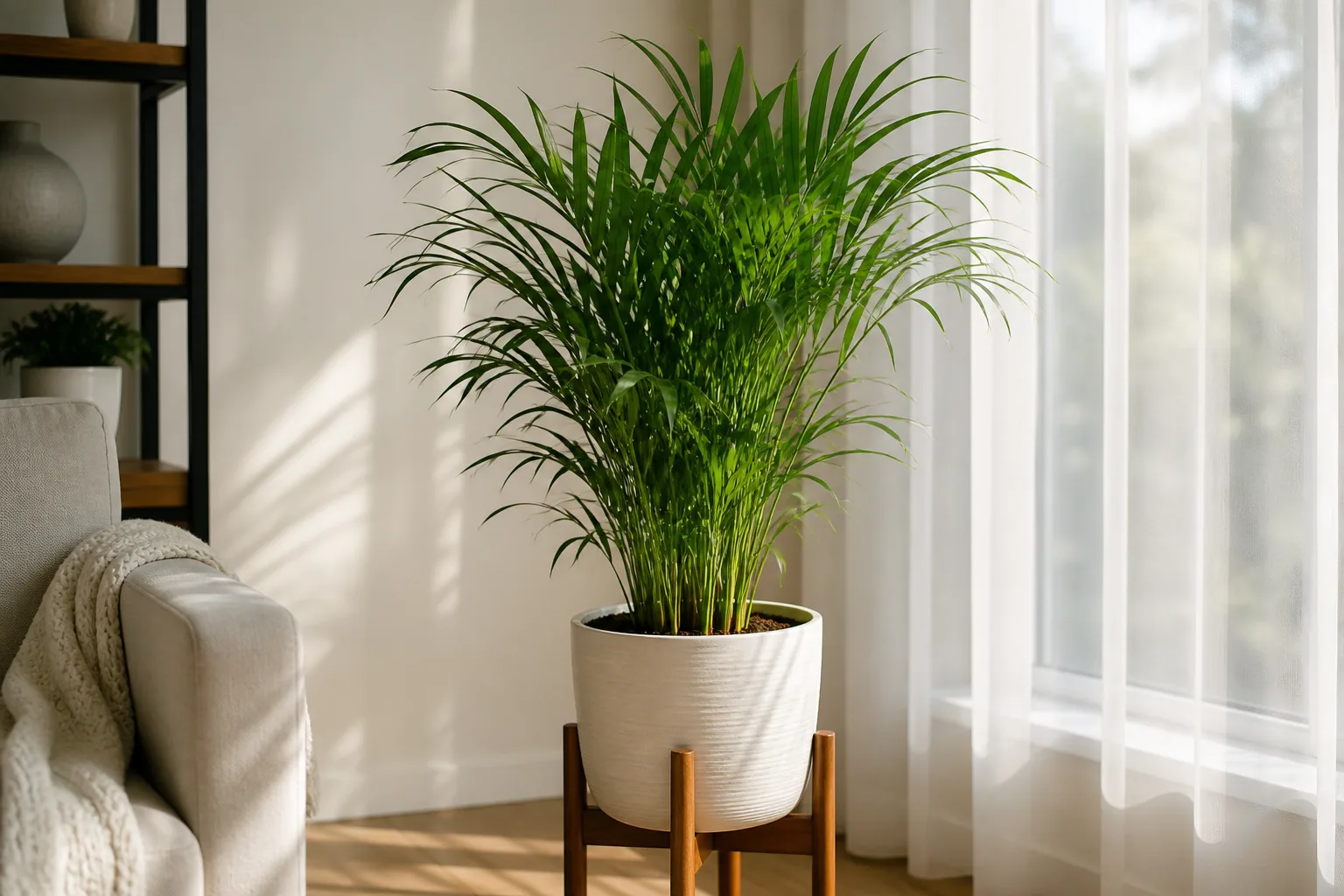
Give it very bright indirect light, away from heating vents and cold drafts. A bathroom is suitable only if it has enough natural light and airflow. In a dry home, a humidifier is more dependable than occasional misting; it does not replace sound root care.
Keep the potting mix evenly moist while the plant is actively growing, but never leave the root ball submerged in runoff. The challenge is balance: letting it become bone-dry can stress it, while a heavy pot that stays wet can suffocate roots. Check the mix with a finger or wooden probe before watering, and use a free-draining medium. If the plant repeatedly develops brown tips despite consistent watering, assess room humidity, drafts, water quality, light, and root condition rather than reaching first for a stronger fertilizer.
Choose a majesty palm only if you have bright space, steady watering habits, and room for a large plant. For a similar feathered outline with a more forgiving routine, consider kentia instead.
6. Cascade palm: a clumping palm for evenly moist soil
Cascade palm, often called cat palm, is Chamaedorea cataractarum, a true palm in the same broad genus as the parlor palm. It grows as a low, dense clump of slender stems instead of forming one obvious trunk. Its fountain of fine fronds makes it useful beside a bright window or as a floor-level accent where a tall palm would feel out of scale.
Indoors, provide bright indirect light and water before the whole pot dries out. It prefers a more consistently moist root zone than a ponytail or yucca, but “moist” does not mean standing water: the mix still needs oxygen and the pot needs drainage. Check below the surface instead of watering every day by habit.
Allow room for its basal clump and keep the stems at their original depth when repotting. Division is possible, but separating a healthy clump can set it back; wait until repotting is necessary and divide only a rooted portion.
Choose it over majesty if you want a lower clump of multiple stems, but avoid it if your plants routinely dry out. Inspect leaf undersides for spider mites and scale. If you cannot keep the mix evenly moist without leaving it soggy, consider kentia or ponytail instead.
7. Ponytail palm: a sunny palm lookalike
Ponytail palm (Beaucarnea recurvata) is not a palm. It is an evergreen succulent in the asparagus family, with a swollen trunk-like base that stores water and a fountain of narrow, curling leaves. The RHS classifies it in Asparagaceae and describes that bulbous base and its long, recurved foliage. (RHS ponytail-palm profile)
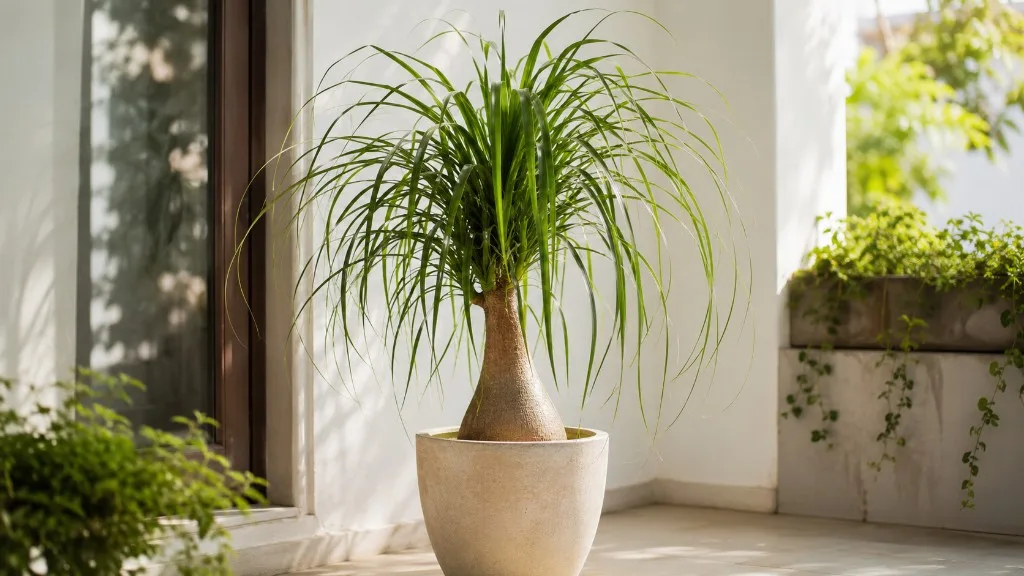
Its water-storing base changes the care routine. Give it a bright window and free-draining mix, then let the root zone dry well before watering again. Unlike cascade or majesty palms, it should not sit in continuously moist soil. Drought tolerance does not make up for a dim room.
Slow-growing and comfortable in a snug pot, a young ponytail palm can fit a sunny desk or shelf. Keep the swollen base above the mix to prevent trapped moisture. Do not cut the top to control height; remove only dead leaves and leave room for the foliage to arch outward.
Buy it for a sunny spot if you tend to underwater rather than overwater. It is a poor match for dim rooms, damp oversized pots, or anyone who wants feathered fronds; its leaves extend well beyond the compact trunk.
8. Sago palm: a cycad with a serious toxicity warning
Sago palm (Cycas revoluta) is a cycad, not a true palm. Its rigid, glossy fronds emerge in a circle from a thick central trunk, and new leaves usually arrive in a flush rather than continuously. NC State Extension identifies it as a member of Cycadaceae and explains that cycads reproduce with cones rather than palm-like flowers. It grows very slowly, so a small plant can remain manageable for a long time. (NC State Extension sago palm profile)
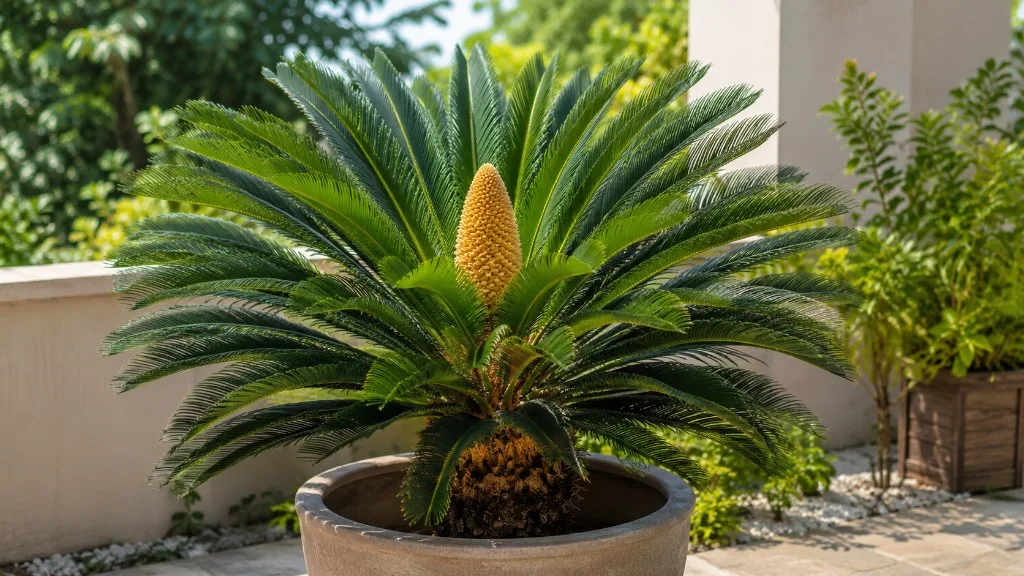
The deciding factor is safety. ASPCA lists sago as toxic to cats, dogs, and horses, naming cycasin as its toxic principle; NC State also warns that it is poisonous to people. Keep every part away from pets and children. If anyone ingests it, contact a veterinarian, poison-control resource, or medical professional promptly. (ASPCA Animal Poison Control; NC State Extension)
For care, give it bright filtered light or a carefully acclimated sunny location, and use a pot with excellent drainage. Let the surface dry between waterings, especially in winter when growth slows. NC State notes that poor drainage and overwatering can lead to root rot, while harsh sunlight can damage foliage. Protect the plant from cold and avoid disturbing the roots unnecessarily; cycads are slow to replace damaged or removed foliage.
Sago palm suits a bright home without accessible children or animals and a gardener who values architectural foliage over rapid growth. If safety is uncertain, choose another plant.
9. Yucca palm: a bold, drought-tolerant lookalike
“Yucca palm” usually refers to spineless yucca (Yucca elephantipes), also sold under other botanical synonyms. It is a yucca, not a palm: the RHS classifies it in Asparagaceae and describes its upright cane-like trunks and stiff, leathery leaves. The architectural silhouette works well in a bright living room, but the plant can become a substantial shrub or small tree over time. (RHS spineless yucca profile)
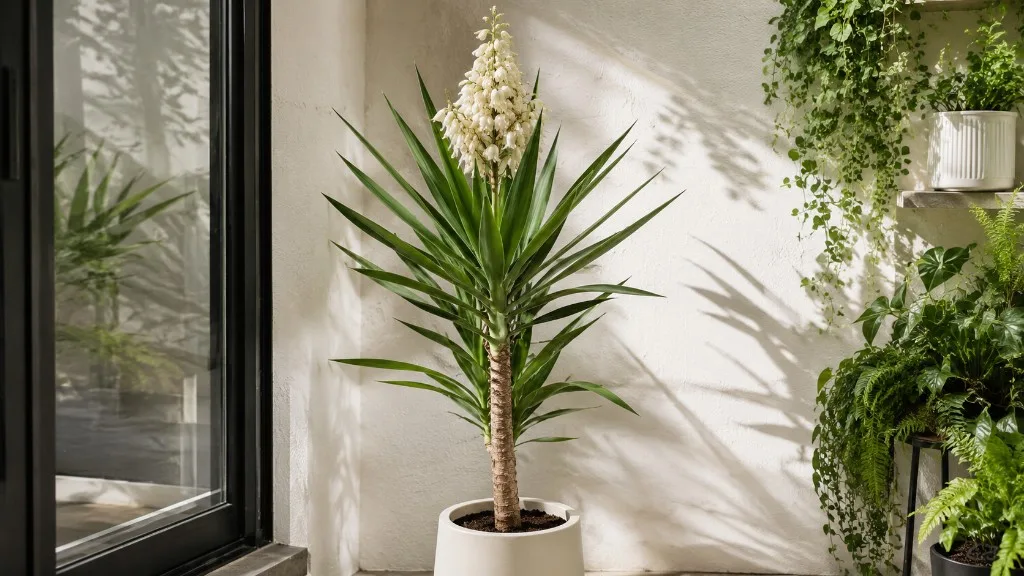
Put it in the brightest practical indoor location, ideally where it can receive several hours of strong light. Acclimate it over a week or two if it has been growing in shade; an abrupt move into hot direct sun can scorch leaves. Water thoroughly, then allow much of the mix to dry before watering again. A drainage hole is essential, and a heavy pot should not be left with water standing in its base.
Yucca suits a sunny room and a gardener who prefers occasional thorough watering over frequent checks. It is a poor fit for a low-light apartment, narrow walkway, or pet that chews foliage. The RHS lists spineless yucca as harmful if eaten, so keep it out of reach. (RHS spineless yucca profile)
Choose yucca for its upright shape and tolerance of drier soil, not because it belongs to the palm family. Leave room for the leaves and rotate the pot occasionally for balanced growth.
Compare the nine plants at a glance
| Plant | Best starting spot | Water preference | Main trade-off |
|---|---|---|---|
| Parlor palm | Bright or lower indirect light | Slight surface dry-down | Compact; not for dark rooms |
| Kentia palm | Medium to bright indirect light | Water after surface begins to dry | Slow, but eventually broad |
| Areca palm | Bright filtered light | Even moisture in active growth | Full, feathery, and thirsty |
| Chinese fan palm | Bright filtered light | Moderate moisture; drain well | Fan leaves; needs space |
| Majesty palm | Very bright indirect light | Evenly moist, never soggy | Large and demanding |
| Cascade palm | Bright indirect light | More evenly moist | Dense clump; dislikes long dry spells |
| Ponytail palm | Bright sun after acclimation | Let mix dry well | Succulent, not a palm |
| Sago palm | Bright filtered light | Dry surface between waterings | Cycad; toxic if ingested |
| Yucca palm | Strong light to sun | Let much of the mix dry | Yucca; harmful if eaten |
These are starting points, not rigid schedules. A small terracotta pot in a warm, bright room dries faster than a large plastic pot in a cool corner. Let the plant, container, and season determine when to water.
A care routine that works for indoor palms
Indoor palms do not share one watering rule. A moisture-loving cascade palm and a water-storing ponytail palm need opposite routines despite their similar nursery labels. Both need suitable light, drainage, and care based on the root zone rather than a calendar.
Match light to the species before changing water
Light affects how quickly a plant uses water. In a dim corner the mix stays wet longer; continuing the old routine can leave roots oxygen-starved. Sudden direct sun can scorch leaves and dry a pot faster. Move plants gradually and judge progress by new growth.
Parlor and kentia can stand farther from a window than areca or Chinese fan palms, but still need daylight. Majesty and cascade prefer filtered light; ponytail, sago, and yucca need brighter positions. Acclimate any plant moved from shade. The RHS distinguishes low-light-tolerant palms from those needing stronger light and warns that direct sun through glass can scorch foliage. (RHS indoor-palms guide)
Water according to the root zone, pot, and season
Check moisture before watering. A finger in the top inch or two or a wooden skewer in a deep pot can show whether the root ball is dry. Water thoroughly when the species is ready, let excess drain, and empty the saucer. If water runs down the sides, water in two slower passes.
Prevent root rot with drainage, an airy mix, and the right dry-down for the species. Stones in the bottom of a pot do not replace a drainage hole. In winter, slower growth often means less water: keep cascade and majesty from drying completely, while letting ponytail, sago, and yucca dry more deeply.
Manage humidity, feeding, pruning, and repotting
Dry heated air can contribute to crisp edges on humidity-sensitive palms. Keep foliage away from vents; use a clean humidifier if dry air remains a problem. Wipe dusty leaves with a damp cloth and check both sides for pests.
Feed during active growth and follow the product label. Extra fertilizer will not speed up a slow palm; excess salts can damage roots. Wait after repotting before feeding. Remove fully brown or broken fronds with clean shears, never the central growing point. Repot when roots fill the pot or the mix degrades, moving up one size and keeping the trunk at its former depth.
Troubleshoot symptoms before cutting or fertilizing
Brown tips are a symptom, not a diagnosis. Check for dry or soggy mix, drafts, new direct sun, mineral-heavy water, and dry heated air. Correct one likely cause at a time; old brown tissue will not turn green. The RHS lists dry air, drafts, chilling, underwatering, and overwatering among possible causes. (RHS indoor-palms guide)
One or two yellow lower fronds can be normal aging if new growth looks healthy. Widespread yellowing, soft stems, or sour-smelling mix calls for a drainage and root check before fertilizing. Pale, stretched growth suggests too little light; bleached patches on the window side can signal scorch.
Stippling, webbing, sticky residue, or small bumps can signal spider mites, scale, or mealybugs. Isolate the plant, inspect undersides and stem joints, and wipe or rinse the foliage before choosing treatment. Identify the pest first; fertilizer or a watering change will not solve an infestation.
Conclusion: choose for the room you have
The best indoor palm is the one whose light and water needs fit your home. Pick parlor or kentia for a slower-growing true palm; choose areca or Chinese fan for a brighter, more spacious room; and treat majesty and cascade as moisture-sensitive choices. Ponytail, sago, and yucca look palm-like but need different care, and sago carries a serious ingestion hazard.
Before buying, check the botanical name, measure the spot, and look at the light across an ordinary day. Then choose a draining pot and build your watering routine around the plant’s actual mix. That simple match between species and room is what keeps a tropical-looking plant from becoming a weekly rescue project.