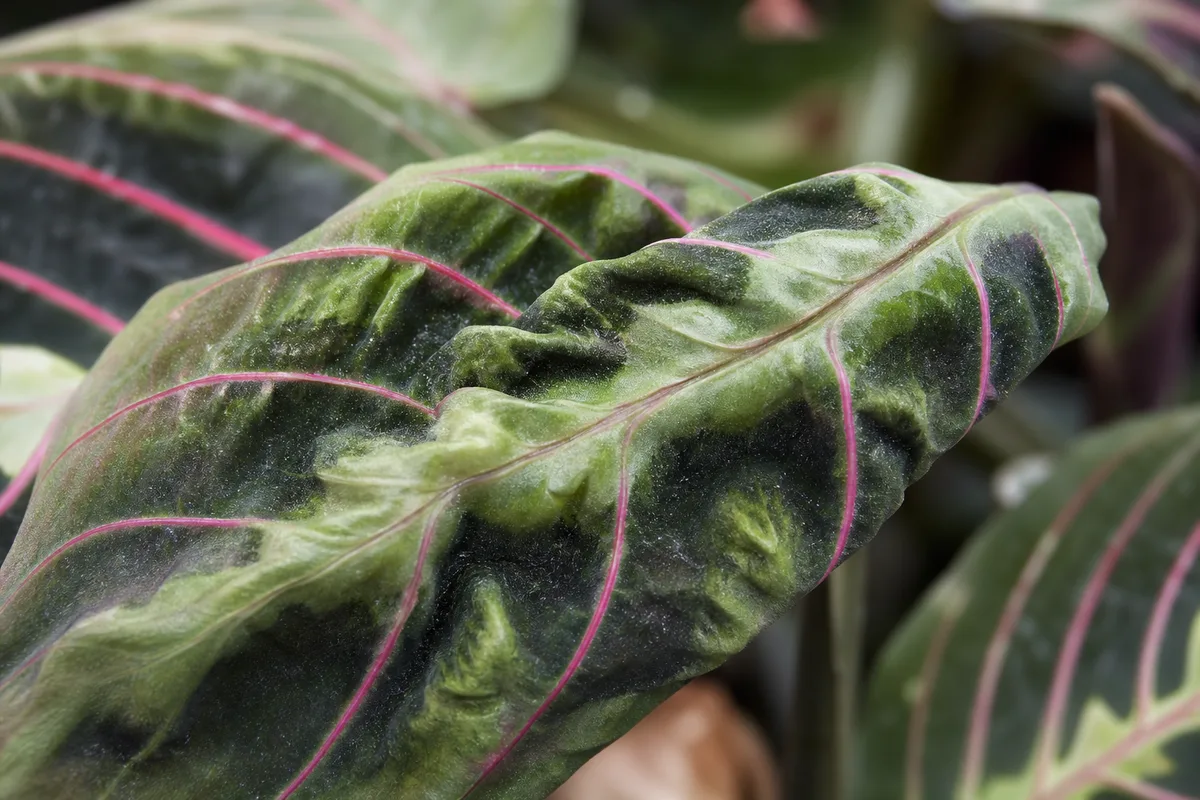
Curling leaves are easy to overread and easy to underread. One curled pothos leaf may be old damage from a dry weekend. A calathea that folds tighter every afternoon may be reacting to dry air, heat, or bright glass. New growth that opens twisted, scarred, and speckled can push pests much higher on the list than watering. The point of the Leaf Curl Diagnosis Tool is to slow that guesswork down and turn the pattern into a short, testable list of causes.
Use this page when a houseplant has leaves that cup inward, roll downward, twist, pucker, wrinkle, or fail to unfurl normally. The tool works best when you combine what you see on the leaf with the context around it: soil moisture, pot weight, light exposure, room humidity, recent moves, new plants nearby, and whether damage is on old leaves, new leaves, one side, or the whole plant.
The Leaf Curl Diagnosis Tool is a pattern-matching guide for indoor plant stress. It does not identify a plant pathogen in a laboratory sense, and it cannot see hidden roots or insects through the screen. It ranks likely explanations for curling foliage based on the symptom pattern you enter, then points you toward the next physical check.
The most common buckets are moisture stress, root stress, low humidity, heat or light stress, cold or draft stress, pest feeding, nutrient or salt stress, and normal plant movement. Those categories overlap. A plant can curl because the pot is bone dry, but it can also curl because wet soil damaged roots and the plant can no longer move water upward. Missouri Botanical Garden notes that both too much and too little water are common indoor plant problems, and that dead or damaged roots can rot after a drought-and-rewater cycle rather than recovering cleanly (indoor plant problems).
That is why the tool treats leaf curl as a clue, not a verdict. It asks you to separate the visible shape from the conditions that produced it.
No online leaf curl tool can confirm a virus, identify every mite species, measure root oxygen, test soluble salts, or distinguish every cultivar-specific habit. If a valuable plant is collapsing quickly, if a pest is spreading across a collection, or if you suspect a regulated plant disease, use the result as triage and get expert help from a local extension office, plant clinic, or experienced grower.
The tool also does not promise that curled leaves will flatten again. Many leaves keep their damaged shape after the stress is fixed. Your real success signal is usually clean new growth, stable soil behavior, and a halt in spreading damage. This matters because people often keep changing care after old damage stays visible, even when the underlying issue has already improved.
Start with curl direction, then check the whole plant
Direction is useful, but it is not enough by itself. Inward cupping often appears when leaves are losing water faster than roots can replace it. Downward curling or limp curling often appears with wet soil and root stress. Twisting, puckering, or scarred new leaves often points toward pest feeding, temperature swings, or erratic development while the leaf was still expanding.
RHS describes several useful distinctions for houseplants: crinkled or creased leaves can come from stop-start development, often tied to irregular watering or temperature variation; some plants such as Maranta may curl inward in bright light and dry air; and cold, dry conditions can curl leaf margins outward (leaf damage on houseplants). Treat those patterns as strong hints, then confirm with the rest of the plant.
Check where symptoms start. New leaves tell you what is happening now. Older leaves may tell you what happened weeks ago. One-sided curl near a window points toward light, heat, or cold glass. Whole-plant curl with a light pot points toward drought. Whole-plant curl with a heavy pot points toward root stress. Curl plus sticky residue, stippling, webbing, or black specks moves pests higher.
Read the pot before changing water
Watering is the easiest mistake to make because the same curled leaf can trigger opposite fixes. Before you add water, lift the pot. Feel the mix at the surface and deeper through a drainage hole if possible. Look for a gap between dry mix and the pot wall. Check whether the saucer or cachepot has standing water.
If the pot is light, the mix is dry at depth, and leaves feel thin or papery, drought stress is plausible. A thorough watering followed by full drainage is usually more useful than a small splash on the surface. Missouri Botanical Garden’s indoor plant factsheet recommends watering many plants when the mix is dry about one inch down, watering thoroughly, and not letting plants sit in drainage water (houseplant watering guidance).
If the pot is heavy, cool, and wet, do not treat curl as thirst. Wet roots can fail to supply water because oxygen is limited and roots are damaged. In that case the next step is drainage, air, and root inspection if decline continues. A leaf curl diagnosis is strongest when it matches the pot, not just the leaf.
Dry pot curl
Dry pot curl usually has a straightforward story. The plant has used the available water, the mix has shrunk or lightened, and leaves curl, fold, wilt, or crisp as water pressure drops. You may see it first on thin-leaved plants, hanging baskets, newly repotted plants with disturbed roots, or plants in small nursery pots near warm glass.
The fix is not just “water more often.” Rehydrate the root ball evenly, let excess water drain, then ask why it dried too far. More light, warmer rooms, smaller pots, terracotta, rootbound soil, fans, and heating vents can all shorten the interval. Use the watering frequency calculator after you confirm the pot really is drying too quickly.
Wet pot curl
Wet pot curl is more deceptive. The leaf looks thirsty, but the root zone is already saturated. Common clues include yellowing lower leaves, a sour smell, fungus gnats, soft stems, heavy pot weight, and soil that stays wet for many days. In this situation, adding more water can deepen the problem.
Move the plant into brighter appropriate light, empty standing water, improve airflow around the pot, and pause watering until the upper mix begins to dry. If the plant keeps declining, slide it from the pot and inspect the roots. Firm pale roots are encouraging. Brown, black, hollow, or mushy roots mean the curl is probably connected to root damage rather than a simple drink.
Separate humidity stress from underwatering
Low humidity and underwatering both create water-loss symptoms, but they leave different evidence. Underwatering shows in the pot. Humidity stress shows in the air around the foliage, especially when soil moisture is otherwise reasonable.
RHS explains that dry indoor air, especially in heated homes, can make houseplants lose more water than they take up, producing dry, crispy leaves, leaf drop, and wilting (how plants lose water). A separate RHS guide notes that low air humidity increases transpiration and can leave plants at risk of wilting when water loss from leaves exceeds uptake by roots (low humidity and transpiration).
The Leaf Curl Diagnosis Tool weighs humidity higher when the plant is a tropical thin-leaved species, the curl worsens near vents or bright windows, tips or edges are crispy, the pot is not extremely dry, and a hygrometer reads low at canopy height. It weighs underwatering higher when the pot is light, mix is dry through the root ball, leaves recover after a deep drink, and the pattern appears after missed watering.
For humidity-sensitive plants, compare the diagnosis with LeafyPixels guides such as low humidity, curling leaves, and plant-specific pages for calatheas, ferns, peace lilies, anthuriums, and alocasias.
Look for heat, bright glass, and sudden light changes
Heat and light stress often look dramatic because the leaf surface is where the stress happens. A plant close to a hot south or west window can roll, bleach, crisp, or wilt during the brightest part of the day, then partly recover later. RHS lists wilting, rolling, bleaching, and crispy leaves as signs of heat stress in houseplants, especially in very hot rooms such as conservatories in midsummer (poorly houseplant guidance).
The tool ranks heat or light stress higher when curling is strongest on the window-facing side, symptoms intensified after a move, leaves feel warm or sun-faded, and the pot dries faster than usual. It ranks heat lower when damage is evenly distributed across shaded leaves, the plant is far from glass, or the newest leaves are distorted before they ever reach the light.
Do not solve heat curl by moving a stressed plant into a dark corner. Pull it back from direct glass, diffuse harsh sun with a sheer curtain, and keep the plant in bright but suitable light. If you are unsure whether brightness is too low or too high, compare with the plant light finder or the grow light distance calculator.
Inspect pests before spraying
Pests are a major cause of distorted new growth, but they should be confirmed before treatment. Aphids cluster on tender growth and can curl or pucker leaves. Thrips scrape and feed in ways that scar or distort leaves and flowers. Spider mites often create pale stippling and fine webbing, especially on leaf undersides. Broad mites and cyclamen mites can distort new growth severely, but they are hard to confirm without magnification.
UC IPM notes that spider mites are tiny, commonly feed on houseplants and ornamentals, and often show up as stippling or webbing on leaf undersides (spider mite symptoms). UC IPM also notes that thrips feeding can distort or scar leaves, flowers, or fruit (thrips damage). For indoor plants, Clemson Cooperative Extension lists options such as insecticidal soap, neem oil extract, pyrethrins, and physical removal, and notes that treatment often has to be repeated multiple times (houseplant insect guidance).
Use a 10x hand lens if you have one. Check new growth, undersides, petiole joints, curled leaf pockets, and neighboring plants. Tap foliage over white paper. Look for moving dots, black fecal specks, sticky honeydew, shed skins, stippling, webbing, or deformed shoots. If pests are present, isolate the plant and use the houseplant pest identifier before reaching for a spray.
Do not confuse normal movement with damage
Some plants move. Prayer plants, calatheas, marantas, and related plants naturally raise and lower leaves in response to daily light cycles. New leaves also emerge rolled or folded before opening. That is not the same as stress curl.
Normal movement is rhythmic, reversible, and matched across healthy leaves. Stress curl is persistent, uneven, accompanied by edge damage, or tied to a recent change. A maranta that lifts leaves at night and relaxes by morning is behaving differently from a maranta that stays tightly curled all day with crispy margins near a vent.
Timing helps. Take a photo at the same time of day for several days. If the leaf angle changes predictably but tissue stays firm and new leaves open cleanly, do not overcorrect. If the curl tightens, new leaves deform, or brown edges spread, treat it as a diagnostic pattern.
The inputs should reflect what you can verify. For curl direction, choose the closest visible shape: inward cupping, downward roll, edge curl, twisted new growth, or general limp curling. For spread, note whether one leaf, one side, new growth, old growth, or the whole plant is affected. For speed, distinguish sudden change after a move from slow decline across several weeks.
For moisture, do not rely on the surface alone. A peat-heavy mix can look dry on top while staying wet in the center, and a hydrophobic root ball can shed water down the pot wall while the middle stays dry. Pot weight, drainage-hole checks, a wooden skewer, or a moisture meter used carefully can all improve the input.
For environment, measure what you can. A small hygrometer near the plant is better than guessing whether a room feels dry. A thermometer near a window can reveal heat or cold swings that the room thermostat misses. For light, the human eye adjusts too well to judge intensity accurately; use the light finder or a phone meter as a rough check.
Worked example: curled calathea near a heat vent
Imagine a calathea with leaves curling inward by late afternoon. The pot is slightly moist, not heavy. Edges are crispy. The plant sits near a forced-air vent, and a small hygrometer at leaf height reads 32% relative humidity. There is no webbing, stippling, sticky residue, or new plant nearby.
The tool should rank low humidity and heat movement higher than simple underwatering. The physical evidence supports that: the soil is not bone dry, the leaf edges are crisp, the curl worsens during the day, and the plant type is humidity-sensitive. The least risky next step is to move it away from the vent, stabilize moisture, and raise local humidity with a humidifier or better grouping. Damaged margins will not heal, so judge the fix by the next leaves.
If the same plant had a feather-light pot and soil pulling away from the wall, drought would rise. If it had fine webbing and pale stippling, spider mites would rise. The same curled shape would mean something different because the context changed.
Worked example: twisted pothos new growth after a new plant arrives
Now picture a pothos with older leaves that look fine, but the newest leaves open twisted and scarred. You notice tiny black specks on new growth and a silvery, scraped look on a few leaves. The plant sits near a newly purchased philodendron.
Here the tool should move pest feeding above watering. Old leaves are not showing a whole-plant water problem, damage is concentrated in tender new growth, and the black specks plus scarring fit a pest check. A careful inspection with a hand lens and isolation are better next steps than fertilizer or a watering change. If thrips are confirmed, treatment needs contact with hidden insects and follow-up checks, not a single casual spray.
If no pests are found after repeated inspections, then look at stop-start growth: irregular watering, temperature swings, or physical damage while leaves unfurl. But pests deserve the first serious check because the pattern is concentrated in new tissue and can spread.
What to do after the result
Treat the tool result as a ranked action list. Start with the cause that is both likely and easy to verify. Do not stack five fixes in one day unless the plant is in active danger. Changing water, light, pot, soil, fertilizer, humidity, and pesticide all at once makes it impossible to learn what helped.
For likely drought, water thoroughly and watch whether the plant regains firmness. For likely overwatering or root stress, stop adding water, improve drainage, and inspect roots if decline continues. For likely humidity or heat stress, move the plant away from vents or hot glass and stabilize the air around it. For likely pests, isolate, identify, and treat based on the pest rather than the symptom alone.
Use related tools to narrow the next step. The root rot risk checker helps when curl appears with wet soil. The humidity needs checker helps when curl stacks with crispy edges. The fertilizer dilution calculator helps if salt or overfeeding is suspected. The plant disease identifier is a better fit when curling comes with lesions, halos, mildew, or spreading spots.
Common mistakes that make leaf curl worse
The first mistake is watering from emotion. Curled leaves look thirsty, but a wet pot with damaged roots needs less water, not more. Always check the root zone before responding.
The second mistake is spraying without a pest ID. Insecticidal soaps and oils can be useful, but they work best when they contact the target pest, and some plants react badly if sprayed in heat, direct sun, or poor conditions. Confirm the pest, test a small area when appropriate, and follow the label.
The third mistake is blaming humidity for every curled tropical plant. Low humidity is common indoors, but it does not explain sour soil, mushy stems, stippling, sticky residue, or sudden one-sided scorch. Humidity is one variable in the diagnosis, not a universal answer.
The fourth mistake is expecting old leaves to recover. Once tissue is scarred, crisped, or deformed, it often stays that way. A correct diagnosis shows up as healthier new growth and slower spread, not cosmetic reversal.
When to stop troubleshooting and get help
Get outside help when the plant is expensive, rare, part of a large collection, or declining quickly despite careful checks. Also get help if you suspect a serious disease, cannot identify a spreading pest, or need pesticide guidance around children, pets, food crops, aquariums, or sensitive people.
For most houseplants, a local extension office, plant clinic, botanical garden help desk, or experienced independent nursery is a better escalation than a random image search. Bring photos of the whole plant, close-ups of leaf undersides, the pot and drainage setup, and notes on watering, light, humidity, and recent changes. A good diagnosis depends on the pattern, not only the most damaged leaf.
Conclusion
The Leaf Curl Diagnosis Tool works best when you use it as a disciplined first pass: describe the curl, read the pot, inspect the undersides, measure the room, and connect the symptom to recent changes. Curling leaves can come from drought, wet roots, dry air, heat, cold, pests, salts, or normal movement, so the strongest answer is the one that matches both the leaf and the evidence around it.
Start with the least risky confirmation step. Check moisture before watering. Inspect pests before spraying. Move plants away from obvious heat or draft stress before repotting. Then judge progress by new growth and whether the curl stops spreading. That gives you a diagnosis you can test, not just a label that sounds confident.