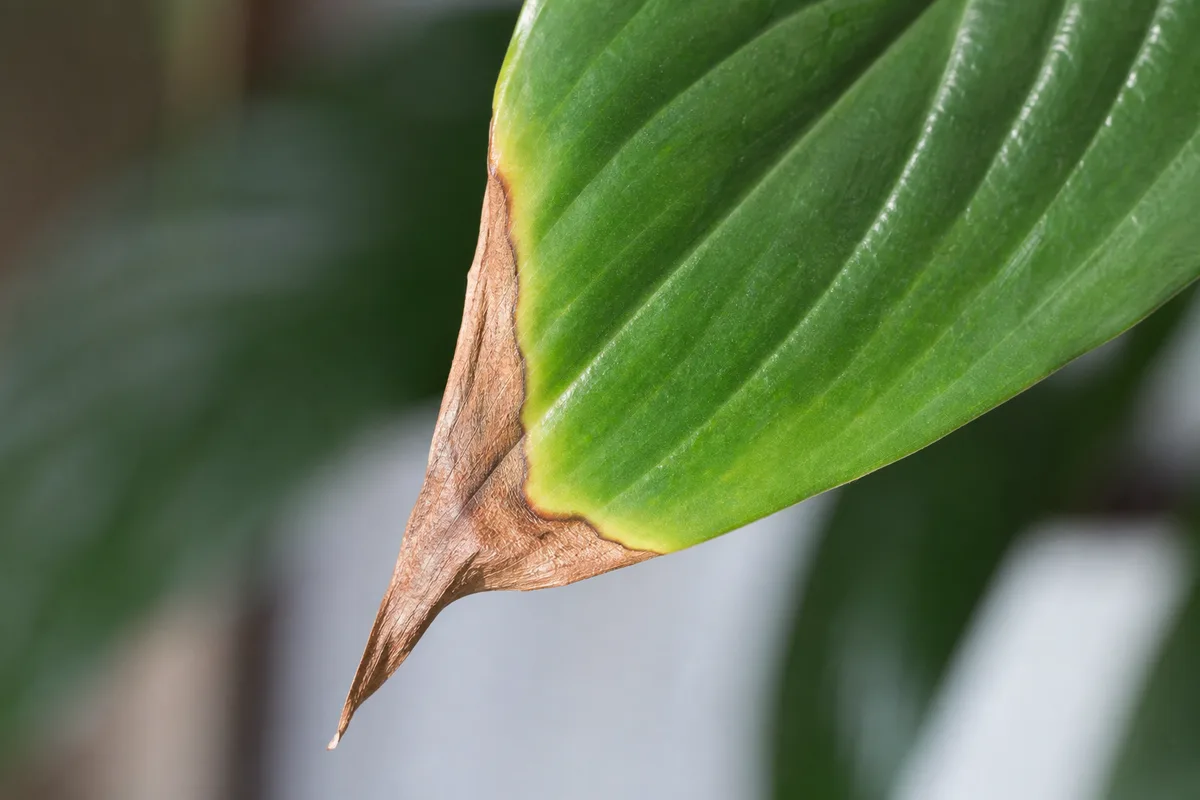
Brown leaf tips are frustrating because they look specific, but they are rarely caused by one single thing. Dry air, hard water, fertilizer salts, missed waterings, damaged roots, heat vents, and spider mites can all leave a similar crispy edge. The Brown Tips Diagnosis Tool helps you sort those lookalikes by comparing the shape of the damage, the speed of change, the soil condition, and your recent care history.
Use the tool as a triage step, not as a verdict. A brown tip is dead tissue, so it will not turn green again. The useful question is whether the plant is still making clean new growth. If new leaves are opening without fresh burn, the old tips are evidence of a past stress. If every new leaf arrives with a dry edge, the stress is still active and worth diagnosing.
The tool turns a messy symptom into a ranked shortlist. It asks you to look at where the browning starts, how evenly it appears across the plant, whether the leaf edge is dry or soft, whether the soil is wet or dry, whether white crust is present, and whether the plant recently received fertilizer or a water-source change.
That matters because “brown tips” is a symptom category, not a diagnosis. NC State Extension lists low humidity, poor water quality, excess fertilizer, overwatering, underwatering, and pH problems among possible causes of leaf tips turning brown in container plants. The tool’s job is to help you decide which of those causes best matches the evidence in front of you.
The tool cannot smell sour potting mix, test electrical conductivity, inspect the full root ball, identify your municipal water chemistry, or confirm a mite infestation under magnification. It also cannot know whether a plant was stressed before you bought it. A plant shipped in winter, repotted roughly, or kept in a dark store corner may show tip burn weeks later even after you improve its care.
So the result should lead to a check, not an impulsive fix. If the tool says “likely salts,” check for crust, recent feeding, hard water, and a slow-draining pot. If it says “likely drought,” check pot weight and moisture through the root zone, not only the top surface. If it says “likely pest stress,” inspect undersides and petioles with a bright light.
Leaf tips and margins are exposed edges. They lose moisture easily, and they are often the first visible place where a plant shows that roots, water movement, or the growing environment are under stress. The tissue dries, collapses, and turns tan to dark brown. Once cells in that patch are dead, the plant does not repair the patch; it works around the damage by keeping the remaining green tissue alive and producing new leaves.
The pattern is more useful than the color. A narrow tan rim on many older leaves points in a different direction than a few black, soft patches on leaves touching wet soil. A dry triangular tip after a skipped watering says something different from evenly browned margins after a strong fertilizer dose. The tool is built around those pattern differences.
Start with the pattern, not the panic
Before changing anything, take two minutes to describe the damage as if you were reporting it to someone who cannot see the plant:
- Are the tips dry, crisp, and papery, or dark, soft, and spreading?
- Is the damage only on old leaves, only on new leaves, or on both?
- Are margins browning evenly, or are there spots, halos, stippling, or webbing?
- Did the issue appear after fertilizing, repotting, moving the plant, turning on heat, or letting the pot dry hard?
- Is the pot light and dry, heavy and wet, or wet on top but dry below?
Those answers matter more than a generic care rule. A peace lily, dracaena, calathea, spider plant, fern, and ZZ plant can all get brown tips, but the most likely cause shifts with plant type and care history. Sensitive foliage plants often react quickly to water quality and dry air; drought-adapted plants are more likely to punish extra water than a short dry spell.
The main causes the tool weighs
Low humidity and dry indoor air
Low humidity usually creates dry, papery edges while the rest of the leaf may remain reasonably green. It is common in winter rooms with forced-air heat, near radiators, on high shelves where warm air pools, and close to air-conditioner drafts. University of Minnesota Extension notes that tropical ferns placed high in hotter, drier air may develop brown frond tips, which is the same kind of edge desiccation many thin-leaved houseplants show indoors.
Humidity-related tips often develop gradually. You may see the newest leaf unfurl with a dry point, or a calathea-style leaf may curl slightly before the edge crisps. The potting mix may be drying at a normal rate, and there may be no white crust, no recent fertilizer event, and no sour root smell. The clue is the microclimate around the leaf, not just the calendar. A plant near a vent can live in much drier air than the room average shown by a thermostat.
Fertilizer burn and soluble salts
Fertilizer burn often looks like dry browning at the tips and margins on several leaves at once, especially after a feed. It may come with white crust on the soil surface, pot rim, or drainage holes. University of Maryland Extension describes fertilizer toxicity and high soluble salts in indoor plants as causing browning or dieback of leaf tips and margins, along with possible reduced growth, wilting, leaf drop, and root-tip injury.
The key idea is concentration. Plants need nutrients, but roots still have to absorb water across a salt gradient. When dissolved salts build up in the potting mix, water movement becomes harder for fine roots. A plant can wilt or scorch even when the mix is not bone dry. This is why a plant can look thirsty after fertilizing and still be harmed by adding more fertilizer.
Tap water, fluoride, sodium, and hard-water minerals
Water quality is a common hidden variable. Some indoor plants tolerate ordinary tap water for years; others respond with repeated tip burn, especially if the water is softened, very hard, or contains additives that sensitive plants dislike. University of Minnesota Extension notes that some indoor plants, including orchids and long, narrow-leaved plants, can be sensitive to tap water containing chloride and fluoride.
This does not mean every brown tip is a tap-water problem. It means water quality moves higher on the list when the plant is a known sensitive type, the damage is evenly repeated across many leaves, the plant is otherwise watered correctly, and fertilizer has not recently changed. Dracaena, spider plant, peace lily, calathea relatives, and many ferns are common examples where growers often test a switch to filtered, distilled, reverse-osmosis, or collected rainwater for ornamental use.
Underwatering and hydrophobic potting mix
Underwatering creates brown tips when the root ball dries enough that water supply cannot keep up with transpiration. The pot usually feels light, lower leaves may droop or curl, and the mix may pull away from the pot wall. In peat-heavy mixes, a severe dry-down can become hydrophobic: water runs down the sides and out the drainage holes without rewetting the center.
Do not diagnose drought from the top half inch alone. A large pot can feel dry on top while staying wet near the root center, and a compacted root ball can be wet outside but dry inside. Virginia Cooperative Extension’s houseplant watering guidance recommends checking whether the potting soil surface becomes moist after bottom watering and repeating the process when a hydrophobic soil resists rewetting. That is useful when a plant acts thirsty even after a quick pour-through.
Overwatering and root damage
Overwatering can also end in brown tips because damaged roots cannot supply water properly. This is the part that confuses people: a plant can sit in wet mix and still show dry edges if the roots are oxygen-starved or rotting. Clemson Extension explains that roots need both water and oxygen, and when roots are surrounded by water they may be unable to take up oxygen and may rot.
Overwatering-related brown tips rarely appear alone. Look for yellowing, dull leaves, sour or swampy smell, fungus gnats, blackened root tips, a pot that stays heavy for too long, or stems that soften near the soil line. If those signs are present, do not respond to brown tips with more water. The useful move is to restore root-zone air: improve drainage, reduce watering frequency, increase light if appropriate, and inspect roots if decline continues.
Heat, sun scorch, and air movement
Hot glass, afternoon sun, radiators, fireplaces, and forced-air vents can dry leaf tips faster than roots can replace water. This damage is often directional. Leaves facing the window or vent show it first, while shaded inner leaves look cleaner. The brown area may be sharper and more localized than salt or humidity burn.
Use the tool’s placement questions carefully. “Bright room” is not enough information. A plant can be in bright indirect light for most of the day but still catch one hour of intense sun through glass. Likewise, a plant can be across the room from a vent but directly in its airflow path. If the damage is worst on the exposed side, solve the exposure before changing fertilizer or water source.
Pests and disease lookalikes
Spider mites, thrips, scale, and leaf spot diseases do not always start as classic brown tips, but they can create edge damage that gets mistaken for humidity or salts. Spider mites are especially relevant because they like warm, dry indoor conditions and can cause stippling, bronzing, webbing, and leaf decline. NC State Extension describes twospotted spider mite feeding as producing tiny chlorotic spots called stippling, with heavier damage leading to yellowing or bronzing and silk webbing.
The tool should push pests higher when brown tips appear with fine speckles, dulling, sticky residue, webbing, black specks, or distorted new growth. Do not spray first and inspect later. Confirm the pest pattern under the leaves, along veins, at petiole joints, and in tight new growth. Treating an imagined pest can stress a plant that really needed better watering or cleaner water.
Good inputs make the result sharper. Start with the visible symptom: crisp tip only, tip plus margin, full leaf edge, scattered spots, or soft spreading patches. Then add the care timeline. The most useful dates are the last deep watering, last fertilizer application, last repot, last move, and when heat or air conditioning started running regularly.
For soil status, use more than one check. Lift the pot. Insert a wood skewer or finger deeper than the surface if the plant and pot size allow it. Look at the drainage holes. If safe, slide the nursery pot out of the cachepot and inspect the lower mix. The top inch can be dry while the lower root ball stays wet, and that difference changes the diagnosis.
For water quality, note whether you use tap, softened tap, filtered, distilled, rainwater, or aquarium water. Note whether you bottom water, top water, or rarely flush the pot. Salt problems are more likely when water and fertilizer enter the pot repeatedly but little water drains away.
How to interpret the ranked result
Treat the top result as the best next check. If the tool ranks “soluble salts” first, look for crust and recent feeding, then flush only if the plant is not already sitting in a failing wet root ball. If it ranks “low humidity” first, measure humidity at plant height for a few days before buying a humidifier. If it ranks “underwatering” first, rehydrate the mix thoroughly and watch whether leaves regain firmness.
The second and third results are not filler. Brown tips often come from stacked stress. A calathea in dry winter air may also receive hard tap water. A root-bound spider plant may dry too fast, then accumulate salts because each watering is shallow. A ZZ plant may show old dry tips from drought, then decline after the owner overcorrects with weekly water. The order tells you what to check first; it does not prove the other causes are absent.
Quick diagnostic examples
Example 1: crispy tips with white crust.
A 6-inch peace lily has tan tips on eight older leaves. The soil surface has a pale crust, the owner fertilized twice in one month, and water usually goes into a decorative pot with no full drain-through. The tool should rank soluble salts or fertilizer burn high because the symptom pattern and care history line up. University of Maryland Extension recommends leaching houseplants with clear water every four to six months by applying at least twice the pot volume and letting it drain completely.
The practical fix is not to feed harder. Remove crust if it is present, flush the pot if drainage is good, empty the saucer, pause fertilizer, and judge recovery by new leaves. If the pot has no drainage hole, repotting into a draining container may matter more than any flush.
Example 2: dry tips after winter heat starts.
A rattlesnake calathea opens new leaves with dry points in January. The pot dries on a normal schedule, there is no crust, no recent fertilizer, and no pests under magnification. The plant sits near a warm air register. The tool should rank humidity or heat airflow high. The next step is to move the plant out of the draft, measure humidity at canopy height, and stabilize watering rather than repeatedly trimming and fertilizing.
This is a good case for comparing two runs: one with “dry air or vent exposure” selected and one without it. If the diagnosis shifts strongly, the microclimate is probably the lever to test first.
Example 3: brown tips with heavy wet soil.
A pothos has brown tips, yellowing lower leaves, and a pot that remains heavy for ten days after watering. The owner has been adding water because the tips looked dry. The tool should rank root stress or overwatering above simple drought. The leaf edge is dry, but the root-zone evidence points to poor oxygen and declining roots.
The safest next step is to stop watering until the mix dries appropriately, improve light if the plant is in a dim corner, make sure the pot drains, and inspect roots if yellowing spreads. Adding a humidifier or switching water may not hurt, but it will not solve roots sitting in stale wet mix.
Common mistakes when using the diagnosis
The first mistake is assuming brown tips always mean underwatering. Dry-looking tissue can come from roots that are too dry, roots that are too wet and damaged, or roots struggling against salts. Check the root zone before adding water.
The second mistake is chasing cosmetic repair. Trimming dead tips can make a plant look better, but it does not diagnose the cause. If you trim, use clean scissors and follow the leaf shape, leaving a tiny brown edge rather than cutting into healthy green tissue. Then watch the next leaf, not the old scar.
The third mistake is changing five variables at once. If you flush, repot, move the plant, raise humidity, change water, and apply pest spray in the same weekend, you may never know what helped. Worse, the stacked stress can create new symptoms. Use the tool to choose the lowest-risk first move.
The fourth mistake is ignoring plant identity. A succulent with brown tips and wet soil needs a different response than a fern with brown tips and dry air. Use the result alongside plant-specific LeafyPixels guides where available, especially for sensitive groups such as calatheas, ferns, peace lilies, dracaenas, spider plants, and peperomias.
When to use related LeafyPixels pages
Use the brown tips symptom guide when you want a broader symptom-first explanation. Use the crispy leaves guide if the whole leaf blade feels dry, not just the tip. Use the low humidity guide when dry air, curling, and winter heat are part of the pattern. Use the chemical damage guide when browning follows sprays, cleaners, fertilizer spills, or treated water.
If the plant has yellowing, wilting, sour soil, or soft stems, compare the result with root-zone tools and guides before treating tip burn as a cosmetic water-quality problem. If you are unsure which symptom dominates, start with the broader Plant Problem Diagnosis Tool or the Why Is My Plant Dying? Tool.
When to slow down or get help
Most brown-tip cases are not emergencies. Slow down when the plant is valuable, newly imported, part of a large collection, or declining quickly. Also slow down when brown tips appear with black mushy roots, a sour smell, spreading spots with halos, sticky residue, or pests on multiple plants. Those patterns can move beyond simple cosmetic burn.
For edible plants, pesticide use, severe infestations, or suspected disease spreading through a collection, use local extension guidance or a qualified horticulture professional. Indoor-plant advice online is often written for ornamentals, and treatment choices can change when food crops, children, pets, or pesticide labels are involved.
Conclusion
The Brown Tips Diagnosis Tool is most useful when you bring it real observations: the exact browning pattern, recent care changes, soil moisture, water source, fertilizer history, humidity, and pest clues. Brown tips are common, but they are not meaningless. They are a record of stress at the leaf edge.
Start with the ranked result, verify the physical evidence, and make one measured change. For many plants, the win is not making old tips disappear. It is seeing the next leaf open clean, firm, and green.