Tillandsia Repotting: How to Remount an Air Plant Safely
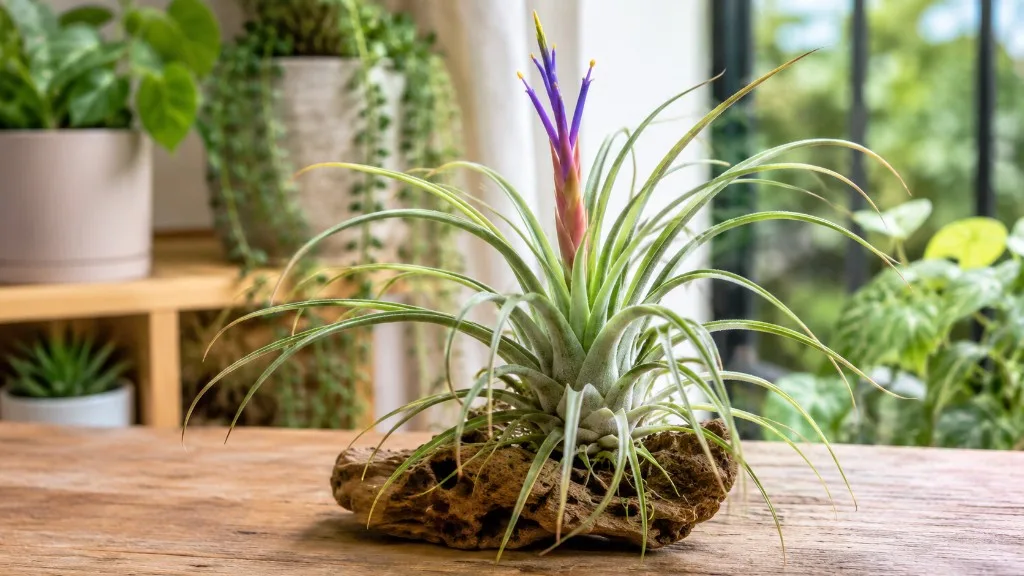
Tillandsia Repotting: How to Remount an Air Plant Safely
Tillandsia Repotting: How to Remount an Air Plant Safely
Tillandsia repotting is usually the wrong phrase for the right problem. Air plants do not need a larger pot of fresh mix. What they often need is a better mount, a safer way to dry after watering, or a split between the mother plant and its pups before the clump becomes unstable.
Michigan State University Extension notes that tillandsias are epiphytes and can be damaged or killed if they are treated like normal potted houseplants. That is the core principle for this page. If you are “repotting” a Tillandsia, you are almost always remounting, reattaching, or dividing, not upgrading soil volume.
What repotting actually means for an air plant
There are three common situations that send people searching for this page.
- The plant fell off its mount or the hardware is failing.
- The display traps water at the base and the plant is starting to soften or darken.
- A clump has produced enough pups that it no longer dries or hangs evenly.
All three are real maintenance issues. None are solved by potting the plant in soil. UF/IFAS Gardening Solutions recommends mounting air plants on surfaces that do not hold water, which is a more useful rule than any pot-size advice.
When a Tillandsia should be remounted
A healthy air plant does not need to be disturbed just because the display looks old. Remount only when the current setup is making care harder or less safe.
Good reasons to remount include:
- the plant rotates or slips on the mount
- moss, bark pockets, or adhesive are staying wet too long
- the base looks dark, soft, or sour after watering
- the clump is now too heavy for the original support
- the plant is in a decorative setup that never fully dries
If the plant is stable, dries well, and shows firm new growth, leaving it alone is usually better than “refreshing” it for appearance alone.
Check the base before you touch the hardware
The first job is not choosing wire or glue. It is checking whether the plant is healthy enough to remount.
Look for:
- a firm base rather than soft or slimy tissue
- leaves that stay attached at the center
- no sour smell
- no blackening where leaves meet the base
University of Minnesota Extension warns that crowns rot when water does not drain away after watering. If the base is already compromised, remounting onto another decorative surface without trimming and drying first simply moves the problem.
The safest mounting materials
The best mount is the one that holds the plant securely without trapping water. UF/IFAS Gardening Solutions suggests surfaces such as cork, bark, shells, or shallow dishes with dry pebbles. Those work because they let air move around the plant instead of packing moisture against the base.
Good choices include:
- cork bark
- driftwood or clean bark pieces
- open wire frames
- shallow dishes with dry stones where the plant sits on top, not buried
The bad choices are the ones people keep trying for aesthetic reasons: wet moss nests, deep crevices that hold water, enclosed globes, and any setup where the plant stays damp long after watering ends.
Wire or line is usually the most forgiving option
For most home growers, removable attachment is easier to live with. Wire or fishing line lets you take the plant off the mount, water it, dry it upside down, and put it back without soaking the mount itself every time.
That flexibility matters because Penn State Extension recommends soaking Tillandsia about 20 to 30 minutes and then allowing them to dry within a few hours. A removable mount makes that rhythm easier and safer than a permanently fixed setup.
Use a gentle loop low on the base, not pressure across the center growth point. The goal is support, not compression.
Adhesive can work, but it raises the need for discipline
UF/IFAS Gardening Solutions notes that air plants can be attached with adhesive or wire. Adhesive is not automatically wrong, but it reduces your margin for error because the plant is now tied to a surface that may stay wet longer than the plant itself.
Use adhesive only when:
- the base is fully dry and healthy
- the mount dries quickly
- you do not need to soak the entire piece regularly
- you are willing to watch the bond line closely for trapped moisture
If your normal care style is frequent full soaking, wire is usually the better long-term choice.
Step-by-step: how to remount a Tillandsia
Remounting should feel careful, not elaborate.
- Let the plant dry first so the base is easy to inspect.
- Remove old moss, stale adhesive, or rotting material from around the base.
- Trim only clearly dead or soft tissue with clean scissors.
- Let any fresh cuts dry before attaching the plant again.
- Place the plant where water will run away from the center instead of pooling in it.
- Attach with wire, line, or a small amount of adhesive applied only at the base.
Do not pack moss around the base to “stabilize” it. Do not bury it in gravel. Do not wedge the plant so tightly that leaves stay pressed against the mount after watering.
When to separate pups instead of remounting the whole clump
Sometimes the right answer is not a stronger mount. It is a smaller clump.
Penn State Extension recommends waiting until pups are roughly one-third to one-half the size of the mother plant before separating them. That guideline is useful because very small pups dry out faster and have less reserve if the move goes badly.
Separate pups when:
- the clump has become top-heavy
- inner surfaces stay damp too long
- you want better airflow around each plant
- one side of the clump is declining while offsets are healthy
If the clump is drying well and the shape is still manageable, you can leave it intact longer.
How to separate pups cleanly
Work with a dry plant. Hold the mother plant low and check whether the pup twists free with gentle pressure. If it does not, use clean scissors to cut as close to the joining point as possible without shredding tissue.
After separation, give both pieces time to dry before resuming routine watering. That pause is more important than any rooting trick. Fresh wounds plus trapped moisture are what turn a simple division into a rot problem.
Aftercare decides whether the remount worked
The remount itself is only half the job. The other half is making sure the plant dries well afterward.
Penn State Extension emphasizes drying after watering, and UF/IFAS emphasizes airflow. In practical terms, that means:
- water the plant, not the decorative nest
- shake out trapped water
- dry the plant with the base angled down when possible
- do not return it to a closed, humid pocket while still wet
If the base stays firm and new growth resumes, the remount worked. If the center loosens, smells sour, or keeps darkening, the display is still holding too much moisture.
Common remounting mistakes
The repeated failures are usually not mysterious.
- Treating an air plant like a potted plant.
- Reusing wet moss around the base.
- Choosing a mount that looks good but never dries.
- Reattaching a plant without checking for hidden rot first.
- Separating pups too early.
- Using a permanent bond when your care routine really requires removability.
These are all fixable, but only if you treat the mount as part of the growing environment rather than just décor.
Conclusion
The helpful version of Tillandsia repotting is not “what pot size next?” It is “how do I give this air plant a drier, safer, more maintainable attachment?” Most of the time that means remounting, not potting, and sometimes it means splitting pups instead of forcing one oversized clump to stay together.
Start by checking the base, then choose the simplest setup that lets the plant dry well after watering. If you love soaking, use a removable mount. If you want a fixed display, choose a fast-drying surface and watch the bond area carefully. In Tillandsia care, the mount is not separate from the plant’s health. It is part of the root-zone decision, even when there is no real pot at all.
When to use this page vs other Tillandsia guides
- Tillandsia overview - Start here if you need the full care context before changing the display.
- Tillandsia soil - Use this if the plant is still sitting in soil, moss, or another moisture-holding setup.
- Root Rot on Tillandsia - Use this if the base is already soft, dark, or sour.