Brown Tips on Schefflera: Causes, Checks & Fixes
Quick answer
Brown tips on Schefflera usually come from low humidity, uneven watering, mineral buildup, or sun scorch. First, correct humidity and watering rhythm; browned tissue will not turn green again, but new growth can come in clean.
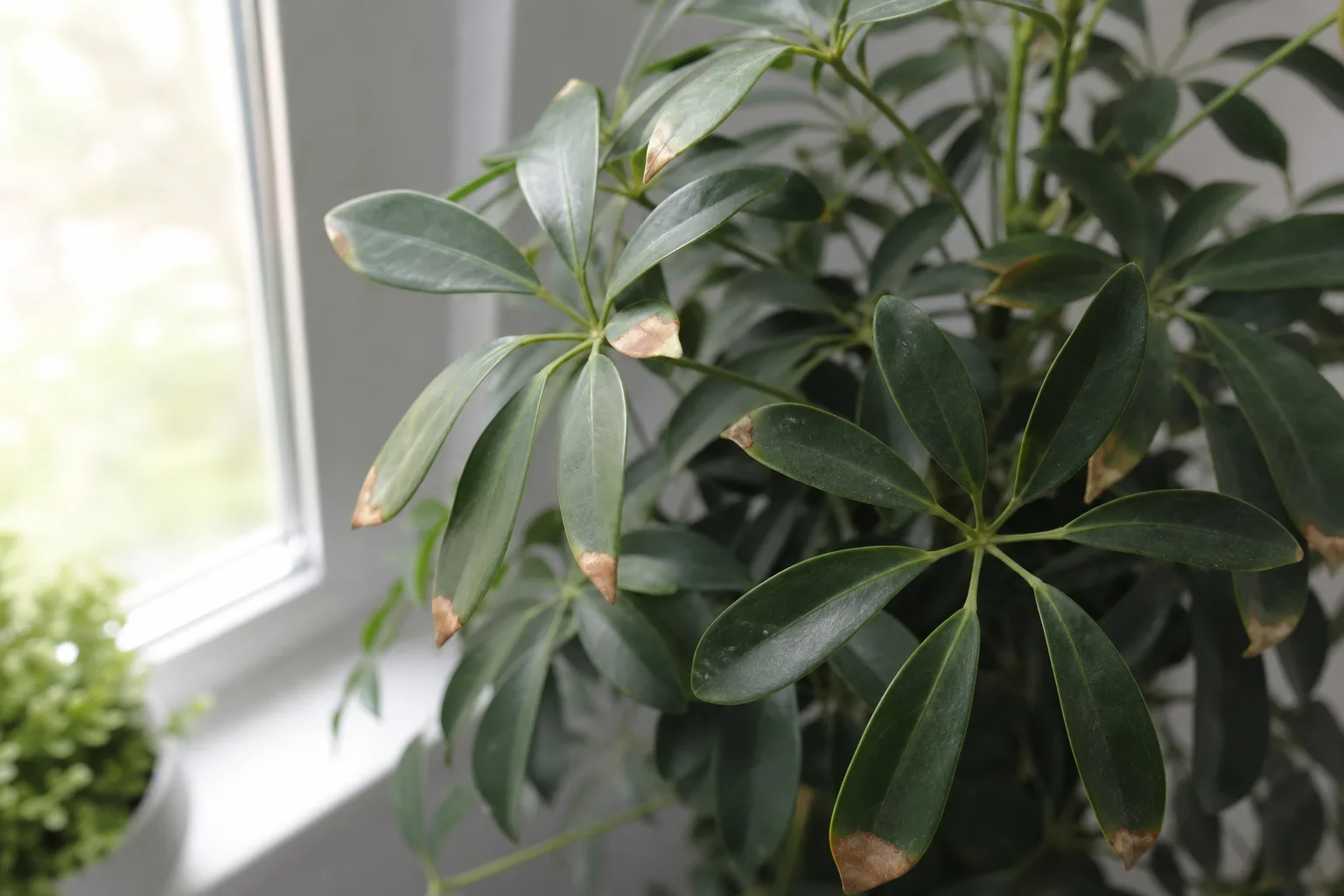
Brown Tips on Schefflera: Causes, Checks & Fixes
This guide covers brown tips on Schefflera. See also the general Brown Tips guide, watering, and light pages for this plant.
Brown Tips on Schefflera: Causes, Checks & Fixes
Quick answer
On Schefflera, brown tips are most often an environmental margin-burn pattern, not a disease. The first move is simple: stabilize moisture and humidity before trying treatments. Schefflera can react to both dry and overly wet conditions, and leaf drop can happen when soils are too moist or too dry. If tips started during heating season or near vents, dry air is usually part of the problem.
If your plant is still growing and stems are firm, this is usually recoverable. Existing brown tips stay brown, but new leaflets can emerge clean once stress is corrected.
What brown tips look like on Schefflera
Schefflera arboricola has palmate leaves with multiple leaflets in a whorl, so tip damage often appears first on individual leaflet margins rather than across the entire leaf. Common patterns include:
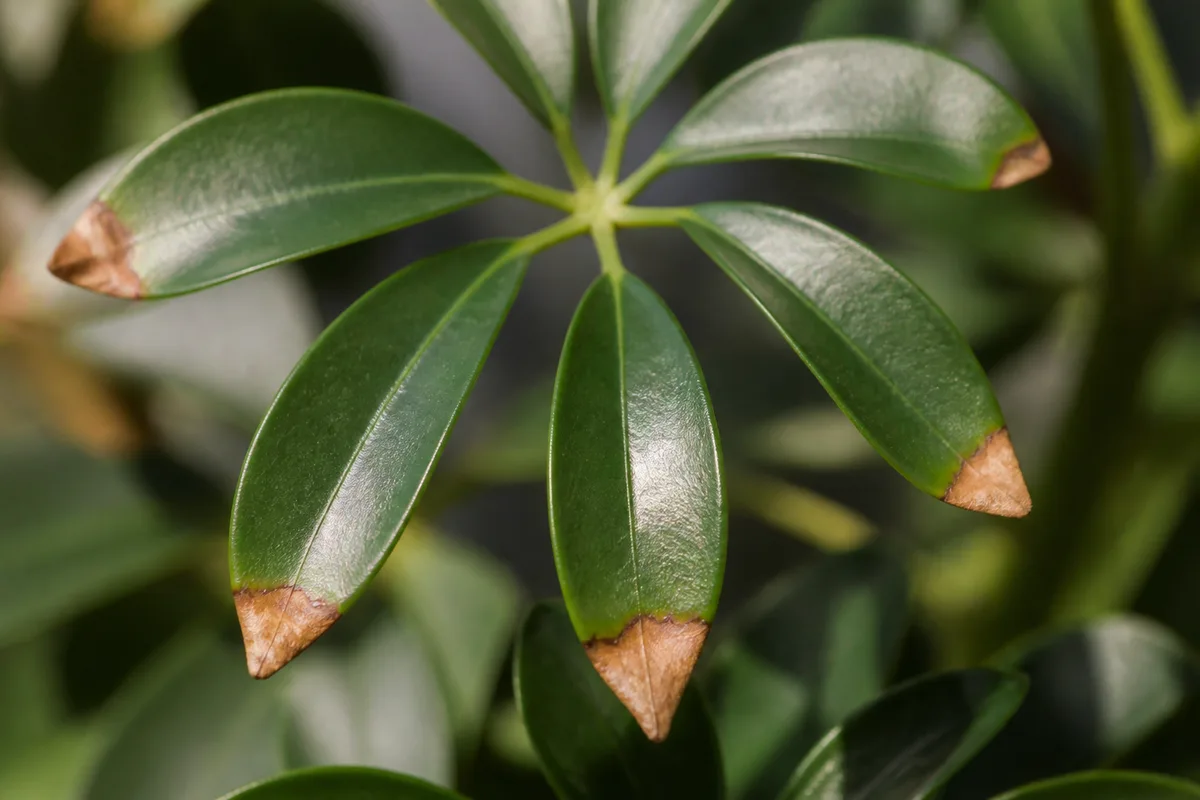
Brown Tips symptoms on Schefflera - compare with healthy tissue on the same plant.
- crisp, tan-to-brown points on leaflet ends
- damage worse on leaves closest to a vent or radiator
- older leaves dropping after tip burn persists
- one-sided scorch where strong direct sun hits only the window-facing side
If you also see tiny pale stippling and fine webbing, consider spider mites: their feeding causes chlorotic stippling and webbing, especially in warm, dry indoor conditions.
Why Schefflera gets brown tips
1) Dry indoor air during heating season
Schefflera is a tropical foliage plant that does better with moderate humidity. NC State notes it likes high humidity, and winter homes often drop below ideal plant comfort. Penn State explains indoor winter RH commonly falls below 30% in heated spaces, while houseplants generally benefit from higher humidity than that baseline (Penn State Extension).
2) Watering swings (too dry, then too wet)
Letting the root ball swing between drought and saturation stresses leaflet edges first. Clemson notes Schefflera problems indoors are frequently tied to too much or too little water, and root rot on Schefflera risk rises with frequent wetness (Clemson HGIC).
3) Salt or fluoride accumulation
When you water lightly and repeatedly, dissolved minerals can accumulate in potting mix and at leaf margins. This can worsen existing tip browning, especially in slower winter growth.
4) Direct-sun scorch or hot/cold drafts
NC State warns that bright, direct light can burn leaves, while Clemson notes drafts and nearby heat/AC can damage Schefflera foliage (Clemson HGIC).
How to confirm the cause (five-step order)
Use this order so you do not stack random fixes:
- Check root-zone moisture first. If the pot is heavy and wet for many days, overwatering is more likely. If bone-dry repeatedly, drought swings are likely.
- Check canopy humidity where the plant sits. Use a hygrometer at plant height, not across the room.
- Map the damage pattern. Vent-side or radiator-side leaves worsening first strongly suggests dry-air stress.
- Inspect light exposure by side. One-sided crisping on the window side points to sun scorch.
- Rule out mite lookalikes. Look at leaflet undersides for stippling and webbing; spider mites are favored by dry conditions (UMN Extension).
If you need deeper context, compare overlapping stress pages:
First fix to try
For most homes, start with environment stabilization:
- Move the plant away from direct vent airflow and harsh midday direct sun.
- Resume deep, even watering only when the top layer has dried appropriately for your pot size.
- Raise local humidity with a humidifier or pebble tray setup. Missouri Extension notes humidity trays can raise local humidity around plants when used correctly (MU Extension).
Do this for 10–14 days before making major changes like Schefflera repotting guide. Early repotting can add stress when roots are already recovering.
Step-by-step recovery plan
Week 1: stabilize
- Keep watering consistent; do not alternate drought and flood cycles.
- Rinse dust from leaves gently; MOBOT notes cleaning leaves with a damp sponge is appropriate.
- Pause fertilizer on visibly stressed plants.
Week 2: leach and reassess
- If tips continue spreading and your water is mineral-heavy, run a thorough leaching flush through the pot once to reduce accumulated salts.
- Recheck for mites and treat only if confirmed.
Weeks 3–6: monitor new growth
- Browned tissue stays browned.
- Improvement means newly emerging leaflets remain green at the tips and spread slows.
Recovery timeline and what success looks like
Most Schefflera tip-burn cases improve in pattern within 2–4 weeks after conditions are corrected. Cosmetic recovery is slower because existing damage does not reverse. Judge progress by:
- reduced rate of new browning
- firmer stems and steadier turgor
- healthy new whorl development
- less leaf drop over time
If decline accelerates despite stable care, inspect roots and reassess for pests or chronic overwatering.
Lookalikes to rule out
Brown tips vs yellow-whorl drop
Tip burn: crisp edges with otherwise green leaflets.
Overwatering stress: broader yellowing and drop, often from lower leaves first.
Brown tips vs spider-mite injury
Tip burn: edge necrosis without fine stippling pattern.
Spider mites: speckled stippling plus webbing and progressive bronzing (UMN Extension).
Brown tips vs sun scorch
Tip burn from humidity/watering: spread across many leaves, often linked to season and airflow.
Sun scorch: concentrated on exposed window-facing side after intense direct light.
What not to do
- Do not water more just because the tips look dry; check root moisture first.
- Do not fertilize heavily to “green up” a stressed plant.
- Do not repot, prune hard, and spray pesticides all at once.
- Do not rely on brief misting alone as your humidity strategy in very dry rooms.
How to prevent brown tips next time
Build a simple routine:
- Keep Schefflera in bright filtered light, with direct sun introduced gradually.
- Water deeply, then allow the upper mix to dry before the next soak.
- Keep it away from radiator, heater, and AC draft streams (Clemson HGIC).
- During heating season, monitor RH near the canopy and adjust with humidification if air becomes very dry (Penn State Extension).
- Periodically flush the pot to reduce fertilizer/mineral accumulation.
For baseline care references, use:
Pet safety note while trimming
Schefflera is toxic to cats and dogs, so collect and discard trimmed leaf pieces promptly. If a pet chews the plant and develops oral irritation, drooling, or vomiting, contact your veterinarian or poison support promptly.
When to use this page vs other Schefflera guides
- Schefflera watering guide - Use for routine moisture checks before assuming brown tips is the main issue.
- Schefflera problems hub - Browse all 18 common issues on this species.
- Low Humidity on Schefflera - Different entry point when symptoms overlap with brown tips.
- Underwatering on Schefflera - Different entry point when symptoms overlap with brown tips.
- Overwatering on Schefflera - Different entry point when symptoms overlap with brown tips.