How to Propagate Philodendron Micans: Water & Mix Guide
How to Propagate Philodendron Micans: Water & Mix Guide
How to Propagate Philodendron Micans: Water & Mix Guide
Philodendron Micans propagation starts with one rule that never changes: every cutting needs at least one node - the slightly swollen joint where a velvet leaf attaches and roots emerge. Philodendron hederaceum var. hederaceum is a fast trailing aroid with soft herbaceous stems and nodes every few centimetres, which is why water jars fill with white roots so reliably. The mistake that wastes the most Micans cuttings is not choosing water over mix - it is taking a beautiful leaf with no node, bruising velvet tissue during rough handling, or letting a stem sit in cloudy water until the submerged node rots.
This guide covers where to cut on a velvet vine without damaging iridescent leaves, water versus moist aroid mix rooting, realistic two-to-three-week timelines in warm bright conditions, transplanting at roughly 2.5 cm (1 inch) root length, filling a hanging basket from one leggy parent, pet safety while handling sap, and what to do when propagation stalls. For parent-vine shaping that supplies propagation material, see the Philodendron Micans pruning guide.
Why Philodendron Micans Is One of the Easiest Aroids to Propagate
Micans belongs to the same species complex as heartleaf philodendron and Brasil - a trailing philodendron group Iowa State Extension describes as the easiest to propagate from stem cuttings. Unlike large self-heading philodendrons that need bigger stem sections and more patience, Micans produces long vines studded with nodes every few centimetres. Each node is a potential root-and-shoot factory. Cut just below a node, keep velvet leaves above the waterline, give the tissue bright indirect light and clean moisture, and roots typically appear within two to three weeks in warm indoor conditions - sometimes faster when aerial root nubs are already visible on the parent vine.
That speed is why Micans sits beside pothos and tradescantia on extension lists of houseplants suited to stem-tip propagation. You are working with biology that evolved to reroot when vines contact moist forest litter - not coaxing a woody plant into producing callus from a dry leaf.
Velvet Trailing Vine Biology
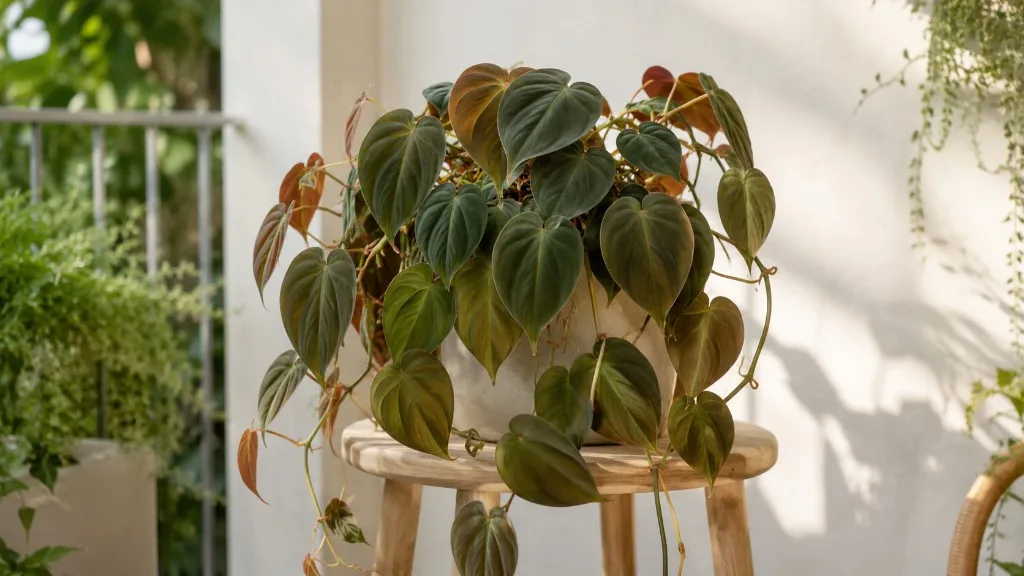
Philodendron Micans is a velvet-leaf cultivar of Philodendron hederaceum var. hederaceum - a cascading, climbing vine in the arum family native from Mexico through Tropical America. Indoors it typically trails several feet from a hanging basket or climbs a slim moss pole when given support. Stems stay relatively soft and herbaceous, which matters for propagation: soft tissue hydrates easily, cells divide quickly at wound sites, and roots push out from nodes without the long callus wait woody plants demand.
The velvet surface - fine trichomes that shift bronze, green, and deep purple in different light - is the main practical difference from plain green heartleaf during propagation. Trichomes hold water droplets and show permanent water spots if leaves are splashed or submerged. They also bruise when stems are squeezed, dragged across shelves, or crushed in a crowded jar. Handle vines gently, support cuttings on your palm rather than pinching leaves, and keep all foliage above the waterline in jars.
Micans is hemi-epiphytic in habitat: it roots along stems as it climbs tree trunks. That habit explains why nodes root so willingly in water and why cuttings with existing aerial root stubs often root fastest.
Node Anatomy on Micans Internodes
A node on Micans is the point where a leaf petiole attaches, an axillary bud waits dormant, and - on mature vines - a tiny aerial root nub may already be visible as a pale bump opposite the leaf base. The smooth stem between two nodes is the internode. Roots do not emerge from internode tissue alone; they need the meristematic cells concentrated at the node.
Before you cut, trace the vine with your finger. The node feels slightly thicker than the internode and often shows a pale ring. A brown stub where an old leaf fell off marks a node - viable tissue even without a current leaf attached.
A single velvet leaf floating in water without an attached node will not become a plant. It may stay green for weeks and even grow water roots from the petiole base, but without axillary bud tissue at a node it cannot produce new stems. This is the most common Micans propagation failure: a gorgeous iridescent leaf with no node, doomed to remain a leaf forever. Always include node tissue on every cutting.
Method Selection: Water vs Moist Aroid Mix
Both methods work for Philodendron Micans. Iowa State Extension recommends stem sections 3 to 6 inches long with lower leaves removed, rooted in water or rooting media like perlite or well-drained potting soil. Your choice depends on how you like to monitor progress, how many cuttings you are starting, and whether you want to skip the water-to-soil transition.
Water propagation lets you watch roots form day by day in a clear jar - ideal for beginners, for checking whether a questionable node is viable, and for protecting velvet leaves you can keep entirely above the waterline. The trade-off is an extra water-to-soil transition that can stress fragile new roots if handled roughly.
Moist aroid mix or sphagnum-perlite skips transition shock because roots grow directly in the medium they will live in. You cannot see roots without a gentle tug test, but established plants often settle faster after propagation. A 50:50 blend of perlite and peat-free potting mix, or straight moist sphagnum around the node, works well.
Water vs Moist Mix Comparison
| Factor | Water jar | Moist aroid mix / sphagnum |
|---|---|---|
| Root visibility | Excellent - clear glass | Poor - gentle tug test only |
| Typical rooting time | 2–3 weeks in warm bright conditions | 3–4 weeks |
| Velvet leaf safety | Easy - keep all leaves above water | Must bury node only, leaves above mix |
| Transplant shock | Moderate at water-to-soil move | Minimal - already in soil |
| Rot risk if neglected | High if water stays stale | Lower if mix is airy and not soggy |
| Best for | Beginners, single cuttings, visual checks | Multiple cuttings, direct potting |
For most home growers starting with one or two cuttings from a pruning session, water is the easier entry point. Switch to moist mix when you are propagating a dozen trimmings at once or when you want to pot directly into a shared container.
Best Time to Propagate Philodendron Micans
Propagate during active growth - roughly spring through early summer - when warmth and daylight support cell division at cut surfaces. Micans pushed in a bright indoor room during these months roots fastest because metabolism matches the propagation setup you provide.
Fall propagation works in heated homes with stable 18–29°C (65–85°F) temperatures and bright indirect light matching the Micans light guide. Winter propagation is possible but slower: expect rooting at the long end of the two-to-three-week range, or longer if the room is cool and dim. Avoid taking cuttings from a parent that is yellowing from overwatering, recovering from shipping, or fighting active mealybugs - stressed tissue rots before it roots.
If you are trimming a leggy vine anyway, treat pruning and propagation as one job in spring. The parent gets shaped, and every healthy segment below your pruning cuts becomes propagation material.
Tools, Materials, and Safety
Gather supplies before you cut so velvet stems do not sit out drying while you search for scissors:
- Sharp bypass pruners or scissors, wiped with rubbing alcohol
- Clear glass jar or vase for water method (narrow neck supports stem upright without submerging leaves)
- Small pots with drainage holes and peat-free potting mix with perlite for transplant - same blend recommended on the Micans soil guide
- Moist sphagnum moss or perlite for direct rooting
- Optional rooting hormone - helpful but not required for Micans
- Nitrile gloves if aroid sap irritates your skin
Philodendron Micans contains insoluble calcium oxalate crystals that irritate mouth tissue and cause drooling and vomiting if chewed. The ASPCA lists heartleaf philodendron (Philodendron hederaceum) as toxic to cats and dogs. Wear gloves if you are sensitive to aroid sap, wash hands after handling cut stems, and keep cuttings and water jars out of reach of pets who chew plants. Propagation trimmings left in water on a low kitchen counter are a common exposure route - place jars on upper shelves or in closed rooms pets cannot access.
Choosing the Best Parent Vine
Start from a healthy, actively growing parent. Firm green stems, no widespread yellowing, no mealybug cotton in leaf axils, and soil that dries on a normal watering rhythm all signal good donor material. A weak parent produces weak cuttings no matter how clean your jar is.
Look for vines with at least one node per cutting segment, ideally two nodes when you are taking longer sections. Iowa State stem-cutting guidance recommends cuttings with at least two nodes and 3–6 inches of stem. Two nodes give insurance: if the basal node fails, the upper node may still activate.
Compact Internodes vs Long Trailers
Internode length affects the look of your finished plant. Vines with short internodes - nodes close together - produce bushier pots and fuller hanging baskets when you root several cuttings together. Vines with long internodes - common on leggy Micans stretching toward dim light - give fewer nodes per foot of stem and look sparse unless you pack many cuttings in one pot.
For a moss pole display, take cuttings from the lower portion of a climbing vine where nodes are already close to support material; aerial roots may have started and root faster in water. For a trailing basket, prefer compact growth from a well-lit parent rather than the thinnest runner from a dark corner.
If the parent is leggy from insufficient light, propagation still works - but improve light on both parent and new cuttings afterward or the next generation will stretch the same way.
Preparing Stem Cuttings Step by Step
Follow this sequence every time:
- Identify a healthy vine with firm green tissue and visible nodes.
- Decide cutting length - target 10–15 cm (4–6 inches) with one or two leaves at the top and at least one node below the lowest leaf.
- Cut just below a node at a slight angle with clean blades. The node should sit at the bottom of the cutting.
- Remove leaves that would sit underwater or buried in mix - typically the bottom one or two leaves, exposing the node. Handle velvet blades by the stem, not the leaf face.
- Optional: dip the cut end in rooting hormone, tapping off excess powder.
- Place immediately in water or moist medium - do not let the cut end dry for hours on a counter.
If you are trimming a long leggy vine into multiple cuttings, work from tip toward base, making each cut just above a node on the remaining parent vine so the parent can branch from that node. Each segment between cuts becomes its own propagation piece. Maintain correct orientation: the end that was closer to the soil goes down in water or mix.
Method 1: Rooting in Water
Water propagation is the most popular Micans method because feedback is instant: you see white root initials within days in warm conditions.
- Fill a clean glass jar with room-temperature water - tap water is fine if you let it sit overnight so chlorine dissipates.
- Insert the cutting so the lowest node is submerged while all velvet leaves stay above the waterline. Never submerge foliage; wet trichomes develop permanent water spots and leaves rot, fouling the water.
- Place the jar in bright indirect light - an east window or a few feet back from a south window. Avoid direct hot sun on the jar, which heats water and encourages algae.
- Change the water every few days, or whenever it looks cloudy. Refresh water one to two times per week at minimum and never let the water level drop enough to expose developing roots to air.
- Wait for roots about 2.5 cm (1 inch) long or longer - typically two to three weeks for Micans in warm bright conditions, sometimes faster when aerial roots were already present on the node.
- Transplant into potting mix when roots are sturdy enough to handle gently (see Transplanting section below).
Jar Setup and Water-Change Schedule
Use a jar narrow enough that leaves rest on the rim and support the stem upright without submerging upper nodes. Clear glass helps you spot rot early - brown mushy tissue at the submerged node means discard that cutting and start fresh.
Change water before it smells sour or turns green with algae. Fresh oxygen in the water reduces anaerobic rot bacteria. If you forget for a week and water clouds, replace it immediately, rinse the stem under lukewarm running water, and trim any soft brown tissue back to firm green above the node.
Multiple cuttings can share one jar if nodes do not crowd and velvet leaves have air space. Space them so each stem gets light; a crowded jar with overlapping wet leaves invites fungal issues and bruises trichomes.
Method 2: Rooting in Moist Aroid Mix
Direct-to-medium rooting suits growers who want to skip the water stage or who are starting many cuttings at once.
- Fill a small pot or cup with drainage holes with moist perlite, sphagnum moss, or a 50:50 perlite and peat-free potting mix. The medium should feel like a wrung-out sponge - damp throughout, not dripping.
- Poke a hole with a pencil, insert the cutting so at least one node is buried and no velvet leaves are underground.
- Firm the medium lightly around the stem to eliminate air pockets without compressing perlite into mud.
- Place in bright indirect light at 18–29°C (65–85°F).
- Keep the medium consistently moist - never bone dry, never waterlogged.
- Optional humidity dome: a clear plastic bag over the pot (not touching leaves) raises humidity in dry homes. Remove it for an hour daily to exchange air.
- Test for roots after two to three weeks with a gentle tug. Resistance means roots formed; if the cutting pulls out cleanly, replant and wait another week.
Rooting hormone accelerates perlite rooting but is optional for Micans. Sections that already show aerial roots at the node often root fastest.
Building the Right Rooting Environment
Micans cuttings root fastest when four environmental factors align:
Light: Bright indirect - roughly the same level recommended for mature Micans on the light guide. Too dim slows rooting and encourages leggy new growth with dull velvet color; direct sun through glass overheats water jars.
Temperature: Warm room temperatures 65–85°F (18–29°C) support steady root development. A propagation mat set to the low 70s°F can shorten timelines in cool rooms but is optional.
Humidity: Average home humidity 50–60% is adequate for Micans. Extremely dry winter air may wilt cuttings without roots; a bag cover or grouping jars together helps. Avoid blasting cuttings with dry heating vents - velvet leaves desiccate faster than glossy philodendron foliage.
Airflow: Stagnant wet conditions invite rot. Change water regularly, avoid sealing cuttings in airtight containers without daily venting, and do not place jars in dark cupboards.
Transplanting Rooted Cuttings
Move water-rooted cuttings to soil when roots are about 2.5 cm (1 inch) long or longer and white or cream colored, not thin translucent threads only a few millimetres long. Iowa State Extension instructs potting water-rooted philodendron when new roots are several inches long; in practice, 2.5–5 cm (1–2 inches) gives enough anchor to survive the transition without waiting so long that water roots become brittle.
Choose a small pot - 8–10 cm (3–4 inches) across for one cutting - with drainage holes. Use the same well-draining aroid mix recommended on the soil guide. Pre-moisten the mix so it is evenly damp before planting.
- Gently remove the cutting from the jar. Rinse roots briefly under lukewarm water if gel or algae coats them.
- Plant so the node sits just at or slightly below the soil surface - do not bury velvet leaves.
- Water lightly to settle mix around roots, then let excess drain fully.
- Place in bright indirect light. Avoid direct sun for the first week.
- Do not fertilize until you see new growth - usually two to four weeks after transplant.
Perlite-rooted cuttings already in mix may only need upsizing once roots circle the container - see the repotting guide for when to move up a size.
Aftercare During and After Rooting
Newly rooted Micans needs steadier, simpler care than the established parent:
Watering: Keep mix lightly moist for the first two weeks after transplant - not saturated. Check the top 2–3 cm; water when it begins to dry. Once new velvet leaves appear, transition toward the normal watering rhythm for mature Micans.
Fertilizer: Hold all fertilizer until active new growth shows. Half-strength balanced liquid feed monthly during spring and summer is enough once the plant is established - details on the fertilizer guide.
Light: Bright indirect supports compact new leaves with healthy iridescent color. Low light produces thin pale growth and long internodes even on rooted cuttings.
Handling: Resist pulling cuttings to check roots daily. Each tug breaks fragile root hairs and bruises velvet leaves. Judge success by new leaf emergence at the top node with clean trichome texture.
Parent plant care: After you take cuttings, the parent may look sparse. It will branch from nodes below your cuts within two to four weeks in active growth. Continue normal care rather than overwatering to compensate.
Filling a Pot with Multiple Cuttings
One of the best uses for Micans propagation is creating a full pot from one leggy parent. Root three to six cuttings - each with one node and one or two leaves - and plant them together in a single container once water roots are 2.5 cm or longer.
Space cuttings evenly around the pot rim so future growth fills outward symmetrically. Shorter internode segments from a well-lit parent produce the bushiest result. Trailers from a leggy vine work if you plant enough of them close together; otherwise the pot looks sparse until summer growth fills gaps.
You can also root several cuttings in one large jar, then transplant as a group - just ensure nodes stay submerged and velvet leaves do not overlap in wet piles. For hanging baskets, plant rooted cuttings slightly closer than you would for a tabletop pot because gravity pulls growth outward and down.
Common Propagation Problems and Recovery
Mushy stem at the submerged node: Stale water or a weak cutting. Trim back to firm green tissue, replace water, and retry. If the whole stem is soft, discard and take a fresh cutting from healthier tissue.
Cloudy water and sour smell: Bacterial bloom. Replace water, rinse stem, trim any brown tissue. Increase change frequency to twice weekly.
Water spots on velvet leaves: Splashing or partial submersion. Keep all foliage above the waterline; wipe spots gently with a dry cloth only if they bother you - some marks are permanent.
Cutting yellows but stem stays firm: Often normal as the plant redirects energy to roots. If yellowing spreads up the stem or the base softens, discard.
Roots form but no new top growth after transplant: Usually low light, overwatering in heavy mix, or transplant shock. Move to brighter indirect light, confirm mix drains well, and hold fertilizer until conditions stabilize.
Single leaf in water forever, no vine growth: No node on the cutting. Start over with node tissue.
Pests on parent transfer to cutting: Inspect leaf axils before cutting. Mealybugs and spider mites travel with stems. Treat the parent before propagating.
Pet chewed a cutting: Treat sap exposure seriously - the ASPCA documents oral irritation and vomiting in cats and dogs from philodendron ingestion. Contact your veterinarian if a pet ate plant tissue.
When propagation fails repeatedly, step back and fix the parent environment - light, watering, and pest status - before taking more cuttings. Propagation multiplies healthy plants; it does not rescue a dying one.
When Not to Propagate
Do not propagate Micans as a first response to every problem. If pests, rot, or severe dehydration are active on the parent, stabilize it first or take only clean unaffected material from the healthiest portion of the vine. Propagation is a backup plan, not a cure for bad conditions.
Hold off when the parent is in repot shock, showing root-rot symptoms (chronic yellowing, soft stems, sour soil), or sitting in very dry air below roughly 40% humidity. Fix the underlying condition first, then propagate once new growth resumes.
Avoid major propagation projects immediately after shipping or during a pest treatment cycle when stress is already high. A single cutting from a healthy tip is fine; stripping half the plant is not.
Conclusion
Philodendron Micans rewards a simple workflow: cut below a node, keep velvet leaves above the waterline, change water every few days, and pot when roots reach about 2.5 cm. Water propagation offers the clearest feedback; moist aroid mix skips transition shock. Choose spring or summer for fastest results, start from firm green vines with short internodes when you want a full basket, and keep jars away from pets because calcium oxalate sap is toxic if chewed.
For a fuller display, root several compact cuttings together or combine propagation with a spring pruning session on a leggy parent. Link the process to the rest of your Micans care - overview, light, watering, soil, and repotting - and each new plant starts with the same conditions that made the parent worth cloning in the first place.
When to use this page vs other Philodendron Micans guides
- Philodendron Micans overview - Start here for whole-plant context before deep-diving this topic.
- Philodendron Micans problems hub - Jump to symptom-specific fix guides when this care topic does not resolve the issue.