Philodendron Micans Fertilizer: When and How to Feed
Philodendron Micans Fertilizer: When and How to Feed
Philodendron Micans Fertilizer: When and How to Feed
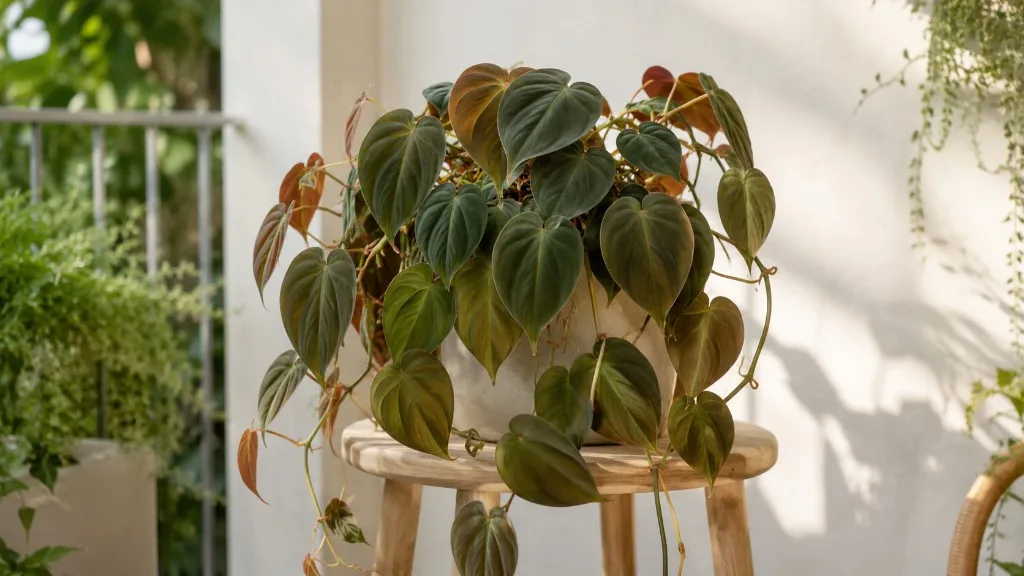
Philodendron Micans fertilizer is one of those topics where the generic heartleaf schedule is almost right - and almost wrong enough to scorch velvet. Philodendron hederaceum var. hederaceum ‘Micans’ is a fast-trailing hemi-epiphytic aroid whose juvenile leaves are covered in fine trichomes that create an iridescent bronze-to-green surface. Those hairs do not change the basic NPK math, but they change how you read damage: brown crispy margins on fuzzy new growth look dramatic long before a glossy Brasil would show the same salt stress, and a dim corner Micans can sit pale and stretched while you keep feeding a plant that actually needs more photons, not more nitrogen.
The practical goal for most home growers is conservative: balanced water-soluble fertilizer at half the label strength, applied every four to six weeks from mid-spring through early fall while the vine is actively pushing new leaves, then paused entirely in late fall and winter for typical indoor rooms. Water onto moist soil, never dry roots. If the plant trails from a small hanging basket in bright light, expect faster nutrient draw and faster salt buildup - adjust frequency by watching internode length and soil crust, not a rigid calendar. Freshly repotted, drought-stressed, or salt-burned Micans need no feed until stable new growth returns.
This guide covers Micans-specific biology, when to feed and when to stop, month-by-month and light-adjusted schedules, NPK product choice, safe application steps, velvet-leaf symptom reading, hanging-basket and repot caveats, salt-flush recovery, and how feeding couples to the rest of the [Micans care cluster](/plants/philodendron-micans/Philodendron Micans overview/). For shared philodendron mechanics across cultivars, see the genus fertilizer guide.
Reviewed by the LeafyPixels Review Board against botanical references and extension guidance. Author: sai-ananth. Methodology: recommendations checked against NC State, Iowa State Extension, Illinois Extension, Nebraska Extension, and Missouri Botanical Garden publications before publication.
Quick Answer: Half-Strength Balanced Liquid on Active Growth
Philodendron Micans does best with a complete water-soluble balanced fertilizer such as 10-10-10 or 20-20-20, diluted to half the label strength, applied every four to six weeks from March through September (temperate-climate framing) while new velvet leaves are unfurling. Use the shorter interval for fast trailers in bright indirect light or small pots; stretch to every six to eight weeks in moderate light or if slow-release fertilizer is already in the mix.
Pause entirely from late fall through winter for most indoor setups without strong supplemental grow lights. Illinois Extension advises fertilizing houseplants only when actively growing, typically once every one to three months between March and September, and warns that excess fertilizer burns roots - especially when growth slows in dim light. Iowa State Extension recommends fertilizing philodendrons lightly once or twice a month during active spring and summer growth with a balanced all-purpose product - the half-strength liquid schedule here sits inside that conservative range.
Never feed dry soil, newly repotted plants (wait three to four weeks), or vines showing white salt crust - flush with plain water first. Judge success by compact new growth: short internodes, normal leaf size, clean velvet texture, and no white residue on the soil rim.
Why Micans Feeding Follows Velvet Trailing Vine Biology
Botanically, Micans is Philodendron hederaceum var. hederaceum* - the velvet juvenile form within the heartleaf complex. NC State Extension lists Philodendron micans among the previous names for P. hederaceum and describes the species as a trailing or climbing Araceae vine with rapid growth under favorable indoor conditions. Most growers treat Micans as a hanging-basket or high-shelf trailer, though it will climb a moss pole and produce larger leaves when given support - behavior that changes how much canopy one pot must feed.
Unlike an upright self-heading philodendron, a long Micans specimen builds continuous stem and leaf mass along the vine. Each new node is another leaf, another petiole, another stretch of stem drawing nitrogen for tissue expansion and potassium for overall vigor. In bright east or filtered south light, a 20 cm basket can add 30–60 cm of vine in a single growing season; that speed is why Micans often needs the four-week end of the feeding range while a dim-corner plant may need six to eight weeks - or no fertilizer at all until you improve light.
How Fast Vining Changes Nutrient Demand
Nutrient demand tracks growth rate × leaf area × light, not pot brand. A Micans in roughly 600–900 foot-candles at the canopy (bright indirect - see the light guide) metabolizes faster than the same cultivar three meters from a north pane. Faster metabolism means faster uptake - and faster leaching when you water thoroughly, which is exactly what watering Micans correctly requires.
Feeding vignette (home observation, temperate indoor room): Two 15 cm hanging Micans started on the same half-strength monthly schedule in May. Plant A hung 0.5 m from an east window (~700 foot-candles at top leaves); Plant B sat on a dim interior shelf (~150 foot-candles). By September, Plant A showed 2–3 cm internodes, firm bronze-green new leaves, and needed feeding every four weeks without salt crust. Plant B stretched to 6–8 cm internodes, pale green new growth, and looked worse after monthly feeds - pale leaves traced to light deficit, not hunger. After moving Plant B closer to the window and pausing fertilizer six weeks, the next two new leaves shortened internodes and regained velvet color; feeding resumed at six-week intervals only after growth stabilized.
That pattern is why this guide emphasizes light-adjusted frequency over a single monthly rule copied from glossy heartleaf templates.
Velvet Leaves and Salt Burn Diagnostics
The velvet surface is functional, not decorative. Fine trichomes scatter light and hold micro-droplets; they also make tip and margin burn visible as crisp brown zones on still-young fuzzy leaves, sometimes before you notice crust on the soil. Glossy heartleaf philodendrons can carry early salt stress with subtler marginal tanning; Micans announces trouble loudly.
Distinguish three common pale-or-brown patterns before you change fertilizer:
- Salt burn: brown crispy margins on newer leaves, white/yellow crust on soil or pot rim, wilt on moist soil - flush and pause feed
- Light deficit: uniform pale green new growth, long internodes, vine leaning toward window - improve light before feeding more
- Chronic overwatering: yellowing from base, sour mix smell, soft stems - fix watering and roots; fertilizer worsens salt load in soggy mix
Missouri Botanical Garden recommends bright indirect light and avoiding full sun on P. hederaceum, noting spindly stems in too-dark conditions - the same leggy pattern Micans shows when growers misread pale vines as under-fertilization.
When to Fertilize: Active Growth vs Winter Rest
Timing follows metabolism, not guilt. Feed when Micans is actively producing new leaves and extending stems, and stop when growth slows sharply. Indoors, that rhythm tracks longer days, warmer rooms, and usable light at the leaf surface.
Nebraska Extension warns not to fertilize dormant plants because unused nutrients build harmful fertilizer salts in soil. Determine activity by new leaves, side shoots, or visible vine extension - not by whether old trailing foliage still looks green. A Micans that appears “alive” through December in a short-day room may produce almost no new nodes while salts accumulate from continued summer-style feeding.
Spring and Summer Feeding Window
Start feeding when you see fresh velvet shoots - new leaves unfurling with bronze-pink tone, roots active if you gently inspect, and the top 3–5 cm of mix drying on your normal watering rhythm. In temperate climates that usually means mid-spring through early fall, roughly April through September depending on room temperature and window exposure.
During this window, half-strength balanced liquid every four to six weeks suits most container Micans. Fast trailers in bright light or 12–15 cm baskets often sit at four weeks; established plants in moderate light or nutrient-enriched mix may need only six weeks. Both are acceptable if new growth stays compact and the soil surface stays free of heavy crust.
Fall Taper and Winter Pause
Taper in early to mid-fall as day length drops. A final half-strength feed in early fall is reasonable if you still see new nodes forming; then stop entirely from late fall through winter - roughly November through February for typical room-grown plants without strong grow lights.
Exception: If you run supplemental grow lights 12–14 hours daily per the light guide and the plant keeps pushing new velvet leaves all winter, you may feed lightly at half strength every eight to ten weeks - but watch for salt crust more aggressively. Skipping winter feeds remains safer than forcing growth with nutrients roots cannot process in low-metabolism conditions.
Month-by-Month Feeding Schedule
Use this table as a framework, then adjust by light, pot size, and visible growth. Temperate Northern Hemisphere months shown; shift three to four weeks in subtropical climates where indoor growth continues longer.
| Month | Growth phase | Feeding guidance |
|---|---|---|
| January–February | Low indoor growth | No fertilizer for typical setups |
| March–April | Waking up, new shoots | Start half-strength liquid when active growth visible |
| May–August | Peak trailing growth | Every 4–6 weeks; bright-light baskets on shorter end |
| September | Slowing slightly | Every 6–8 weeks or taper off |
| October | Wind-down | Final light feed if still growing, then pause |
| November–December | Rest period | No fertilizer unless strong grow lights + new leaves |
Pair the schedule with a monthly plain-water flush in hard-water homes or small hanging baskets - leaching every four to six months prevents crust that Micans shows on velvet leaves before glossy cultivars do. Illinois Extension recommends leaching pots every four to six months with a large volume of plain water to reduce salt buildup.
Best Fertilizer Type and NPK for Micans
The best Philodendron Micans fertilizer for most homes is a complete water-soluble balanced houseplant formula with nitrogen adequate for leafy vines, phosphorus moderate, and potassium for stress tolerance. Micans is grown for foliage and vine length, not flowers - skip bloom boosters with high phosphorus.
Balanced Liquid Formulas
A 10-10-10 or 20-20-20 water-soluble fertilizer diluted to half strength is the default across extension guidance for philodendrons and foliage houseplants. Illinois Extension lists balanced ratios such as 10-10-10 and foliage-friendly 1:2:1 ratios like 5-10-5, with the rule to never exceed label strength.
Some growers prefer a slightly nitrogen-leaning foliage ratio such as 3-1-2 at quarter to half strength when they want steady leaf production without pushing weak elongation in marginal light. That is optional - balanced formulas at conservative strength outperform specialty bottles applied at full label rate.
Liquid formulas win for control: you mix, dilute, and apply a known dose to moist soil, then discard saucer runoff. Measure with a spoon or syringe; “eyeballing” concentrates errors.
Organic, Slow-Release, and What to Skip
Fish emulsion, compost tea, or seaweed extract work at half strength or weaker if you already use them - they feed soil biology alongside the plant but smell more and can attract fungus gnats if over-applied. Rinse velvet leaves if any splash occurs; fuzzy foliage shows residue permanently.
Slow-release granules mixed into soil at repotting can suit larger baskets, but in small 12–15 cm hanging pots they release unpredictably and stack with liquid feeds - skip liquid for two to three months if slow-release is already in the mix, or avoid dual feeding entirely in tight containers.
Skip foliar feeding on Micans for routine care. Velvet trichomes hold droplets and concentrate salts on leaf surfaces; soil feeding after a plain-water pre-moisten is safer. Skip fertilizer-pesticide combos and full-strength outdoor label rates on indoor containers.
Step-by-Step: How to Feed Philodendron Micans Safely
Safe feeding is mostly order of operations:
- Confirm active growth and season. New velvet leaves or extending vines? Inside spring–summer window? If winter and static, stop.
- Inspect for salt crust or crispy new margins. White rim residue means flush, not feed.
- Water with plain water if the top 3–5 cm is dry. Bring roots to even moisture before fertilizer touches them - never pour concentrate onto dry mix.
- Mix fertilizer at half label strength in room-temperature water.
- Apply slowly across soil surface with a narrow-spout can, keeping solution off fuzzy leaves and the crown.
- Stop when a little water drains from the bottom; discard saucer runoff within 30 minutes.
- Log the date so you do not double-feed during an enthusiastic week.
Morning feeding after hydration is a common practice because splashes dry quickly, but moist-soil-first matters more than clock time.
Adjust Feeding Frequency by Light Level
Light sets the metabolism ceiling. Use this band table with the month-by-month framework above:
| Light situation | Foot-candles (approx.) | Suggested interval | Strength |
|---|---|---|---|
| Bright indirect (east, filtered south/west) | 500–1,000+ | Every 4 weeks | Half label |
| Moderate indirect | 200–500 | Every 4–6 weeks | Half label |
| Low indirect (survival, not vigor) | Under 200 | Every 6–8 weeks or pause until light improves | Half label if feeding at all |
| Winter room, no grow lights | Low | Skip November–February | - |
| Winter under grow lights, active new leaves | Supplemental | Every 8–10 weeks | Half label |
A Micans under bright light that dries its pot every 7–10 days in July metabolizes faster than a shaded office plant on a 14-day dry cycle - match feed frequency to that growth speed, not a blog’s generic “monthly” headline.
Signs Feeding Is Working vs Burn or Deficiency
Healthy feeding response shows on new growth: firm velvet leaves opening at normal size for your light level, internodes 2–4 cm in bright conditions (wider in moderate light but not constantly stretching), stems sturdy enough to trail without snapping, and no white crust on soil. Iridescent bronze-green color on juvenile leaves reflects adequate light plus steady nutrition - fertilizer alone cannot restore sheen in a dim room.
Under-fertilizing is gradual and appears on new tissue while older leaves still look acceptable: slower leaf production in peak summer despite good light and moisture, uniformly paler new leaves (not isolated pest spots), smaller successive leaves, and general lack of vigor after more than one season in depleted mix with zero feeding. If only older lower leaves yellow while new growth looks fine, check yellow-leaves causes - natural senescence, overwatering, and underwatering outrank fertilizer.
Over-fertilizing and salt stress dominate Micans fertilizer problems: brown crispy margins on fuzzy new leaves, white/yellow crust on soil or clay pot rims, sudden wilt or leaf drop on moist soil, stunted new leaves with burnt edges, and occasionally dulled iridescence when root uptake is impaired - Oregon State Extension links concentrated soluble salts to reduced water uptake and tip burn even when soil feels moist. See brown-tips for overlap with low humidity and tap-water damage - salt burn usually follows a recent feed or visible crust.
Micans-Specific Fertilizer Mistakes
The failures that show up most on velvet trailers are predictable:
- Full label strength in small hanging baskets
- Feeding every watering with liquid concentrate - salts stack faster than vines use them
- Winter feeding because trailing foliage still looks green
- Foliar feeds on trichome-covered leaves
- Slow-release pellets plus monthly liquid in 12 cm baskets
- Feeding immediately after repotting into nutrient-enriched mix
- Feeding drought-stressed or root-rot plants to “perk them up”
- High-phosphorus bloom boosters that do not improve velvet color
- Assuming pale stretched vines need nitrogen when they need brighter light
- Ignoring salt crust until velvet margins crisp
Repot, Slow-Release, and Hanging Basket Traps
After repotting into fresh mix with starter fertilizer or compost, wait three to four weeks before the first liquid feed. Many commercial blends already carry a charge; doubling up causes immediate marginal burn on the next unfurling leaf.
Hanging baskets dry faster on top but can hide salt concentration at the bottom near drainage holes where water evaporates slowly. If you bottom-water routinely, still top-flush every four to six weeks to move salts out - bottom-wicking alone does not leach minerals the way a full top soak does.
Slow-release pellets buried in a shallow basket can create a hot zone near roots while the surface looks lean. Prefer liquid control for small trailers; if you use granules, use half the label rate and skip liquid entirely for the release window stated on the package.
Recovery After Over-Fertilizing
If you suspect burn, stop fertilizing immediately and leach the soil:
- Move the pot to a sink or tub where drainage is free.
- Scrape salt crust from the soil surface without removing more than 1 cm of mix.
- Water slowly with plain room-temperature water until it runs from drainage holes; let drain fully.
- Repeat two to three times over 30–60 minutes with full drainage between passes.
- Pause all feeding four to six weeks while monitoring new growth - a typical home-climate heuristic, not a rigid rule.
- Resume at half strength only when new velvet leaves emerge without crispy margins and crust is gone.
Badly burned leaves will not revert to green - judge recovery by the next one or two leaf cycles of clean new growth. If crust returns within weeks, consider repotting into fresh mix and a clean pot.
Nebraska Extension describes leaching with twice the pot’s water volume poured gradually until all passes through - using less water does not flush effectively.
How Fertilizer Fits With Micans Light, Water, and Soil
Fertilizer only works when the rest of the system is in range. Micans in bright indirect light uses nutrients faster than the same vine in deep shade, where leggy-growth and pale color are usually light problems. Consistently moist, well-drained soil - standard potting mix with 20–25% perlite, drying predictably in the top 3–5 cm - keeps root uptake steady; fertilizing waterlogged roots only adds salt stress.
Pair feeding with your real watering rhythm: a bright summer basket that needs water weekly may need the shorter feed interval; a winter plant on a 12–16 day dry cycle needs none until spring shoots appear. After pruning for bushiness, stay on half-strength schedule rather than doubling doses to “replace” removed leaf area.
Pet and Child Safety Note
Philodendron Micans contains calcium oxalate crystals that cause oral irritation if chewed - the same toxin class Iowa State Extension notes for philodendrons generally. The ASPCA lists related heartleaf philodendrons as toxic to pets, causing oral irritation, drooling, and GI upset if ingested. Concentrated fertilizer solution and crusty soil are not safe for pets or children either. Keep trailing vines out of reach, store bottles locked away, and contact your vet if symptoms appear after ingestion.
Conclusion
Philodendron Micans fertilizer success is conservative feeding matched to real trailing growth - not a calendar copied from an upright cultivar template. Use balanced water-soluble formula at half strength, feed every four to six weeks during active spring and summer, and pause in late fall and winter unless grow lights keep new velvet leaves coming. Water onto moist soil, adjust interval by light level, and read new growth: compact nodes and clean fuzzy leaves mean your rhythm works; crispy margins and white crust mean flush, pause, and fix light and water before you reach for the bottle again.
When in doubt, less is more. Micans tolerates a lean season far better than it tolerates salt burn on the next unfurling leaf.
When to use this page vs other Philodendron Micans guides
- Philodendron Micans overview - Start here for whole-plant context before deep-diving this topic.
- Philodendron Micans problems hub - Jump to symptom-specific fix guides when this care topic does not resolve the issue.