Yellow Leaves on Philodendron Lemon Lime: Causes, Checks &
Quick answer
Yellow leaves on Philodendron Lemon Lime usually mean roots are stressed-most often from soil staying wet too long. First step: stop watering, check the top 3–5 cm of mix, and confirm drainage before the chartreuse color dulls further.
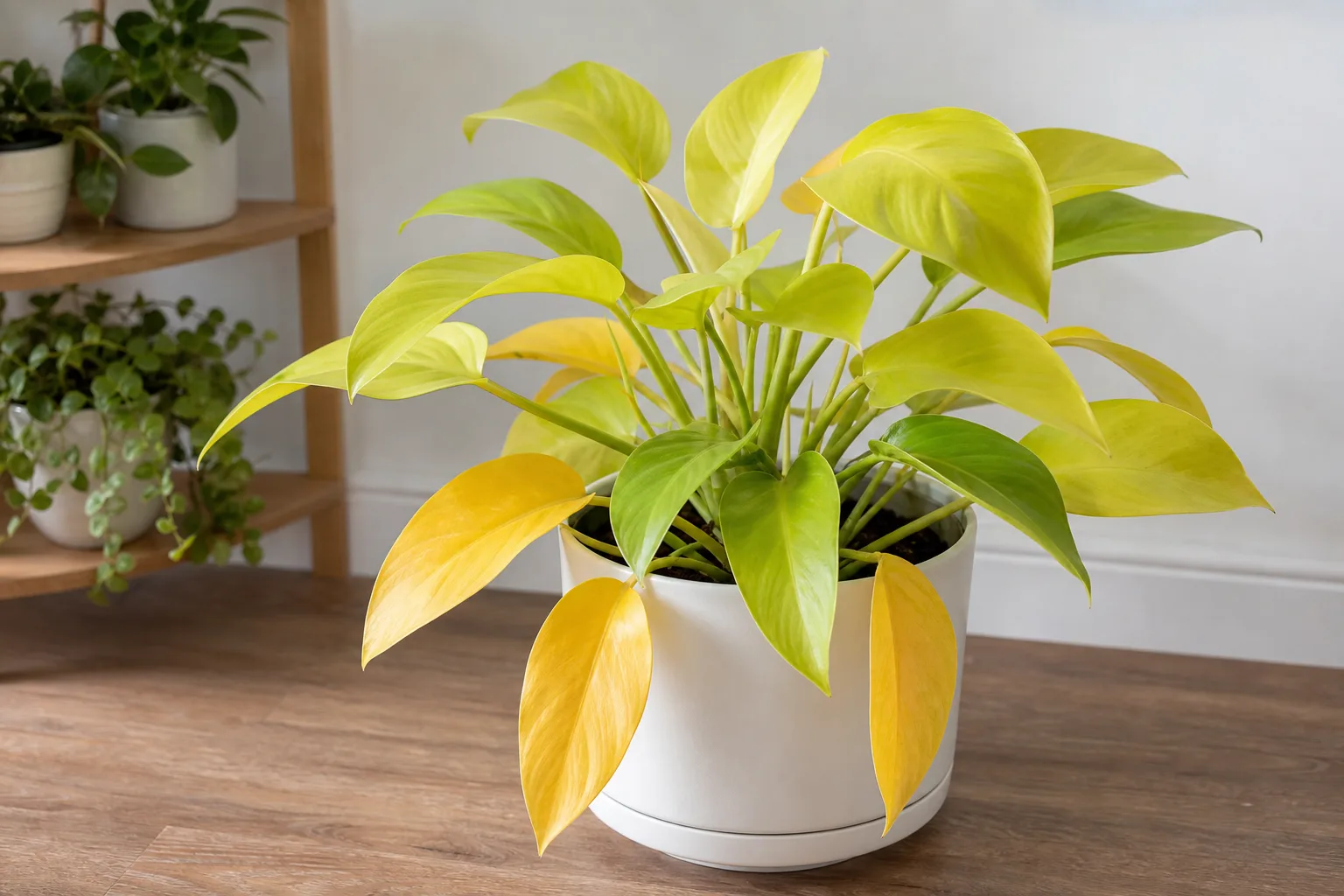
Yellow Leaves on Philodendron Lemon Lime: Causes, Checks & Fixes
This guide covers yellow leaves on Philodendron Lemon Lime. See also the general Yellow Leaves guide, watering, and light pages for this plant.
Yellow Leaves on Philodendron Lemon Lime: Causes, Checks & Fixes
Quick answer
On Philodendron hederaceum ‘Lemon Lime’, yellow leaves are almost always a root-zone or environment signal, not a mystery disease. The cultivar’s naturally pale chartreuse tissue makes diagnosis harder than on dark green heartleaf types-you must read texture, pattern, and soil moisture, not color name alone.
First step: stop watering and check the top 3–5 cm (about 1–2 in.) of mix. A heavy cool pot with damp soil days after the last drink points toward overwatering stress. A light dusty pot with crispy edges points toward underwatering. One slow yellow leaf at the base while new growth stays vivid is often normal turnover.
| Pattern | Soil / pot | Urgency | Next guide |
|---|---|---|---|
| Dull chartreuse, limp vines, heavy wet pot | Damp 3+ days | Moderate | Overwatering |
| Crispy yellow edges, curled leaves | Dry throughout | Moderate | Underwatering |
| Chartreuse fade, long gaps between nodes | Slow dry-down | Low–moderate | Not enough light |
| Sour smell, soft nodes, fast spread | Wet, may smell | High | Root rot |
| One old lower leaf over months | Normal dry-down | Low | Monitor only |
Why Lemon Lime yellows (and why color alone misleads)
Lemon Lime is a bright yellow to chartreuse cultivar of heartleaf philodendron with thin, vivid leaves that show stress faster than darker forms. Because the plant is already pale, a stressed leaf looks dull and limp-not necessarily “more yellow” than healthy tissue. Read pattern and pot weight first.
Overwatering and root stress
Chronic wet soil is the leading cause. NC State notes that root rot can occur in overly wet soil on P. hederaceum, and damaged roots cannot deliver water or nutrients even when mix feels moist-so chartreuse dulls while the pot stays heavy. For full wet-soil rescue branches and severity triage, use the dedicated overwatering guide rather than repeating protocol here.
Underwatering and fine root loss
Repeated drought yellows lower leaves as fine roots die back. The pot feels light, mix is dusty several centimeters down, and leaf margins may crisp. This is the opposite weight pattern from overwatering-see underwatering on Lemon Lime when dry soil accompanies limp vines.
Low light slowing dry-down
Dim corners slow transpiration so a summer watering rhythm becomes chronic wetness at the root zone even when the surface looks acceptable. Missouri Botanical Garden notes that if conditions are too dark, stems become spindly and growth slows-pairing low light with heavy pots is a common yellowing compound on chartreuse cultivars. The light guide and not enough light problem page cover placement fixes.
Nutrient depletion in old mix
Generalized pale yellowing on multiple older leaves without sour soil or mushy stems can follow years in the same peat-heavy mix. Hold fertilizer until you confirm moisture and light are correct-the fertilizer guide covers half-strength feeding after stress resolves.
Cold drafts and temperature swings
NC State lists an ideal philodendron range of 65 to 85 °F and warns that drafts should be avoided on tropical aroids. Winter glass, AC vents, and frequently opened exterior doors can chill leaves on the exposed side and trigger sudden yellowing even when watering looks unchanged. Move the pot off cold sills before assuming root failure.
What yellow leaves look like on Philodendron Lemon Lime
Healthy Lemon Lime holds a bright yellow to chartreuse tone with firm petioles and springy vines. Stress patterns to watch:
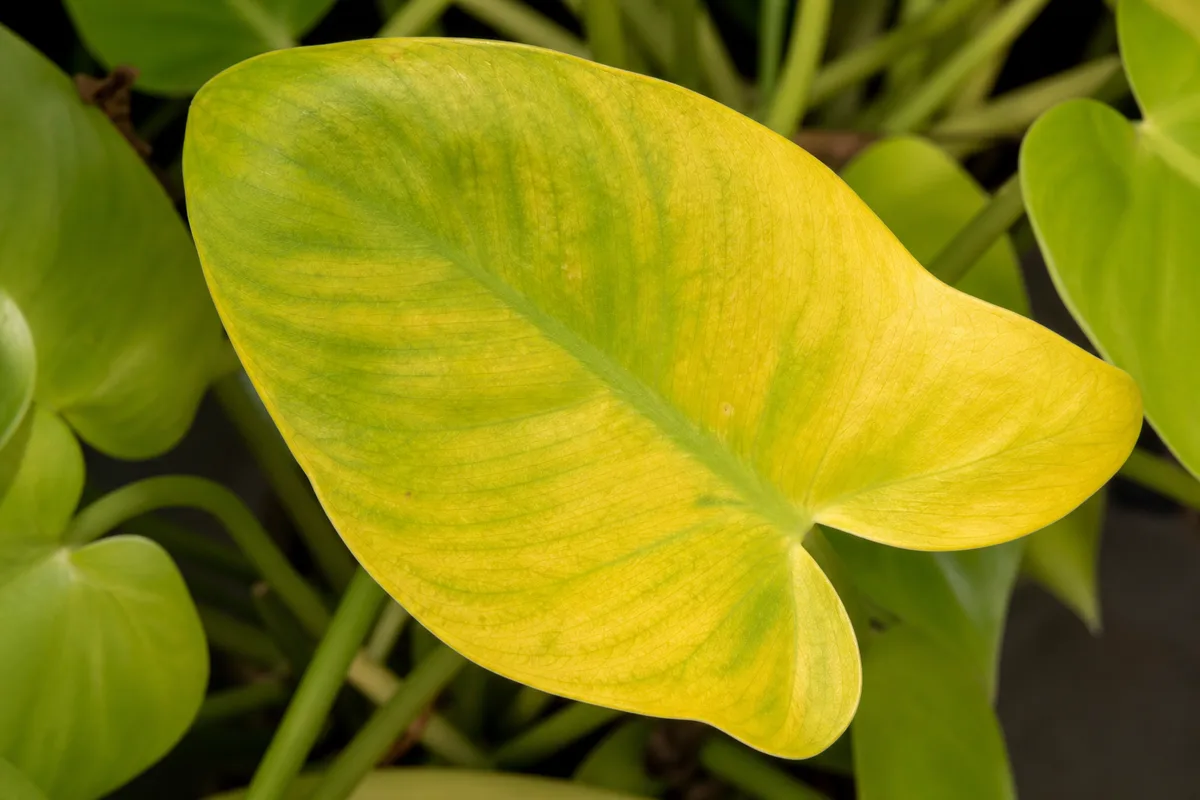
Yellow Leaves symptoms on Philodendron Lemon Lime - compare with healthy tissue on the same plant.
Stress vs. normal chartreuse tone
- Healthy: crisp, evenly luminous yellow-green; petioles firm; pot dries on a predictable rhythm
- Stressed: dull, flat, or translucent tissue; limp petioles; pot stays heavy or dries unevenly
- Normal aging: one bottom leaf yellows slowly while vines keep producing vivid new tips
Pattern guide
- Lower, older leaves first with firm stems-often watering rhythm, nutrients, or aging
- Multiple leaves at once with limp stems and wet soil-root stress; escalate if sour smell appears
- New growth smaller and paler-light or root issue; check node spacing against the light guide
- Mushy base with sour soil-advanced root decline; open the root rot guide
- Sun-facing bleach-pale yellow-white patches with crispy edges, not uniform dulling
Lemon Lime is often confused with ‘Brasil’ or with Neon pothos-both are chartreuse trailing houseplants, but Lemon Lime is Philodendron hederaceum with softer heart-shaped leaves and no dark green margin stripe. Uniform dulling across whole leaves is care stress, not Brasil variegation revert.
Cause-branch decision table
| Likely cause | Soil moisture | Stem texture | Leaf pattern | First move | Deep guide |
|---|---|---|---|---|---|
| Overwatering / early root stress | Wet, heavy | Limp, firm nodes | Lower leaves dull first | Stop watering; dry top 3–5 cm | Overwatering |
| Underwatering | Dry, light pot | Limp, may crisp | Lower yellow with dry edges | One deep soak, then dry-down | Underwatering |
| Low light + slow dry-down | Moist at depth | Firm, stretched | Pale small new leaves | Brighter indirect light | Not enough light |
| Nutrient depletion | Normal | Firm | Gradual older-leaf pale yellow | Fix water/light first; light feed later | Fertilizer |
| Cold draft | Variable | Usually firm | Sudden yellow on draft side | Move off vent/glass | Wilting |
| Sun bleach | Normal | Firm | Bleached patches, crispy edges | Pull back from direct sun | Light guide |
| Pests | Any | Firm unless secondary rot | Stippling, webbing, sticky residue | Inspect undersides | Spider mites, aphids |
| Normal senescence | Normal dry-down | Firm | One old leaf only | Monitor | - |
How to confirm the cause
- Soil moisture - Insert a finger 3–5 cm deep. Wet, cool soil days after watering points to overwatering.
- Pot weight - A heavy pot with limp leaves suggests roots are failing, not that the plant needs more water.
- Light level - Wide node gaps and chartreuse fade in a dim corner compound wet-soil problems.
- Leaf pattern - Lower-only yellowing with firm stems differs from widespread collapse or new-growth failure.
- Root check - If soil smells sour or yellowing spreads to new growth, unpot and inspect. Mushy roots mean the root rot protocol-not another dry-down cycle alone.
First fix for Philodendron Lemon Lime
Stop watering until the top 3–5 cm of mix is dry. Empty any saucer water. If soil has stayed wet for more than a week with declining chartreuse, unpot and inspect roots-trim mushy tissue and repot into fresh airy mix per the soil guide. Make one change at a time; do not fertilize, repot heavily, and prune on the same day.
Step-by-step recovery
- Let the mix dry to your normal checkpoint (top 3–5 cm dry)-see seasonal intervals in the watering guide (often 7–10 days in active growth, 10–14 in cooler months).
- Move the plant to medium or bright indirect light if it has been in a dim corner.
- Remove fully yellow leaves that pull away easily; leave partially green foliage for photosynthesis. Wear gloves when handling trimmings-heartleaf philodendron contains calcium oxalate crystals toxic to pets and can irritate skin.
- Resume deep watering only when dry-soak until runoff, then discard saucer water.
- Watch for new leaves emerging with characteristic bright chartreuse within two to four weeks in warm bright light.
When to escalate to root-rot protocol
Escalate when nodes soften, soil smells sour, yellowing reaches new growth while the pot stays wet, or inspection finds brown mushy roots. Those signs belong on the root rot guide-trim, repot, and consider propagation backup. Mild lower-leaf yellowing with firm nodes and neutral soil rarely needs unpotting.
Lookalike symptoms to rule out
Direct sun can bleach Lemon Lime to pale yellow-white with crispy edges-not the same as root-related dulling. Spider mites and aphids cause stippling and distorted new growth with possible sticky residue-inspect before spraying fungicides. Normal aging affects only the oldest leaf or two on an otherwise vigorous vine. Nutrient deficiency yellowing is usually gradual on multiple older leaves without sour soil or mushy stems. Brasil confusion shows shrinking green/yellow blocks, not uniform chartreuse fade-confirm cultivar on the tag via the overview FAQ.
What not to do
- Do not keep watering because chartreuse leaves look “pale”-check soil first.
- Do not fertilize a wet, declining plant; salts can burn stressed roots.
- Do not assume all yellowing is disease; confirm watering and light before spraying fungicides.
- Do not confuse Lemon Lime with Brasil variegation revert-Lemon Lime has no dark green stripe.
- Do not repot, prune heavily, and fertilize on the same day-see the repotting guide for timing after root inspection.
How to prevent yellow leaves next time
Match watering to how fast the pot dries in your light level. NC State recommends keeping soil slightly moist and slowing winter watering. Use a pot with drainage holes, perlite-amended mix, and bright indirect light so the root zone breathes between drinks. Inspect weekly during active growth-Lemon Lime is a rapid grower that uses water quickly in good light but stalls in shade.
When to worry
Escalate if yellowing reaches new growth, stems soften at nodes, soil smells sour, or more than one-third of leaves collapse within ten days. Mild lower-leaf yellowing on an otherwise bright vine often resolves once watering aligns with soil dryness per the watering guide.
Related Philodendron Lemon Lime guides
- Philodendron Lemon Lime overview - hub page, Neon pothos ID, and seasonal watering FAQ
- Philodendron Lemon Lime watering - 7–10 / 10–14 day starting intervals and dry-down checks
- Overwatering on Philodendron Lemon Lime - wet-soil rescue before roots turn mushy
- Root rot on Philodendron Lemon Lime - trim-and-repot when inspection confirms decay
- Underwatering on Philodendron Lemon Lime - dry-pot lookalike
- Not enough light on Philodendron Lemon Lime - chartreuse fade in dim corners
- Philodendron Lemon Lime light - placement to hold color
- Philodendron Lemon Lime repotting - when perlite-amended mix refresh is needed
- Spider mites on Philodendron Lemon Lime - stippling lookalike
- Aphids on Philodendron Lemon Lime - sticky residue on new growth
Conclusion
Use this page to triage yellowing by pattern and pot weight, not by how pale the cultivar looks. When wet soil and limp dull chartreuse align, dry down and follow the overwatering guide; when roots are mushy or nodes soften, escalate to root rot rescue. Vivid new tips within a few weeks-not old leaves re-greening-mean your Lemon Lime is recovering.