Seeds Not Germinating on Lavender: Causes, Checks & Fixes
Quick answer
Lavender seeds fail from old seed, skipped cold stratification, burying too deep, soggy mix, or impatience-English lavender often needs 2–4 weeks or longer in cool bright conditions after stratification. First step: buy fresh seed, cold-stratify 3–6 weeks in the fridge, surface-sow on gritty mix with light, keep lightly moist not wet, and wait at least six weeks before calling it a loss.
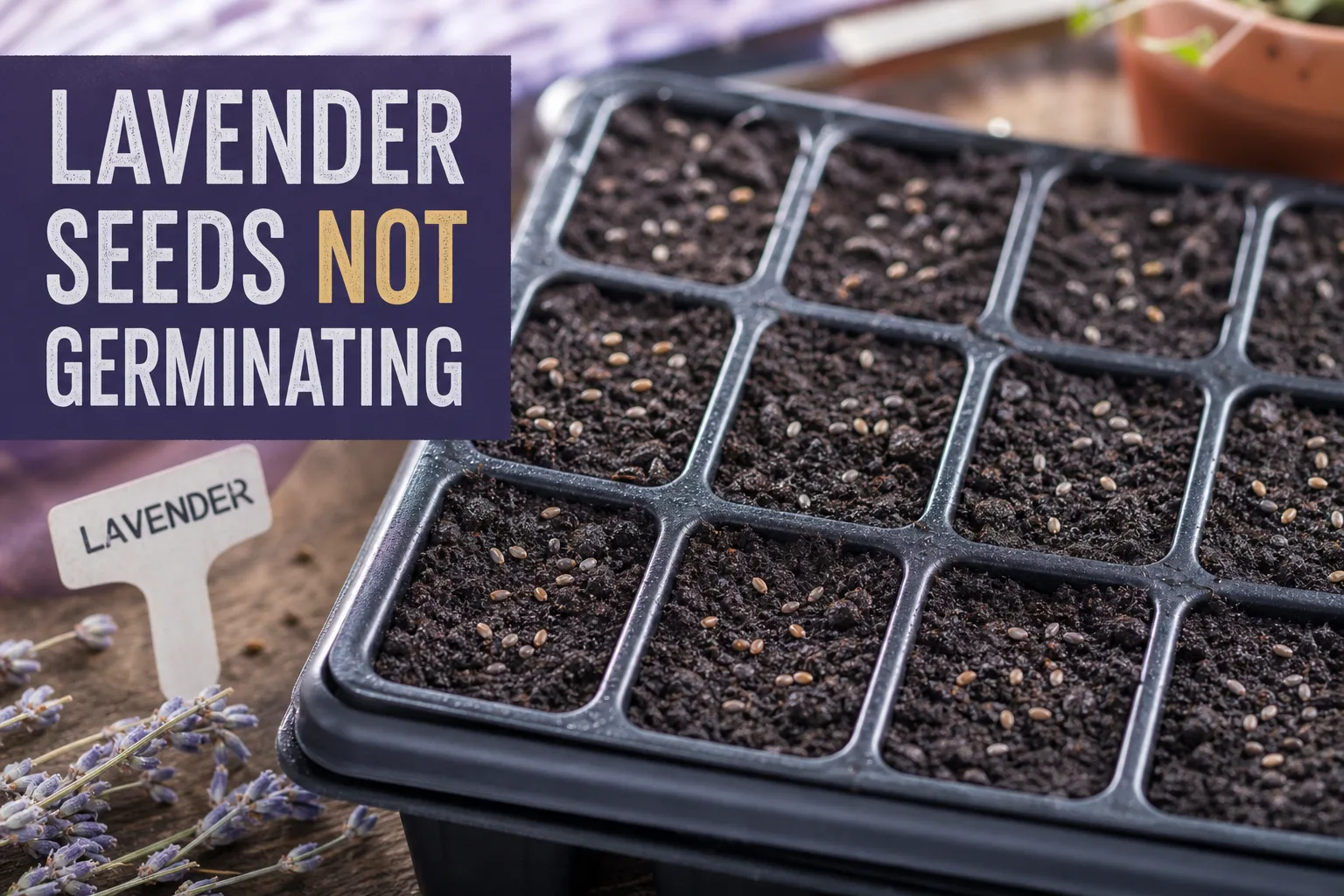
Seeds Not Germinating on Lavender: Causes, Checks & Fixes
This guide covers seeds not germinating on Lavender. See also the general Seeds Not Germinating guide, watering, and light pages for this plant.
Seeds Not Germinating on Lavender: Causes, Checks & Fixes
Quick answer
Lavender seeds not germinating almost always trace to old seed, skipped cold stratification, buried too deep, soggy mix, or giving up too early-not a mysterious bad batch. English lavender (Lavandula angustifolia) commonly takes two to four weeks or longer after chilling, with stragglers still emerging weeks later on healthy trays.
This page covers pre-emergence tray failure only-empty cells, moldy surface rot, or painfully slow waits before any green appears. Post-emergence stretching belongs on the leggy seedlings page; full sowing protocol lives in the lavender propagation guide.
First step: restart with fresh seed-cold-stratify 3–6 weeks moist in the fridge at 2–4°C, surface-sow on sterile gritty mix with light exposure, keep lightly moist not wet at 15–21°C, and label the tray with the sow date so you judge weeks, not days.
What failed germination looks like on lavender
Lavender seed is tiny-think dust specks on pale grit, not chunky herb seed. When germination works, you see miniature silver-green cotyledons pressed flat against the surface within a few weeks of correct sowing. Failed trays show the opposite:
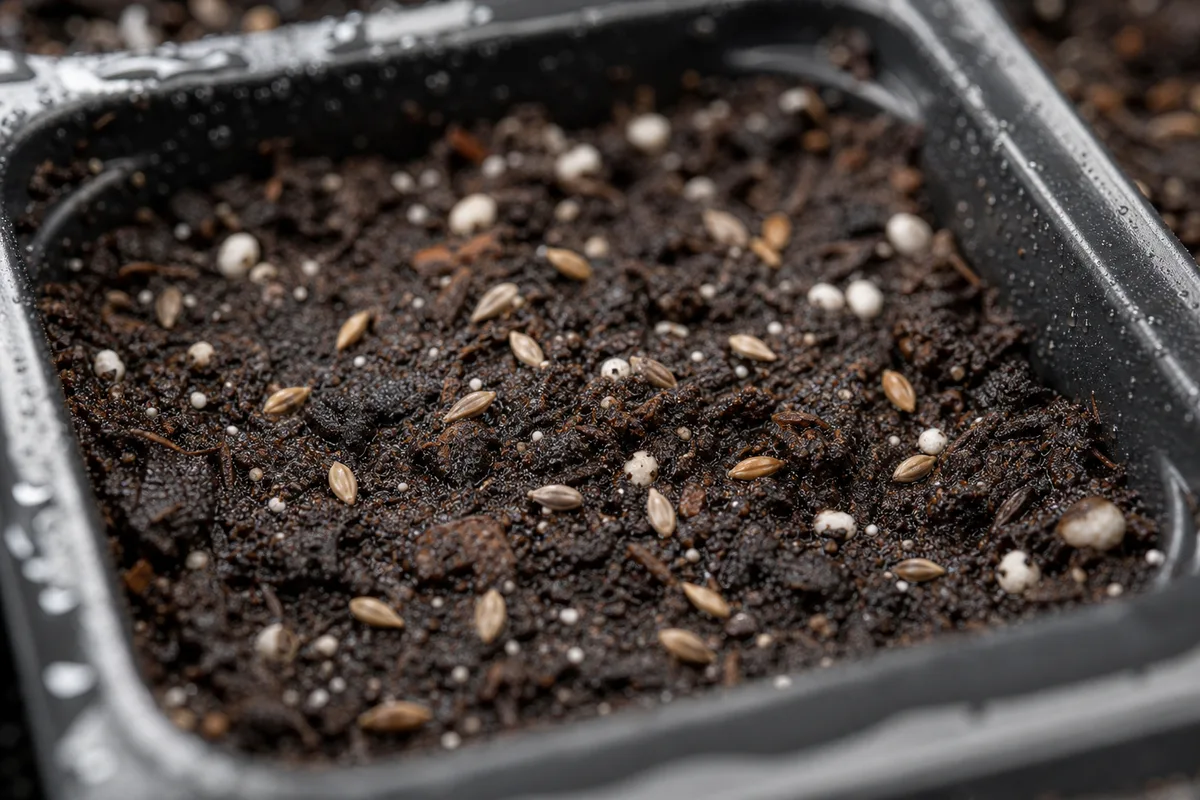
Seeds Not Germinating symptoms on Lavender - compare with healthy tissue on the same plant.
- Empty cells after the lavender window - no split seed coats, no green hooks after four to six weeks at 15–21°C on stratified fresh seed. Unlike basil or lettuce, which can sprout in days, lavender legitimately needs weeks to months on corrected trays.
- Mold or algae on the surface - white or green film inside sealed domes that never vented; often paired with dissolving seed below.
- Pre-emergence rot underground - a dig test reveals swollen seed turned soft, brown, or fuzzy while the tray surface stays bare.
- Patchy emergence - one cell sprouts while neighbors stay blank, usually from uneven moisture, mixed seed age, or skipped stratification on part of the batch.
- Seeds sprouting inside the fridge - viable seed that broke dormancy during stratification; plant immediately rather than returning to cold storage.
Legitimate slow trays can show first sprouts at week three to five when stratification, light, grit, and temperature are correct. Patience is part of the method-not a sign you failed.
Why lavender seed fails to germinate
Lavender evolved as a woody Mediterranean perennial that experiences winter cold before spring warmth. Many English lavender lines carry seed dormancy that cold-moist stratification breaks-typically three to six weeks at 35–40°F (2–4°C) in slightly moist sand, vermiculite, or paper towel inside a sealed bag in the refrigerator, not the freezer. Skipping stratification often produces uneven, delayed, or zero emergence even when other conditions look fine.
Surface sowing matters because lavender seed is small and energy-limited. Bury seed deeply and the embryo exhausts stored reserves before reaching light and air-even when horticulture literature debates whether lavender is strictly “light-dependent” versus depth-limited. Sow on the surface, press lightly for soil contact, and cover with only a thin dusting of fine grit or vermiculite porous enough for light penetration.
Old or poorly stored seed loses viability fast. Buy fresh seed each season and sow within a year when possible. Named cultivar seed from packets labeled ‘Hidcote’ or ‘Munstead’ will not breed true-offspring vary from the parent plant, which is expected with sexual reproduction, not a germination defect.
Soggy peat or sealed wet domes rot seed before sprout. Lavender wants gritty, free-draining mix even at the seedling stage-Mediterranean drainage culture starts at sowing, not after transplant.
Heat above 24°C (75°F) or dark cold wet trays also stall germination. Target 65–70°F (18–21°C) in bright conditions after stratification. A windowsill alone often combines cold night soil with weak light-supplement with grow lights 12–16 hours daily, kept 2–4 inches above emerging seedlings.
Species expectations differ. L. angustifolia English lavender is the common slow-germination case. Spanish or French types such as L. stoechas are often treated as tender annuals in cold climates and may follow different timing-check your packet rather than assuming one calendar fits every lavender line.
How to confirm the cause
Work through these checks in order before you dump the tray or blame your technique:
-
Seed age and source - Was seed bought this season? Stored cool and dry? Pre-primed or acid-scarified commercial seed may skip fridge stratification per packet directions-unprimed English lavender seed usually needs chilling.
-
Stratification completed? - Three to six weeks moist cold at 2–4°C before sowing. Note start and end dates on the bag.
-
Sowing depth - Seeds on the surface, pressed in, with only a fine grit or vermiculite dusting-not buried to the bottom of the cell.
-
Moisture pattern - Moldy surface means too wet with poor airflow. Cracked dry crust with firm unchanged seed below means seeds never imbibed consistently. Bottom-water and let the surface lighten slightly between drinks.
-
Temperature - Confirm tray stays roughly 15–21°C (59–70°F). Heat mats help in cool rooms; do not cook seed above 24°C.
-
Light - Bright location or grow lights on a timer. Dark closets after sowing delay or prevent emergence.
-
Time waited on corrected setup - Less than four weeks on first attempt with unstratified seed is too soon to abandon. Eight weeks with zero emergence on fresh stratified seed at correct depth, moisture, and temperature points to dead seed or a bad batch.
Dig-test protocol
After four weeks with no visible sprouts, gently uncover one seed with a toothpick:
- Firm, dry, unchanged seed in cool mix - warmth or patience was the limiter; verify temperature and wait longer.
- Firm seed in warm moist mix after six to eight weeks - likely dead or very old seed; run a paper-towel viability test on ten seeds before refilling a full tray.
- Soft, brown, or fuzzy seed in wet mix - pre-emergence rot; discard tray, sterilize, and resow with grittier mix and less dome time.
If depth, moisture, temperature, stratification, and seed freshness are correct and nothing emerges after eight weeks, buy new seed rather than nursing an empty flat through summer.
First fix for lavender
Restart with fresh seed: cold-stratify 3–6 weeks, surface-sow on sterile gritty mix, press in without burying, mist lightly, and place under bright cool light or grow lights at 15–21°C.
Discard moldy or sour-smelling batches-reusing contaminated media rarely self-corrects. Label the tray with stratification end date and sow date. Expect weeks, not days, before the first green appears.
Do not bury seed, do not seal a wet dome for weeks without daily venting, and do not discard a corrected tray at day ten on the first stratified attempt.
Step-by-step recovery
-
Discard failed moldy batches - Empty affected cells, wash trays with dilute bleach rinse, and start with fresh sterile mix.
-
Stratify new seed - Mix seed with slightly moist vermiculite or lay on damp paper towel, seal in a labeled bag, and refrigerate 3–6 weeks at 2–4°C. Check weekly for mold; medium should feel moist, not dripping. Plant any seed that sprouts in the bag immediately.
-
Surface sow on gritty sterile mix - Peat-free seed compost blended with perlite or coarse sand. Pre-moisten, firm lightly, scatter a few seeds per cell, press flat, dust with fine grit or vermiculite.
-
Cover lightly and vent - Clear dome or plastic wrap holds surface moisture; lift daily to exchange air and prevent mold.
-
Bright light from day one - Grow lights 12–16 hours daily, 2–4 inches above the tray top. Vent or remove cover after first sprouts appear.
-
Bottom-water lightly - Add water to the tray, pour off excess after 20–30 minutes. Keep surface evenly moist, never soggy for days.
-
Transplant at first true leaf pair - Move the strongest seedling per cell into individual gritty cells; handle by leaves, not fragile stems.
If two stratified resows with verified fresh seed fail at correct depth, warmth, and moisture, switch to softwood cuttings-the faster, clone-true path most lavender growers use for named cultivars. See the lavender propagation guide for cutting timing and mix.
Recovery timeline
Pre-emergence failure has no above-ground recovery-you judge the next sowing, not the old tray.
On corrected fresh stratified seed, expect first sprouts between weeks two and six, with staggered emergence normal through week eight. Usable seedlings with firm true leaves typically arrive eight to twelve weeks from sow when light stays strong.
Worsening signs during a retry: mold spreading despite venting, mix smelling sour, or dig tests showing seeds that swelled then collapsed without shoots-fix moisture, sterility, or seed source before waiting longer.
Germination failure vs post-emergence problems
| Symptom | Pre-emergence (this page) | Post-emergence (other guides) |
|---|---|---|
| Bare tray weeks after sow | Yes - stratification, depth, seed age | No - if nothing ever emerged |
| Thin stretched stems after sprout | No | Leggy seedlings |
| Collapse at soil line on wet mix | Rare pre-emerge; usually post-emerge | Damping-off - new tray, less water |
| Yellow cotyledons on emerged plants | No | Yellow-seedlings / culture check |
| Wrong plant habit from seed | Cultivar non-trueness expected | Propagation choice - use cuttings for clones |
Causes to rule out
- Damping off after sprout - Seedlings collapse at the soil line once green appeared. That is a post-emergence fungal problem, not failed germination. Restart with less moisture and better airflow.
- Wrong species expectations - L. stoechas and tender lavenders differ in hardiness and timing from English lavender; read the packet.
- Winter-sow confusion - Outdoor winter sowing can stratify naturally in cold climates, but warm spells or wet soil may rot surface seed. Fridge stratification indoors is more predictable for first attempts.
What not to do
Do not bury lavender seed deep like bean or squash seed. Do not keep a sealed wet dome for weeks without ventilation. Do not discard a stratified tray at day ten. Do not assume a named cultivar packet will produce identical plants-variation is normal from seed. Do not nurse an empty tray past eight weeks on fresh corrected seed; buy new seed instead.
How to prevent failure next time
- Buy fresh seed yearly; store cool and dry in a paper envelope.
- Stratify 3–6 weeks moist at 2–4°C before spring sowing, or use packet-directed pre-primed seed.
- Surface sow on sterile gritty mix; bottom-water for even moisture.
- Sow indoors 10–12 weeks before last frost so seedlings size up under lights before plant-out.
- Run a paper-towel viability test on ten seeds before filling a full tray.
- Provide 12–16 hours of grow light daily; a windowsill alone is often insufficient in spring.
- Consider cuttings when you need a clone of a specific plant-see lavender propagation.
Lavender care cross-check
Germination failure is almost always protocol-stratification, surface light sowing, gritty moisture, fresh seed, and calendar patience-not bad luck. Once seedlings emerge, they need the same sharp drainage and Lavender light guide culture mature lavender expects; review the lavender overview for watering and soil rhythm.
When to worry
Moldy tray is a restart signal, not a wait signal. Zero sprouts at eight weeks on fresh stratified seed at correct temperature, depth, and moisture means new seed source-not another month of hope. Seeds dissolving in dig tests mean rot is active; sterilize trays before resowing.
Related lavender problems
- Lavender propagation - Full seed stratification, sowing, and cuttings fallback
- Lavender overview - Sun, soil, and drainage culture hub
- Leggy seedlings on lavender - Post-emergence light failure, not empty trays
- Yellow seedlings on lavender - Cotyledon yellowing after sprout
- Seedlings falling over on lavender - Damping-off and weak stem collapse
- Stunted growth on lavender - Slow development after seedlings establish
Conclusion
Lavender seeds fail quietly when cold stratification, surface sowing, gritty moisture, fresh seed, or realistic timelines were missing-not because the species is impossible from seed. Confirm with a dig test, restart on sterile gritty mix under grow lights, and allow six to eight weeks on corrected trays before calling it a loss. If fresh stratified seed still will not break, cuttings deliver faster, clone-true plants for the cultivar you already grow.
When to use this page vs other Lavender guides
- Lavender watering guide - Use for routine moisture checks before assuming seeds not germinating is the main issue.
- Lavender problems hub - Browse all 51 common issues on this species.