Leggy Growth on Ficus Burgundy: Causes, Checks & Fixes
Quick answer
Leggy Ficus Burgundy stems mean the plant is stretching for light-not a disease. Move it to bright indirect light first; faded burgundy reversion and long gaps between large leaves confirm etiolation before you prune or fertilize.
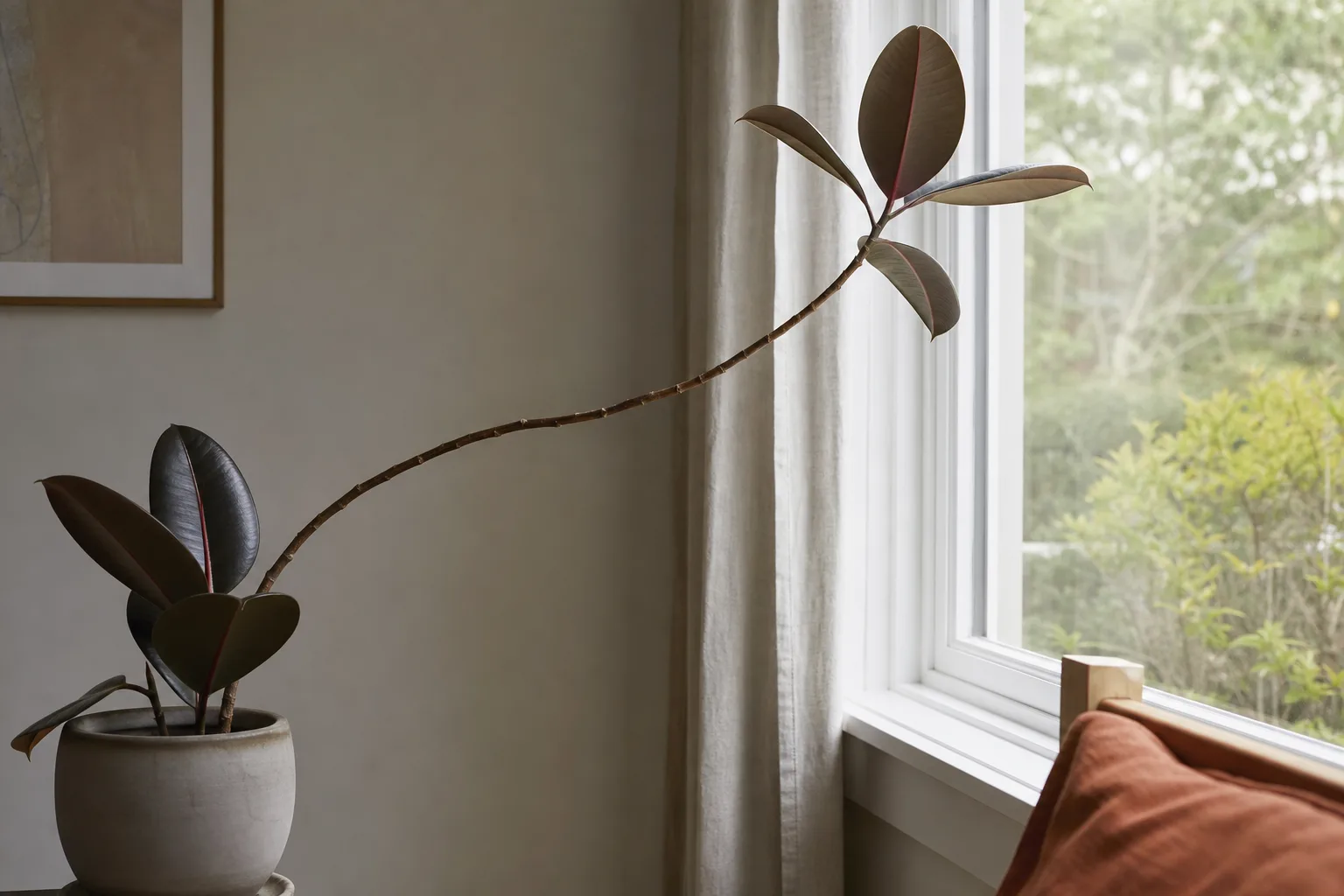
Leggy Growth on Ficus Burgundy: Causes, Checks & Fixes
This guide covers leggy growth on Ficus Burgundy. See also the general Leggy Growth guide, watering, and light pages for this plant.
Leggy Growth on Ficus Burgundy: Causes, Checks & Fixes
Quick answer
Leggy growth on Ficus Burgundy (Ficus elastica ‘Burgundy’) is almost always insufficient light, not nutrient deficiency or disease. This dark-leaf rubber plant cultivar needs bright indirect light to maintain compact internodes and its characteristic burgundy-tinted new foliage. In dim rooms, stems stretch toward windows, gaps between large glossy leaves widen, new leaves emerge smaller and greener (reverting toward solid green), and the tree-like silhouette turns into a sparse pole.
First step: move the plant to brighter indirect light-typically an east window or filtered south/west exposure within one to three feet of glass. Do not fertilize, repot, or hard-prune on day one. Acclimate over seven to fourteen days if the plant lived in deep shade, then judge the next two or three new leaves for tighter spacing and returning dark color before spring pruning.
This page is the leggy etiolation hub for Burgundy rubber plants: what stretch looks like, how to confirm it, step-by-step recovery, and when to prune. For the broader low-light picture-including stalled stipules, wet-soil compounds, and full window placement-see not enough light on Ficus Burgundy.
Leggy etiolation vs. not enough light on Ficus Burgundy
These two pages overlap because leggy growth is how chronic under-lighting often shows up on Ficus elastica ‘Burgundy’. The split keeps each URL useful without repeating the same essay twice.
| Question | Read this page (leggy growth) | Read not enough light |
|---|---|---|
| Primary symptom | Long internodes, window lean, bare lower trunk | Green reversion, slow stipules, dull color, wet soil in dim corners |
| Your main ask | ”Why is my burgundy rubber plant so tall and sparse?" | "Why is my plant turning green and growing slowly?” |
| Unique focus | Pruning after light fix, old stem permanence, cultivar stretch comparison | Full low-light diagnosis, shadow test, compound root-stress patterns |
| First fix | Brighter indirect light, then spring prune | Brighter indirect light, then reassess watering |
Both pages share the same first action: increase usable light at the canopy. Start here when stretch and lean dominate; use the sibling page when growth has stalled without obvious reaching, or when soil stays wet in a dark corner.
What leggy growth looks like on Ficus Burgundy
Healthy Burgundy rubber plant foliage is stiff, glossy, and large with relatively short spaces between leaves. New leaves emerge from bright red or pink stipules at the stem tip and unfold dark burgundy to near-black when light is adequate. Leggy growth breaks that pattern:
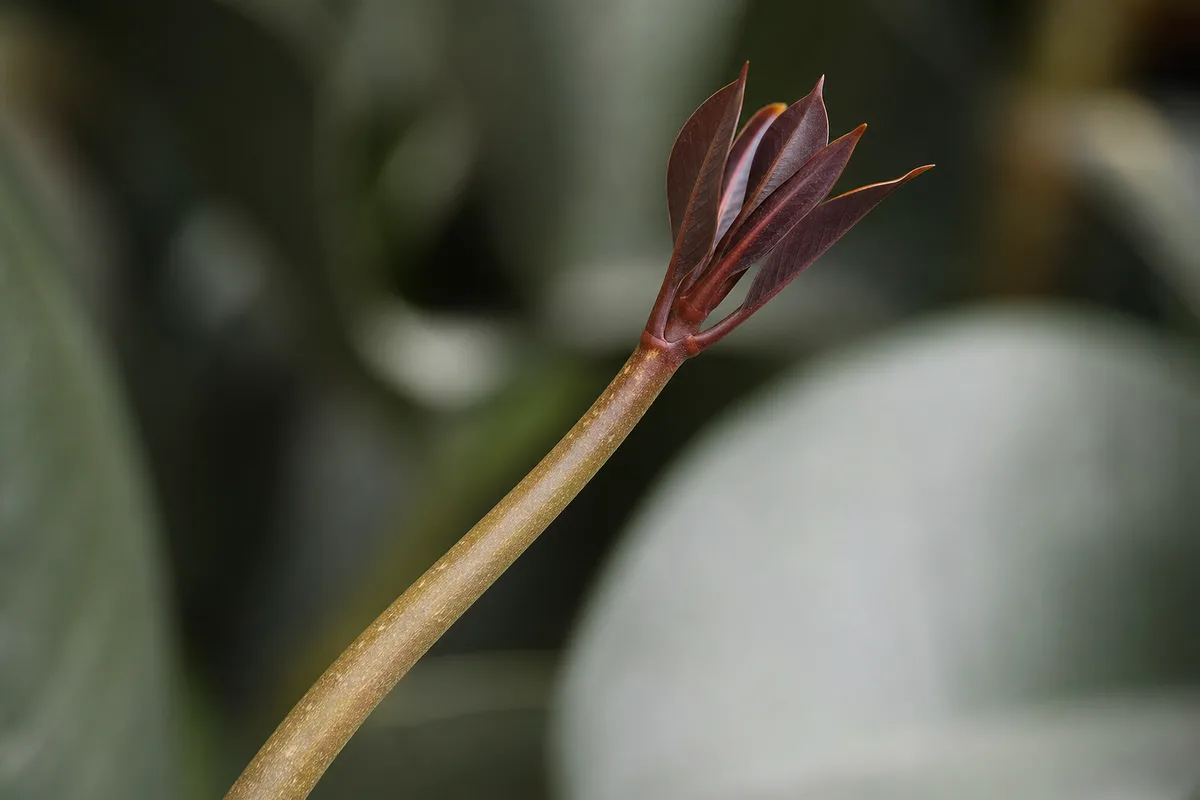
Leggy Growth symptoms on Ficus Burgundy - compare with healthy tissue on the same plant.
- Long bare gaps along upright stems-the internode between leaf pairs visibly lengthens
- Smaller or paler new leaves with reduced burgundy coloration-new growth may look mostly green while older leaves stay dark
- Strong lean toward the brightest window or lamp-plants stretch or lean toward light when brightness is too low
- Lower leaf drop leaving a naked trunk while the tip keeps stretching
- Thin soft new stems that cannot hold large leaves upright without leaning
The burgundy cultivar adds a diagnostic layer solid-green rubber plants share but this selection highlights: new leaf color. When photons are scarce, the plant shifts toward more chlorophyll and less anthocyanin-the burgundy pigment that makes this cultivar worth keeping. Green-dominant new foliage on long internodes is etiolation on Burgundy, not a separate nutrient crisis.
This differs from leaf drop after a move (sudden shed from draft or relocation-hold stable bright care four to six weeks) and from overwatering yellowing (wet heavy pot, limp leaves, sour smell-not long internodes alone).
Why Ficus Burgundy gets leggy
Rubber plants evolved in bright filtered tropical conditions-not deep interior shade. Clemson Extension notes rubber plants prefer bright light but are adaptable to low light-they survive dim corners yet may grow tall and lanky indoors without enough brightness. Low light triggers etiolation: the plant stretches toward usable light, elongating internodes to reach photosynthetically useful photons.
Etiolation and dark-pigment photon demand
Dark burgundy leaves absorb more light for photosynthesis but also cost more energy to maintain than plain green tissue. In marginal light, Burgundy prioritizes survival over display color-producing greener, thinner new blades on longer stems. That is why green reversion on new leaves often appears before the plant looks obviously weak to casual observation.
Human vision adapts to dim rooms; the plant does not. A spot that feels “fine” to you may still be low light for a cultivar bred to stay dark and upright.
Burgundy vs. Robusta vs. Tineke light thresholds
| Cultivar | Typical indoor light need | Leggy / reversion signal |
|---|---|---|
| ’Burgundy’ (this page) | Bright indirect; east or filtered south/west within 1–3 ft of glass | Green new leaves on long internodes; lean toward window |
| ’Robusta’ (solid green) | Moderate to bright indirect; tolerates slightly dimmer spots longer | Long internodes and lean; less obvious color shift |
| ’Tineke’ / variegated | Brightest of the group; variegated zones bleach first | Faded margins plus stretch; fails fastest in north rooms |
Burgundy may survive a hallway longer than variegated rubber plants, but survival without burgundy color defeats why you bought this cultivar. Do not compare stretch tolerance to pothos-different metabolism, different compactness bar.
Common contributing factors:
- Distance from windows-light intensity drops sharply with distance from glass
- Winter daylight shrink-same physical spot that worked in summer may trigger stretch October through February
- One-sided exposure without weekly rotation
- Over-fertilizing in low light-weak elongated shoots the plant cannot support with dense foliage
- Natural tree habit left unpruned-MOBOT notes unpruned stems create a tall narrow tree-like form even in decent light
How to confirm the cause
Work through these checks before repotting, feeding, or mass pruning:
- Window relationship - Is the canopy within one to three feet of east or filtered south/west light? Beyond six feet from the same pane is often low-light territory for bright indirect rubber plant culture.
- Lean direction - Stems pointing at the brightest glass strongly suggest light-seeking stretch.
- New vs. old leaf size and color - Smaller greener new leaves vs. older burgundy-tinted foliage fits etiolation; uniform large dark leaves fit adequate brightness.
- Season timing - Did stretch worsen after daylight shortened?
- Soil check - Waterlogged mix with yellow lower leaves and no long internodes suggests watering problems instead. Stretch plus wet heavy soil in a dim corner is a compound pattern-fix light and dry-down together.
Two-week new-leaf trial
Move the pot closer to the brightest safe window without changing water, fertilizer, or pot size. Wait ten to fourteen days and read the next emerging leaf. If internodes on new growth tighten and fresh foliage darkens compared with the most recent stretched leaf, light was the limiter. No improvement after a genuine light upgrade in warm months suggests checking roots or pests-but on Burgundy, stretch with green reversion almost always traces to brightness first.
Leggy vs. move shock vs. overwatering
| Pattern | Internodes | Soil | Leaf color | Urgency |
|---|---|---|---|---|
| Leggy etiolation | Long gaps, window lean | Often damp slowly in dim light | Green new leaves, dark old leaves | Fix light within weeks |
| Move / draft shock | Normal spacing | Normal dry-down | Uniform drop, not gradual stretch | Hold stable care 4–6 weeks |
| Overwatering / root stress | May coexist with stretch in dim corners | Wet, heavy, sour | Yellow lower leaves, limp tissue | Reduce water; inspect roots |
First fix for Ficus Burgundy
Move to brighter indirect light and acclimate over seven to fourteen days if coming from deep shade. Clemson notes rubber plants grow best with morning light from an east window. Missouri Botanical Garden recommends bright indirect light or part shade with protection from afternoon sun for Ficus elastica indoors.
Hold everything else steady while you test the move:
- Do not fertilize until new leaves sit closer together and burgundy color returns on fresh growth.
- Do not repot unless roots are clearly failing-legginess is not a pot-size issue.
- Do not hard-prune before light improves-you will get bare stubs that stretch again in the same dim spot.
If the best window still falls short, add a full-spectrum LED grow light 30–45 cm (12–18 inches) above the canopy for 10 to 12 hours daily on a timer-close enough that a soft shadow falls on the top leaves at midday. Details on distance and scorch vs. stretch sit in our light guide.
Step-by-step recovery
After light improves, work through these steps in order-one major change at a time:
- Acclimate to stronger light over seven to fourteen days if the plant lived in deep shade-move closer in stages or filter midday heat until large burgundy leaves adjust.
- Rotate the pot weekly so all sides receive similar exposure and new growth stays more even.
- Judge the next two to three new leaves - Look for shorter gaps between emerging leaves, firmer gloss, and burgundy color returning on fresh blades. Old stretched internodes never shrink; success shows only on new tissue.
- Match watering to brighter conditions - More light means faster dry-down per our watering guide. Do not keep a dim-corner schedule on wet soil.
- Prune leggy stems in spring once active growth resumes with tighter spacing. Cut just above a leaf node to encourage branching. Wear gloves-milky sap can irritate skin. See our pruning guide.
- Remove no more than one-third of the canopy in a single session on a stressed plant. Stagger hard cuts if the trunk is severely bare.
- Add or adjust grow lights if winter daylight or north windows still limit compact growth after the window move-maintain 10 to 12 hours daily through short-day months.
Tip cuttings from pruned stems root easily in water or moist mix if you want a backup while the parent fills in.
Recovery timeline
Two to three weeks after a light upgrade in spring or summer: the next leaf from a red stipule should unfold more confidently, with a shorter internode than the most recent stretched section. Burgundy color may take two to three new leaves to fully return after a long dim period.
One to two growing seasons: Bushier shape develops with spring pruning once compact new growth is established. A severely leggy plant may need two pruning cycles over a year to look full again.
Old stretched tissue: Permanent. Judge success by new leaf spacing, gloss, and color-not by old bare stem length disappearing.
Winter: Recovery slows even after a successful light fix. Do not force growth with fertilizer or extra water.
Worsening signs after a light increase: Brown scorched patches mean too much direct sun too fast-pull back and acclimate more slowly. Yellowing with wet soil means reduce water even though light improved.
Lookalike symptoms and causes to rule out
Normal upward growth in good light. Young Burgundy stems naturally reach upward. Compact internodes and large dark new leaves distinguish healthy vertical growth from etiolation.
Leaf drop after a move. Rubber trees shed when relocated or exposed to cold drafts. That is shock, not legginess-look for long internodes and lean over weeks, not just fallen leaves on the floor.
Overwatering in a dark corner. Yellow lower leaves, sour soil smell, and soft stems suggest root stress. Plants in dim rooms grow more slowly and use less water-if you keep a bright-room watering schedule, wet soil plus stretch invites root problems.
Slow growth without active stretch. Dim light but stable internode length from years ago may present as slow growth rather than active reaching-same light fix, different primary symptom.
Spider mites or mealybugs. Stippling, webbing, or cottony clusters indicate pests. They may slow vigor but do not produce the classic directional stretch toward windows typical of legginess.
Mistakes to avoid
Do not fertilize in unchanged dim light-that pushes weak elongated shoots without fixing the energy deficit. Do not repot for legginess alone. Do not jump to harsh midday south sun without acclimation-scorch risk on large dark leaves. Do not prune heavily before light improves-weak regrowth follows. Do not leave Burgundy in a north room and expect compact burgundy color. Do not stack repotting, pruning, and feeding on the same day as a major light move-rubber trees drop leaves when several variables change at once.
How to prevent leggy growth next time
Match placement to how Burgundy actually grows-not where the pot looks best in a dark corner.
- Light: Six to eight hours of bright indirect light daily per our light guide-east window or filtered south/west within one to three feet of glass.
- Rotation: Turn the pot weekly so one side does not carry all the long internodes.
- Pruning: Prune in spring before stems become bare trunks-MOBOT notes pruning main branches encourages a bushier habit.
- Winter grow lights: When daylight shortens, supplement north rooms with full-spectrum LED 10 to 12 hours daily before the second long internode appears-not after the fifth.
- Water: When light increases, confirm the top 1 to 2 inches dry before watering per our watering guide-do not keep a dim-room schedule on wet soil.
- Dust: Wipe glossy dark leaves monthly so scattered light reaches chloroplasts.
Track internode length on each new leaf, not day-to-day height. Catch stretch on the second long gap, not when the trunk is bare.
When to worry
Legginess alone is a care adjustment, not a crisis. Escalate if:
- Stems soften or blacken at the base while soil stays wet-possible root rot, not just stretch
- More than a third of leaves drop within weeks alongside rapid lean
- Pale green new growth continues for three or more months despite a clear light upgrade
- Stretch plus wet sour soil in a dim corner-fix light and dry-down the same week; see overwatering
- Stems lean so far large leaves threaten to snap before new growth stiffens-stake temporarily or prune after light improves
Otherwise, move the pot, wait for two to three new leaves, then prune in spring for shape.
Related Ficus Burgundy guides
| Guide | When to use it |
|---|---|
| Overview | Species context, burgundy color-light relationship, pet toxicity |
| Light | Window placement, hand-shadow test, grow-light distance |
| Watering | Dry-down rhythm after you increase light |
| Pruning | Node cuts, sap handling, bushier shape |
| Not enough light | Full low-light hub-stall, wet-soil compounds, shadow test depth |
| Slow growth | Stipule silence without obvious stretch |
| Overwatering | Yellow leaves, wet heavy pot in dim corners |
| Yellow leaves | Lower-leaf yellowing patterns beyond stretch |
| Root rot | Soft stems, sour soil, stretch plus chronic wetness |
| Rubber plant leggy growth | Parent species reference for generic F. elastica etiolation |
Related tool
Use the Plant Problem Diagnosis Tool to narrow causes for leggy growth on this plant before changing multiple variables at once.