Yellow Leaves on Dragon Tree: Causes, Checks & Fixes
Quick answer
Yellow leaves on Dragon Tree are usually either normal lower-leaf aging or root stress from staying wet too long. First check: are only the oldest leaves at the bottom of each cane yellowing, or are multiple leaves yellowing while soil is still damp? That one split tells you whether to monitor normally or act fast.
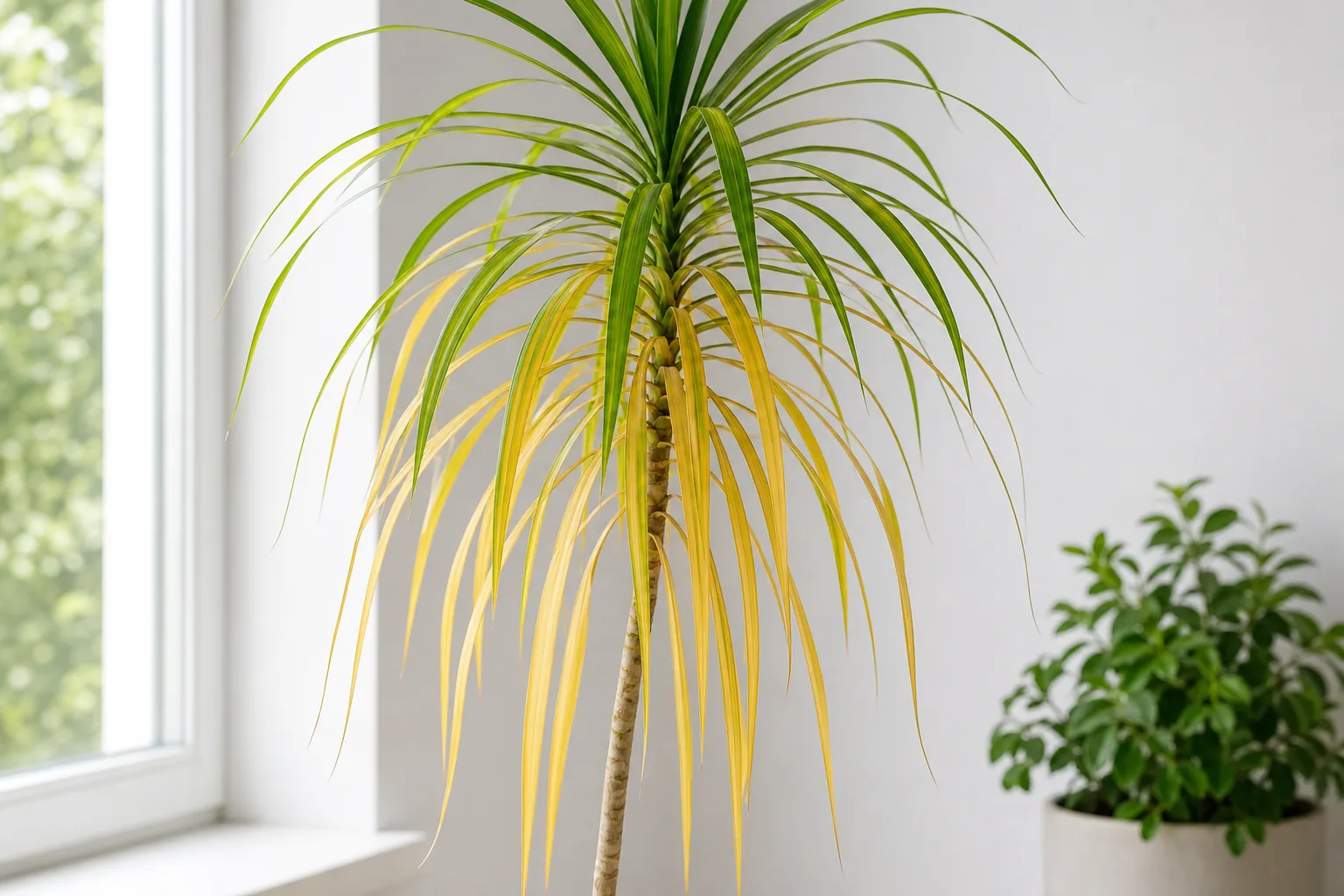
Yellow Leaves on Dragon Tree: Causes, Checks & Fixes
This guide covers yellow leaves on Dragon Tree. See also the general Yellow Leaves guide, watering, and light pages for this plant.
Yellow Leaves on Dragon Tree: Causes, Checks & Fixes
Quick answer
Yellow leaves on Dragon Tree (Dracaena marginata) are a symptom, not a diagnosis. On this cane-form plant, a small amount of lower-leaf yellowing is expected as old leaves age out. Stress yellowing looks different: it spreads faster, often appears with wet mix or weak light, and can escalate to soft stems if roots fail.
First check: look at leaf position and soil moisture together. If only the oldest leaves at the bottom of each cane are yellowing and the cane stays firm, this is usually normal senescence. If multiple leaves on one or more canes yellow while the pot is still heavy and damp, treat as root-stress risk and move to the confirmation steps below.
Yellow leaves vs. brown tips vs. drooping on Dragon Tree
Yellow leaves are not always the same problem as brown tips or drooping leaves on Dragon Tree. Brown tips often point to water-quality or salt stress first, while full-leaf yellowing is more often tied to normal lower-leaf aging or root stress. Drooping can appear with both overwatering on Dragon Tree and underwatering on Dragon Tree, so moisture checks matter more than appearance alone.
If your symptoms overlap, cross-check related guides early: brown tips, drooping leaves, and not enough light.
What yellow leaves look like on Dragon Tree
Pattern A: normal lower-leaf aging
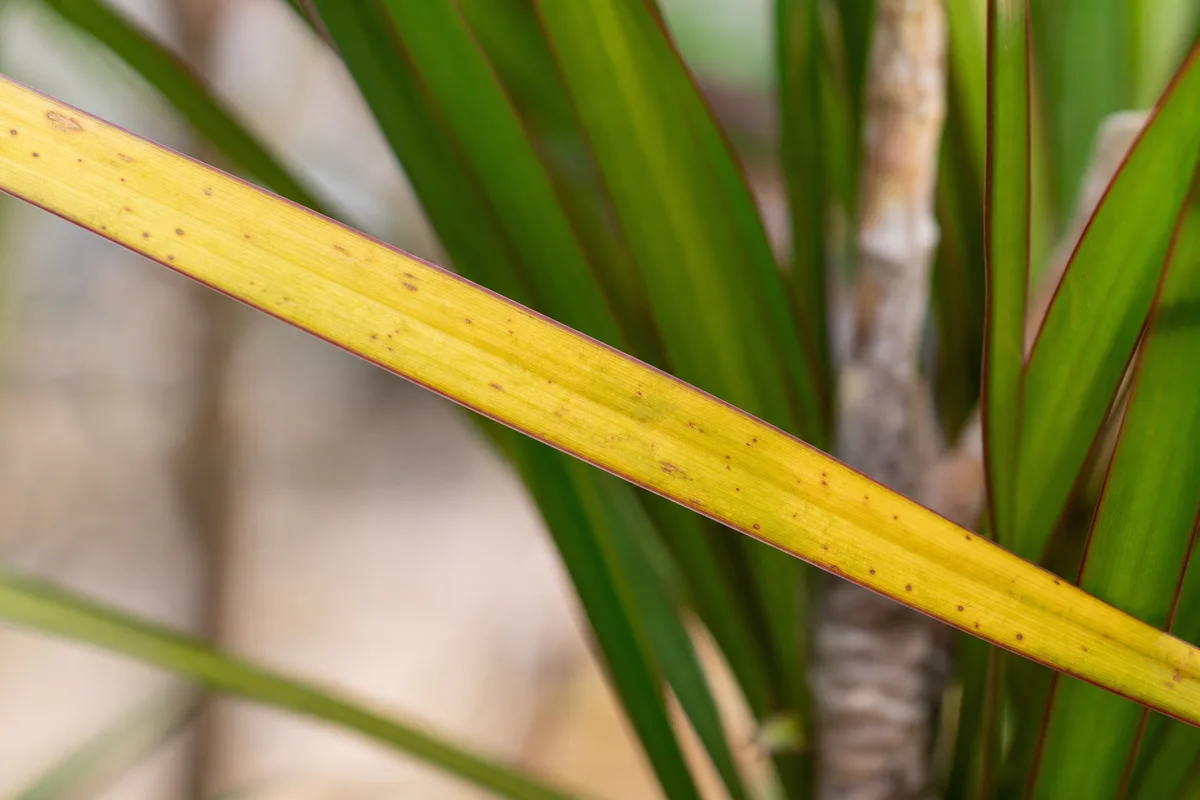
Yellow Leaves symptoms on Dragon Tree - compare with healthy tissue on the same plant.
Dragon Tree naturally sheds old leaves as canes elongate. You usually see one older leaf yellow from the bottom of a cane while the rosette at the top remains green and upright. This pattern aligns with common indoor-plant senescence guidance from Missouri Botanical Garden.
Pattern B: wet-soil yellowing
Overwatering often produces broader yellowing, not just one lower leaf. Leaves may feel softer, and the pot stays heavy for many days. Root rot commonly follows poor drainage or frequent watering and is more likely when the plant sits in a saucer or dense mix.
Pattern C: fluoride/salt stress
Dracaena is unusually sensitive to fluoride. Tip or margin yellowing/burn can start before whole-leaf decline, especially with fluoridated tap water, high-salt fertilizer use, or fluoride-containing inputs.
Pattern D: low-light decline
In dim rooms, leaves can become paler and growth weakens. RHS light guidance for dracaena notes that plants tolerate lower light but perform best in bright indirect conditions, and low light also slows dry-down, which increases overwatering risk.
Why Dragon Tree gets yellow leaves
- Normal senescence: older lower leaves naturally cycle out as canes mature.
- Overwatering: oxygen-poor roots cannot support healthy foliage; yellowing accelerates.
- Underwatering: repeated deep drought can yellow and crisp lower leaves.
- Fluoride/salt injury: marginal burn and yellowing from water/fertilizer chemistry.
- Low light + wet cycle: dim placement keeps soil wet longer, compounding root stress.
- Temperature shock: sudden drafts or temperature swings can trigger drop/yellowing.
These causes can overlap. The practical goal is not to label every factor on day one, but to identify the dominant branch first.
Lookalike symptoms and first direction
| Pattern | Most likely cause | First direction |
|---|---|---|
| One oldest lower leaf per cane, slow pace, firm cane | Normal aging | Remove spent leaf only |
| Multiple leaves yellowing while mix stays wet | Overwatering/root stress | Stop watering, inspect roots |
| Light pot, dry mix, dull limp leaves | Underwatering | Deep soak once, reset Dragon Tree watering guide |
| Brown/yellow tips on otherwise firm leaves | Fluoride/salt stress | Switch water source, flush mix |
| Pale weak growth in dim area | Low light | Move to brighter indirect light |
| Soft cane base with wet mix | Root rot escalation | Emergency unpot + trim; see root rot |
How to confirm the cause
Use this order so you do not over-correct:
- Leaf position check: Are yellow leaves mostly the oldest, lowest leaves on each cane?
- Pot weight check: Compare with right-after-watering weight. Heavy for too long suggests slow dry-down.
- Depth moisture check: Probe several spots; surface dryness alone is not enough.
- Cane firmness check: Press lightly at the soil line. Soft tissue is an escalation sign.
- Smell check: Sour smell plus wet mix supports rot risk.
- Dragon Tree light guide check: If growth is stretching and pale, increase light before adjusting fertilizer.
- Water-source check: If tips burn repeatedly despite decent watering rhythm, review fluoride/salt exposure.
If wet-soil yellowing persists after one full dry-down cycle, unpot and inspect roots. Brown, soft roots with odor are classic overwatering/root-rot signs.
First fix (choose one, based on confirmed branch)
If this is normal aging
Remove the fully yellow leaf at its base and continue regular care. Do not change watering or fertilizing based on one aging leaf.
If this is wet-soil yellowing
Pause watering until at least the top half of the mix is dry. Increase airflow and bright indirect light. Empty saucers quickly after watering. If cane softness appears, escalate to the Dragon Tree root rot guide.
If this is underwatering
Soak thoroughly once until drainage runs, then resume a moisture-led rhythm using the Dragon Tree watering guide. Avoid alternating long drought with heavy drenching.
If this is fluoride/salt stress
Switch to rainwater, distilled, or low-mineral filtered water. Avoid superphosphate-heavy feeding and inputs with high fluoride exposure, consistent with Penn State fluoride-toxicity management and MSU Extension notes on fluoride injury.
If this is low light
Move to brighter indirect light and keep watering conservative until dry-down normalizes. Do not fertilize aggressively to force color.
Step-by-step recovery when watering stress is confirmed
- Stabilize conditions first: Move the plant to bright, indirect light and keep temperature steady.
- Reset watering rhythm: Water only when a deep moisture check shows meaningful dry-down, not by calendar.
- Inspect root-zone risk signs: If mix stays wet and the cane softens, unpot to inspect roots the same day.
- Trim only dead tissue: Remove mushy roots and fully yellow leaves; keep firm tissue and any healthy roots.
- Repot into draining mix: Use a pot with drainage and avoid leaving runoff in saucers.
- Track recovery by new growth: Old yellow leaves will not turn green; success is no upward spread and healthy new top growth.
Recovery timeline
- Normal aging: immediate stability; only occasional lower-leaf drop continues.
- Mild watering correction: 2-4 weeks before yellowing slows and new leaves look stronger.
- Root-stress recovery: often 4-8+ weeks, depending on remaining healthy roots.
- Fluoride/salt correction: old damage remains; improvement shows on new growth over one to two new leaf cycles.
Fully yellow leaves do not recover color. Progress is measured by stable green new growth and no upward spread of yellowing.
What not to do
- Do not add fertilizer as your first response to yellow leaves on wet soil.
- Do not water again just because leaves look limp if the pot is still heavy.
- Do not repot immediately for every yellow leaf; confirm wet-root symptoms first.
- Do not ignore repeated tip-burn patterns if using fluoridated water.
- Do not leave trimmed yellow leaves where pets can chew them; Dracaena is toxic to cats and dogs.
When to worry
Treat this as same-day urgent if any of these appear:
- Cane base softening at soil line
- Foul smell from wet mix
- Rapid multi-leaf yellowing across multiple canes
- Yellowing reaching newer top leaves
- Black/mushy roots on inspection
Those signs suggest active root failure, not routine aging.
How to prevent yellow leaves next time
- Follow a moisture-led schedule using Dragon Tree watering guidance, not a fixed weekly calendar.
- Keep the plant in bright indirect light so dry-down is predictable.
- Use a draining pot and avoid standing water in saucers.
- Use low-fluoride water if tip burn repeats.
- Reduce watering in cooler/darker seasons.
- Cross-check related symptoms early: brown tips, not enough light, drooping leaves, underwatering, overwatering, root rot, and dragon tree overview.
When to use this page vs other Dragon Tree guides
- Dragon Tree watering guide - Use for routine moisture checks before assuming yellow leaves is the main issue.
- Dragon Tree problems hub - Browse all 16 common issues on this species.
- Overwatering on Dragon Tree - Different entry point when symptoms overlap with yellow leaves.
- Underwatering on Dragon Tree - Different entry point when symptoms overlap with yellow leaves.
- Not Enough Light on Dragon Tree - Different entry point when symptoms overlap with yellow leaves.