Fungus Gnats on Dieffenbachia Camille: Winter Overwatering
Quick answer
Fungus gnats on Dieffenbachia Camille almost always mean the soil surface stays wet too long - often from a summer watering schedule kept through winter in a dim corner. First step: stop watering until the top inch of mix is dry, then use yellow sticky traps and a BTI drench only if adults keep returning.
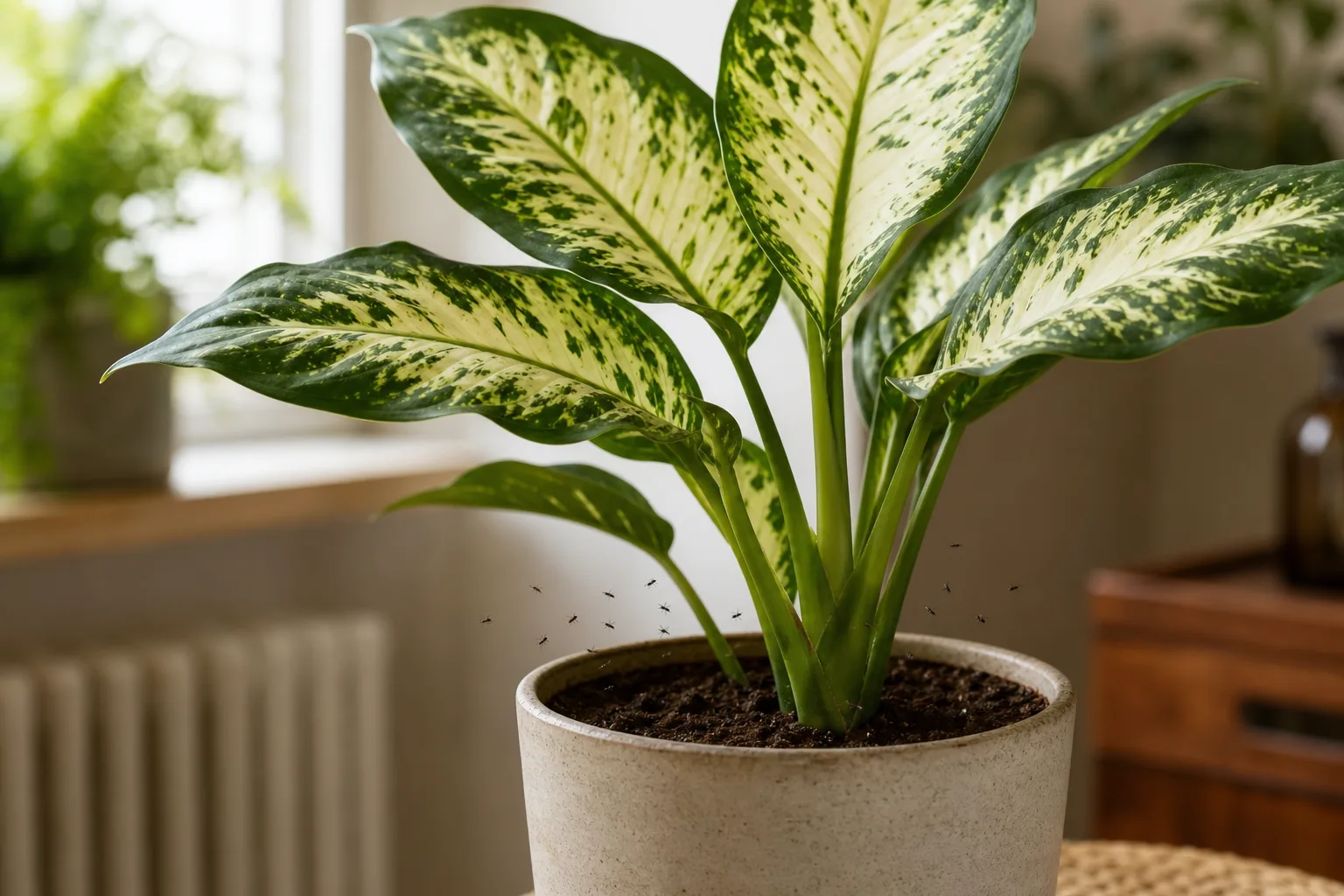
Fungus Gnats on Dieffenbachia Camille: Winter Overwatering Warning & Dry-Down Fix
This guide covers fungus gnats on Dieffenbachia Camille. See also the general Fungus Gnats guide, watering, and light pages for this plant.
Fungus Gnats on Dieffenbachia Camille: Winter Overwatering Warning & Dry-Down Fix
Quick answer
Tiny black flies hovering over your Dieffenbachia Camille pot are almost never a random pest invasion - they are a wet-soil signal. On this cream-variegated dumb cane, gnats show up when the top inch of mix stays damp too long, usually because watering still follows a bright-window summer rhythm while the plant sits in lower winter light and uses water slowly. Camille’s pale center panels carry less chlorophyll than all-green dumb cane, so the same pot in the same dim corner dries slower - and wet organic soil is exactly where fungus gnat larvae feed.
First step: stop watering until the top inch of mix feels dry to your finger and the pot feels noticeably lighter. Do not reach for sprays, Dieffenbachia Camille repotting guide, or repeated drenches on day one. Gnats are a symptom of chronically wet soil; drying the surface breaks their life cycle before any chemical fix can work.
If yellow lower leaves, a heavy wet pot, or soft cane bases at soil level appear with the gnats, treat this as overwatering escalation, not a mild fly nuisance - see the overwatering and root rot guides after your first dry-down check.
Why Dieffenbachia Camille gets fungus gnats
Adult fungus gnats lay eggs in consistently moist organic potting mix. Larvae live in the top layer, feeding on fungi, decaying organic matter, and sometimes fine roots. The biology is generic - but why Camille gets them repeatedly is cultivar-specific.
Winter schedule mismatch in low light
Camille on an office desk or side table away from windows grows slowly from fall through early spring. Many owners water every seven to ten days because that worked in summer near a sheer-curtained window. In winter, the same volume keeps the surface wet for two weeks or more. UMN Extension notes that fungus gnats thrive in wet potting soil - and Camille’s reduced transpiration in dim rooms makes that wet window longer than on a brighter all-green dumb cane in the same spot.
The watering guide recommends stretching to every fourteen to twenty-one days in winter when the top inch is actually dry - not on a calendar.
Case note (January 2026 grower log): A six-inch Camille on a fluorescent-lit office desk (no window within three metres) was watered every Monday through winter. Gnats appeared in week three; the top inch still felt cool and clung to a finger on day twelve after the last drink. After a full dry-down hold, winter intervals stretched to every eighteen days verified by finger and pot weight. Yellow sticky trap catch fell from roughly fifteen adults per card to two within eleven days; full fly absence took twenty-eight days across two BTI drench cycles. Old yellow bottom leaves dropped unchanged; recovery was judged on firm new cream-centered crown leaves only.
Variegation and slow dry-down in dim corners
Camille’s cream-centered leaves have less photosynthetic tissue per blade than deeper-green cultivars. In low light, the plant pulls less water from the root zone, yet the top of peat-heavy nursery mix still holds surface moisture between drinks. Bottom-watering can help roots drink without flooding the surface - but if you never let the top inch dry, larvae keep hatching in that damp band. NC State Extension advises allowing the top 1-inch surface to dry completely before watering Dieffenbachia again - the same dry-down that starves gnat larvae.
Shared wet-surface habitat with mold and debris
Camille naturally sheds lower leaves onto the mix. On a wet surface, those leaves decay into larval food alongside fungal growth - the same conditions that produce white mold on soil. Gnats and mold on soil often arrive together; both mean fix moisture before stacking treatments.
Oversized decorative pots, dense peat mix without perlite, and cachepots that trap runoff extend surface wetness. Dieffenbachia is frequently overwatered, and Illinois Extension notes that wet soil can rot the base of the canes quickly on dumb cane - gnats are often the visible early warning before yellow leaves and soft stems follow.
What fungus gnats look like on Dieffenbachia Camille
Use these labeled checks when comparing your pot to photos in extension guides - the signs are in the soil and air around the rim, not on Camille’s smooth cream-variegated blades.
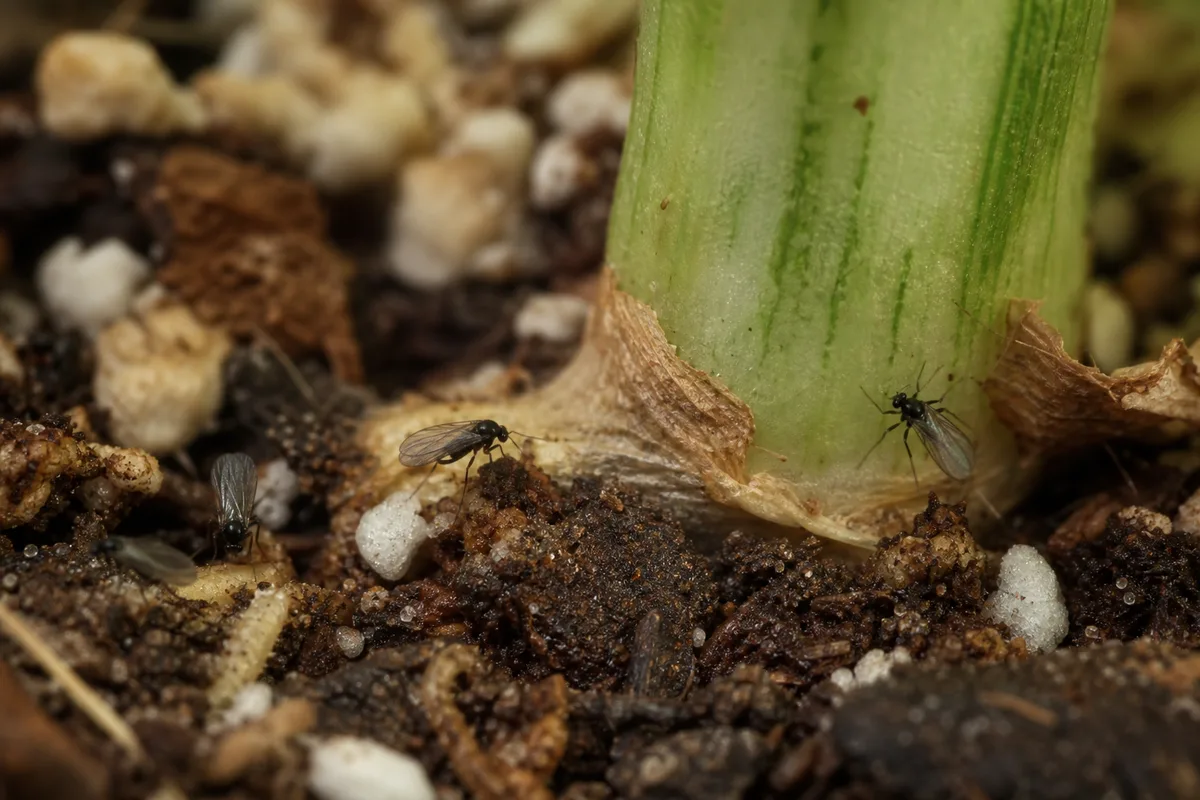
Fungus Gnats symptoms on Dieffenbachia Camille - compare with healthy tissue on the same plant.
Adults around the pot
Small dark flies, roughly 1/8 inch long, hovering near the soil surface - especially when you water or tap the pot rim. They are weak fliers compared to fruit flies and tend to stay close to moist mix rather than swarming the kitchen. Colorado State Extension describes fungus gnats as small, delicate-bodied flies that develop in the growing medium of houseplants.
Trap placement reference: Lay a yellow sticky card horizontally just above the cream-colored pot rim or flat on the soil surface beside the cane - adults rise from the wet layer and stick on contact. One card per pot is enough to monitor trend, not to end the infestation alone.
Larvae in the top inch of mix
Peel back the top layer gently and you may see translucent white worm-like larvae in the upper 1–2 inches of mix. Larvae usually occupy the top 2 to 3 inches of growing medium, depending on moisture. A potato wedge pushed an inch into damp soil and checked after a few days can confirm active larvae - if present, small white maggots cluster on the cut surface.
What Camille damage looks like (often paired with yellow lower leaves)
Pure gnat pressure on a healthy, correctly watered Camille is usually mild: annoying flies, maybe slight slowdown, but firm upright canes and stable cream-centered upper leaves. Larvae feed on fungi and decay first; root chewing becomes more concerning when soil never dries.
The dangerous pattern is gnats plus yellowing lower leaves, limp panels, and a heavy pot that stays wet days after watering. That combination points to chronic overwatering and possible cane stress - not a pest you can trap away. UConn’s Dieffenbachia factsheet notes evenly moist soil and bright filtered light as baseline needs - chronically wet mix violates the first requirement even when flies are the symptom you notice first.
Gnats only vs. overwatering crossover on Camille
| Sign | Gnats only (moisture fix) | Gnats + overwatering / cane stress |
|---|---|---|
| Adult flies | Few to moderate; drop after dry-down | Persistent swarm even as surface dries |
| Pot weight | Lightens noticeably between drinks | Stays heavy days after watering |
| Cane bases at soil | Firm, dry-feeling tissue | Soft, brown, or hollow |
| Lower leaves | Stable or normal aging drop | Yellowing spread on wet mix |
| Surface mold | Clears after scraping + dry-down | Returns within days |
| First action | Dry top inch, traps, BTI if needed | Overwatering + root rot inspection |
If canes are firm, crown leaves look normal, and only flies annoy you after a corrected dry-down, you are still in standard gnat recovery - not emergency surgery.
Lookalike insects to rule out
Not every small fly near your Camille is a fungus gnat:
| Insect | Where you see it | Key difference on Camille |
|---|---|---|
| Fungus gnat | Hovering over damp potting mix when watering | Weak fliers tied to wet soil surface |
| Fruit fly | Kitchen, compost, fallen fruit - may visit any plant | Attracted to fermenting organic matter, not primarily soil moisture |
| Shore fly | Greenhouse or very wet saucers with algae | Stockier body; breeds on algae film, not just potting mix |
If flies appear within a day of watering and largely disappear after the top inch has been dry for a week, fungus gnats on wet Camille soil are confirmed.
Confirm fungus gnats in five checks
Work through these before repotting or spraying:
- Finger the top inch. If it feels cool and clings to your skin days after the last drink, overwatering or slow dry-down is confirmed - gnats are expected in that environment.
- Lift the pot. A heavy feel long after watering means saturated mix. Compare weight to how the pot felt when you last watered thoroughly; the watering guide pot-weight test applies here.
- Tap the rim. Disturbing the surface should send adult gnats flying if present. None flying from bone-dry mix for a week points elsewhere.
- Inspect cane bases at soil level. Firm, dry-feeling tissue supports a moisture-and-gnat fix. Soft, brown, or collapsing lower stems mean investigate root rot - not traps alone.
- Check for mold and fallen leaves. Fuzzy white or gray patches on the surface, plus decaying Camille lower leaves, share the same wet-soil cause as larvae. See mold on soil if both appear.
Confirmed fungus gnats mean small flies tied to chronically moist top mix, larvae in the upper inch when you look, and improvement when that layer dries - not a single fly after one heavy watering mistake.
First fix: dry the surface and fix watering rhythm
Stop watering until the top inch of mix is dry and the pot has lost noticeable weight. This single pause is the first fix - not sticky traps, not BTI, not repotting. Letting the top 1–2 inches of soil dry completely before watering again disrupts the gnat life cycle, because larvae cannot survive in dry soil and egg-laying females prefer moist mix.
Then align rhythm with Camille’s actual placement:
- Summer active growth near filtered light: often every seven to ten days when the top inch dries.
- Winter or dim corners: often every fourteen to twenty-one days - verify with finger and weight, not memory.
- After every drink: empty the saucer within thirty minutes; never let the pot sit in a cachepot full of runoff.
Move Camille slightly closer to bright filtered indirect light if the surface has stayed damp more than ten days - not direct sun that bleaches cream centers, but enough brightness that the mix cycles between moist and dry. Remove fallen lower leaves from the soil surface so they stop feeding larvae.
Wear gloves when handling damp mix or trimming near the cane. Dieffenbachia sap contains calcium oxalate crystals that irritate skin; disturbing wet soil near the base exposes cut tissue to moisture that can worsen rot. Floor-level Camille pots near pets or toddlers carry an extra placement risk - Dieffenbachia is toxic to dogs and cats when chewed, independent of any pest treatment. Keep BTI granules and disturbed soil out of reach; wash hands before handling pets after soil work.
Treat larvae and adults (after dry-down)
Only add these once the top inch dry-down is underway - otherwise you treat flies while the soil still invites new eggs.
Yellow sticky traps
Place yellow sticky cards just above the pot rim or laid horizontally on the soil surface. Adults stick on contact, reducing egg-laying. Traps monitor progress; they do not replace drying the mix.
BTI drench
Bacillus thuringiensis israelensis (BTI) - available in products like Mosquito Bits - targets fungus gnat larvae when applied as a soil drench. Colorado State Extension notes that Bti applied as a drench to the growing medium can kill larvae. Mix per label directions, apply to moist (not flooded) top mix where larvae feed, and repeat on the label interval for several weeks to catch overlapping generations. BTI affects larvae, not eggs or adults - dry-down plus traps handle the rest.
What not to use on Camille’s broad smooth leaves
Avoid foliar pesticide sprays on Camille’s broad, smooth, cream-variegated leaves. Water spots and chemical residue show permanently on pale tissue. Pooling spray or drench runoff at the cane base keeps the stem wet and raises rot risk. UF/IFAS Dieffenbachia guidance emphasizes well-drained soil and avoiding waterlogged conditions - keep treatments in the soil layer, not on foliage.
Do not keep the soil constantly moist to “help” a stressed yellowing Camille while gnats persist - that deepens the overwatering cycle gnats signal.
Recovery timeline
Adult counts usually drop within one to two weeks once the top inch stays dry between waterings and traps catch stragglers.
Full control often takes three to four weeks because eggs and pupae in moist pockets hatch in overlapping waves. Adult gnats live about one week and larvae develop over roughly two weeks - plan for more than one generation.
Judge improvement by:
- Fewer flies when you water or tap the pot
- Pot weight cycling lighter between drinks
- Firm new leaves from the crown with stable cream variegation
- No return of larvae in a potato wedge test after dry-down
Old yellow bottom leaves may not re-green; Camille drops aging lower foliage naturally. Recovery shows in new crown growth and firm canes, not cosmetic repair of spent leaves.
When this is overwatering or cane rot - not just gnats
Escalate beyond standard gnat treatment when:
- Lower leaves yellow while mix stays damp and the pot feels heavy days after watering
- Cane bases feel soft or hollow at soil level
- Mix smells sour at the drainage hole even after surface scraping
- Gnats swarm with mold that returns within days of removal
That pattern is chronic overwatering with possible cane or root failure - follow the overwatering protocol and unpot for inspection per the root rot guide if tissue is mushy. Traps and BTI alone cannot save a Camille whose roots have already lost function.
Should you repot during a gnat infestation?
Wait if mix is merely damp and canes are firm. Dry-down, surface scraping, fallen-leaf removal, and BTI after the top inch dries usually resolve mild Camille infestations without disturbing roots.
Repot now if:
- Mix stays waterlogged for weeks despite corrected watering
- Soil smells sour at drain holes or feels spongy throughout
- Cane bases are soft and you need to inspect roots immediately
- Peat has broken down into a dense, never-drying mat
When repotting for rot or failed drainage, discard the old mix - larvae and eggs live in the top organic layer. Move to a slightly smaller pot with fresh perlite-amended mix only after trimming any mushy roots and letting cut surfaces air-dry briefly. Do not upsize “to help drying” - a bigger wet ring often worsens gnats on Camille.
Mistakes that make Camille gnats worse
- Watering on a calendar instead of checking the top inch - especially in winter low light.
- Bottom-watering without ever drying the surface - roots drink while the top inch stays gnat-friendly.
- Adding fertilizer or extra water because cream leaves look limp while soil is already wet.
- Repotting into a larger pot to “help drying” - a bigger wet outer ring often worsens gnats.
- Spraying leaves instead of fixing soil moisture - risks water spots on variegation and wet cane bases.
- Handling soil bare-handed near cut stems - sap irritation plus unnecessary stem moisture.
How to prevent fungus gnats on Dieffenbachia Camille
Long-term prevention is normal good Camille care:
- Water when the top inch dries - detailed in the watering guide with finger, skewer, and pot-weight checks.
- Use well-draining mix with perlite in a pot with open drainage; right-size the container to the root ball.
- Remove spent lower leaves from the soil surface weekly.
- Adjust winter intervals when growth slows - do not keep midsummer frequency in a dim room.
- Scout new purchases. A heavy nursery pot with yellow edges often means roots have been kept too wet; dry the surface before the next drink after bringing Camille home.
- Address mold early. Surface mold and gnats share wet soil - see mold on soil if white fuzz appears.
Yellow sticky traps in problem seasons catch stragglers; a preventive BTI drench is optional on persistently difficult pots but never substitutes for correct dry-down rhythm.
Related Dieffenbachia Camille problems
- Mold on soil - white surface fuzz sharing the same wet-soil habitat as gnats
- Overwatering - heavy wet pot and yellow lower leaves with gnats
- Root rot - soft cane bases and sour mix when gnats signal chronic wet feet
- Yellow leaves - separating gnat-adjacent yellowing from normal lower-leaf drop
- Dieffenbachia Camille overview - cream variegation biology and baseline care
When to use this page vs other Dieffenbachia Camille guides
- Dieffenbachia Camille watering guide - Use for routine moisture checks before assuming fungus gnats is the main issue.
- Dieffenbachia Camille problems hub - Browse all 16 common issues on this species.
- Overwatering on Dieffenbachia Camille - Different entry point when symptoms overlap with fungus gnats.
- Mold on Soil on Dieffenbachia Camille - Different entry point when symptoms overlap with fungus gnats.
- Root Rot on Dieffenbachia Camille - Different entry point when symptoms overlap with fungus gnats.