Wilting on Anubias: Causes, Checks & Fixes
Quick answer
Limp Anubias leaves in a tank rarely mean underwatering-start with a rhizome squeeze test. A firm green rhizome with drooping leaves usually signals emersed melt or shock; a soft, discolored rhizome points to rot from burial, ammonia, or stagnant flow.
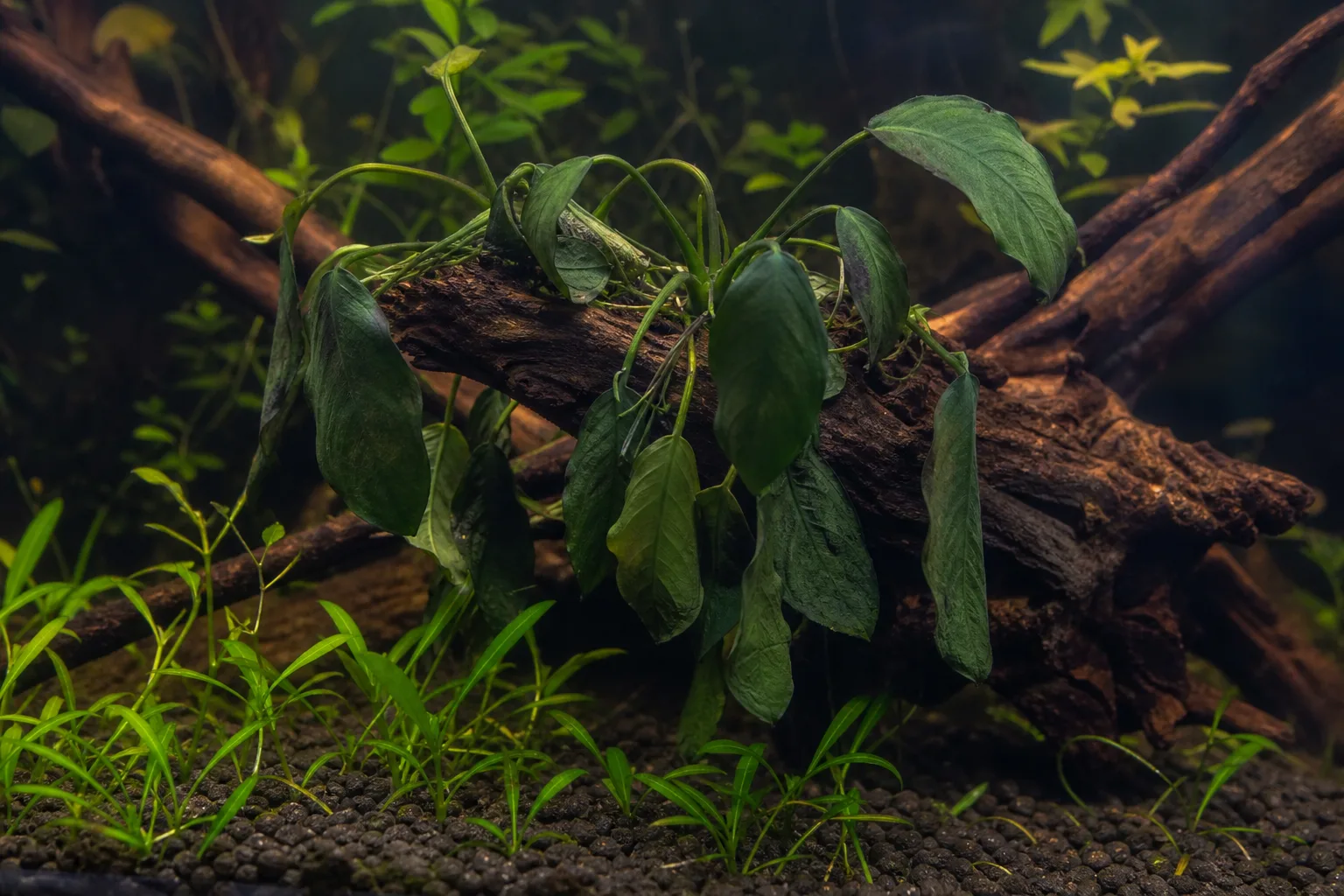
Wilting on Anubias: Causes, Checks & Fixes
This guide covers wilting on Anubias. See also the general Wilting guide, watering, and light pages for this plant.
Wilting on Anubias: Causes, Checks & Fixes
Quick answer
Wilting on Anubias barteri and its cultivars-Anubias nana, Anubias coffeefolia, and related forms-almost never means the plant needs more water in the houseplant sense. Submerged Anubias lives in tank water around the clock. Limp, hanging, or soft-looking leaves usually trace to rhizome health, tank chemistry, flow, or emersed-to-submersed transition, not a dry root ball.
First step: squeeze the rhizome gently with clean fingers. The rhizome is the thick horizontal stem where leaves and roots meet. Firm, green rhizome tissue with limp leaves often means melt or shock-the plant can recover. Soft, squishy, discolored, or foul-smelling rhizome tissue means rot until proven otherwise. Only after that split should you test ammonia, audit flow, or trim leaves.
Why Anubias wilting is not houseplant wilt
Houseplant wilt is about roots failing to pull water from soil-too dry, too wet, or rotted. Anubias is an epiphyte adapted to shaded, fast-flowing forest streams in West and Central Africa/27805), where it clings to rock and wood with the rhizome exposed to moving water. In aquariums it follows the same rule: the rhizome must stay above substrate; only roots may sit in gravel or sand.
Because Anubias grows slowly-often one new leaf every two to four weeks-each leaf stays in place for months. Stress shows up as limp tissue that does not spring back, not as a quick afternoon droop that recovers overnight. That slow turnover also means limp leaves can linger long after you fix water quality, which frustrates keepers who expect instant rebound.
Tank water is always present, so “underwatering on Anubias” in the terrestrial sense does not apply unless the plant was left emersed to dry out during shipping or a tank drain. For fully submerged stock, look at oxygen at the rhizome, ammonia during cycling, burial in substrate, and stagnant pockets behind hardscape before assuming a watering mistake.
What wilting looks like on Anubias
Emersed melt and post-shipment shock
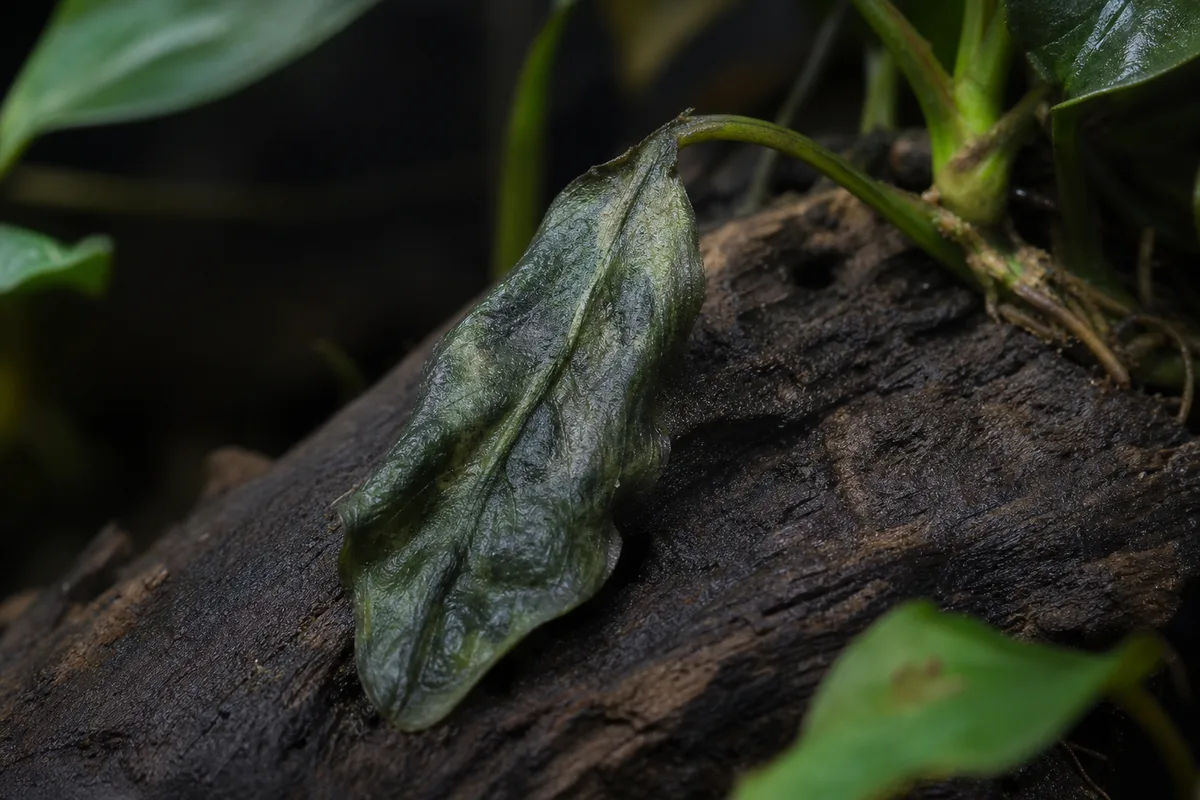
Wilting symptoms on Anubias - compare with healthy tissue on the same plant.
Most store Anubias is grown emersed (above water) at nurseries, then sold for submersed tanks. Old emersed leaves have a waxy cuticle built for air; underwater they often turn soft, translucent, or limp before the plant builds smaller submersed leaves. Melting does not always happen with Anubias because it is such a slow grower, but when it does, the rhizome stays firm and green while older leaves sag and detach.
Tissue-culture (in-vitro) stock often skips the dramatic melt window because it was raised submerged from the start-limp leaves on a TC cup more often mean shipping shock, light change, or a buried rhizome after planting, not classic emersed transition. Emersed-grown pots are the group most likely to look wilted for four to eight weeks while submersed leaves replace nursery foliage.
This pattern is common one to three weeks after purchase, after a long shipment, or following a large parameter swing. Leaf stalks may yellow from the tip inward. The plant looks wilted even though tank conditions are acceptable.
Rhizome rot with limp leaves
Rot is the dangerous mimic. Leaves go limp because the rhizome loses structural integrity. Infected rhizomes feel mushy, may show jelly-like discoloration, and can smell foul. Leaves from rotting sections often detach at the stalk base with soggy ends. Roots growing from the affected zone brown and dissolve.
The top trigger is burying the rhizome in substrate-if planted on the bottom, the rhizome must not be covered because it tends to rot. Tight thread, excess glue on rhizome tissue, ammonia exposure in uncycled tanks, and dead zones with no flow all push the same outcome.
Ammonia and nitrite stress during cycling
Anubias cannot outgrow ammonia spikes the way fast stem plants sometimes can. Slow growth limits ammonia uptake/27805), leaving tissue vulnerable while a new tank establishes nitrifying bacteria. UF/IFAS notes that a new biofilter needs six to eight weeks to reduce ammonia and nitrite effectively. In practice, wilting or melting Anubias added on day one of an uncycled tank often tracks elevated ammonia or nitrite, especially combined with a partially buried rhizome. Leaves may limp tank-wide without a localized soft spot at first.
Flow stagnation and temperature shock
Wild Anubias lives as a rheophyte in rushing water-plants restricted to swift rivers and flash-flood zones. Stagnant water behind stacked driftwood lets detritus and biofilm coat slow-growing leaves and suffocates rhizome tissue. Leaves look droopy and dull; algae may follow.
Sudden temperature drops or hot spikes during water changes also reduce turgor. Anubias tolerates a wide band-Dennerle lists 22–28°C as optimum for Anubias barteri/27805)-but rapid swings stress tissue faster than a stable reading slightly outside the ideal.
High light and CO2 stress
Anubias is built for low to medium light and survives without injected CO2. When it sits directly under intense LEDs for long photoperiods, or when CO2 injection is dialed high while flow is poor, leaves can look limp or translucent from photoinhibition and carbon stress even though the rhizome stays firm. The pattern is often newest leaves hanging lower first, sometimes with pale or bleached patches, while algae coats older blades.
The fix is not more fertilizer-it is shade from hardscape, a shorter photoperiod, and stable CO2 only if you already run injection. Cross-check light placement in our Anubias light guide before treating limp foliage as rot.
Lookalikes: algae weight and physical damage
Heavy green spot algae or black beard algae on thick leaves adds weight and makes foliage hang lower without true wilt-rhizome stays firm and leaves feel leathery, not translucent. A crushed leaf from fish, snails, or rough handling wilts locally while neighbors stay rigid. Shipping bruises one stalk while the rest of the clump is fine.
| Pattern | Rhizome feel | Water tests | Likely cause |
|---|---|---|---|
| Limp emersed leaves, firm rhizome, recent purchase | Firm, green | Ammonia/nitrite 0 ppm | Emersed melt or acclimation |
| Limp leaves spreading from one end | Soft or discolored at that end | Any ammonia/nitrite | Rhizome rot (often burial) |
| Whole plant limp in new tank | May stay firm briefly | Ammonia or nitrite above 0 | Cycling stress |
| Droopy but leathery leaves, algae visible | Firm | Normal | Algae load, not vascular wilt |
| Single limp leaf | Firm | Normal | Physical damage |
| Limp new leaves under bright light, firm rhizome | Firm | Normal | Light or CO2 stress |
How to confirm the cause
Work through these checks in order:
- Rhizome squeeze and burial audit - Lift or inspect without yanking glued plants. Rhizome must sit on top of substrate or hardscape. Any buried section is suspect.
- Ammonia and nitrite test - Use a liquid test kit. For long-term Anubias tanks, aim for 0 ppm ammonia and 0 ppm nitrite. In a new tank, a reading of 0.25–1.0 ppm ammonia with 0 ppm nitrite on week one is common while bacteria establish-partial water changes and patience beat relocation during that window.
- Days since purchase or major change - Melt timeline of four to eight weeks is normal for emersed stock adapting to submersed growth, matching guidance in our Anubias overview FAQ on yellowing after setup.
- Flow check - Drop a small flake or watch detritus after feeding. If particles sit on Anubias leaves for many minutes while open water clears, reposition the plant or redirect filter outflow.
- Temperature log - Note heater failures, cold tap dumps, or summer room heat. Match change water within about 2°F (1°C) of tank temperature.
- Light and CO2 audit - Confirm the plant is not directly under the brightest zone of the tank and that photoperiod is not excessive for a slow grower.
- Leaf tissue feel - Translucent, melting tissue with firm rhizome differs from leathery algae-coated droop. Smell the rhizome only if rot is suspected-healthy tissue has no foul odor.
Cross-check overlapping symptoms on our yellow leaves on Anubias and drooping leaves on Anubias pages when color change accompanies limpness.
First fix for wilting Anubias
If any part of the rhizome is buried or pressed into substrate, expose it immediately. Gently lift the rhizome onto rock or wood, leave roots in gravel if needed, and do not cover the rhizome when planting on the bottom. That single correction fixes a large share of wilting cases without stacking other interventions.
After exposure-or if the rhizome was already correct-pick one secondary action based on what you confirmed:
- Ammonia or nitrite above 0: Stop adding fish food excess, perform partial water changes with matched temperature, and finish cycling before expecting recovery. See Anubias water parameters for ammonia limits and change rhythm.
- Firm rhizome, recent purchase, melting emersed leaves: Trim limp leaves at the rhizome with sharp scissors. Wait for submersed leaves; do not fertilize heavily or relocate daily.
- Soft rotting rhizome section: Cut away all mushy tissue with a sterile blade until only firm green remains, then reattach to hardscape. Advanced rot may not respond to chemicals; removal of infected tissue is the practical first step.
- Stagnant flow: Angle filter output or move the plant to mid-current-not direct blast-so leaves flutter gently.
- High light or CO2 stress: Move the plant to shade, shorten photoperiod, and stabilize injection before changing fertilizer.
Do not bury the rhizome deeper to “prop up” limp leaves, dose extra fertilizer during an ammonia spike, or tear the plant off hardscape repeatedly in one week.
Recovery timeline
Emersed melt with a firm rhizome: Expect four to eight weeks before a consistent crop of submersed leaves appears. Old limp leaves will not re-firm; they drop or stay limp until trimmed.
Rhizome exposure after partial burial: Stability often shows within one to two weeks-no new soft spots, no spreading smell. First new leaf may take two to six weeks because of Anubias’s slow growth.
Cycling-related wilt: Leaves may stay limp until ammonia and nitrite read 0 ppm for several days. Full aesthetic recovery can take a month or more after the cycle completes.
Active rhizome rot: Soft tissue does not heal. Success means the cut-back rhizome stays firm and produces one new leaf. If rot crosses the whole rhizome, salvage is unlikely-compare with root rot on Anubias when decay spreads through roots and rhizome together.
Light or CO2 stress: Once intensity drops, limp new leaves often stabilize within one to two weeks; older damaged blades may still need trimming.
Judge improvement by firm rhizome + new leaf from the rhizome, not by old leaves standing upright again. A healthy rhizome can produce new leaves within two to three weeks after planting even when older foliage melts.
What not to do
- Do not treat limp Anubias like a dry houseplant. Adding more “watering” logic or misting emersed leaves in a submerged tank misses the epiphyte diagnosis.
- Do not bury the rhizome to stabilize drooping foliage. Covering the rhizome causes rot on this species.
- Do not dump fertilizer into an uncycled tank because leaves look weak-ammonia and excess nutrients stress slow growers first.
- Do not pull a glued rhizome off wood repeatedly to inspect underneath; one careful lift after a gentle wiggle is enough.
- Do not assume all limp leaves mean death. A healthy rhizome can produce new leaves within two to three weeks after planting even when older foliage melts.
When to worry
Escalate beyond watchful waiting when:
- The rhizome turns soft, smells rotten, or shows spreading jelly-like discoloration
- Ammonia or nitrite stays above zero while leaves collapse in a cycled tank
- Every leaf limps within weeks despite firm rhizome, good flow, and zero ammonia-reinspect for hidden buried sections or chronic cold water
- No new submersed leaf after six to eight weeks post-melt with confirmed good placement
For a firm rhizome with limp nursery leaves in the first two months, trimming and stable care is enough urgency-this species recovers slowly but reliably when the stem stays healthy. If rot spreads after surgical cuts, ask your local fish store or an aquascaping forum for a second opinion before discarding rare cultivars.
How to prevent wilting next time
Mount Anubias on hardscape from the start using thread or gel glue on roots and rhizome ends-not across the entire rhizome. Attach to stone or driftwood for best results. Cycle new tanks or use established filter media before adding slow epiphytes. Keep gentle flow across the rhizome, perform weekly partial water changes per our Anubias watering guide, and trim melting emersed leaves promptly so decay does not invite bacteria onto the rhizome.
When buying, prefer specimens with firm rhizomes and avoid pots with the rhizome already buried under wool. After shipping, float or quarantine in cycled water before final placement to reduce shock. TC cups adapt faster but still need the rhizome exposed after planting.
Anubias care cross-check
| Topic | Where to read next |
|---|---|
| Rhizome rule, melt FAQ, species traits | Anubias care overview |
| Ammonia, flow, temperature, water changes | Anubias water parameters |
| Rhizome decay and mushy tissue | Root rot on Anubias |
| Yellowing with or without limp leaves | Yellow leaves on Anubias |
| Drooping without full wilt language | Drooping leaves on Anubias |
| Light placement and photoperiod | Anubias light requirements |
Conclusion
Wilting on Anubias is a rhizome-first diagnosis, not a watering emergency. Squeeze the stem, separate firm green tissue from mushy rot, test ammonia in new tanks, and audit flow and light before reaching for fertilizer. Limp old leaves rarely re-turgore on this slow epiphyte-trim them, stabilize placement, and judge success by the next leaf from the rhizome, not by yesterday’s foliage standing tall again.
When to use this page vs other Anubias guides
- Anubias watering guide - Use for routine moisture checks before assuming wilting is the main issue.
- Anubias problems hub - Browse all 16 common issues on this species.
- Underwatering on Anubias - Different entry point when symptoms overlap with wilting.
- Overwatering on Anubias - Different entry point when symptoms overlap with wilting.
- Root Rot on Anubias - Different entry point when symptoms overlap with wilting.