Anthurium Fertilizer Guide: Bloom-Boosting NPK, Schedule
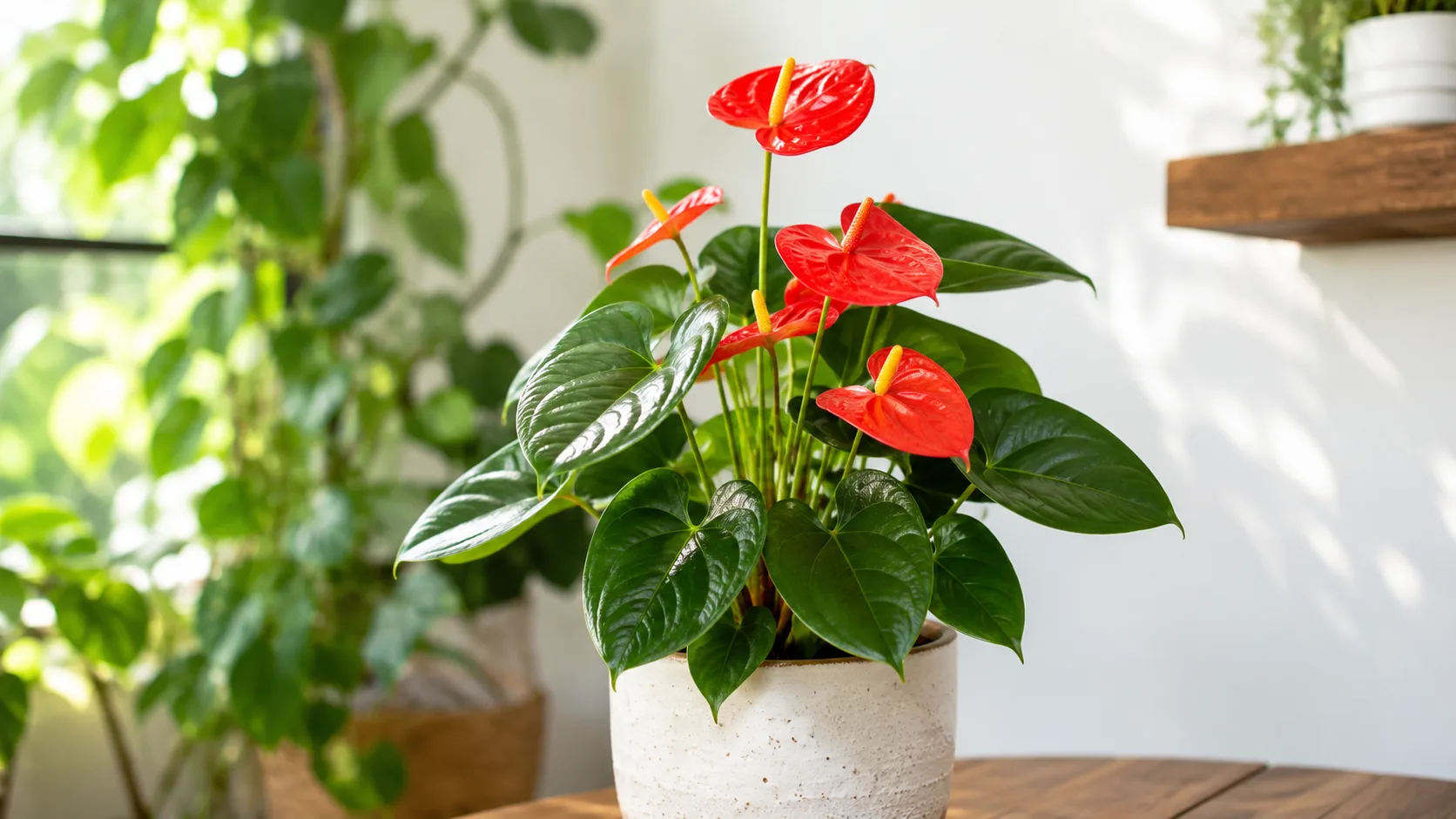
Anthurium Fertilizer Guide: Bloom-Boosting NPK, Schedule, and What to Avoid
Anthurium Fertilizer Guide: Bloom-Boosting NPK, Schedule, and What to Avoid
Anthurium andraeanum, the waxy red, pink, or white “flamingo flower” sold by the millions as a houseplant, is a forgiving plant in many ways but a surprisingly strict eater. The biggest difference between an Anthurium that pushes out four to six spathes a year and one that sits there with glossy leaves and no flowers is almost always light, but right behind light sits fertilizer: the right NPK ratio, at the right dilution, on the right schedule, applied to a properly moist root system. The wrong feed, the wrong dose, or the wrong season can undo months of careful watering in a single application.
This guide walks through the science and the practice of feeding anthuriums, drawing on the University of Florida IFAS Extension interiorscape production guidelines, the Missouri Botanical Garden plant finder entry, the Royal Horticultural Society’s anthurium growing advice, peer-reviewed work on Anthurium andraeanum nutrient solutions, and the day-to-day experience of aroid and orchid collectors. The goal is a single, complete routine you can follow with a $15 bottle of liquid fertilizer and a watering can.
Why Anthurium Fertilizer Is Different From a Generic Houseplant Feed
Most general-purpose houseplant fertilizers are designed for foliage plants in soilless potting mix. Anthurium is a tropical aroid, related to philodendrons and monsteras, and its feeding biology looks more like an orchid’s than a pothos’s. In the wild, Anthurium andraeanum grows as an epiphyte or terrestrial herb in the mountain forests of Colombia and Ecuador, where its roots thread through leaf litter, moss, and bark rather than rich loam. The plant evolved to pull small, steady amounts of nutrients from a fast-draining, low-organic medium, and it never developed a tolerance for the salt concentrations a tomato or a rose bush happily drinks.
That single fact explains almost every feeding rule that follows. Anthuriums:
- absorb nutrients efficiently from low concentrations, so heavy doses are wasted and damaging
- prefer nitrate and ammoniacal nitrogen over urea, because urea requires microbial breakdown the root zone cannot always supply
- sit in coarse, airy mixes that leach quickly, so small frequent doses outperform large monthly doses
- store reserves in thick stems and leaves, so they can coast through a true rest period without feeding
The UF/IFAS Extension’s ENH956 commercial production guide for interiorscape anthurium spells out the practical consequence: target a 3-1-2 N-P₂O₅-K₂O ratio during the vegetative phase, then shift to 1-2-2 to promote flowering, and treat any soluble-salt reading above roughly 2 dS/m (deciSiemens per meter) as a clear signal to cut back or flush. The Missouri Botanical Garden’s plant finder entry makes the same point in lay terms: keep the medium consistently moist, but never let fertilizer salts accumulate, and refresh the soil every couple of years to drop the mineral load.
What an Anthurium Actually Needs From Fertilizer (NPK + Micros Explained)
A complete anthurium fertilizer delivers the three macronutrients (nitrogen, phosphorus, potassium), the three secondary nutrients (calcium, magnesium, sulfur), and a panel of micronutrients (iron, manganese, zinc, copper, boron, molybdenum). Many cheap fertilizers skip the micros. On an anthurium, that omission shows up as interveinal chlorosis (yellowing between green veins) on the newest leaves long before the older growth suffers, because the plant cannot move iron and zinc out of old tissue into new growth.
The Role of Nitrogen, Phosphorus, and Potassium
Nitrogen drives leaf and stem growth. Phosphorus drives root development, energy transfer, and the metabolic steps that lead to flower bud initiation. Potassium drives stomatal function, sugar transport, color in the spathe, and overall stress tolerance. On an aroid, the practical balance that decades of grower experience and the UF/IFAS research support is roughly three parts nitrogen to one part phosphorus to two parts potassium during the leafy growth phase, dropping nitrogen and raising phosphorus once the plant is mature enough to bloom. Skewing too hard in any direction causes specific problems. Too much nitrogen gives you a glossy, dark-green plant that refuses to flower. Too much phosphorus locks out iron and zinc, which shows up as yellow new growth even in bright light. Too little potassium produces weak stems, dull flower color, and slow recovery from any stress.
Why Calcium, Magnesium, and Trace Elements Matter
Calcium strengthens cell walls and root tips; without enough of it, new leaves come out twisted or cupped. Magnesium is the central atom of the chlorophyll molecule, so deficiency shows up as yellowing between the veins of older leaves first. A 4:1 calcium-to-magnesium ratio is the working target for most aroid mixes, which is one reason MSU Orchid Fertilizer 13-3-15 (which contains 8% calcium and 2% magnesium) lines up so well with anthurium needs. The trace elements, especially chelated iron, zinc, manganese, and boron, are needed in tiny amounts but their absence quickly stalls growth. A “urea-free” claim on the label is worth checking for, because urea has to be broken down by microbes before plants can use it, and aroid mixes in pots are not biologically rich enough to do that job reliably.
Choosing the Right NPK: 3-1-2 vs 1-2-2 vs Bloom Boosters
The single most useful decision framework for anthurium feeding is the two-phase model promoted by the UF/IFAS Extension guide: vegetative phase at a 3-1-2 ratio, then a deliberate shift to 1-2-2 when the plant is ready to flower. The Royal Horticultural Society’s anthurium guidance and the University of the West Indies’ commercial production notes both describe a similar staged approach.
The Vegetative Phase (3-1-2) and Why Most Growers Start Here
The 3-1-2 ratio, expressed as real-world products like 9-3-6, 12-4-8, or 15-5-10, supplies enough nitrogen to push out new leaves and stems, enough phosphorus for healthy roots, and enough potassium to keep the plant firm and resistant to stress. For most indoor anthuriums, this is the right baseline for the entire active growing season. Switching to 1-2-2 is only useful when the plant has a full canopy of mature leaves, is sitting in good light, and you are actively trying to trigger spathes.
The Bloom Phase (1-2-2) and When Switching Actually Helps
A 1-2-2 ratio, which in real products looks like 4-15-12 or 6-14-7, drops the nitrogen signal and elevates phosphorus. The mechanism is hormonal: high nitrogen keeps cell-division pathways pointed at leaf expansion, while elevated phosphorus tilts the plant toward reproductive growth and the development of flower-bud meristems that mature into spathes. If your anthurium is mature, has at least six healthy leaves, is getting 12 to 14 hours of Anthurium light guide, and has gone four to six weeks without producing a new leaf, switching to a 1-2-2 feed for two to three applications spaced two to three weeks apart is a reasonable trigger. If any of those conditions are not met, the switch will not produce blooms and may make things worse.
Why “Bloom Booster” 0-10-10 or 5-50-17 Can Backfire
Big-box bloom boosters with extreme middle numbers such as 0-10-10, 5-50-17, or 10-52-10 are calibrated for annual flowers and vegetables that fruit heavily in one season. On a long-lived tropical aroid, they tend to cause more problems than they solve. Excess phosphorus binds iron, zinc, and manganese in the root zone, producing a textbook micronutrient deficiency on the newest leaves. They also raise the total salt load faster than the plant can process it. The peer-reviewed study on Anthurium andreanum nutrient solutions published in Scientia Horticulturae found that the best growth and flower yield came from balanced nitrate-rich solutions with moderate phosphorus, not from phosphorus-heavy ones. Aroid-collector communities broadly echo this: skip the bloom booster, use a complete 3-1-2 or 1-2-2 at low strength, and put the energy into light and humidity instead.
The Best Anthurium Fertilizer Picks (Backed by Sources)
Any complete, urea-free fertilizer with a balanced 3-1-2 or 1-2-2 ratio, calcium, magnesium, and a full micros panel can work. The picks below are the ones most consistently endorsed by extension services, aroid collectors, and orchid growers for anthurium-style root systems.
Dyna-Gro Foliage Pro 9-3-6. A liquid concentrate that delivers all 16 essential nutrients, including 2% calcium and 0.5% magnesium, in a urea-free nitrate/ammoniacal formula. The 9-3-6 NPK translates directly to the 3-1-2 vegetative-phase ratio recommended by UF/IFAS, and the 4:1 Ca:Mg ratio is a good match for aroids. It mixes easily and is the most widely used daily driver in the aroid community.
MSU Orchid Fertilizer 13-3-15. Developed at Michigan State University, this water-soluble granular formula was originally designed for orchids but works extremely well on anthuriums because both are epiphytes with similar root biology. It is urea-free, includes 8% calcium and 2% magnesium, and is calibrated for tap or reverse-osmosis water, which removes the need for a separate Cal-Mag supplement. The 13-3-15 NPK runs slightly higher in nitrogen and potassium than the strict 3-1-2 guideline, but performs well across both vegetative and bloom phases in bark-based container media.
Jack’s Classic 20-20-20. A general-purpose water-soluble fertilizer that, when diluted to quarter strength, lands near 5-5-5 - a true balanced feed. It is urea-based, so a touch slower in cold or low-microbial mixes, but cheap, widely available, and reliable for anthuriums that are otherwise doing well.
Farmer’s Secret Anthurium 4-15-12. A phosphorus-forward 1-2-2 liquid formulated specifically for anthuriums, designed to be used in short bursts during the bloom trigger window rather than as a year-round feed.
Osmocote Plus controlled-release granules. Useful for large containers, outdoor patio pots in Zones 11–12, or anyone who forgets to liquid-feed. Apply once at the start of the growing season at the low end of the label rate, and avoid it in small pots where the release curve is harder to control.
Dilution: Why “Quarter to Half Strength” Is Non-Negotiable
Label rates on most houseplant fertilizers are calibrated for plants grown in soilless mix under bright greenhouse light. Indoor anthuriums see roughly a tenth of that light, sit in cooler rooms, and grow in a coarse mix that does not hold much moisture or nutrient reserve. Feeding at full label strength on that plant is the single most common cause of fertilizer burn. The University of Florida IFAS interiorscape guide sets a working target of about 50 ppm nitrogen (parts per million) once a month for finished indoor plants, which is roughly a quarter to a fifth of the rate on most bottle labels. White Flower Farm’s anthurium growing guide recommends the same approach in plain English: feed every other week with liquid houseplant fertilizer diluted to one-quarter strength.
The “weakly, weekly” rule popularized in orchid and aroid circles means the same thing in a different rhythm. Instead of a moderate dose every two weeks, you give a quarter-to-fifth-strength dose with every watering. The total nutrient delivered is similar, but the salt load in the pot at any one moment is much lower. This is the safest method for low-light indoor conditions, for anthuriums mounted in very airy mixes, and for any plant that has ever shown even mild leaf-tip burn. The trade-off is discipline: you have to remember that plain waterings count, and you cannot top up the dose “just this once” without throwing off the whole system.
Fertilizing Schedule by Season (Active Growth vs Dormancy)
Anthuriums do not have a true winter dormancy the way a deciduous tree does, but growth slows sharply when days shorten, light intensity drops, and temperatures fall. Matching feed to that rhythm matters more than matching it to the calendar.
Spring and Summer: The “Weakly, Weekly” or Biweekly Approach
From roughly April through September in the Northern Hemisphere, an anthurium in active growth should be fed on a steady cadence. Two practical schedules both work:
- Biweekly at half to quarter strength: Apply a 3-1-2 liquid like 9-3-6 diluted to one-quarter of the label rate every 14 days. Plain water between feeds keeps salts from accumulating.
- Weakly, weekly at very dilute strength: Apply the same fertilizer at one-eighth to one-fifth of the label rate with every watering. Skip the dose on the watering after a flush.
If you are trying to trigger a bloom cycle, switch to a 1-2-2 feed for two to three applications spaced two to three weeks apart once the plant has six or more mature leaves, then return to 3-1-2 once spathes appear.
Fall and Winter: When to Stop or Sharply Reduce
From roughly October through March, growth slows. The plant will still take up some nutrients, but the demand is far lower than in summer. Continuing to feed at summer rates is the surest way to end up with leaf-tip burn in January. Drop to half the summer cadence, switch to a 4-6 week interval, or stop fertilizing entirely for a 4 to 6 week cool rest period. If the plant is sitting under supplemental LED lighting that keeps the photoperiod at 12+ hours per day, it will keep growing and you can continue a reduced weekly or biweekly schedule. If it is in a low-light corner, stop feeding until you see new growth resume in spring.
The Application Method That Prevents Root Burn
The order of operations matters. Never apply fertilizer to dry media. Salts move into root tissue much faster when the surrounding mix has no moisture to buffer them, and a single dose onto bone-dry roots is often enough to scorch tips across the whole plant. Water the plant normally the day before, or at least an hour before, so the medium is damp. Then pour the diluted fertilizer solution slowly over the entire surface until about 10% of the volume runs out of the drainage holes. That runoff is what carries excess salts out of the pot rather than letting them re-crystallize on the surface.
A few additional habits pay off:
- Use room-temperature water. Cold water shocks the roots and slows uptake.
- Pour over the soil, not the leaves or open blooms. Wet blooms spot and rot; wet crowns can invite fungal issues.
- Skip the dose if the plant is dry, wilting, recently repotted, or has visible leaf damage you have not diagnosed. Diagnose first, then resume feeding.
- If you are using a fertilizer that has been sitting mixed for more than a week, discard it. Microbial growth in dilute fertilizer solutions is fast and inconsistent.
Signs of Over-Fertilization (and Exactly What to Do)
Fertilizer burn on anthuriums is recognizable once you know the pattern. The most common symptoms, in order of how quickly they appear:
- Brown, crispy leaf tips and margins. The classic first sign, caused by salts accumulating in the vascular tissue at the leaf edge.
- White or tan crust on the soil surface or pot rim. Mineral salts precipitating out of the solution as it evaporates.
- Sudden wilting right after feeding. The roots have been chemically burned and cannot move water fast enough to keep up with transpiration.
- Yellowing older leaves combined with dark, healthy new growth. Often a sign of nitrogen excess pushing fast top growth that the roots cannot support.
- Leaf drop after a feeding. A late and serious symptom of root burn.
- Stunted or deformed new leaves. Often a micronutrient lockout from too much phosphorus binding iron and zinc.
If you catch any of these, the immediate move is the same: flush the pot thoroughly, then pause feeding. Details of the flush are in the next section. After flushing, hold off fertilizer for 6 to 12 weeks, longer if root damage was severe, and resume at a lower strength than you used before. The plant will not replace burned leaves, but the next round of new growth is your cleanest signal that the salt load has dropped back to a safe level.
How to Flush Anthurium Soil the Right Way
Flushing is not a synonym for watering heavily. It is a deliberate procedure to dissolve and wash out accumulated fertilizer salts. Done right, it takes about five minutes per pot and should be done preventively once a month during the active growing season in addition to any time you see burn symptoms.
- Move the pot to a sink, bathtub, or outdoors where drainage water can run freely.
- Use room-temperature, unsoftened water. Water softeners add sodium, which is the last thing a salt-stressed root system needs.
- Pour slowly over the entire surface, equal to roughly two to three times the volume of the pot. A 6-inch pot needs about a quart to a half gallon of water to flush effectively.
- Let it drain fully. Do not let the pot sit in the runoff; reabsorbed salts defeat the purpose.
- Wait 10 to 15 minutes, then repeat once. The first pass dissolves the salts; the second carries them out of the root zone.
- Allow the pot to drain for 20 to 30 minutes before putting it back in its saucer or decorative cachepot.
- Skip the next scheduled feeding and resume at a lower concentration when growth confirms recovery.
The UF/IFAS extension guidance for commercial anthurium production takes this a step further with a pour-through test: water the pot to collect, then measure the leachate’s electrical conductivity (EC) with a $20 meter. A reading between 0.8 and 1.2 dS/m is the target zone. Above 2 dS/m, you are accumulating salts; above 3 dS/m, the plant is in active stress. Most home growers will not run a pour-through test, but the principle is useful: if your pot has a visible salt crust or your plant has burn symptoms, you are well above the safe zone and a flush is overdue.
Organic Options: Worm Castings, Orchid Blends, and Compost
Anthuriums respond well to organic inputs as long as the overall nutrient delivery stays balanced and the salt load stays low. Three organic options are worth considering, often used together rather than as a replacement for a complete feed.
Worm castings are a slow-release organic amendment rich in nitrogen, calcium, magnesium, and beneficial microbes. A top-dress of one to two tablespoons of castings per 6-inch pot, refreshed every three to four months during the growing season, provides a steady background feed that buffers the spikes and dips of a liquid program. They are not, on their own, a complete fertilizer for an anthurium; their NPK is typically around 1-0-0 with low total analysis. Pair them with a dilute synthetic or a weak orchid feed for best results.
Orchid fertilizer blends are an excellent fit for anthuriums because orchids and anthuriums share the same epiphytic root biology, bark-based media, and sensitivity to salt and urea. MSU Orchid Fertilizer 13-3-15 is the most cited option in the aroid-collector world, and Dyna-Gro’s Foliage Pro 9-3-6 is the most common all-around pick. Both work in organic-leaning routines as the primary source of calcium, magnesium, and trace elements, with worm castings providing the biological layer.
Compost and leaf-mold teas can supplement a routine but should not replace a complete fertilizer. A well-made compost tea applied monthly adds microbial diversity and a small amount of nutrients, but the analysis varies wildly and it is hard to know what you are delivering. Use it as a soil drench after the main fertilization, not as a substitute.
A few organic-adjacent options are commonly recommended online but are not great choices. Coffee grounds are acidic and high in nitrogen, but they compact the root zone and mold easily on top of the mix. Banana-peel water is variable, low in total nutrients, and supports microbial growth inconsistently. Eggshell water adds calcium in a form roots cannot readily absorb. Stick with labeled, measured products for the main feed and use organic amendments as a complement.
Common Mistakes to Avoid With Anthurium Fertilizer
Most anthurium fertilizer problems come from a short list of recurring mistakes. Watching out for these saves the plant far more reliably than any specific product recommendation.
- Feeding at full label strength. The single most common error. Indoor anthuriums need quarter to fifth strength, not the rate on the bottle.
- Feeding a dry plant. Always water first, then feed. The moisture buffer in damp mix is what keeps salts from burning roots.
- Feeding in low light. A plant in a dim corner uses very little nutrient. Cut back or stop until you can either move it to brighter light or supplement with a grow light.
- Feeding year-round without a rest. An anthurium without a four to six week break in winter accumulates salts faster than it uses them. Pause or sharply reduce from late fall through early spring.
- Chasing blooms with bloom boosters. A 0-10-10 or 5-50-17 fertilizer does not create blooms on an aroid. It creates micronutrient lockout. Fix the light first, then use a 1-2-2 at low strength.
- Ignoring the pot’s salt load. A white crust on the soil or pot rim is the early warning. Flush the pot once a month during active growth as preventive maintenance.
- Fertilizing a stressed, repotted, or sick plant. Newly repotted anthuriums have damaged root hairs and cannot process nutrients efficiently. Wait four to six weeks, or until you see new growth, before resuming the normal schedule.
- Using softened water. Water softeners swap calcium and magnesium for sodium. Sodium builds up in the root zone and burns the same way over-fertilization does. Use rainwater, reverse-osmosis water, or tap water that bypasses the softener.
- Mixing fertilizer with pesticide or fungicide. The combined salt load is unpredictable. Apply them on different days, at least a week apart.
Conclusion
Feeding an anthurium well is not a complicated recipe, but it is a specific one. A complete, urea-free fertilizer in a 3-1-2 ratio (such as Dyna-Gro Foliage Pro 9-3-6 or MSU Orchid Fertilizer 13-3-15) at quarter to fifth strength, applied on a steady cadence through the active growing season, paused through a cool winter rest, and supplemented with a monthly plain-water flush, will keep the plant glossy, the roots white, and the spathes coming back four to six times a year. Switch to a 1-2-2 feed only when light, leaf count, and a four to six week growth pause all line up, and even then, only for a few applications. Skip the bloom boosters, the coffee grounds, and the banana-peel water, and put the energy you would have spent on those into light, humidity, and an airy mix.
The single most important takeaway is the one the University of Florida IFAS extension service has been telling commercial anthurium growers for decades: more is not better, balance is better, and a slightly underfed plant will always outperform a slightly burned one. Get the NPK and the dilution right, give the plant the rest it needs in winter, flush when salts build up, and the rest of the routine will take care of itself.
When to use this page vs other Anthurium guides
- Anthurium overview - Start here for whole-plant context before deep-diving this topic.
- Anthurium problems hub - Jump to symptom-specific fix guides when this care topic does not resolve the issue.
- No Flowers on Anthurium - Escalate here when fertilizer adjustments are not enough.
Related Anthurium guides
- Anthurium overview
- Anthurium watering
- Anthurium light
- Anthurium soil
- Anthurium propagation
- Anthurium repotting
- No Flowers on Anthurium
- Anthurium problems
Related tool
Try the Fertilizer Dilution Calculator with anthurium pre-selected to estimate needs for your setup.