White Spots on Zinnia: Causes, Checks & Fixes
Quick answer
White spots on zinnia are usually powdery mildew-a dry flour-like film that smears when rubbed and spreads from inner leaves in humid weather. Run the rub test first, then thin crowded plants or isolate seedlings with cottony tufts before spraying anything.
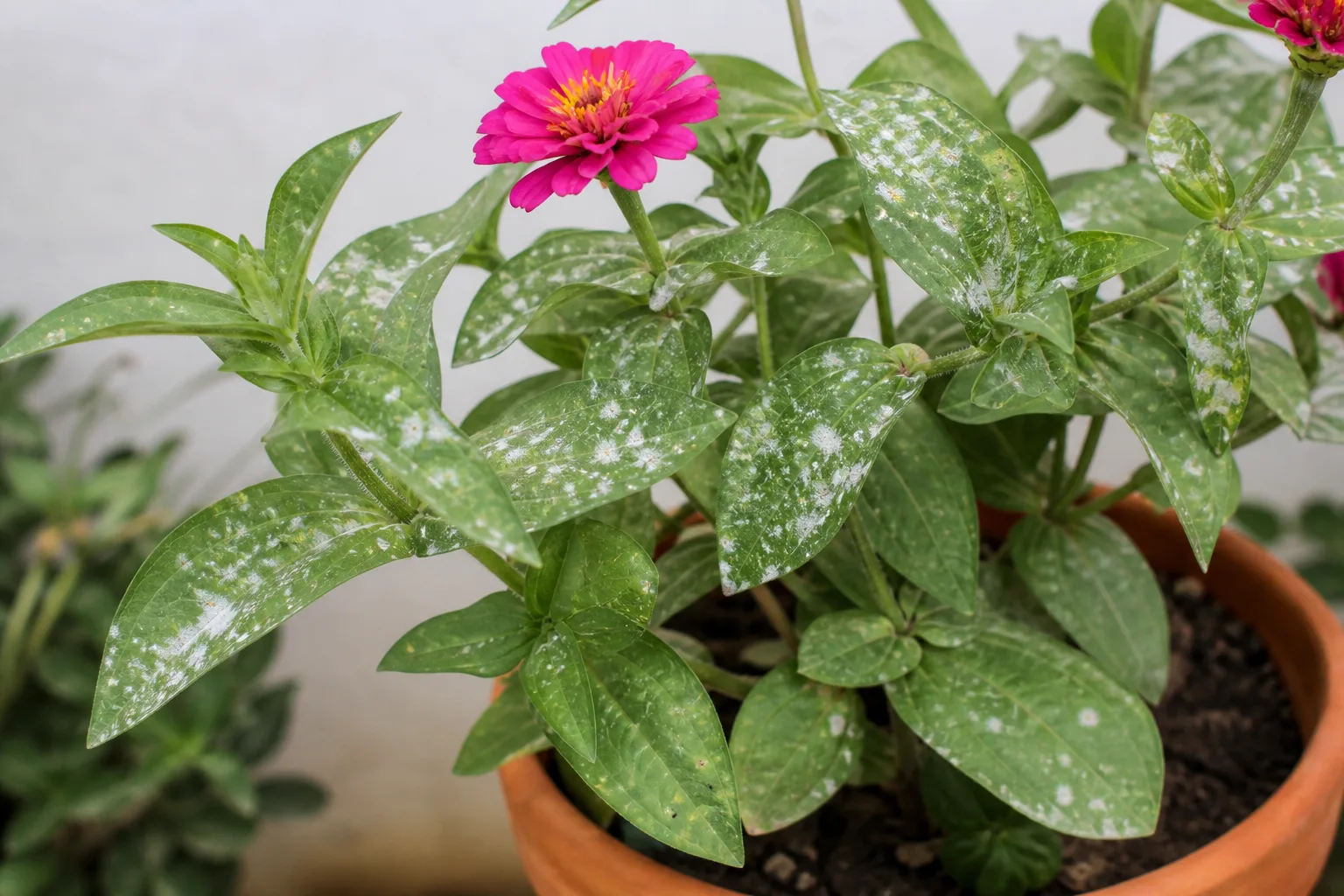
White Spots on Zinnia: Causes, Checks & Fixes
This guide covers white spots on Zinnia. See also the general White Spots guide, watering, and light pages for this plant.
White Spots on Zinnia: Causes, Checks & Fixes
Quick answer
Scope: This page diagnoses white spots on zinnia foliage-whatever the cause. If you already know the problem is powdery mildew and want full spray intervals and resistant-cultivar detail, start on the powdery mildew on Zinnia protocol. If cottony tufts and honeydew point to pests, see mealybugs on Zinnia.
White spots on zinnia leaves most often mean powdery mildew-a dry, flour-like fungal film that starts on shaded inner leaves and spreads outward when beds are crowded and humidity lingers. Less often you will see mealybugs (cottony white tufts in stem joints on indoor seedlings), mineral or hard-water splash (uniform pale dust that wipes off once), or dried pesticide residue (appears right after spraying).
First step: rub one coated leaf with a damp finger. Powdery mildew smears and regrows on the same spots within days. Mealybugs crush to a pinkish smear only when you target a discrete waxy tuft. Mineral dust and spray residue wipe away cleanly without smearing fungal growth.
Once you know which pattern fits, route to the right fix-not every white spot needs fungicide. Confirmed mildew on outdoor beds: thin overcrowded plants and open airflow first, then follow the full powdery mildew on Zinnia protocol. Cottony clusters on seedling flats: isolate and treat per the mealybugs on Zinnia guide before planting out.
White spots on zinnia: leading causes at a glance
| What you see | Most likely cause | Urgency | First action |
|---|---|---|---|
| Flat dry white film on leaf faces; smears when rubbed | Powdery mildew | Manage now; escalate if canopy coats over | Thin spacing; remove worst coated leaves; see powdery mildew guide |
| Raised cottony tufts in stem joints; sticky honeydew | Mealybugs | Act same day on seedling flats | Isolate seedlings; dab clusters with alcohol; see mealybugs guide |
| Uniform pale dust; wipes off once; no spread | Mineral or hard-water splash | Low-cosmetic only | No treatment needed; adjust watering or rinse once |
| Gray fuzz mainly on leaf undersides after wet weather | Downy mildew (uncommon) | Medium-remove before spread | Improve drainage and airflow; remove affected leaves |
| Brown or black spots-not white | Alternaria or Cercospora leaf spot | Medium-scout weekly | See black spots on Zinnia or leaf spot disease |
Why zinnia leaves develop white spots
Garden zinnias (Zinnia elegans and related annuals) push dense summer foliage in full sun. That growth habit creates two different white-spot stories depending on where you grow them.
Powdery mildew (most common)
Powdery mildew is the leading diagnosis when white patches look like the plant was dusted with flour. The fungus Golovinomyces (syn. Erysiphe) cichoracearum produces powdery white spots and blotches on leaves, stems, and flower parts. Spots typically start on lower leaves and can spread to cover the entire plant in humid, stagnant air between crowded stems.
Zinnias in packed cutting-garden rows trap humidity even on sunny days. Large double-flowered heirlooms are more susceptible than compact resistant lines. Late summer-when plants are fullest and nights stay warm and humid-often accelerates spread on inner leaves before outer growth shows symptoms.
Open beds vs. sheltered containers. Mature zinnias in open full-sun beds dry quickly between morning dew and midday heat. The same cultivar grouped in three or four pots on a sheltered porch, against a hedge, or under an eave holds humid air between stems for hours longer. That microclimate is where inner-canopy mildew becomes the default white-spot story-even when the plant tag says “full sun.”
Less common: mealybugs, mineral splash, spray residue
Mealybugs produce localized white wax clusters in protected joints, not a uniform film across open leaf surfaces. They are far more common on greenhouse-started zinnia seedlings and sheltered porch containers than on mature outdoor bed plants in open sun.
Mineral splash from hard water, lime-treated paths, or dusty wind events leaves pale residue that does not spread to new leaves over successive days.
Pesticide or foliar-feed residue appears shortly after application, coats leaves uniformly, and does not smear like living fungal growth.
Downy mildew is rare on zinnias in many regions. When it appears, grayish fuzz sits primarily on leaf undersides after prolonged wet conditions-unlike the dry upper-surface powder of true powdery mildew.
What white spots look like on zinnia
Early signs on lower and inner leaves
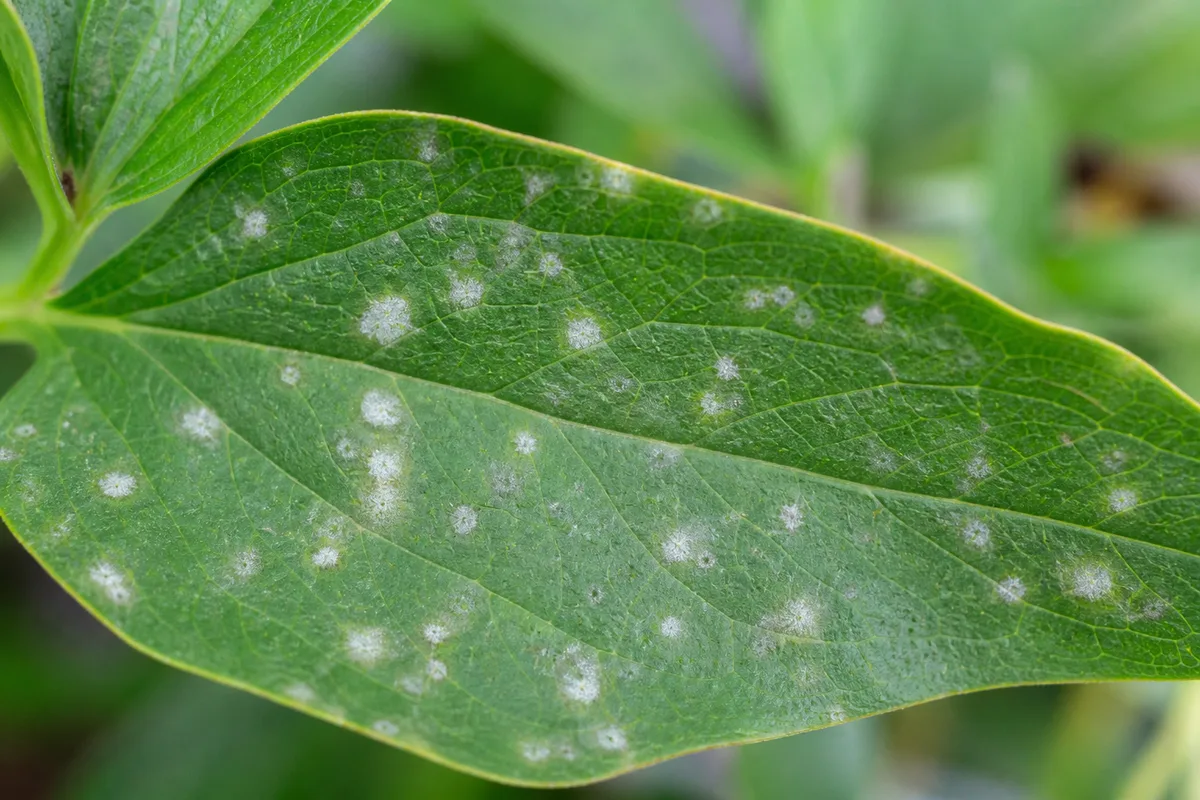
White Spots symptoms on Zinnia - compare with healthy tissue on the same plant.
Powdery mildew often begins as small white circular spots on upper leaf surfaces, frequently on lower or inner leaves where sun and breeze are weakest. Fine white dusting may appear on leaf edges, petioles, and young stems before patches merge.
Mealybugs show up earlier in the season on seedlings as tiny cottony dots tucked where leaves meet stems-easy to miss if you only scan open leaf faces.
Visual confirmation cues (what to look for before the rub test):
- Mildew: Even pinhead-sized white circles on upper leaf faces, often on the shadiest leaves in the row
- Mealybugs: Discrete white cotton balls in leaf axils and stem crotches, not a flat film across the leaf blade
- Mineral dust: Even pale coating across leaf tops after overhead watering or lime splash; no progression to new leaves over several days
Established infection and bloom impact
Heavy powdery mildew coats entire leaves, stems, and sometimes flower parts with thick white growth. Lower leaves may yellow and die from the base upward. Severely affected zinnias lose vigor and bloom size as photosynthesis drops.
Mealybug colonies produce sticky honeydew on leaves below feeding sites, which can turn sooty black. Stunted seedlings with wax coating most of the crown rarely recover enough for a normal transplant.
How to confirm the cause
Work through this six-step checklist before you treat. Each step narrows the diagnosis without lab work.
- Rub test - Lightly rub a coated leaf with a damp finger. Powdery mildew smears and leaves faint residue. Mineral dust or dried spray wipes away cleanly without smearing living fungal growth.
- Location pattern - Mildew usually starts on shaded inner leaves and spreads outward. Cottony tufts cluster in stem joints and leaf axils. Uniform coating across every leaf after a dusty event suggests debris, not fungus.
- Spacing audit - Measure distance between mature stems. Dwarf zinnias need roughly 20–25 cm; tall cutting types need 30–45 cm. Tight spacing strongly supports a mildew diagnosis in humid weather.
- Watering review - Confirm whether sprinkler or hose spray hits foliage in late afternoon. Base watering keeps canopies drier and is part of long-term prevention per the zinnia watering guide.
- Growth context - Indoor seedling flats and crowded six-packs favor mealybugs. Outdoor bed plants in full sun with humid stagnant canopies favor powdery mildew.
- Underside check - Flip a coated leaf. Dry white powder on the upper surface points to powdery mildew. Grayish-purple fuzz primarily on undersides after wet weather suggests downy mildew instead.
If the rub test smears white growth, spacing is tight, and inner leaves led the outbreak, you have enough to act on mildew. If wax sits only in joints with honeydew below, route to the mealybug guide.
Symptom → guide routing decision table
| Your finding | Confirmed cause | Route to |
|---|---|---|
| Smears on upper leaf; spreads from inner canopy | Powdery mildew | Thin first → powdery mildew guide |
| Cottony tufts in axils; honeydew below | Mealybugs | Isolate → mealybugs guide |
| Wipes clean once; no regrowth | Mineral dust | No spray; rinse if cosmetic |
| Gray fuzz on undersides after rainy weeks | Downy mildew (rare) | Remove leaves; improve airflow |
| Brown-gray lesions, not chalky white | Cercospora or Alternaria | Leaf spot disease or blight |
White spots that are NOT powdery mildew
Mealybugs
Mealybugs look like small pieces of cotton wedged into stem joints-not a flat dry film spread across leaf faces. They excrete sticky honeydew, may attract ants, and crush to a pinkish smear when you press a dry swab into a tuft. Outdoor zinnias in open full-sun beds are rarely troubled; the risk window is indoor starts and sheltered containers. Full identification and treatment: mealybugs on Zinnia.
Mineral and hard-water residue
Pale chalky deposits from hard water, lime dust, or wind-blown soil wipe off once and do not return on the same spots within days. They do not yellow leaves progressively or spread from inner canopy outward. No fungicide or insecticide is needed-adjust splash sources if residue is chronic.
Downy mildew (rare)
Downy mildew produces grayish fuzz primarily on leaf undersides and needs prolonged leaf wetness. Zinnia powdery mildew sits mostly on upper surfaces as dry white powder you can smear. If undersides show fuzz after rainy weeks, remove affected leaves and improve airflow.
Spots that are not white at all
Reddish-brown lesions with gray centers point to Alternaria blight. Small roundish gray-centered spots may be Cercospora leaf spot-see leaf spot disease on Zinnia. Neither presents as chalky white film. See black spots on Zinnia when spots darken rather than whiten.
First fix for zinnia
Run the rub test, name the cause, then take one targeted action-do not spray fungicide on day one without a diagnosis.
If mildew confirmed (smears, spreads from inner leaves, tight spacing): Thin overcrowded plants and remove the heaviest powdery-coated lower leaves to open airflow. Bag and trash infected tissue-do not compost it. This single cultural step is the correct first response before any spray. Full spacing targets, spray intervals, and resistant cultivar choices live on the powdery mildew on Zinnia page.
If mealybugs confirmed (cottony tufts in joints, honeydew): Isolate affected seedlings or containers the same day. Dab every visible cluster with a cotton swab dipped in 70% isopropyl alcohol before reaching for broad sprays. Follow the complete protocol on mealybugs on Zinnia.
If mineral dust confirmed (wipes clean, no spread): No treatment needed. Rinse foliage once if appearance bothers you and adjust hard-water splash sources.
Step-by-step recovery
Recovery paths diverge once you confirm the cause.
Powdery mildew path:
- Complete thinning and leaf removal as above.
- Switch to base watering in morning so foliage dries quickly.
- If coating still spreads after airflow improves, apply potassium bicarbonate or horticultural oil on remaining healthy green tissue per label-fungicides protect new growth; they do not erase white coating already on leaves. Avoid oil and bicarbonate sprays in midday heat above label temperature limits.
- Scout weekly and pinch off new infected leaves while spots are still pinhead-sized.
- For severe beds where most leaves are coated and growth has stopped, replanting resistant stock often outperforms endless spray cycles on a spent annual. Details: powdery mildew on Zinnia.
Mealybug path:
- Isolate infested trays or pots.
- Dab visible clusters with alcohol; repeat every three to five days until no new wax appears.
- Apply insecticidal soap on a test leaf first if alcohol alone is insufficient-follow the full sequence on mealybugs on Zinnia.
- Do not plant heavily infested seedlings into garden beds.
Mineral residue path: Rinse once if needed; no follow-up spray cycle.
Recovery timeline
Spacing and leaf removal for mildew show results within several days when humidity drops-new growth should emerge without white coating within one to two weeks if airflow holds.
Spray protection for mildew takes longer: expect one to two weeks of label-interval applications before spread clearly slows. Old powdery leaves stay blemished; judge success by clean new leaves and normal bud development.
Mealybug recovery on seedlings depends on how early you catch colonies. Clean new growth at stem tips within one to two weeks after consistent alcohol dabbing is a good sign. Heavily wax-coated crowns may not be worth saving when zinnia seed restarts quickly.
Mineral dust clears immediately after a single rinse.
What not to do
Do not overhead water to “wash off” mildew-that keeps leaves wet longer and can spread other diseases.
Do not apply fungicide to mealybugs or insecticide to powdery mildew without confirming the cause-wrong treatments waste time while the real problem spreads.
Do not load nitrogen fertilizer on mildew-stressed zinnias; lush young growth is more susceptible to infection.
Do not compost heavily infected zinnia tops. Illinois Extension recommends removing infected plant material at season end rather than adding it to compost. Sanitize snips after cutting coated tissue.
Do not ignore early pinhead spots on inner leaves. Catch mildew when patches are small and removal is easy.
Zinnias are non-toxic to dogs, cats, and horses, but follow label re-entry intervals if spraying outdoors near pets.
How to prevent white spots on zinnia next season
Space at sowing and after germination. Thin direct-sown rows to one strong seedling per 20–30 cm for dwarfs, wider for tall cutting types.
Water at the base in morning. Keep foliage dry to discourage fungal diseases; match zinnia culture to dry foliage habits per the zinnia watering guide.
Choose resistant genetics for humid climates. Profusion, Zahara, and Oklahoma series carry meaningful mildew resistance compared with many large double heirlooms.
Quarantine indoor seed starts for a week and inspect stem joints before transplant-mealybugs travel on shared benches and crowded flats.
Scout weekly from midsummer onward when heat and humidity rise together. Catch white spots when they are still pinhead-sized.
End-of-season sanitation. Rake out infected plant debris at season end without composting coated tissue.
Rotate planting sites in small gardens when possible. Full culture basics: Zinnia overview.
When to worry
Treat as urgent when white coating covers most of the plant, lower leaves yellow and die in sequence from the soil line up, new buds fail while mildew spreads to flower stems, or cottony mealybug clusters blanket a seedling flat days before transplant.
Pull and destroy severely stunted mildewed plants that stopped blooming to reduce spore load on neighboring flowers. Zinnias are inexpensive to restart from seed or resistant transplants mid-season when infection dominates in August.
Low-level white spotting on a few inner leaves in an otherwise blooming row is worth managing but not a crisis. Thin, remove spotted leaves, and monitor.
If cultural fixes and labeled sprays fail across a commercial cutting row or repeated August outbreaks collapse most of the stand, contact your local cooperative extension office for site-specific disease management guidance.
Conclusion - choose your path
| If you find… | Do this first | Do not… |
|---|---|---|
| Pinhead white spots on inner leaves; row still blooming | Thin spacing; remove worst coated lower leaves | Spray fungicide before opening airflow |
| Most leaves coated; buds failing in August | Replant resistant Profusion or Zahara stock | Invest in endless spray on a spent annual |
| Cottony tufts on seedling flat before transplant | Isolate; alcohol-dab every cluster same day | Plant out infested six-packs |
| Pale dust wipes clean; no spread | Rinse once if needed | Treat as fungus or pest |
| Gray fuzz on undersides after wet weeks | Remove leaves; improve drainage | Assume upper-surface powdery mildew |
White spots on zinnia are a routing problem, not a single disease. The rub test tells you whether August calls for thinning, replanting, alcohol dabs, or no action at all-match your next step to smear pattern, location, and how much bloom season remains.
FAQs
Are white spots on zinnia always powdery mildew?
No. Powdery mildew forms a flat dry film on leaf faces that smears when rubbed and regrows within days. Mealybugs leave raised cottony tufts in stem joints with sticky honeydew below. Mineral or hard-water splash wipes off once and does not spread. The rub test and location pattern usually separate these in minutes.
How do I tell powdery mildew from downy mildew on one zinnia leaf?
Flip the leaf. Powdery mildew sits as dry white powder on upper surfaces you can smear with a damp finger. Downy mildew-rare on zinnias-shows grayish-purple fuzz primarily on undersides after prolonged wet weather, not a dry flour-like film on top. If only the upper face powders and smears, treat as powdery mildew per the powdery mildew guide.
What should I check first when zinnia leaves show white spots?
Rub one coated leaf with a damp finger first. If it smears, audit plant spacing and overhead-watering habits before reaching for spray. If wax sits in leaf axils only, inspect crowded seedling flats and neighboring trays for mealybugs. Uniform pale dust after hard water or lime splash wipes clean without smearing.
Should I spray fungicide on day one for white spots on zinnia?
Not before you confirm the cause. Powdery mildew confirmed by smear and tight spacing should get thinning and leaf removal first-cultural fixes often slow spread without spray. Mealybugs need alcohol dabbing on tufts, not fungicide. Mineral dust needs no treatment. Spray only when mildew keeps spreading after airflow improves; full intervals live on the powdery mildew guide.
How do I prevent white spots on zinnia next time?
Space plants for airflow, water at the base in morning per the zinnia watering guide, choose mildew-resistant Profusion or Zahara series for humid climates, quarantine indoor seed starts, and rake out infected debris at season end without composting coated tissue.
Related Zinnia guides
- Powdery mildew on Zinnia - full cultural and spray protocol for confirmed mildew
- Mealybugs on Zinnia - seedling flats, alcohol dabbing, and insecticidal soap
- Black spots on Zinnia - when spots darken to brown or black instead of white
- Leaf spot disease on Zinnia - Cercospora and gray-centered lesions
- Zinnia watering guide - base watering and soil-moisture checks
- Zinnia overview - spacing, sun, and variety selection
- All Zinnia problems
Related tool
Use the Plant Problem Diagnosis Tool to narrow causes for white spots on this plant before changing multiple variables at once.