Leggy Growth on Syngonium White Butterfly: Causes, Checks &
Quick answer
Leggy growth on Syngonium White Butterfly means long bare internodes and small pale leaves from etiolation-White Butterfly needs more light than a solid-green arrowhead vine to stay compact. First step: move to brighter indirect light and acclimate over one to two weeks; prune stretched tips only after new compact growth appears.
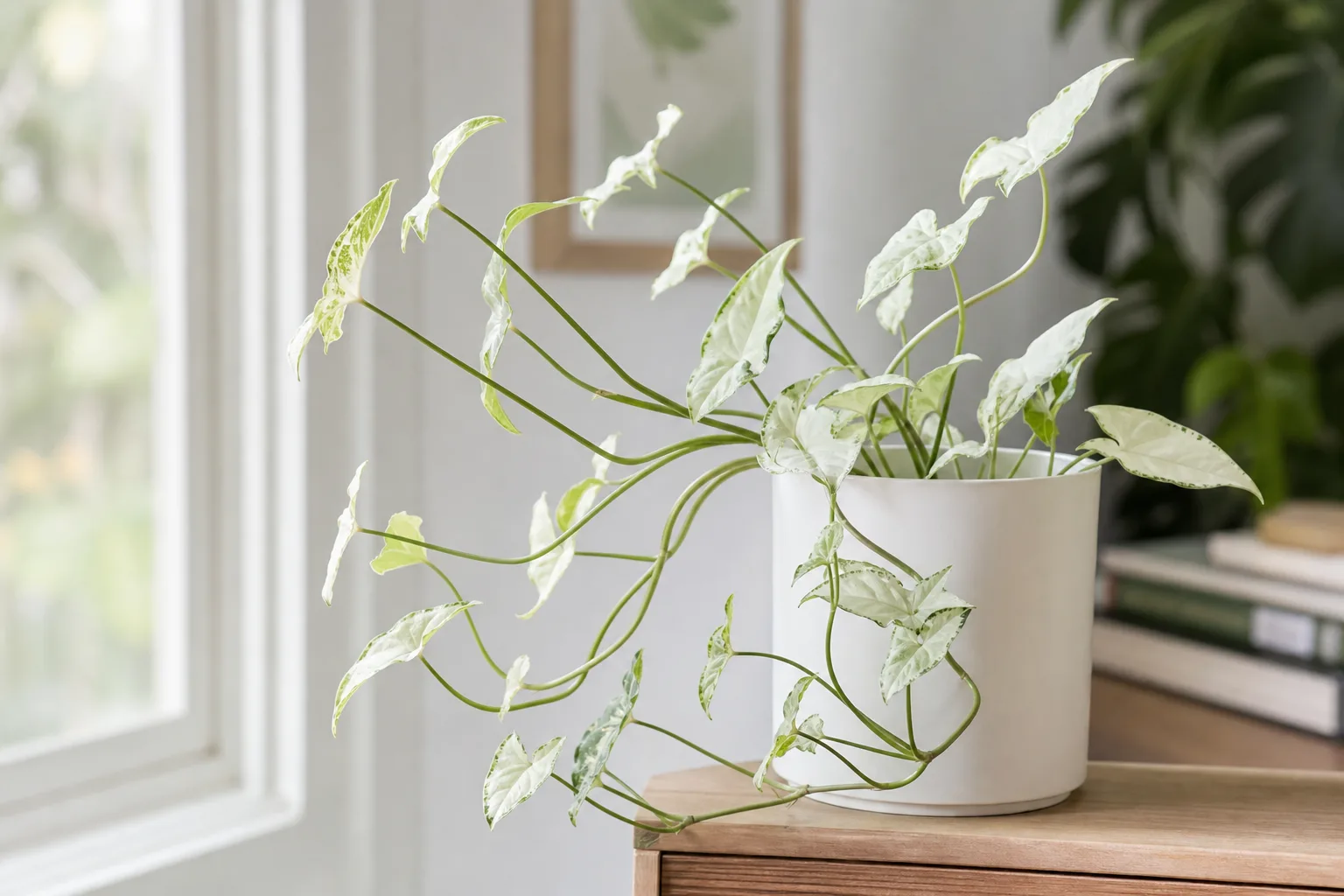
Leggy Growth on Syngonium White Butterfly: Causes, Checks & Fixes
This guide covers leggy growth on Syngonium White Butterfly. See also the general Leggy Growth guide, watering, and light pages for this plant.
Leggy Growth on Syngonium White Butterfly: Causes, Checks & Fixes
Quick answer
Leggy growth on Syngonium White Butterfly (Syngonium podophyllum ‘White Butterfly’) is etiolation-the plant stretching toward usable light because current brightness is too low for its pale variegation. White leaf sectors contain less chlorophyll than green tissue, so White Butterfly needs more brightness than a solid-green arrowhead vine to hold compact form. When light drops, internodes lengthen, leaves shrink, stems lean toward glass, and new foliage often loses crisp white veining.
First step: move the pot to your brightest safe indirect-light location and acclimate over one to two weeks. Do not fertilize, repot, or prune heavily on day one. Better light is the foundation; shape correction comes after the plant shows tighter new growth.
This page covers stretch morphology and pruning timing-how to read internode spacing, tell etiolation from normal vining, and trim elongated stems once light improves. If your main symptoms are dim-room placement, washed-out variegation, and a full light-confirmation workflow, start with our not enough light on Syngonium White Butterfly guide; pruning alone in deep shade cannot restore compact white-veined foliage.
What leggy growth looks like on Syngonium White Butterfly
White Butterfly starts compact with juvenile arrowhead-shaped leaves on short petioles. Leggy etiolation changes that silhouette in recognizable ways:
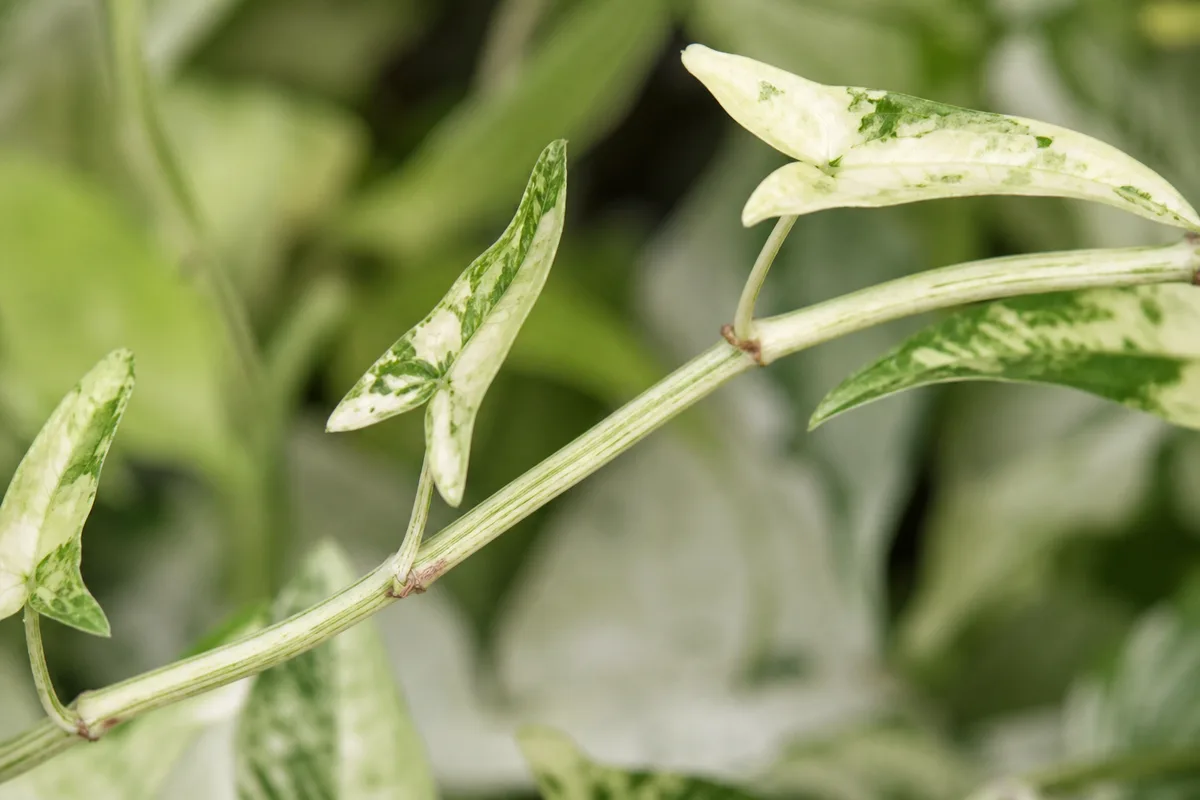
Leggy Growth symptoms on Syngonium White Butterfly - compare with healthy tissue on the same plant.
- Long bare stem sections with leaves spaced far apart compared with earlier growth
- Smaller new arrowhead leaves that open pale, thin, or with much less white veining
- Stems leaning strongly toward the brightest window or lamp
- Soft, floppy vines that cannot support their own weight without leaning on a shelf or wall
- One-sided stretch when only one face of the pot receives real light
- Lower leaf drop on older sections, leaving a sparse vine-like profile
On White Butterfly specifically, internode length is the diagnostic metric. Healthy compact growth often shows leaf pairs 1–2 cm apart on young shoots. Etiolated stems push gaps of 3–6 cm or more with noticeably smaller blades at each node. White veining fades on new leaves before the plant looks dramatically different from across the room-pattern loss and stretch happen together.
Some vining is normal as Syngonium matures. NC State Extension notes that young plants stay shrubby while older plants develop a vine-like habit with cascading stems. The question is whether stretch coincides with declining variegation and shrinking leaf size, not just age. If newest leaves are smaller, greener, and farther apart than leaves from six months ago in the same spot, treat it as etiolation.
Compare with not enough light on Syngonium White Butterfly: that guide covers broader dim-light placement, acclimation, and green-reversion biology. This page focuses on reading stretch and when to prune after light correction.
Why Syngonium White Butterfly gets leggy growth
Insufficient light for variegated tissue
Variegated plants carry a photosynthetic handicap. Ohio State University Extension explains that all-green portions of variegated plants are often more vigorous because green leaves contain more chlorophyll and harvest sunlight more efficiently. On White Butterfly, pale sectors produce less energy per leaf area. In dim corners, the plant stretches toward brighter zones and may push solid-green shoots that grow faster than variegated stems.
Seasonal light drop indoors
Winter shortens daylight and pushes pots deeper into rooms for warmth. Even a plant that looked fine in summer can etiolate after months at the same interior shelf. University of Maryland Extension notes that indoor plants become spindly or leggy as they stretch for more light, often leaning when light arrives from one direction.
Natural vining habit mistaken for a problem
Syngonium is a climbing aroid. NC State describes a bush-like juvenile habit that becomes vine-like with age. Fast summer growth on a moss pole can look leggy even when light is adequate. Context matters: healthy vining keeps white veining quality steady; etiolation shows declining leaf size and pattern at the same time.
Overfertilizing in low light
Heavy feeding when the plant cannot use light efficiently can push weak, elongated tissue. This is secondary to light, but it explains why some White Butterfly plants stay spindly despite regular fertilizer. Fix light first; feed lightly only during active growth in brighter conditions.
Low light plus slow water use
Leggy White Butterfly plants in dim corners transpire slowly. Soil that stayed appropriately dry in a bright window may remain wet too long in shade, compounding stress and raising overwatering risk. Light correction often improves dry-down rhythm without changing pot size.
How to confirm the cause
Work through these stretch-focused checks before changing anything else:
- Internode measurement - Measure the gap between consecutive leaves on the newest vine. Etiolated growth shows noticeably longer spacing than compact nursery growth or leaves from a brighter period.
- New growth quality - Are the last two or three leaves smaller, paler, or with less white veining compared with older patterned leaves? That pattern confirms light stress on White Butterfly.
- Direction of lean - Strong lean toward one window means the plant is actively seeking light. Rotate the pot 180° and watch whether new growth follows the brightest side within two weeks.
- Shadow test at the leaf - Hold your hand above the foliage at midday. Bright indirect light casts a soft, diffuse shadow; deep shade gives almost none. Target bright indirect light at the leaf for variegated syngonium-see our White Butterfly light guide for window placement detail.
- Etiolation vs. vining fork - If the plant vines evenly on a support, holds white veining on new leaves, and internodes stay short, you may prefer a bushier shape through pruning rather than emergency relocation.
- Reversion check - Look for fully green stems with no white sectors. Green reversions can outgrow variegated portions; removal timing is covered in depth on the not-enough-light guide.
- Watering cross-check - Confirm whether soil stays wet for days. Wet mix with stretch suggests low light slowing uptake; dry mix with limp leaves points more to underwatering than etiolation alone.
If light is weak and internodes are stretching, you have enough evidence to fix placement first. For a full seven-step dim-light confirmation workflow, use the not-enough-light guide.
First fix for Syngonium White Butterfly
Move the pot to brighter filtered indirect light and acclimate gradually.
Target an east-facing window, a south or west window filtered by a sheer curtain, or a spot within one to three feet of bright glass where white tissue will not scorch. If the plant lived in deep shade, increase exposure over seven to fourteen days rather than jumping to harsh direct sun-pale variegated sectors burn easily. NC State Extension notes direct sun tends to burn or bleach arrowhead foliage.
Do not repot, fertilize, or cut the plant back hard until you see one or two new leaves opening with tighter spacing in the brighter spot. Light must lead; pruning follows compact new growth.
Step-by-step recovery
Once the plant sits in stronger indirect light, work through recovery in this order:
- Acclimate exposure - Shift the pot closer to the window in stages if coming from a dim room. Watch for bleaching or brown patches on white sectors; back off slightly if scorch appears.
- Adjust watering - Brighter light increases transpiration. Check the top inch of mix before each drink rather than keeping a shade-era schedule that leaves roots wet too long.
- Rotate weekly - Turn the pot a quarter turn every week so all sides receive similar light and stems stop leaning one direction.
- Wait for compact new growth - Judge the light fix by the next one or two leaves. Shorter internodes and stronger white veining mean the spot works.
- Prune leggy tips after confirmation - Once a new leaf opens with shorter spacing, trim elongated stems just above a node to stimulate lateral shoots. Sterilize blades between cuts. See our White Butterfly pruning guide for node placement and tool hygiene.
- Remove green reversions - Cut fully green stems back to the base or to a node with visible variegation. This prevents vigorous green tissue from overtaking White Butterfly character.
- Choose your habit - For a compact tabletop plant, keep pruning vining stems as they elongate. For a climbing display, add a moss pole or trellis and train the natural vine habit NC State describes rather than fighting every long stem.
Skip fertilizer until new growth looks stable for two weeks. A stressed, stretched White Butterfly does not need a nutrient push in dim conditions-it needs photons.
Recovery timeline
Leggy Syngonium White Butterfly does not shrink old internodes; recovery shows in new tissue.
- Week 1–2 after relocation: Lean may persist on old stems, but new buds should orient toward the brighter source. Soil should dry slightly faster.
- Week 3–6: First new arrowhead leaf opens. Judge success by shorter petiole spacing and stronger white veining-not by old bare stems filling in.
- Month 2–3: A second compact leaf confirms the spot works. Safe to prune the worst stretched sections above nodes.
- Season-long: Bushier side shoots appear after tip pruning. Fully green reversion slows if you remove green stems promptly.
If no new leaves appear after six to eight weeks in a genuinely brighter spot, reassess whether the window is still too dim, whether roots are healthy, or whether chronic wet soil in shade progressed to root rot.
Lookalike symptoms to rule out
| Pattern | Likely cause | Where to read next |
|---|---|---|
| Long internodes, fading white veining, window lean | Etiolation (this page) | Fix light, then prune |
| Dim room, green reversion, seven-step confirmation | Not enough light | Placement and acclimation depth |
| Even vining on moss pole, steady variegation | Normal maturation | Pruning for shape |
| Wet soil, yellow lower leaves, soft stem base | Overwatering in shade | Overwatering |
| Limp leaves, very dry mix throughout | Underwatering | Underwatering |
| Stalled growth without dramatic stretch | Slow growth | Slow growth |
Normal mature vining: Older White Butterfly plants climb naturally. Healthy vines keep reasonable variegation and leaf size. Etiolation adds smaller, greener leaves and longer gaps than earlier growth at the same stage.
Nutrient deficiency: True deficiency usually affects older leaves first with uniform yellowing or necrosis, not directional stretch toward a window. Increase light before assuming fertilizer will fix spacing.
What not to do
Do not over-fertilize in low light-it pushes soft stretchy growth without fixing the energy deficit. Do not place in unfiltered midday sun without acclimating; white tissue scorches faster than green syngonium leaves. Do not prune hard before improving light-cut stems regrow just as stretched in the same dim corner.
Keep away from pets; arrowhead plant is toxic to cats and dogs. Contact your veterinarian if a pet ingests plant tissue.
Mistakes to avoid
- Pruning hard before improving light - Cut stems regrow just as stretched in the same dim corner.
- Jumping into direct midday sun - White variegation scorches faster than green Syngonium tissue.
- Fertilizing heavily to force bushiness - Nutrients cannot replace adequate light for variegated leaves.
- Ignoring green reversions - All-green shoots compete more efficiently for light and can dominate the pot.
- Assuming legginess means Syngonium White Butterfly repotting guide - Rootbound checks matter, but repotting without light correction does not fix etiolation.
- Leaving wet soil in a dim corner - Slow growth plus soggy mix invites root problems. Pair light fixes with a dry-down check.
Wear gloves when pruning; Syngonium contains calcium oxalate crystals that irritate skin. Keep trimmed stems out of pet reach.
How to prevent leggy growth next time
Place White Butterfly where bright indirect light is realistic most of the day-not a hallway shelf that looks bright to human eyes. East windows work year-round; south and west need filtering. Cross-reference 400–800 foot-candle targets from our light guide when choosing a permanent spot.
Rotate the pot weekly before one-sided lean starts. Plan for winter supplementation if your brightest window still drops below what white variegation needs-indoor light supplementation can replace weak seasonal window light without scorching pale leaves.
Prune early if you want a compact bushy pot; provide a trellis early if you prefer a climbing vine with larger mature foliage. Remove fully green stems as soon as they appear. Water when the top inch of mix dries, adjusting rhythm as light seasons change-brighter months dry pots faster.
When to worry
Leggy growth alone is rarely fatal. Escalate when:
- All-green reversion dominates most of the plant and variegated shoots stall
- Stems collapse or snap repeatedly despite support
- New leaves stay tiny and green for two months after a genuine light upgrade-possible root disease or chronic overwatering in shade
- White sectors brown and melt after a sudden move to direct sun-that is scorch, not etiolation; filter light immediately
Most White Butterfly plants recover once light matches variegation needs. Old stretched stems remain as history, but new compact, white-marked leaves tell you the fix worked.
Conclusion
Leggy growth on Syngonium White Butterfly is etiolation-a stretch response when light is too weak for pale variegation. Confirm the diagnosis through internode spacing, declining white veining on new leaves, and window lean-not a single pale leaf. Fix light before fertilizer or repotting, wait for one or two compact new leaves, then prune elongated tips above nodes for shape. When dim placement and green-reversion biology are your main questions, use the not-enough-light guide; when you need cut placement detail, use the White Butterfly pruning guide.
Related White Butterfly problems: not enough light, overwatering, root rot, slow growth. Care guides: White Butterfly light, White Butterfly pruning, White Butterfly overview.
When to use this page vs other Syngonium White Butterfly guides
- Syngonium White Butterfly watering guide - Use for routine moisture checks before assuming leggy growth is the main issue.
- Syngonium White Butterfly problems hub - Browse all 2 common issues on this species.
- Yellow Leaves on Syngonium White Butterfly - Different entry point when symptoms overlap with leggy growth.