Yellow Leaves on Spider Plant: Causes, Checks & Fixes
Quick answer
If your Spider Plant has multiple yellow leaves, treat it as a root-zone issue first. Pause watering and run a wet-vs-dry check before repotting or feeding, because this species' tuberous roots are prone to stress in waterlogged mix.
Yellow Leaves on Spider Plant: Causes, Checks & Fixes
This guide covers yellow leaves on Spider Plant. See also the general Yellow Leaves guide, watering, and light pages for this plant.
Yellow Leaves on Spider Plant: Causes, Checks & Fixes
Quick answer
Yellow leaves on Spider Plant usually start in the root zone, not from missing fertilizer. This species has fleshy tuberous roots that store reserve food, so it can look fine for a while even when the potting mix is staying too wet. Your first move is simple: pause watering and check moisture deeper in the pot, because root rot usually results from poor drainage or excessive watering. If the plant is crowded, you may have a root-bound wet core (dry top, wet center) that still drives yellowing.
What yellow leaves look like on Spider Plant
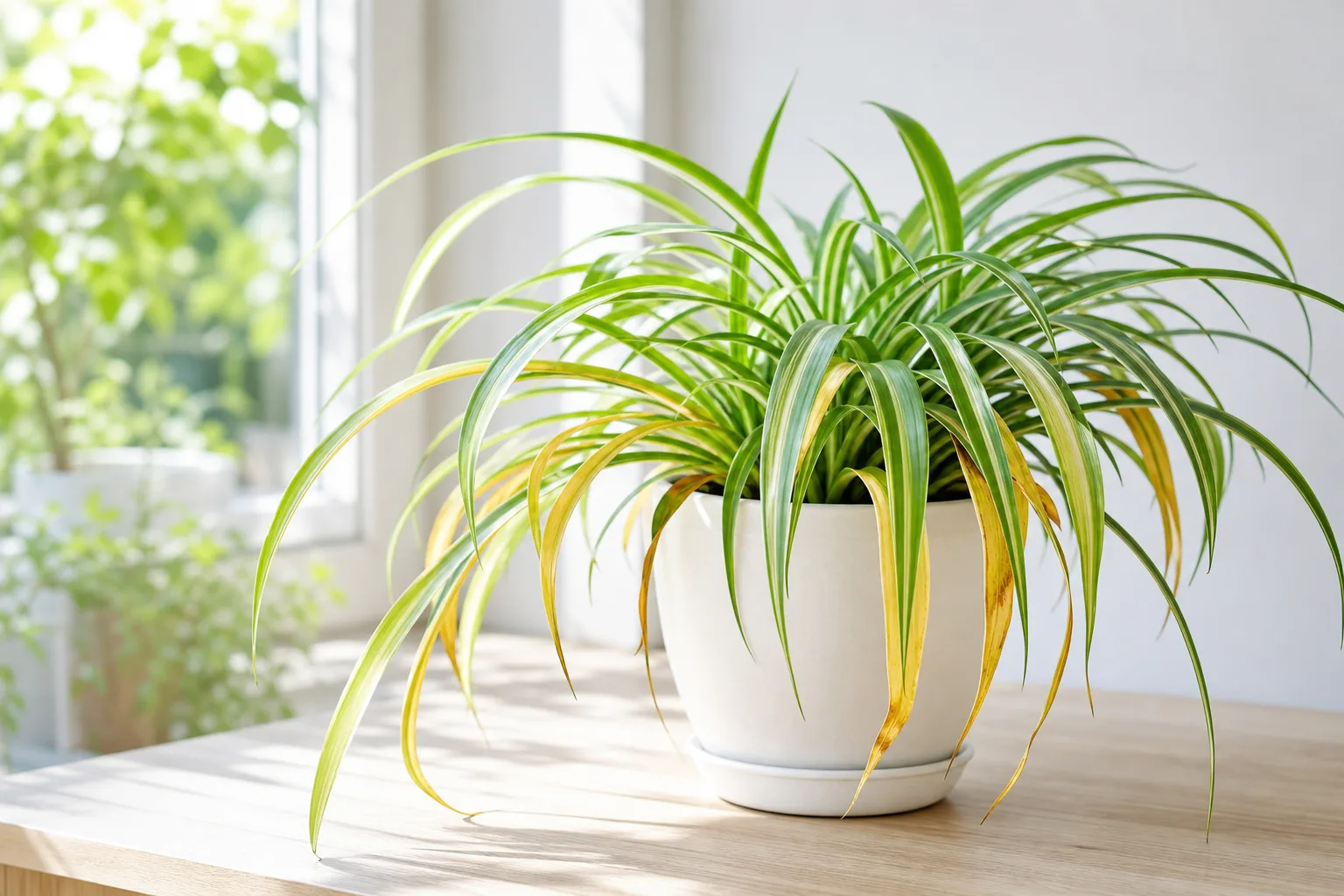
Spider Plant yellowing often starts on lower arching blades, then spreads if root stress continues. You may also see droop in the mother plant or wilting plantlets on stolons when roots are not moving water well. In wet-root cases, leaves tend to feel softer and limp rather than crisp. If only one old base leaf yellows and the rest of the plant is firm, that is often normal aging.
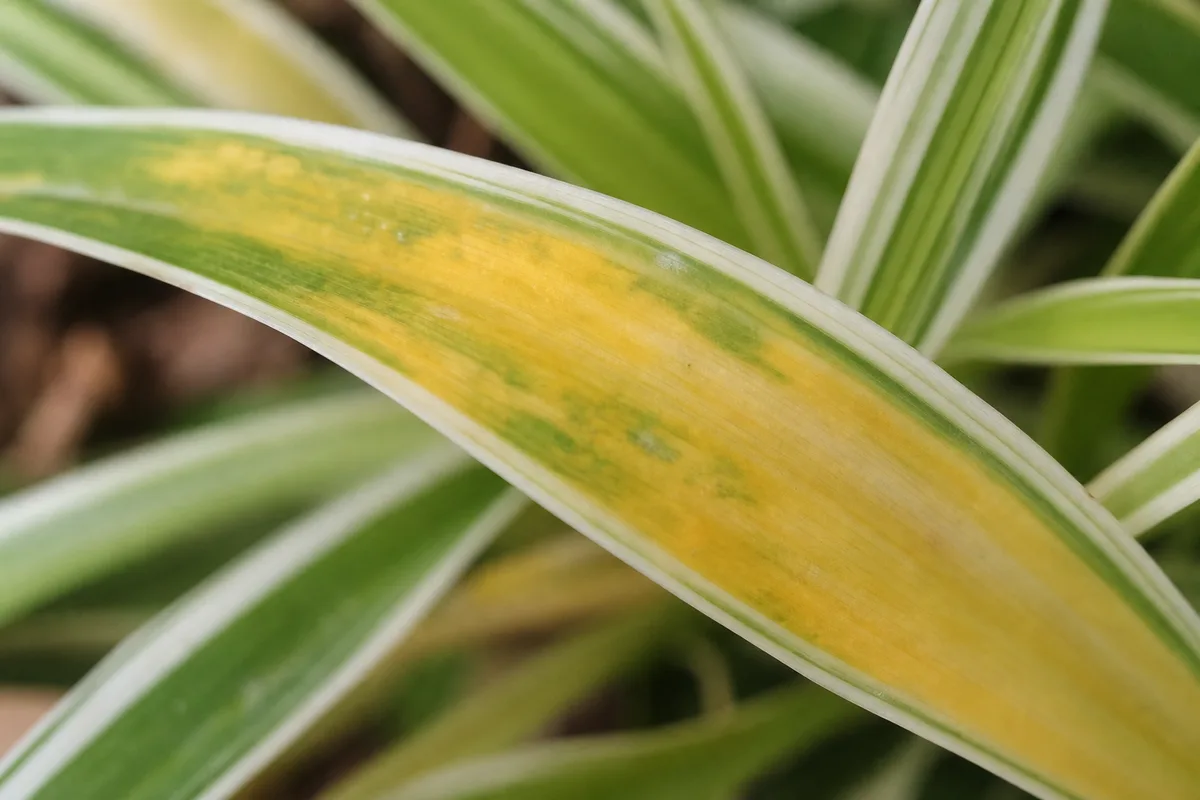
Yellow Leaves symptoms on Spider Plant - compare with healthy tissue on the same plant.
Why Spider Plant gets yellow leaves
1) Overwatering and poor drainage (most common)
Spider Plant likes moisture but not saturated soil. Clemson notes that Spider Plants should dry out briefly between waterings and that root rot is commonly tied to excess water or slow-draining mix. Missouri Botanical Garden also lists this species as susceptible to root rot if waterlogged.
2) Root-bound stress with a wet center
When tuberous roots crowd the container, water behavior gets uneven: the top dries quickly but the center can stay damp and oxygen-poor. Missouri Botanical Garden warns Spider Plant should be divided or repotted before roots burst the container, which is a practical signal that pot pressure is now part of the problem.
3) Underwatering lookalike
Spider Plant tolerates short dry spells better than many foliage plants, but prolonged dryness can still yellow older leaves. NC State describes Spider Plant as tolerant of drought and dry soil rather than immune to it, so repeated full dry-outs can still show up as stress.
4) Light and temperature stress
In dim light, water use slows and overwatering risk rises. Direct sun can also worsen leaf stress because NC State notes Spider Plant is intolerant of direct sunlight. For temperature, keep conditions stable: Clemson recommends 65-75 F days and 50-55 F nights and moving plants away from winter drafts.
5) Water-quality tip burn mistaken for full yellowing
Some Spider Plants get tip burn from dissolved salts, chlorine, or fluoride rather than whole-leaf yellowing. Clemson identifies leaf tip burn from high soluble salts, while UF/IFAS notes this plant is sensitive to fluoridated water. This matters because a tip-burn issue needs a different fix than root rot.
Lookalike checks to rule out quickly
| Pattern | Most likely cause | What confirms it |
|---|---|---|
| Many soft yellow leaves + heavy wet pot | Overwatering/root stress | Soil still wet well below surface days after watering |
| Yellowing with roots circling holes | Root-bound wet-core stress | Tight root mass and uneven dry-down |
| Dry, light pot + some yellow/curling leaves | Underwatering | Mix dry through the root ball, no sour smell |
| Faded leaves in dim corner, slow drying | Low light + watering mismatch | Soil stays moist too long between drinks |
| One older lower leaf yellowing | Normal aging | Rest of plant firm, active new growth |
| Yellowing after cold window nights | Draft/chill stress | Recent temperature drop or cold-air exposure |
How to confirm the cause (6-step check)
- Check moisture 2 inches down and near the center, not just the top crust.
- Lift the pot now and again in 24 hours to compare wet-vs-dry weight.
- Smell the mix; sour or swampy odor supports overwatering stress.
- Inspect drainage holes for dense circling roots or constant dampness.
- If symptoms continue, unpot and inspect roots: firm pale roots are viable; dark mushy roots are failing.
- Review environment: direct sun scorch, dim corners, and winter drafts can amplify yellowing patterns.
If leaves wilt while soil is still wet, treat that as urgent root dysfunction because wilting with wet soil is a classic root-failure signal.
First fix to try
Stop watering until the upper mix dries and the pot feels noticeably lighter. Do not fertilize yet. This single correction prevents piling stress on already weakened roots and gives you a cleaner diagnostic read over the next few days.
Step-by-step recovery by confirmed cause
If overwatering is confirmed
- Remove standing runoff water immediately.
- Improve aeration and dry-back before the next watering.
- If roots are mushy, trim decay and repot into fresh free-draining mix.
If root-bound stress is confirmed
- Repot one size up, not several sizes up.
- Loosen circling roots gently and refresh mix.
- Resume watering only after the top layer dries slightly.
If underwatering is confirmed
- Rehydrate thoroughly once, then let excess drain.
- Shift to consistent dry-back cycles instead of long drought swings.
If light or cold stress is confirmed
- Move to Spider Plant light guide.
- Keep away from cold panes and draft paths.
- Recheck watering frequency after moving, since drying speed changes.
Recovery timeline and what improvement looks like
Expect damaged yellow leaves to stay yellow; they usually do not re-green fully. Track recovery by firm, healthy new growth and symptom slowdown, not by old leaf color reversal. Mild watering errors can stabilize in 1-2 weeks; root-pruning or repot cases often need 3-6 weeks before growth looks consistently strong.
What not to do
- Do not add fertilizer as a first response to widespread yellowing.
- Do not repot into a much larger pot “for future growth.”
- Do not keep watering on a fixed calendar when soil is still wet.
- Do not diagnose only from leaf color without checking pot moisture depth.
How to prevent repeat yellowing
Use a pot with drainage, water based on actual dry-back, and keep the plant in bright indirect light. Spider Plant performs best when you avoid chronic saturation while still providing regular moisture in active growth. For deeper prevention and related issues, use the Spider Plant cluster:
- Spider Plant overview
- Overwatering guide
- Root rot guide
- Underwatering guide
- Watering guide
- Repotting guide
- Drooping leaves guide
- Brown tips guide
When to escalate
Escalate quickly if many leaves yellow together, the crown softens, or roots are collapsing. In those cases, move straight to the root-rot workflow and remove decayed tissue before it spreads. If pets chew fallen leaves, ASPCA lists Spider Plant as non-toxic to cats and dogs, but it is still best to remove damaged foliage promptly.
When to use this page vs other Spider Plant guides
- Spider Plant watering guide - Use for routine moisture checks before assuming yellow leaves is the main issue.
- Spider Plant problems hub - Browse all 4 common issues on this species.
- Root Rot on Spider Plant - Different entry point when symptoms overlap with yellow leaves.