Spider Plant Fertilizer: When, How, and Mistakes
Spider Plant Fertilizer: When, How, and Mistakes
Spider Plant Fertilizer: When, How, and Mistakes
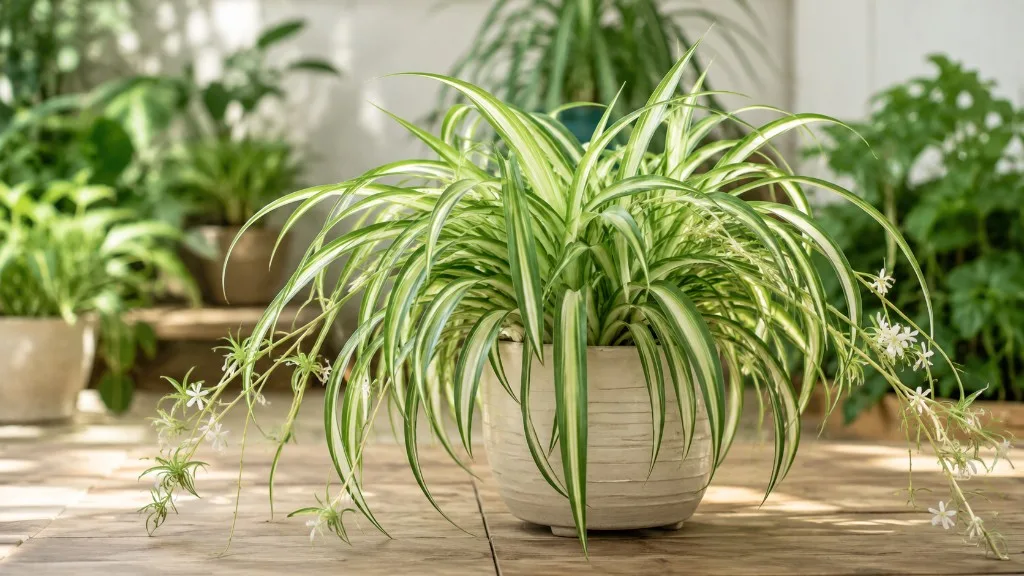
The trailing stolons and tiny plantlets on Chlorophytum comosum are what most growers want - not the largest possible leaves. That goal changes everything about spider plant fertilizer. Spider plants evolved in coastal South African understory with modest nutrition, thick water-storing roots, and a habit of producing baby spiderettes on long wiry stems. University of Wisconsin Extension warns that heavily fertilized plants may not form as many plantlets and that excessive fertilizer may lead to tip browning. Missouri Botanical Garden echoes the same trade-off: do not over fertilize as heavily fertilized plants may not form as many new plantlets.
Feeding is secondary to light, watering, and soil rhythm. When those are stable, a half-strength balanced liquid every four to six weeks during active growth replaces what leaches from the pot - without chasing plantlets with heavy doses that backfire. Spider plants are also particularly sensitive to fluoride in tap water, which means brown tips after a conservative feed may be a water-chemistry problem, not hunger. This page covers timing, product choice, dilution, the plantlet-vs-feeding decision, flush recovery, and the mistakes that cause lasting cosmetic damage.
Reviewed by LeafyPixels Review Board · Author: sai-ananth
Use this guide for proactive feeding schedules. For salt-burn triage after a heavy feed, see brown tips. For baseline species biology, start at the Spider Plant care hub.
Why Spider Plants Need Less Fertilizer Than You Think
Spider plants are moderate growers in good light and near-static in dim corners - nutrient demand follows new tissue production, not calendar guilt. Arching strap leaves, extending stolons, and forming plantlets pull nitrogen, phosphorus, potassium, and trace elements from the potting mix. Each thorough watering leaches a portion of those nutrients. Roots in small pots exhaust what’s left faster than a floor specimen in a twelve-inch container.
Growth, stolons, and what nutrients leave the pot
The fleshy tuberous roots that let spider plants survive missed waterings also store reserve carbohydrates - Missouri Botanical Garden notes tubers store reserve food, so a healthy plant will not run short overnight. Fertilizer replaces gradual depletion during active growth; it does not rescue a pale plant in too little light or one drying out repeatedly. Fix placement and moisture on the overview hub first.
Clemson HGIC recommends feeding during periods of active growth with a water-soluble or time-release houseplant fertilizer at label rates - but for container spider plants, half-strength liquid on moist soil is the safer interpretation extension sources converge on. SDSU Extension lists fertilize every three to four months as a conservative baseline for general care.
The plantlet trade-off: why heavy feeding reduces babies
University of Wisconsin Extension and Missouri Botanical Garden both document the same pattern: push fertilizer hard and you may get fewer spiderettes, not more. Spider plants grow and produce plantlets best when slightly pot bound - a combination of modest nutrition, bright indirect light, and slight root constraint triggers the stolon cascade growers love. Chasing babies with monthly full-strength feeds on dry soil is one of the most common ways beginners stall production and earn brown margins.
Observation log (one growing season, same hanging basket, bright east window): A ‘Vittatum’ specimen fed every six weeks at half strength produced noticeably more trailing plantlets than an identical basket on a four-week schedule at the same dilution. The faster-fed plant showed earlier salt crust on the soil rim and fewer new stolons by midsummer - consistent with extension warnings that heavy feeding suppresses plantlet formation. Your interval may differ by light and pot size; the lesson is that more frequent feeding does not equal more babies.
When to Fertilize Spider Plants
Feed when the plant is actively producing new crown leaves, extending stolons, and forming plantlets with visible root nubs. Stop when growth slows sharply - even if foliage stays green through December. Unused nutrients accumulate as soluble salts while roots absorb water more slowly in cool, short-day conditions. University of Maryland Extension links excessive or frequent fertilizer use to high soluble salts with brown leaf tips, marginal necrosis, and white crust on potting media.
Spring and summer active-growth window
Start feeding when you see fresh growth - new leaves unfurling from the crown, stolons lengthening, tiny plantlets forming at stem tips. In temperate climates that usually means mid-spring through late summer, roughly April through September depending on window exposure and whether the plant hangs in a basket that dries quickly.
SDSU Extension advises waiting four to six months before feeding a newly potted plant. Clemson HGIC repeats the same four to six month post-repot pause. Fresh mix often contains starter fertilizer; adding liquid on top stacks salts before roots have colonized the new volume.
Temperate month framework
The table below is a typical temperate indoor framework, not a law. Watch stolon activity and new leaf color rather than the calendar alone.
| Month (temperate climate) | Growth phase | Feeding guidance |
|---|---|---|
| March–April | Waking up, new shoots | Start half-strength liquid if active growth visible |
| May–August | Peak foliage and plantlet production | Every 4–6 weeks; hanging baskets on shorter end |
| September | Slowing slightly | Reduce to every 6–8 weeks or taper off |
| October | Wind-down | Final light feed if still growing, then pause |
| November–February | Low growth indoors | No fertilizer for typical setups |
A spider plant building steady new leaves and plantlets through July is on schedule. One static despite good light and watering needs those variables fixed before food.
Fall taper and winter pause
No - do not fertilize spider plants in winter under normal indoor conditions. Taper in early to mid-fall as day length drops. One practical pattern: a final half-strength feed in early fall if stolons are still extending, then stop from late fall through winter. University of Saskatchewan recommends fertilizing sparingly in spring and summer only, using half-strength all-purpose fertilizer - implicitly excluding the dormant season.
Exception: plants under strong supplemental grow lights that keep producing new shoots all winter may take half strength every eight to ten weeks with close monitoring for salt crust. Even then, skipping winter feeds is safer than forcing growth with nutrients roots cannot process.
Best Fertilizer for Spider Plants
The best spider plant fertilizer for most homes is a complete water-soluble balanced houseplant formula with equal or near-equal NPK and micronutrients on the label. Nitrogen supports green leaf tissue; phosphorus and potassium support root function and overall vigor at modest levels. Spider plants produce small white flowers indoors, but feeding is about foliage and plantlets - not bloom promotion.
Balanced liquid NPK (10-10-10, 20-20-20)
A 10-10-10 or 20-20-20 water-soluble fertilizer diluted to half strength is the default across extension guidance. Equal ratios keep feeding simple when your goal is steady foliage and trailing babies, not flowers. Some growers use a 3-1-2 foliage formula at label strength if they already own it; beginners should start with balanced 10-10-10 at half strength for predictable dosing.
Worked dilution example: If the label says 1 teaspoon per gallon for houseplants, use ½ teaspoon per gallon. If it says 1 tablespoon per gallon, use 1½ teaspoons. Mix fresh each session - chelated micronutrients degrade in a sitting bucket.
Liquid formulas win for control in six- to ten-inch pots where precision prevents localized salt hot spots. Skip products marketed primarily for roses, tomatoes, or bloom boosters - high phosphorus adds salt load without benefit for spider plant culture.
Can you use leftover orchid or succulent fertilizer? Orchid formulas are often high-phosphorus and low-nitrogen; succulent blends may be too concentrated for a foliage-heavy spider plant in a small pot. If you must use what’s on the shelf, dilute to quarter strength and feed no more than every six to eight weeks during active growth - then watch for tip burn. A balanced 10-10-10 at half strength remains the clearer default.
Organic options, slow-release, and what to skip
Organic liquids - fish emulsion, compost tea, seaweed extract - work at half strength or weaker if smell and dosing precision are acceptable indoors. Slow-release granules and fertilizer spikes release unpredictably in small pots, stack with forgotten liquid feeds, and resist flushing when problems appear. If slow-release is already mixed into bagged potting soil at purchase, treat that as your fertilizer for two to three months and skip liquid on top.
Skip foliar feeding for routine care - spider plants absorb nutrients through roots, and wetting leaves indoors invites fungal spotting without meaningful benefit. Skip fertilizer-pesticide combos unless you are following a pesticide label for a specific pest issue.
Pet note: The ASPCA lists spider plant as non-toxic to cats and dogs. Concentrated fertilizer solution is not safe to ingest - keep bottles and saucer runoff out of reach. Contact your veterinarian or poison control if a pet drinks concentrated fertilizer runoff.
Self-watering pots and decorative cachepots without drainage concentrate salts in the reservoir or trap fertilizer-laden water at the root zone. Spider plants in these setups need quarter-strength feeds at longest intervals - or plain water flushes between feeds - and you should never let the reservoir sit continuously full of fertilized solution.
How Much and How Often to Feed
If you remember one rule: half strength on moist soil during active growth only. Never full label strength on a container-grown spider plant unless you leach salts regularly and feed at extended intervals.
Half-strength dilution math
Spider plants sit in the light to moderate feeder category - more responsive than snake plants, far less tolerant of salt buildup than heavy-feeding vegetables. Cutting liquid rates to one-half is the safest default. Quarter strength suits monthly conservative feeding, young propagations, or plants with a history of tip burn.
Apply enough solution to moisten the full root ball and produce a small amount of drainage from holes - not a crown-flooding pour that rots the central leaf cluster. Empty the saucer within thirty minutes.
Three schedules: conservative, standard, aggressive
| Schedule | Interval | Best for |
|---|---|---|
| Conservative | Half-strength every 3–4 months, spring–summer only | Established plants, plantlet-focused growers, moderate light |
| Standard | Half-strength every 4–6 weeks, spring–early fall | Actively growing plants in bright indirect light |
| Aggressive | Half-strength every 3–4 weeks at most, peak summer only | Bright light, small pots, no salt crust - pause at first browning |
If your main goal is maximum plantlets, lean conservative. If your main goal is leaf size on a single specimen, standard may fit - but watch margins on variegated cultivars first.
Post-repot waiting period
Hold fertilizer for four to six months after repotting. Use plain water and good light while roots colonize fresh mix. Stolon production may pause briefly - normal. Pushing nutrients during root establishment causes more problems than it solves.
Step-by-Step Safe Feeding
Feeding order matters: dry soil plus concentrated fertilizer equals root burn; stressed plants plus any fertilizer equals worse stress.
Step 1: Confirm active growth season - or grow-light winter exception - and that the plant was not repotted within four to six months.
Step 2: Inspect newest leaves, soil surface, and drainage hole. Brown tips, white crust, yellowing, or sour smell mean do not feed - diagnose first.
Step 3: Water if soil is dry. Feed only when the top two inches are evenly moist - never pour fertilizer onto bone-dry roots.
Step 4: Mix at half strength. Measure with a dedicated spoon or syringe.
Step 5: Pour slowly around the base, not onto the leaf crown where liquid can sit and cause rot.
Step 6: Discard drainage from the saucer after fifteen to thirty minutes.
Step 7: Log the date to prevent accidental double-feeding two weeks later.
Pre-feed checklist and the moist-soil rule
Before every application: confirm season (no late-fall feeds without grow lights), soil moisture (water first if dry), salt crust (flush instead of feed), recent repot (skip if within four to six months), and newest leaf color (pale new growth usually means light before hunger). The moist-soil rule is non-negotiable - fertilizer salts draw water osmotically; on dry roots that creates immediate stress.
Signs You Are Getting It Right - and Wrong
A well-fed spider plant is balanced, not the biggest in the room. Positive signals during active season: steady new crown leaves with cultivar-normal color, active stolons with plantlets developing root nubs, no salt crust after several months of feeding, and neutral-smelling soil.
Over-fertilizing - the more common and damaging problem - shows brown or black leaf tips and margins, white crystalline crust on soil or pot rim, brittle leaves despite correct moisture, stalled plantlet production, and wilting shortly after feeding despite wet soil (osmotic stress).
Under-feeding is harder to spot because spider plants survive lean conditions. Possible signs: pale new growth in bright light with correct watering, very slow leaf production, thin weak stolons with few babies. Rule out insufficient light before increasing feed.
Fluoride, chlorine, and fertilizer burn compared
Brown tips are not automatically fertilizer. University of Saskatchewan lists excessively dry soil, low humidity, excess fertilizer, and chlorine/fluoride in tap water among tip-burn causes. Clemson HGIC adds that leaf tip burn is caused by too much fertilizer or water high in soluble salts. UF/IFAS notes spider plants are particularly sensitive to fluoridated water.
| Symptom pattern | White soil crust? | Recent feed? | Water source | Likely cause | First action |
|---|---|---|---|---|---|
| Tips browning after scheduled half-strength feed on moist soil | Yes | Yes, within 2 weeks | Any | Fertilizer / salt burn | Flush, pause feed 4–6 weeks |
| Tips browning on conservative feed, moist soil, no crust | No | No recent change | Hard tap water | Fluoride / chlorine | Switch to rainwater or distilled for 4 weeks |
| Tips crisp, pot very light, soil dusty dry | No | Any | Any | Underwatering | Soak per watering guide |
| Tips browning, soil wet days, soft tubers | Sometimes | Any | Any | Overwatering / root stress | See root rot triage |
If half-strength feeding on moist soil still produces tips browning with no crust, switch irrigation water before increasing frequency.
Flushing After Over-Fertilizing
Stop feeding immediately when you suspect over-fertilization or see salt crust. Flushing runs plain water through the mix until dissolved salts exit the drainage hole.
Move the plant to a sink or tub. Water slowly with room-temperature plain water - rainwater or distilled if fluoride is suspected. Pass roughly three to four times the pot volume through the mix over ten to fifteen minutes. Let the pot drain completely; do not sit in runoff.
Pause all fertilizer for four to six weeks. Resume at half strength on the conservative schedule only after one or two new leaves emerge without fresh burn. Badly burned tips will not green up - trim with clean scissors into healthy tissue if aesthetics matter.
If the plant wilted severely or soil smells sour after flushing, root damage may extend beyond salt stress. Repot into fresh mix, trim mushy roots, and hold off fertilizer for two to three months. For chronic tip burn after conservative care, work through the brown tips guide before escalating feed rate.
Hanging Baskets, Variegated Cultivars, and Baby Plantlets
Hanging baskets dry and leach nutrients faster than floor pots because of increased airflow and gravity-driven drainage. Feed at the shorter end of the four-to-six-week range - every four weeks at half strength - without increasing concentration. A basket cycling bone-dry to soggy will tip-burn regardless of fertilizer quality; stabilize watering first.
Variegated cultivars (‘Vittatum’, ‘Variegatum’) grow slightly slower than solid-green forms because white leaf sections contain less chlorophyll. They rarely need more fertilizer - delicate margins show salt damage first. Feed on the conservative schedule and prioritize bright indirect light.
Baby plantlets newly potted from propagation have small root systems. Wait until they show new leaf growth - usually two to four weeks - before a quarter-strength feed. Full-strength or frequent feeding on young propagations burns delicate roots quickly.
Heat stress: If indoor temperatures exceed 85°F (29°C) (editorial threshold - reduce feed when the plant wilts repeatedly from heat) or the plant wilts from dehydration, skip the scheduled feed. Stressed plants metabolize nutrients poorly.
Spider Plant Feeding Checklist
Use this closing checklist instead of a generic recap - branch on whether you want more plantlets or fuller mother-plant foliage.
Before your next feed
- Active new leaves or stolons visible (not winter pause unless under grow lights)
- Repotted more than four to six months ago
- Top two inches of soil moist - watered first if dry
- No white salt crust, no widespread brown tips after last feed
- Light and watering already stable
Product and dose
- Balanced 10-10-10 or 20-20-20 at half label strength
- No slow-release granules stacked on top of liquid feed
- Saucer emptied after drainage; no fertilizer sitting in self-watering reservoir
Schedule choice
- Plantlet goal: conservative - every 3–4 months or 6 weeks at half strength; stay slightly pot bound
- Foliage goal: standard - every 4–6 weeks spring through early fall
- Log feed date on phone or plant tag
If tips brown after feeding
- White crust present → flush, pause 4–6 weeks, resume conservative
- No crust, conservative feed → test rainwater or distilled irrigation for one month
- Still stuck → brown tips guide before increasing food
Seasonal
- Taper in September; pause November–February for typical indoor setups
- After repotting: plain water only for four to six months
- Trim spent leaves per pruning guide after recovery, not before diagnosing feed issues
Spider plants forgive almost everything except heavy feeding in small pots. When stolons trail freely and new leaves emerge clean, your routine is working. When spiderettes stall and margins crisp, pull back - flush, pause, and resume at half strength on a longer interval.
When to use this page vs other Spider Plant guides
- Spider Plant overview - Start here for whole-plant context before deep-diving this topic.
- Spider Plant problems hub - Jump to symptom-specific fix guides when this care topic does not resolve the issue.
Related Spider Plant guides
- Spider Plant overview
- Spider Plant watering
- Spider Plant light
- Spider Plant soil
- Spider Plant propagation
- Spider Plant repotting
- Spider Plant problems
Related tool
Try the Fertilizer Dilution Calculator with spider-plant pre-selected to estimate needs for your setup.