Crown Rot on Snake Plant: Causes, Checks & Fixes
Quick answer
Crown rot on Snake Plant is advanced decay at the central leaf base where leaves meet the rhizome-usually after root rot, overwatering, or water trapped in the rosette. First step: unpot immediately; if the crown is soft and black, the parent plant cannot recover-propagate firm leaf sections or pups instead.
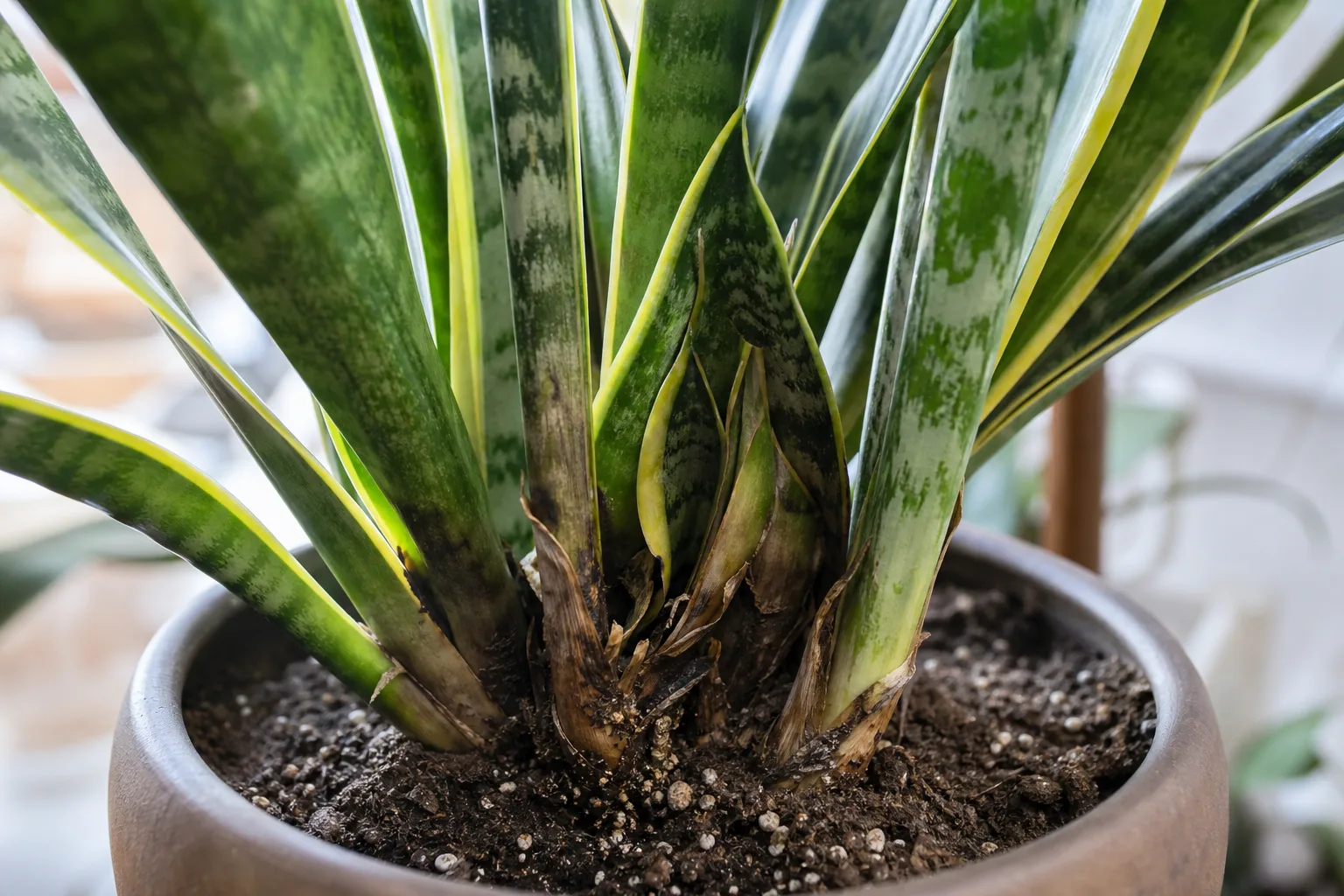
Crown Rot on Snake Plant: Causes, Checks & Fixes
This guide covers crown rot on Snake Plant. See also the general Crown Rot guide, watering, and light pages for this plant.
Crown Rot on Snake Plant: Causes, Checks & Fixes
Quick answer
Crown rot on Snake Plant is advanced decay at the central leaf base where leaves meet the rhizome-usually after root rot on Snake Plant, overwatering on Snake Plant, or water trapped in the rosette. First step: unpot immediately; if the crown is soft and black, the parent plant cannot recover-propagate firm leaf sections or pups instead.
The crown is the heart of a Snake Plant: the thick rhizome and tight leaf bases from which all sword-shaped leaves emerge. When rot reaches this zone, the plant loses its ability to push new growth even if upper leaves still look green. Catching decay while roots alone are affected gives a real rescue window; a mushy crown means switching to propagation.
Why Snake Plant gets crown rot
Crown rot is almost always the final stage of root rot or chronic wet conditions-not a separate disease. Snake Plant stores water in fleshy, succulent leaves and rhizomes adapted to dry African habitats. When roots sit in saturated soil, oxygen drops, fungi and bacteria attack, and decay travels upward into the crown.
Overwatering is the primary driver. Penn State Extension warns that you can kill Snake Plant by overwatering while neglecting water for a month does little harm-evidence that excess moisture, not drought, drives collapse. RHS notes that overwatering and standing in water lead to root rot, which on Snake Plant overview commonly advances into the leaf base.
Watering into the rosette center accelerates crown failure. Missouri Botanical Garden advises using well-drained potting mix and avoiding practices that trap moisture at the base. On Snake Plant, water sitting in the tight funnel of ‘Hahnii’ cultivars or between upright leaves keeps the crown damp for days.
Oversized pots, blocked drainage holes, and heavy peat mix keep outer soil wet while roots are still small-exactly the anaerobic zone where rot starts. Cold drafts plus wet soil slow drying and compound the problem, but the underlying trigger is still moisture at the rhizome.
What crown rot looks like on Snake Plant
Advanced crown rot has unmistakable signs when you know where to look:
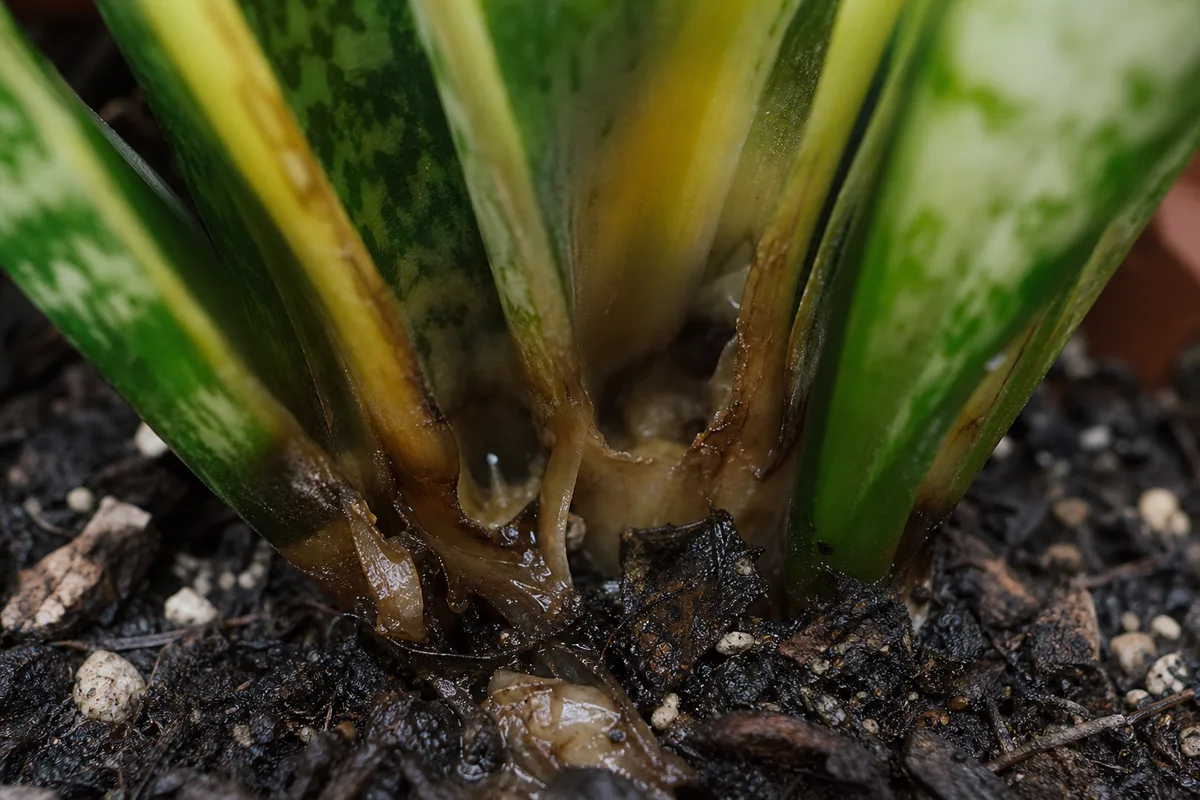
Crown Rot symptoms on Snake Plant - compare with healthy tissue on the same plant.
- Soft, black, or hollow tissue at the center where leaves meet soil
- Foul, sour, or putrid smell from the pot or crown-not just surface soil
- Leaf bases that feel squishy or slip when you tug gently on outer leaves
- Outer leaves still upright while inner bases collapse-a deceptive “healthy” top
- Yellowing or translucence starting at the lowest leaf bases and moving up
- Leaves pulling out with little resistance, leaving a rotted stump
On upright Dracaena trifasciata, rot often hides below soil line until several leaf bases soften. Bird’s Nest ‘Hahnii’ forms show the whole rosette collapsing inward when the shared crown fails.
How to confirm the cause
Follow this inspection order the same day you suspect trouble:
- Pot weight and smell - Heavy, sour-smelling pot strongly suggests active rot.
- Leaf base squeeze test - Press each leaf where it enters the soil. Firm is good; squishy or wet bases are not.
- Crown thumb test - Press the central rhizome/crown directly. Firm tan tissue means rot may still be root-confined. Soft, black, or yielding crown means crown rot.
- Unpot and rinse - Remove wet mix and rinse rhizomes under lukewarm water to see color clearly.
- Damage percentage - Estimate how much rhizome is mushy. Less than one-third with firm crown: root-rot protocol. Soft black crown: propagation protocol.
Healthy Snake Plant rhizomes feel solid, like a firm potato, pale tan to ivory. Rotten tissue is brown-black, slippery, and may fall away when touched.
Lookalike symptoms to rule out
Root rot alone leaves a firm crown even when many roots are mushy-recovery is still possible. Cold damage browns leaf tips or patches after chill but leaves a firm rhizome and neutral soil smell. Physical breakage at one leaf base from bumping the pot is localized, not a spreading black center. Mealybugs cause stickiness and white clusters, not a putrid crown.
First fix for Snake Plant
Unpot the plant immediately and stop all watering. If the crown is firm but roots are rotten, treat as root rot: trim all mushy roots and rhizome sections, air-dry cuts, repot dry in gritty mix, and withhold water for two weeks.
If the crown is soft, black, or hollow, accept that the parent rosette will not recover. Cut away all rotten tissue with sterile scissors until only firm green leaf and rhizome remain. Salvage healthy pups, firm leaf sections, or rhizome pieces with growth points for propagation. Do not return a rotted crown to soil hoping it will callus-it will spread contamination.
Step-by-step recovery
When the crown is still firm:
- Trim every mushy root back to firm tissue; sterilize blades between cuts.
- Dust cut rhizome surfaces with cinnamon and air-dry several hours.
- Repot into a clean pot with drainage holes and dry cactus mix amended with perlite.
- Place in Snake Plant light guide; wait two weeks before first watering.
- Reinspect roots after four weeks for new firm growth.
When the crown is lost but firm leaves remain:
- Cut healthy leaf sections into 5–8 cm segments, keeping track of which end was nearest soil-roots emerge from the bottom edge only.
- Let cuttings callus in a dry place for 24–48 hours.
- Insert bottom ends into dry gritty mix or propagate via division of any firm pups still attached to healthy rhizome.
- Water sparingly only after callusing; new shoots may take four to twelve weeks.
- Discard all black tissue and wash the old pot with hot soapy water before reuse.
Variegated cultivars like ‘Laurentii’ are best preserved through pup division rather than leaf cuttings, which often revert to solid green per Missouri Botanical Garden propagation notes.
Recovery timeline
Root rot caught with a firm crown often stabilizes in two to six weeks with dry Snake Plant repotting guide. New leaves may take two to three months to appear. Once the crown is mushy, the timeline shifts to propagation: leaf cuttings typically root in four to eight weeks; division of pups can produce visible new growth faster. Honest expectation: the original upright clump is gone, but genetics can continue from salvaged tissue.
What not to do
- Do not keep watering because upper leaves look green while the base is soft.
- Do not pour fungicide on a mushy crown without removing rotten tissue first.
- Do not repot into a much larger container “to help it recover.”
- Do not fertilize stressed or propagating cuttings until new growth is established.
- Do not leave the plant in standing saucer water after any watering.
- Do not delay unpotting until leaves collapse-the crown may already be gone.
How to prevent crown rot next time
Water only when the entire pot is bone dry. NC State Extension recommends allowing soil to dry between waterings in the growing season and watering only every one to two months in winter. Use fast-draining mix, pots with open drainage holes, and containers only slightly larger than the root mass.
Water the soil surface, not the rosette center. Empty saucers after every drink. Reduce frequency when the plant moves to lower light or cooler rooms. Weekly checks-pot weight, soil smell, firm leaf bases-catch root rot before it becomes crown rot.
When to worry
Crown rot is high severity on Snake Plant. Escalate immediately if:
- The crown yields to thumb pressure or smells putrid
- Black tissue spreads above soil line within days
- More than half the rhizome is mushy on inspection
- Leaves pull out effortlessly from the center
- Soil stays sour despite stopping water
If a firm rhizome segment and healthy pups remain after aggressive trimming, propagation is realistic. If every leaf base and the crown are black mush, discard contaminated tissue and start fresh from any firm cutting material only.
Conclusion
Crown rot on Snake Plant means decay has reached the central growing point-usually after wet soil, poor drainage, or water in the rosette. Confirm with a soft black crown and foul smell; act by unpotting the same day. A firm crown still allows root-rescue; a mushy crown means propagate and discard the parent. Prevent by bone-dry watering checks, gritty mix, and never trapping moisture at the leaf base. Judge success by firm salvaged tissue and new pups-not by saving a hollow crown.
When to use this page vs other Snake Plant guides
- Snake Plant watering guide - Use for routine moisture checks before assuming crown rot is the main issue.
- Snake Plant problems hub - Browse all 36 common issues on this species.