Leggy Growth on Rhaphidophora Tetrasperma: Causes, Checks &
Quick answer
Leggy growth on Rhaphidophora Tetrasperma is etiolation from insufficient light-long bare internodes, tiny unsplit leaves, and vines leaning toward the window. First step: move to bright indirect light within a few feet of an east or filtered south/west window, install a moss pole, and wait two to three weeks before pruning stretched sections.
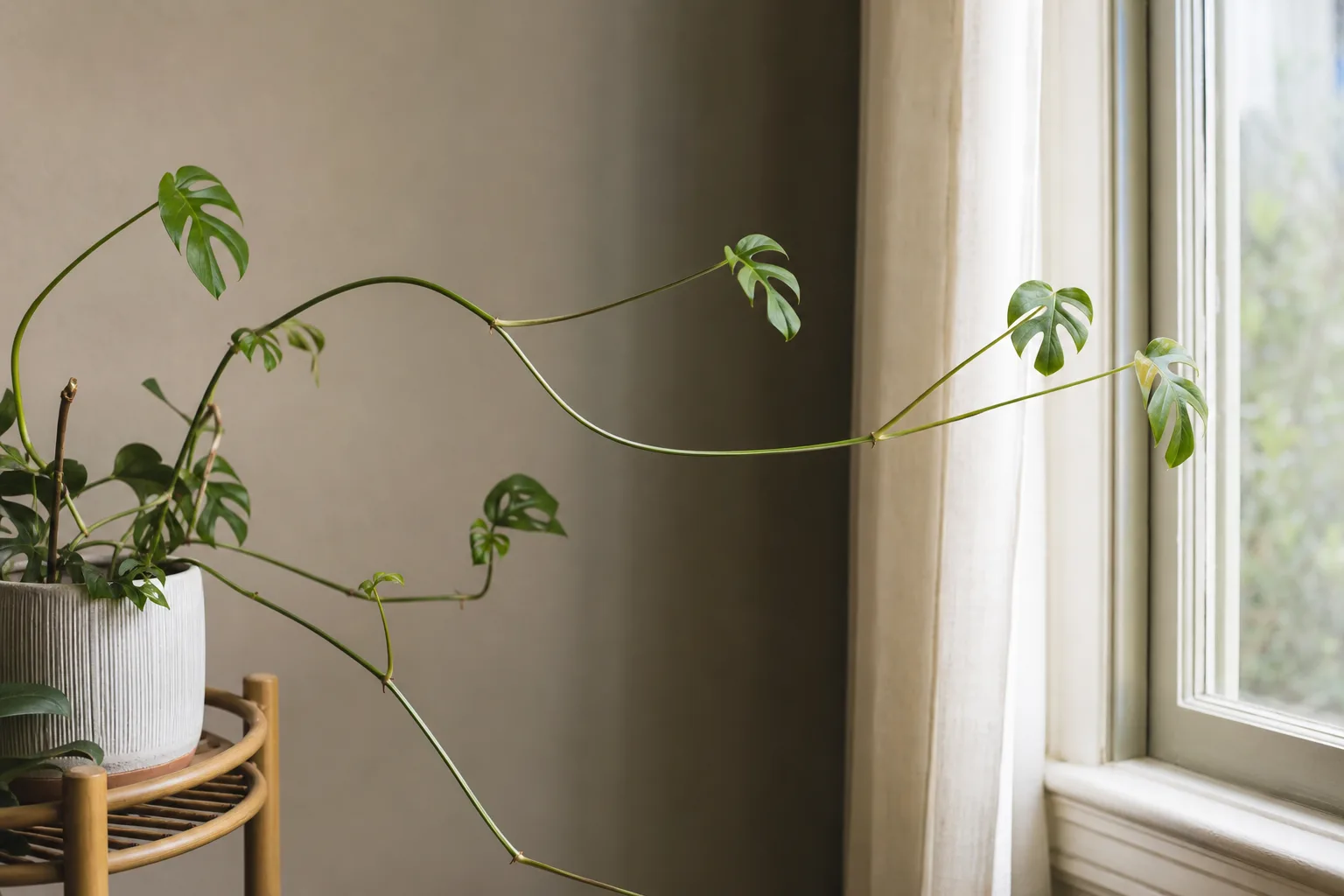
Leggy Growth on Rhaphidophora Tetrasperma: Causes, Checks & Fixes
This guide covers leggy growth on Rhaphidophora Tetrasperma. See also the general Leggy Growth guide, watering, and light pages for this plant.
Leggy Growth on Rhaphidophora Tetrasperma: Causes, Checks & Fixes
Quick answer
Leggy growth on Rhaphidophora Tetrasperma (Rhaphidophora tetrasperma) is almost always insufficient light, not a fertilizer shortage. Retail labels call it Mini Monstera or Monstera Ginny, but this fast tropical climber expects bright, indirect light-not the dim shelf where many aroids survive but never thrive. In weak light the plant etiolates: stems stretch toward photons, internodes lengthen, new blades stay small with few or no fenestrations, and vines lean hard toward the brightest window.
First step: move the pot to bright indirect light within a few feet of an east window or filtered south/west exposure, and install a moss pole at the same time so new growth climbs instead of sprawling across dark furniture. Do not repot, fertilize heavily, or cut back entire vines on day one. Let the plant respond to better light for two to three weeks, then prune bare leaders above a node once compact new growth proves placement is working.
Leggy growth vs not enough light - when to use this page
Both problems trace to low light on the same species, but they answer different search questions.
Use our not enough light guide when you are diagnosing overall dim placement, soil that stays damp too long, yellow lower leaves, or whether your window is bright enough in the first place. That page focuses on the full light-first workflow-placement bands, grow lights, and the light–watering cascade.
This page is for already-stretched vines: long bare gaps between leaves, one-sided lean, tiny unsplit new blades, and the prune-and-fill workflow after you know light was too low. For proactive window placement, lux ranges, and grow-light specs, see the Rhaphidophora Tetrasperma light guide. For node cuts and safe removal limits, see pruning.
Our overview guide explains how to tell Mini Monstera from true Monstera or Philodendron lookalikes. All fixes below apply to standard R. tetrasperma-not variegated sports that need even brighter filtered light.
What leggy growth looks like on Rhaphidophora Tetrasperma
Healthy Mini Monstera holds compact nodes along climbing vines, with new leaves progressively larger and more fenestrated as the plant ascends a support. Leggy etiolation tells a different story:
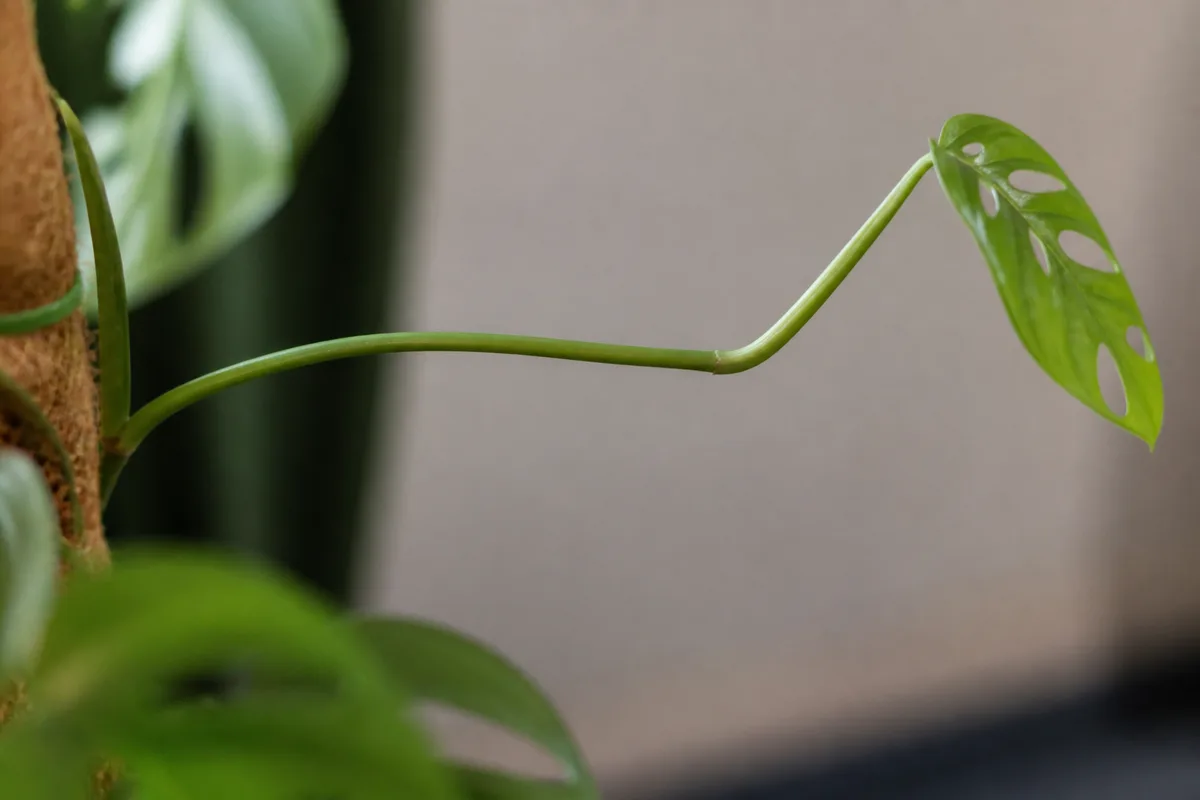
Leggy Growth symptoms on Rhaphidophora Tetrasperma - compare with healthy tissue on the same plant.
- Long internodes - gaps of 8–15 cm or more between leaves on newer vine sections, noticeably longer than older compact growth on the same stem
- Small, unsplit new blades - newest leaves are reduced and oval with few fenestrations, even when older foliage had splits
- Strong lean - leaf faces and vine tips point toward one window or lamp; aerial roots may search along walls toward light
- Horizontal sprawl - without a moss pole, vines trail along shelves and read as leggy even when light is borderline
- Bare lower stems - lower leaves drop on stretched sections while the tip keeps growing thin and weak
- Pale green color - dull foliage instead of deep green blades on recent growth
Unlike etiolation on succulents, aroid stretch still produces thin green leaves-they are just undersized. That distinction matters: you are not dealing with bleached, colorless tissue; you are dealing with a plant spending energy to find photons instead of building split foliage.
Recovery case (March 2026): A Mini Monstera on an interior bookshelf roughly 2.5 m from a west window showed internodes stretching to 12 cm with thumb-sized unsplit leaves. After moving to a filtered east sill 45 cm from glass and tying the vine to a moss pole, the next three leaves emerged at 4–5 cm spacing with visible splits by week three. Old bare sections did not refoliate; pruning those nodes back to the pole produced a bushier column by late April.
Why Rhaphidophora Tetrasperma gets leggy
In its native range on the Thailand–Malaysia peninsula, this species starts on the forest floor and climbs with aerial roots toward brighter filtered canopy gaps. Indoors, that same habit shows up as etiolation: long internodes, thin stems, and a lean toward glass when photons are scarce.
Low light is the primary driver. The species is marketed as easy, but it is not a low-light plant in practice-weak exposure produces thin stems, sparse foliage, and vines that reach for windows. Fast summer growth can also outpace winter daylight, making stretch more obvious after darker months.
Over-fertilizing in dim conditions adds weak, pale stretch. Extra nitrogen cannot replace photons; it can push soft elongated growth when the plant already lacks light energy.
Missing vertical support lets vines sprawl horizontally across dark furniture, which reads as leggy even when light is borderline. Climbing toward light on a moss pole produces better leaf size than trailing along a shelf.
Seasonal light drop catches many growers off guard-a spot that worked in July may be too dim by January. Shift the pot closer to glass or add a lamp from October through March in northern latitudes.
Low light also changes watering math. In bright indirect light, the top 2–3 cm of aroid mix often dries within a week during active growth. In a dim hallway, the same pot may stay wet for two weeks or more. Growers who keep a weekly watering calendar without checking soil often end up with yellow lower leaves from overwatering or inadequate light while vines keep stretching-two stresses that share one root fix: better light so the plant uses water again. See our watering guide once placement improves.
How to confirm the cause
Work through these checks before pruning, fertilizing, or repotting:
- Distance test - Measure how far the pot sits from the nearest window. More than 2 m from glass in a typical living room is often marginal for maintaining leaf size and fenestrations on this fast aroid.
- Directional lean - If leaf faces and vine tips point toward one light source, the plant is actively seeking more intensity.
- New vs. old leaf comparison - Compare the size and fenestration of the last three leaves on a growing tip to leaves from six months ago on the same stem. Smaller, less split new leaves strongly suggest light is the limiter. Plants in brighter light are more compact with normal-size leaves.
- Soil dry-down - Press your finger into the top 2–3 cm. If soil stays wet for two weeks or more in a dim spot, note that-fixing light often corrects the watering rhythm without other changes.
- Shadow test at midday - Hold your hand between the window and the leaf canopy. A sharp, dark shadow suggests enough intensity for active growth; a faint or absent shadow means the spot is likely too dim long term.
- Two-week placement trial - Move the pot to the brightest indirect spot you can offer without hot direct sun on the leaves. Do not change fertilizer, pot size, or watering frequency during the trial. Success means the next leaves emerge closer together with larger blades and more splits.
If the plant improves in brighter indirect light within two to three weeks, you have confirmed insufficient light. If symptoms persist, inspect roots for rot, check for pests, or verify the new spot is still too dim.
First fix for Rhaphidophora Tetrasperma
Move the pot to bright indirect light and install a moss pole-leave both in place for at least two weeks before any other intervention.
Practical targets for most homes:
- East window: on the sill or up to 60 cm back, where morning sun is gentle
- West window: 60–120 cm back, or behind a sheer curtain if afternoon sun is strong
- South window: 90–150 cm back, or filtered through sheer fabric-too much bright sun can burn leaves even when the plant was starving for light
- North window or interior room: usually needs a grow light; natural light alone is often too weak for good fenestrations
Slide the pot gradually over a few days if you are moving it from a very dark room to a much brighter one. A sudden jump into direct afternoon sun can scorch foliage even when the plant was etiolated.
Install or reposition a trellis, totem, or moss pole at the same time if the vine is sprawling. Gently tie the leading stem so aerial roots can attach. Climbing toward light produces better leaf size than letting stems trail along a dark shelf.
If natural light cannot reach compact-growth levels-common in offices and north-facing rooms-add a full-spectrum LED 30–45 cm (12–18 in) above the top leaves for 10–12 hours daily on a timer. The light guide covers fixture distance, acclimation, and hour adjustments in detail.
Do not reach for fertilizer, extra water, or a larger pot to wake up a leggy Mini Monstera. Fertilizer cannot replace photons, and repotting stressed vines adds unnecessary root disturbance.
Pruning and propagating stretched sections
Existing elongated internodes do not compact-recovery shows as tighter spacing and larger new leaves once light improves. Shape the plant after you see proof on the vine tips:
- Wait for compact new growth - Two to three weeks after the light upgrade, confirm the next leaves are closer together with better fenestrations.
- Identify salvageable vines - Find stems with firm green tissue and at least a few healthy leaves near the base or moss pole.
- Prune stretched sections - Cut leggy vines just below a node, leaving enough foliage on remaining stems to keep photosynthesis going. Follow our pruning guide for clean cuts and safe removal limits.
- Root the cuttings (optional) - Single-node stem cuttings root easily in water or moist aroid mix. Use pruned tips to fill sparse areas once the parent plant is stable in better light. See propagation for water-rooting steps.
- Rotate weekly - Turn the pot a quarter turn each week so all sides of the moss pole receive light and the vine does not lean heavily to one direction.
If a vine is mostly bare with only a few leaves at the tip, cut it back harder to a node near the soil line or moss pole. The plant will branch from nodes below the cut when light is adequate.
Recovery timeline
Expect the first new leaves after a light upgrade within two to four weeks in warm growing conditions (roughly 18–27°C / 65–80°F). Those leaves should be larger and more fenestrated than the stretched growth above them.
Old elongated stems remain long permanently-houseplants stretch when they do not receive enough light, and existing internodes do not shorten after placement improves. Judge success by node spacing and leaf quality on new growth, not by waiting for existing bare sections to refoliate along their length.
Full visual recovery-a dense, split-leaf column instead of thin trailing strings-usually takes one to two growing seasons if you prune after light improves and keep watering matched to the brighter spot.
Signs you are on track:
- New leaves closer together on vine tips
- Fenestrations returning on fresh growth
- Faster dry-down in the pot (a sign the plant is actively using water)
- Less leaning within a few weeks of weekly rotation
- Firmer stems and darker green color on recent leaves
Signs the problem is worsening or another issue is involved:
- Yellowing spreads while soil stays wet in the new spot
- Leaf tips brown and papery despite stable humidity-possible scorch from too much direct sun
- New growth stays tiny after four weeks in brighter light-reassess whether the spot is still too dim or spider mites are present
- Soft stems at the soil line and sour smell-root rot needs immediate root inspection, not just more light
Leggy growth vs lookalike problems
| Pattern | Likely cause | Key differentiator |
|---|---|---|
| Long internodes, small unsplit leaves, lean toward window | Leggy etiolation (low light) | Improves within 2–3 weeks after brighter indirect placement |
| Yellow lower leaves, mushy stems, sour soil | Overwatering / root rot | Wet mix for weeks; stretch may be present but base feels soft |
| Limp leaves that recover after a thorough soak | Underwatering | Drooping is episodic, not slow month-by-month stretch |
| Fine webbing, stippled leaf backs | Spider mites | Inspect undersides during pruning-see spider mites |
| Stretch after October with no care change | Seasonal light drop | Same watering calendar but shorter days; add lamp or move closer to glass |
Overwatering paired with dim light is common on fast aroids. Check soil moisture before assuming light alone will solve yellowing. Fixing light without reducing water in a previously dark, wet pot can still leave roots stressed. See overwatering and root rot when wet soil and soft bases accompany stretch.
Mistakes to avoid
- Treating it like a true low-light plant - Mini Monstera may hang on in dim rooms, but it will not keep split leaves or compact form there long term.
- Jumping to direct sun - Moving a stretched plant into harsh south-window sun without acclimation burns foliage. Bright indirect light is the target first.
- Fertilizing a stressed vine - Extra nutrients do not fix etiolation and can burn roots if soil has been wet too long in a dark corner.
- Waiting for bare stems to refoliate - Nodes on long bare sections often stay dormant until you prune back to active growth near a light source.
- Pruning before light improves - Removing growth points in the same dim corner can trigger another round of weak stretched shoots.
- Ignoring seasonal light drop - A spot that worked in summer may be too dim by late winter; shift the pot closer to glass or add a lamp from October through March.
Rhaphidophora Tetrasperma care cross-check
Light and water move together on this plant. In bright indirect light, water when the top 2–3 cm of mix is dry-often every 7–10 days in active summer growth and every 10–14 days in winter when growth slows. In low light, stretch that interval and always verify with a finger test rather than a calendar. Full rhythm details live on the watering guide.
Humidity around 50–70% supports steady leaf development once light is adequate. Temperature between 18–27°C (65–80°F) matches what this species tolerates indoors; keep it out of cold drafts below about 15°C (59°F).
Because Rhaphidophora Tetrasperma contains calcium oxalate crystals toxic if ingested, keep repositioned vines and moss poles out of reach of pets when you move the plant to a brighter windowsill.
How to prevent leggy growth
- Place new pots where bright filtered light reaches the leaf canopy most of the day, not only where the pot looks decorative.
- Provide a moss pole from the start so aerial roots climb toward light instead of sprawling across dark furniture.
- Rotate the container weekly for balanced growth around the support.
- Clean window glass seasonally-dust and film cut usable light more than most growers expect.
- Add a full-spectrum LED grow light 30–45 cm above the foliage for 10–12 hours daily in offices, north rooms, or winter months.
- Re-check placement when furniture moves or when outdoor trees leaf out and shade a formerly bright window.
- Match watering to the light level whenever you relocate the plant.
When to worry
Low light alone is a slow decline, not a same-day crisis. Escalate your response if:
- Soil stays soggy for weeks in a dark room and stems soften at the base
- More than a third of leaves yellow within days after a move-possible shock from too much sun or hidden root rot
- After four weeks in confirmed bright indirect light, new growth is still tiny and unsplit-verify the light source is strong enough or inspect for pests
Rhaphidophora Tetrasperma is resilient when light is corrected. Even a heavily stretched plant can look full again within a season once you improve placement, add a moss pole, and prune leggy vines. The main limit is patience: old stretch does not reverse, but new growth in the right light can restore the Mini Monstera look you bought it for.
Related Rhaphidophora Tetrasperma guides
- Not enough light - full placement diagnosis, light–watering cascade, and grow-light setup
- Light requirements - window bands, lux context, and supplemental fixtures
- Watering - dry-down rhythm after you move to a brighter spot
- Pruning - node cuts and shaping after etiolation
- Propagation - root cuttings to fill bare moss-pole sections
- Root rot - when wet soil and yellowing accompany stretch
- Overview - species ID and full care hub
Related tool
Use the Plant Problem Diagnosis Tool to narrow causes for leggy growth on this plant before changing multiple variables at once.