Root Bound on Mint: Causes, Checks & Fixes
Quick answer
Root-bound mint shows circling rhizomes, edge-only growth, and very fast dry-down. First step: unpot, divide the rhizome mat into healthy sections, and repot each section into fresh mix in a wider container with drainage.
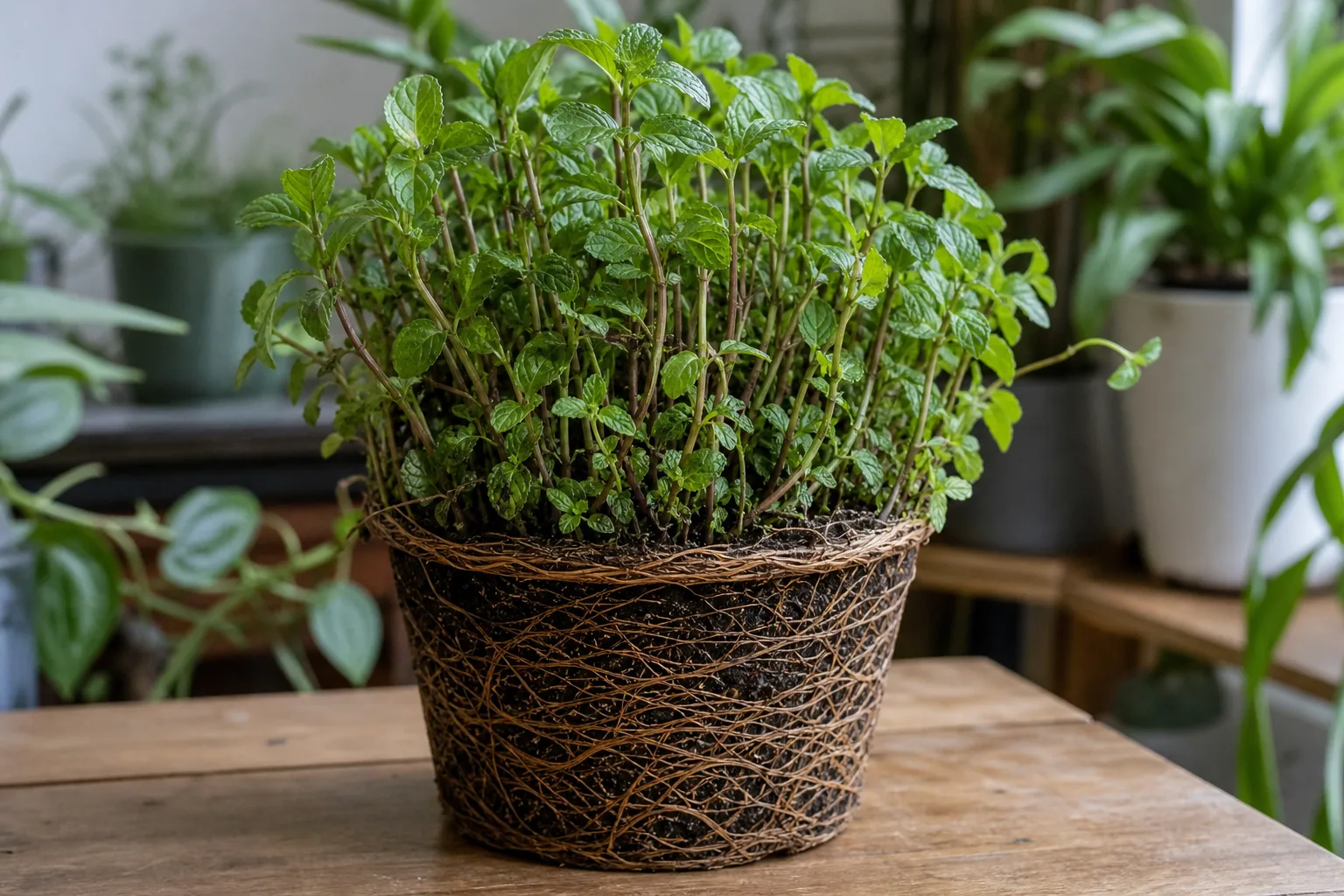
Root Bound on Mint: Causes, Checks & Fixes
This guide covers root bound on Mint. See also the general Root Bound guide, watering, and light pages for this plant.
Root Bound on Mint: Causes, Checks & Fixes
Quick answer
Root-bound mint shows circling rhizomes, rim-only growth, and very fast dry-down-the pot feels light again within hours of watering even though you soaked thoroughly. First step: unpot the plant, divide the congested rhizome mat, and repot healthy outer sections into fresh mix in wider containers with drainage. Do not respond with more water until you have checked roots.
Mint spreads by underground rhizomes and surface runners, which is why University of Maryland Extension and UF/IFAS recommend container growing for control. In a small pot, that same vigor eventually leaves very little usable soil volume, so water and nutrients cycle too quickly and growth quality drops at the centre first.
| Pattern | Root texture | Soil smell | Growth pattern | First action | Next guide |
|---|---|---|---|---|---|
| Tight circling mat, little mix left | Firm, pale | Neutral | Strong at rim, weak centre | Divide and repot | This page |
| Mushy dark roots, wet mix | Soft, brown | Sour | Wilting on wet soil | Trim rot, repot clean tissue | Root rot on mint |
| Loose mix, roots not circling | Firm | Neutral | Whole plant limp, dry top inch | Deep soak, fix schedule | Overwatering on mint |
| Small decorative pot, fast dry-down | May be firm | Neutral | Rim shoots only | Divide or upsize one step | Pot too small on mint |
| Fresh divide, temporary slump | Firm | Neutral | Limp 3–7 days after repot | Shade, hold feed | Transplant shock on mint |
When to use this page vs. sibling guides
Use this page when unpotting shows a dense circling rhizome mat with firm roots and rim-heavy growth-not when mushy decay or simple dry soil is the main finding.
- Mushy rhizomes and sour smell on wet mix → start with root rot on mint for trim-and-discard thresholds.
- Soil dries unevenly but roots still have space → overwatering on mint covers wet-cycle mistakes without congestion.
- Pot diameter is clearly too small before roots circle → pot too small on mint for sizing without division.
- Slump right after a recent divide → transplant shock on mint when stems stay firm and roots were healthy at repot.
If you are unsure, unpot once-the texture and smell split crowding from rot in minutes.
Why Mint gets root bound quickly
Rhizomes grow horizontally and spread aggressively, so mint often outpaces small herb pots even when top growth looks acceptable. Frequent harvesting keeps foliage bushy but does not stop underground spread. Over time, roots and rhizomes occupy most of the container and leave less loose mix to buffer moisture.
RHS and Illinois Extension both note that mint spreads by rhizomes and benefits from periodic division-crowding is expected in containers, not a rare failure.
Grocery and nursery plug congestion
Supermarket and nursery mint often arrives with several stems jammed into a 10–12 cm pot. The rim looks full for weeks while rhizomes already fill the plug below. Edge-only shoots with a bare centre within one active season usually mean the plug was crowded at purchase-not that you failed on watering.
Shallow decorative pots
Wide-but-shallow bowls look fine on a windowsill but give rhizomes little vertical soil volume. Mint’s roots are relatively shallow, yet a thin soil layer dries in hours on a hot sill. The plant wilts daily, you water more, and the rhizome mat packs tighter-classic binding accelerated by geometry, not just time.
Hot balcony dry-down
An 8-inch (20 cm) pot on a south-facing balcony can cycle from soaked to bone-dry in one warm afternoon when a solid rhizome core displaces mix. Afternoon wilt despite morning watering is a common crowding signal in summer-check roots before doubling water volume.
What root bound looks like on Mint
Above soil:
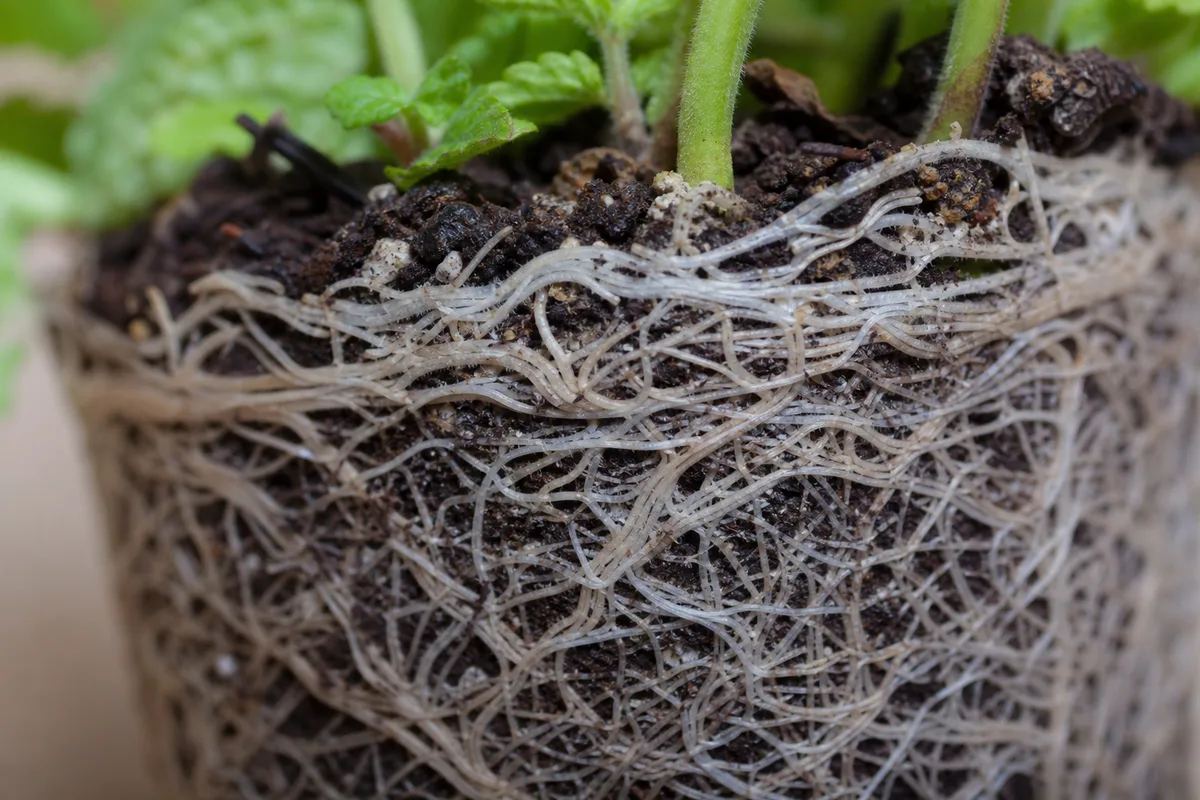
Root Bound symptoms on Mint - compare with healthy tissue on the same plant.
- Growth strongest on the outer ring while the centre is sparse, woody, or unproductive.
- Smaller leaves and weaker regrowth after normal harvest.
- Frequent afternoon wilt in warm weather despite regular watering.
- Water running through quickly, then the pot turning light again unusually fast.
Below soil when you unpot:
- Roots circling at drain holes or visible as a dense white-and-brown mat hugging the pot wall.
- Little loose mix left in the centre-often a solid rhizome pancake.
- In advanced cases, container distortion or cracking from root pressure.
Field example: rim-only grocery mint
A spearmint clump bought in a 12 cm supermarket pot still looked green at the edges after eight weeks on a kitchen windowsill. Unpotting showed a solid rhizome disc with roots tracing the pot wall twice; the centre held only woody stubble. Dividing into three outer sections with fresh mix produced visible new shoots at the rim within about ten days in May light-old centre tissue was discarded.
Field example: balcony fast dry-down
A 20 cm terracotta pot on a warm balcony needed two drinks per day by midsummer while an identical pot of younger divided mint one metre away needed one. Unpotting the thirsty plant revealed a root mat occupying roughly 80% of volume; water ran straight through the channel along the wall. After division into two wide 25 cm pots, the same watering rhythm held for two to three days between soaks within the first week-recovery judged by shoot vigor, not old wilted leaves.
How to confirm the cause
Work through this order so you do not confuse crowding with rot or simple dry-down:
- Water thoroughly and wait 10–15 minutes.
- Slide the plant out of the pot.
- Confirm whether roots and rhizomes form a tight circling mass with little loose mix left.
- Check root texture and smell:
- Firm pale roots with tight circling = binding.
- Mushy dark roots with sour odor = root rot component-see overlap branch below.
- Check growth pattern: edge-heavy shoots plus a tired centre strongly supports root congestion.
If roots are mostly firm and circling, proceed with division and repotting. If significant rot is present, follow the combined crowding-and-rot path instead of treating it as simple binding.
Decision table: root-bound vs root rot vs underwatering
| Signal | Root bound | Root rot | Underwatering (no crowding) |
|---|---|---|---|
| Root feel | Firm, circling | Mushy, pulls away | Firm, not densely circling |
| Mix smell | Neutral | Sour, swampy | Dry, neutral |
| Soil moisture after wilt | Can be moist; pot still light fast | Often wet for days | Dry top 2–3 cm |
| Growth pattern | Rim strong, centre dead | Whole plant decline on wet mix | Even weakness or all stems limp |
| Urgency | Divide before centre loss spreads | Trim and repot same day | Soak once; fix schedule |
| Wrong first move | More water | Another soak | Repot without checking roots |
When two columns match, unpot texture wins over leaf appearance.
Crowding plus rot: triage thresholds
Binding and rot often overlap in old kitchen pots-wet centres in a dense mat stay anaerobic. Use these thresholds after unpotting:
| Finding | Action |
|---|---|
| Firm circling roots, no sour smell, <10% mushy tips | Divide, trim dead tips only, repot into fresh mix |
| 10–30% mushy rhizome tissue, sour local pockets | Cut away all soft brown sections to firm white; discard dead centre; repot survivors only |
| >30% mushy tissue or sour smell through most of mass | Salvage outer firm sections if any exist; otherwise restart from stem cuttings per root rot guide |
| Stems soft above soil, hollow bases | Discard plant; sterilize pot; do not compost infected rhizomes |
After rot trim, always replace exhausted mix-do not shake old sour soil back around saved divisions. See mint repotting for mix and container sizing.
First fix for Mint
First action: divide and repot, not “water more.”
- Unpot the plant and shake off only loose exhausted mix.
- Split the clump along natural seams into sections with healthy roots and active shoot points.
- Discard clearly woody or failed centre portions.
- Pot each section in fresh, moisture-retentive but well-draining media (UF/IFAS herb guidance).
- Use wide containers with drainage; for non-division upsizing only, move one size up (about 2–5 cm wider) per the mint repotting guide.
- Water deeply once to settle mix, then return to normal dry-down-based watering.
RHS recommends dividing established mint clumps in spring or autumn and repotting container plants every few years-matching this first-fix approach for root-bound specimens.
Step-by-step recovery
Prepare
Have clean pruners or a knife, fresh potting mix, and new or cleaned containers with open drainage holes. Watering the day before division helps reduce root breakage in dry, brittle clumps.
Divide and reset the root zone
- Lift the root mass out and locate natural seams in the clump.
- Cut through rhizomes cleanly rather than tearing randomly.
- Keep each division with multiple stems and attached roots.
- Trim only obviously dead top growth; avoid hard pruning every stem at once.
- Replant divisions at the same depth as before.
- Firm mix gently; do not compact it into a dense block.
Re-establish growth
After repotting, keep mint in bright light with brief midday protection for several days if heat is intense. Resume regular harvesting only after clear new growth starts. Delay heavy feeding until fresh growth is visible so roots can re-establish first. Temporary limpness for several days after a hard divide is normal-see transplant shock on mint if stems stay firm.
Recovery timeline and what changes it
Recovery speed depends on temperature, light, division severity, and how much centre tissue you removed-not on a fixed calendar.
| Condition | Typical early signal | What to expect |
|---|---|---|
| Warm bright windowsill (18–24°C), moderate divide | Better water retention | Often within several days |
| Same conditions, active growth season | Visible new shoots at division points | Commonly one to two weeks |
| Cool room or short winter days | Slower shoot push | Several weeks; hold feed |
| Aggressive divide with small sections | Faster soil refresh, more transplant stress | Brief wilt 3–7 days first |
| Hot balcony after divide | Faster dry-down | Check daily; do not overwater to “help” |
You should usually see better water retention within several days and visible new shoots within about one to two weeks during active growth conditions. Full harvest rhythm often returns over the following few weeks.
Judge recovery by new vigorous shoots and reduced afternoon collapse, not by older damaged leaves turning perfect.
Lookalike symptoms
- Underwatering without crowding: root zone still has space, but watering has been inconsistent-pot is light and top mix is dry; roots are not a wall-to-wall mat. Route to overwatering on mint only when wet-soil wilt is the pattern.
- Root rot: roots are dark, soft, and sour-smelling rather than simply dense and circling-use the triage table above and the dedicated root rot guide.
- Low light: stems stretch and weaken without strong root congestion signs; centre may thin but unpotting still shows loose mix.
- Heat stress: short midday droop in extreme heat can happen even in an adequately sized pot-if roots are not circling and the pot holds moisture normally, shade or move rather than divide.
What not to do
Do not keep increasing watering without checking roots. Do not move an intact root pancake into a much larger pot and expect full recovery without division. Do not use heavy garden soil in containers. Do not treat fertilizer as the first response to a congested root zone. Do not compost rhizomes trimmed for rot-discard them to avoid spreading pathogens.
How to prevent repeat crowding
- Keep mint contained in pots to control spread and simplify root checks (University of Maryland Extension).
- Use wide containers with drainage instead of narrow decorative pots.
- Check root congestion at least once per active season; small kitchen pots in warm climates may need division every one to two seasons.
- Divide or repot before severe centre decline; RHS notes container mint benefits from periodic division and repotting, typically every few years in larger pots.
- Refresh exhausted mix during division cycles so moisture and aeration stay balanced.
- Alternate between two pots-one for harvest, one regrowing-if you want continuous kitchen supply without emergency binds (BBC Gardeners’ World container rotation tip).
When to escalate urgently
Escalate quickly if mint wilts daily despite correct watering and firm-looking stems, roots are forcing out and pot walls are deforming, or the centre has nearly stopped producing shoots. If you find widespread mushy roots with sour odor, treat as combined crowding-plus-rot per the triage table-not simple binding.
Discard and restart when more than about one-third of the rhizome mass is mushy with no firm white sections left to trim, or when sour smell returns within a week after repotting with no new shoots in warm light.
Related mint problem guides
| Symptom lead | Guide |
|---|---|
| Mushy rhizomes, sour wet mix | Root rot on mint |
| Wet soil, wilt, roots still firm | Overwatering on mint |
| Pot clearly undersized, roots not yet circling | Pot too small on mint |
| Limp after recent divide/repot | Transplant shock on mint |
| Weak small growth, tunnels in rhizomes | Stunted growth on mint |
| No new shoots in warm weather | No new growth on mint |
| Container sizing and seasonal timing | Mint repotting |
| Full care baseline | Mint overview |
Escalation summary
If unpotting shows a firm circling mat with rim-heavy growth, divide and repot-watering more will not restore centre vigor. If mushy tissue or sour smell appears, trim to firm white rhizome, replace all mix, and follow root rot thresholds when salvage is unclear. If roots have space and soil is simply dry, soak once and fix schedule via overwatering routing. Seasonal root checks prevent the dead-centre emergency that forces rushed division.