Leggy Growth on Golden Pothos: Causes, Checks & Fixes
Quick answer
Leggy Golden Pothos means etiolation-long bare gaps between leaves on vines that reached for weak light. Stretched internodes are permanent. First step: confirm light is now adequate (see not-enough-light guide), then prune leggy sections back to healthy nodes to restart compact growth.
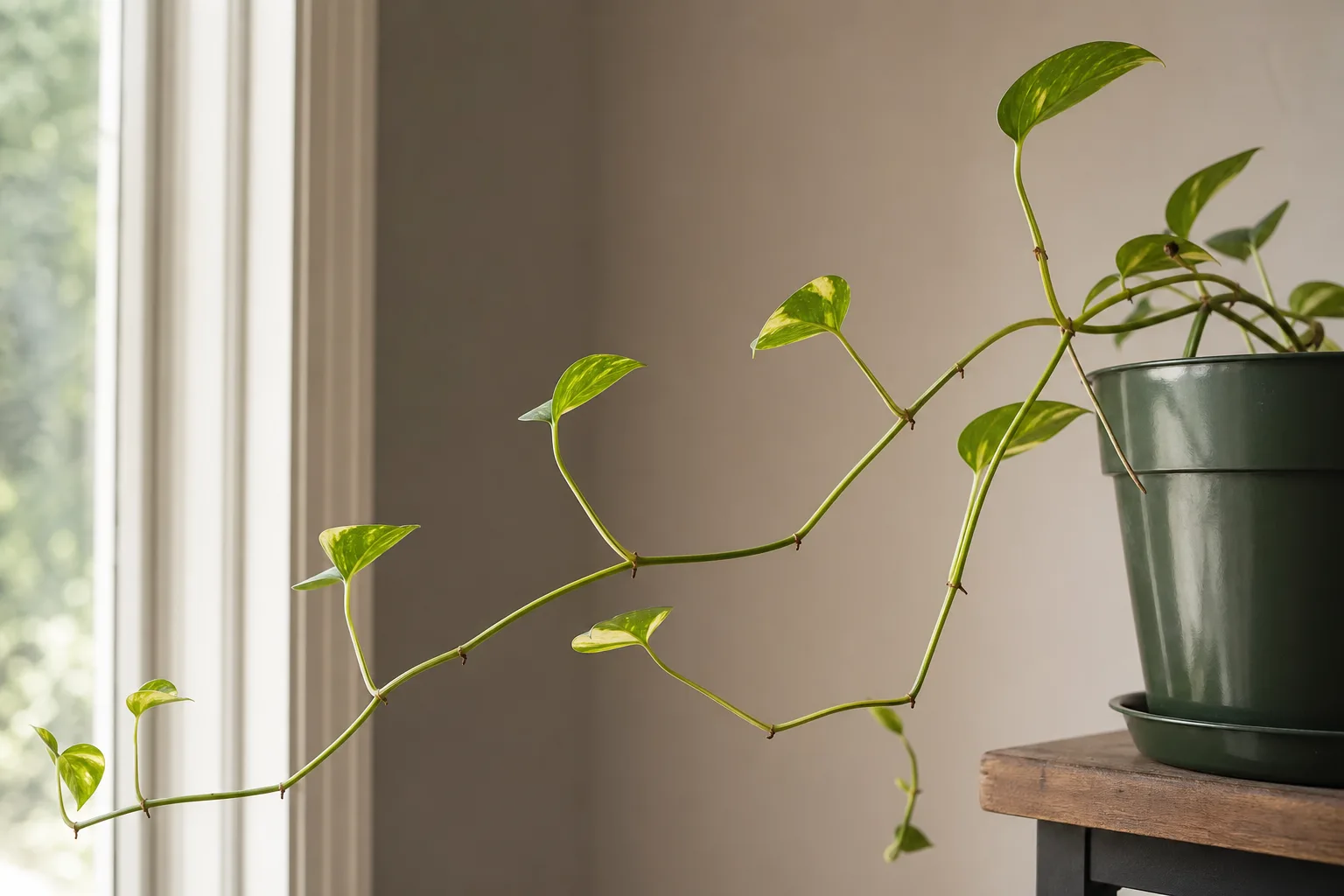
Leggy Growth on Golden Pothos: Causes, Checks & Fixes
This guide covers leggy growth on Golden Pothos. See also the general Leggy Growth guide, watering, and light pages for this plant.
Leggy Growth on Golden Pothos: Causes, Checks & Fixes
Quick answer
Leggy growth on Golden Pothos (Epipremnum aureum) is etiolation-the vine stretches toward photons when light is too weak, leaving long bare gaps between leaves, smaller new foliage, and fading gold variegation. The plant survives dim corners for months, which is why stretch sneaks up slowly.
Critical fact: stretched internodes do not compact again. Better light shapes only future leaves. Bare vines stay bare along their length until you prune.
First step: confirm light is now adequate using the not enough light on Golden Pothos guide-move to bright indirect light and wait two weeks for tighter new leaves. Then prune leggy sections back to healthy nodes to restart bushy growth from the crown or soil line.
This page covers structural recovery after etiolation-pruning, rooting cuttings, and realistic timelines. The sibling not-enough-light page covers diagnosis, placement targets, and the two-week light trial.
Leggy vs. low light still active vs. normal trailing
Not every long vine on Golden Pothos is etiolation. Use this quick read before you cut:
| What you see | Likely cause | Urgency | First move |
|---|---|---|---|
| Wide gaps on new tips only; older section on same vine compact | Etiolation (structural stretch) | Low-cosmetic | Brighten light; wait for compact new leaves; then prune |
| Pot still 6–8+ feet from glass; new leaves small and pale | Low light still active | Medium | Fix placement first-pruning alone will re-stretch |
| Even node spacing, firm stems, strong gold variegation on new leaves | Normal trailing in good light | None | No fix needed-vine is healthy |
| Yellow lower leaves + wet heavy pot + soft stem base in dim room | Overwatering / root rot overlap | High | Stop watering; fix light same week; see rot guide if stems mush |
| Stippling + webbing on thin winter vines | Spider mites on stressed growth | Medium–high | Isolate and rinse undersides before pruning for shape |
What leggy growth looks like on Golden Pothos
Healthy Golden Pothos carries compact nodes with gold-streaked leaves spaced a few centimeters apart on trailing vines. Leggy plants break that pattern:
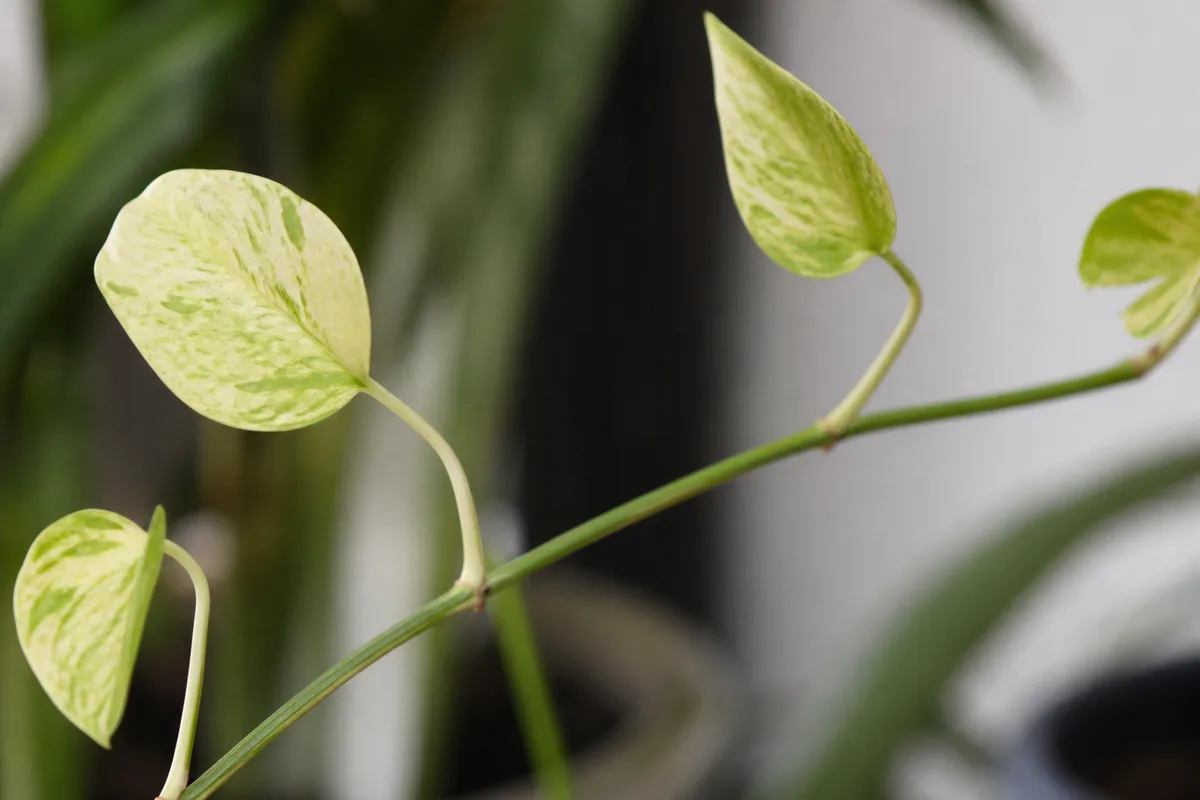
Leggy Growth symptoms on Golden Pothos - compare with healthy tissue on the same plant.
- Long bare sections between leaves on newer tips-internodes wider than older compact growth on the same stem
- Smaller, greener new leaves with weak or absent gold variegation
- Thin reaching vines angling toward one window or lamp
- Sparse trailing strings with foliage only at the ends-leaves concentrating at stem tips is classic “pothos with no leaves in the middle”
- Slow or stalled branching from the base while one leader stretches
Legginess builds over months in the same dim spot. By the time bare vines are obvious, much of the stretch is already locked in.
What leggy growth is not:
- Crispy brown sun-facing patches-too much direct sun; see light guide
- Wilting that recovers after watering-underwatering
- White webbing and stippling-spider mites
- Uniform yellow mushy stems on wet soil-root rot in dark wet rooms
Why Golden Pothos gets leggy
Golden Pothos climbs toward brighter canopy light in nature. Indoors, weak light triggers the same response: long internodes and thin stems reaching toward windows.
Variegation compounds the problem. Gold streaks have less chlorophyll than green tissue. In dim light, the plant loses variegation and produces smaller leaves as it chases photons-recent growth may look nearly solid green. Variegated cultivars lose color below about 150 foot-candles; Marble Queen and Pearls and Jade require more light than standard Golden to hold white patches in identical corners. Neon pothos tolerates lower light better but still stretches when photons are scarce.
Low light slows dry-down, so owners who water weekly in a dark hallway often get yellow leaves and fungus gnats while vines still stretch-stacked stress that looks like multiple problems but starts with photons.
Common traps that accelerate stretch on Golden Pothos:
- Hanging baskets on interior walls more than 6–8 feet from glass-the trailing display looks lush from across the room but the pot sits in a photon desert
- North rooms without grow lights through winter short days
- Shelves blocked by cabinet doors or tall furniture that shade only the soil side while tips reach for a gap
- Bathroom hooks where steam raises humidity but windowless walls offer almost no usable light
How to confirm leggy growth vs. low light still active
Internode comparison and light trial
- Internode comparison - On the same vine, measure gap between the last three leaves vs. leaves from six months ago. Widening gaps confirm etiolation.
- Light placement - If the pot is still more than 6–8 feet from glass or in a windowless room, light is still insufficient-fix that before pruning alone.
- Two-week light trial - After moving to bright indirect light, new leaves should emerge closer together with stronger gold marks. If spacing stays wide, light is still too low.
- New vs. old variegation - Fading gold on recent leaves with compact older variegated foliage below = etiolation in progress.
If light is adequate but old stretch remains visible, you have structural legginess needing prune-not more light alone.
Etiolation vs. rot vs. mite decision table
| Symptom cluster | Internode spacing | Stem / soil | Next step |
|---|---|---|---|
| Etiolation | Wide on new growth only | Firm green stems; mix dries slowly in dim room | Light trial → prune when new leaves compact |
| Active low light | Widening on every new leaf | Lean toward one window | Move pot; hold pruning until light fixed |
| Leaf drop on normal spacing | Nodes close; bare scars where leaves fell | May be firm or wilted depending on cause | Rule out overwatering and pests before blaming stretch |
| Dim + wet rot stack | Any spacing | Sour soil, mushy base, yellow climbing | Same-week light + dry-down; root rot protocol |
| Thin vines + stippling | May be normal or stretched | Dry winter air; webbing at leaf bases | Spider mites rinse before shape pruning |
First fix for Golden Pothos
Ensure bright indirect light is in place, wait for one round of compact new growth, then prune stretched vines back to nodes.
Pruning before light improves produces more stretch on the same bare pattern. Sequence matters:
- Brighten exposure per not-enough-light guide
- Wait 2–3 weeks for tighter new leaves
- Cut leggy vines just below a node, leaving healthy leaves on remaining stems when possible
Stretched growth does not revert; pruning redirects energy to compact new shoots from nodes below the cut. Stem cuttings root easily in water or soil when they include at least one node.
Step-by-step recovery
After light is stable:
- Identify salvageable vines - Firm green stems with healthy leaves near the base or crown
- Prune bare sections - Prune stems back to maintain a bushy habit, cutting just above a node; leave at least two nodes with leaves per remaining stem if possible
- Root pruned tips - Place cuttings with submerged nodes in water or moist mix; full workflow in the propagation guide. Fill sparse areas once the parent is stable
- Rotate weekly - Turn the container so regrowth fills evenly instead of leaning toward one window
- Adjust watering - Brighter light dries soil faster; water when top 4–5 cm is dry per watering guide
- Optional: pin vines - Train new compact growth along the pot rim or coil bare nodes onto moist mix so aerial roots anchor for fuller coverage
If a vine is mostly bare with leaves only at the tip, cut back harder to a node near the soil-the plant branches from nodes when light is adequate.
Recovery timeline
Weeks 1–3: First new leaves after light upgrade show tighter spacing and better variegation.
Weeks 4–8: Pruned stems push side shoots from nodes below cuts.
Months 2–6: Dense trailing form returns if you keep pruning weak leaders and maintain bright indirect light.
Old stretched tissue: Permanent. Judge success on new node spacing, not bare internodes leafing out along their length.
Lookalike symptoms
- Dim but not yet stretched - See not enough light for placement before structural legginess develops
- Yellow wilting on wet soil - Overwatering in low light; fix light and dry-down together
- Solid green only on new growth - Often low light; can also mean the cultivar reverted-check if gold returns after light fix
- Long vines with healthy spacing - Normal trailing growth in good light; not etiolation
- Bare mid-vine with tight node scars - Leaf drop from stress or pests, not etiolation; inspect for spider mites on thin winter vines
What not to do
Do not fertilize leggy pothos to “bulk up”-fertilizer cannot replace photons. Do not repot stressed vines before light stabilizes. Do not wait for bare vines to leaf out along old stretched sections-they rarely backfill. Do not prune heavily in dim light-new growth will stretch again.
How to prevent leggy growth next time
- Place within 2–4 feet of east or west windows or use grow lights 12–14 hours daily in dark rooms
- Rotate weekly per lighting guidance
- Prune early when node spacing widens-do not wait for bare strings
- Match watering to dry-down speed in your light level
- Avoid interior-wall hanging baskets unless you supplement with a grow light aimed at the pot, not just the trailing tips
When to worry
Escalate from cosmetic stretch to same-week action when:
- Wet heavy pot + yellow mushy stems in a dim bathroom or hallway-treat as root rot risk, not shape pruning alone
- New leaves stay tiny and pale after four weeks in what you thought was bright indirect light-re-measure distance from glass or add supplemental lighting
- Stippling and webbing appear on thin stretched vines during dry heating season-isolate and rinse before cosmetic pruning
Routine monitoring is enough if stems stay firm, soil dry-down matches your room, and only old stretched sections need pruning after a successful light trial.
Related Golden Pothos problems
Use this page as the structural recovery hub after you confirm etiolation; branch to sibling guides by symptom:
- Golden Pothos overview - full care, pet safety, and troubleshooting hub
- Not enough light - placement trial and variegation fade before bare vines form
- Root rot - mushy stems when dim rooms keep soil wet too long
- Overwatering - wet-soil stress stacked with slow dry-down in low light
- Spider mites - stippling on thin winter vines mistaken for weak growth
- Propagation - rooting pruned tips to fill bare baskets
- Light - keeping gold variegation strong long term
- Watering - matching drinks to brighter post-recovery dry-down
Conclusion
Leggy Golden Pothos is a triage sequence, not one fix for every bare vine. If light is still marginal, move the pot and run the two-week trial before any scissors touch the plant-pruning in dim corners only re-stretches. If light is fixed but old internodes stay long, prune to nodes and root cuttings for density; stretched tissue never compacts. If wet soil, sour smell, or mushy stems accompany stretch in a dark room, fix light and dry-down the same week and follow the root rot workflow-shape pruning alone will not save rotting roots. Judge success on tight new leaves at vine tips, not on old bare strings filling in.
FAQs
How can I confirm leggy growth on Golden Pothos?
Look for long bare sections between leaves on newer vine tips, smaller or greener new leaves than older ones, and vines leaning toward one window. If the last three leaves on a tip sit far apart compared to six-month-old growth on the same stem, etiolation is confirmed-not a watering issue alone.
What should I check first for leggy Golden Pothos?
Measure distance from the nearest window and compare new vs. old leaf spacing on the same vine. If light is still marginal, fix placement before pruning-cutting in dim corners produces more stretch. Check soil moisture only to rule out wilt that mimics weakness.
Will leggy Golden Pothos vines fill in on their own?
No. Existing elongated internodes stay long permanently. New leaves emerge tighter only after light improves. Prune bare stretched sections back to nodes once new growth shows compact spacing and restored gold variegation.
When is leggy growth urgent on Golden Pothos?
Legginess alone is cosmetic. Act quickly if a dim wet plant shows yellow mushy stems and sour soil-that is root rot risk from slow dry-down in low light, not stretch alone. Thin bare vines in a dark bathroom with constantly wet mix need light and watering correction the same week.
How do I prevent leggy growth on Golden Pothos next time?
Keep the pot within 2–4 feet of bright indirect light, rotate weekly, and add a grow light in dark rooms. Match watering to slower dry-down in dim spots. Prune proactively when node spacing widens instead of waiting for bare strings.
Did my Golden Pothos lose variegation permanently?
Often no-solid green new leaves in dim light usually mean etiolation, not permanent reversion. Move to bright indirect light and watch the next two to three leaves. If gold streaks return on fresh growth, variegation was light-limited. If new leaves stay solid green for months in good light, the sport may have reverted-Marble Queen and Pearls and Jade need brighter spots than standard Golden to hold white patches.
When to use this page vs other Golden Pothos guides
- Golden Pothos watering guide - Use for routine moisture checks before assuming leggy growth is the main issue.
- Golden Pothos problems hub - Browse all 16 common issues on this species.
- Not Enough Light on Golden Pothos - Different entry point when symptoms overlap with leggy growth.
- Slow Growth on Golden Pothos - Different entry point when symptoms overlap with leggy growth.
- Yellow Leaves on Golden Pothos - Different entry point when symptoms overlap with leggy growth.