Not Enough Light on Golden Pothos: Causes, Checks & Fixes
Quick answer
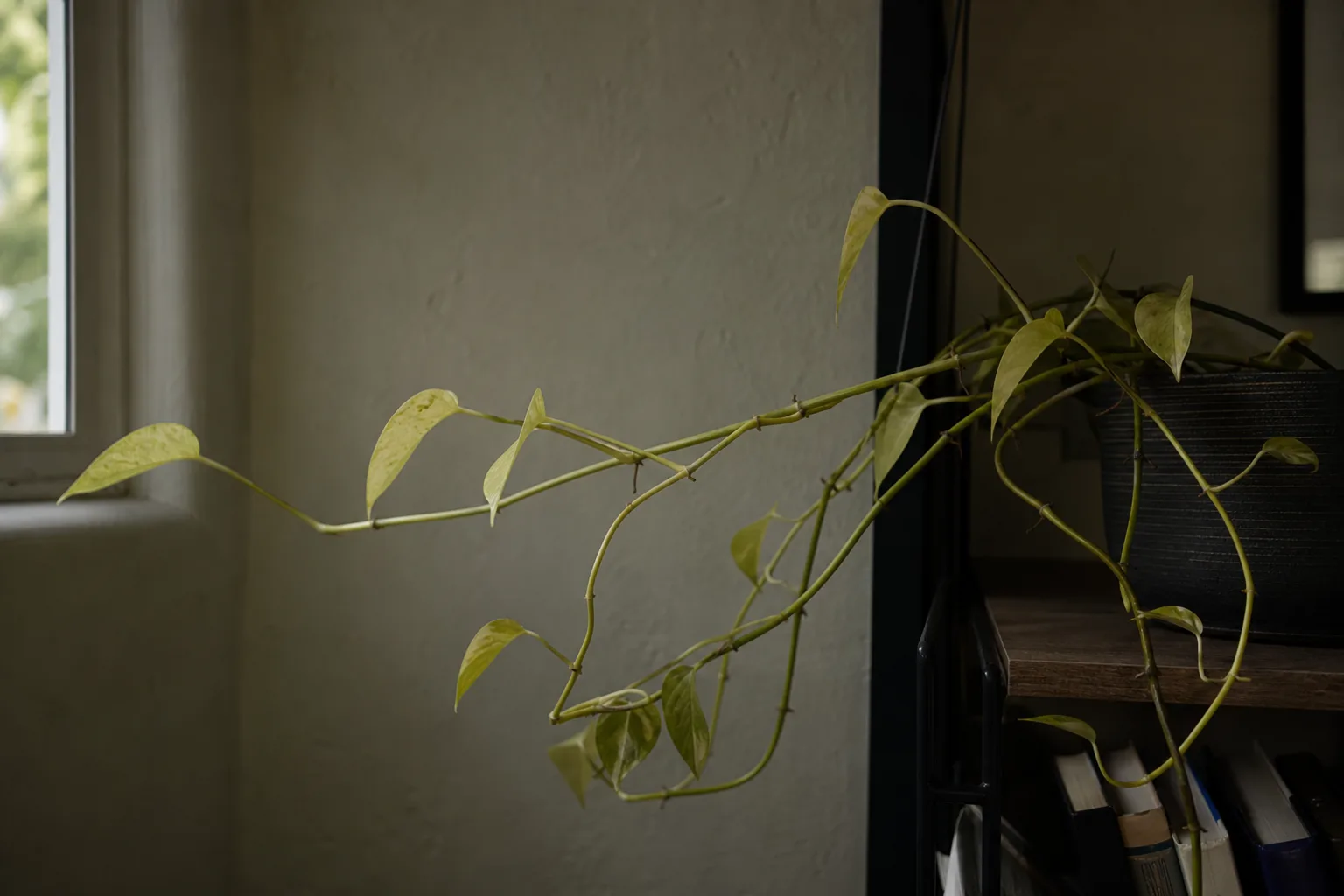
Golden Pothos survives dim rooms but stretches and loses its gold variegation when light is too weak. First step: move the pot to bright indirect light within a few feet of an east or west window and watch new growth for two weeks.
Not Enough Light on Golden Pothos: Causes, Checks & Fixes
This guide covers not enough light on Golden Pothos. See also the general Not Enough Light guide, watering, and light pages for this plant.
Not Enough Light on Golden Pothos: Causes, Checks & Fixes
Quick answer
Golden Pothos (Epipremnum aureum) is sold as a low-light plant, and it will survive in low light conditions for quite some time in dim corners for months. Survival is not the same as healthy growth. When photosynthesis drops, the vine stretches toward whatever light exists, spaces leaves farther apart, and pushes out smaller foliage with less gold variegation.
First step: move the pot to Golden Pothos light guide-typically within 2–4 feet of an east- or west-facing window, or a few feet back from a filtered south window. Leave everything else alone for two weeks and judge the next set of leaves, not the old stretched vines.
Why Golden Pothos loses its look in dim light
In the wild, pothos climbs up trees for sunlight from shaded understory toward brighter canopy light. Indoors, that same instinct shows up as etiolation: long internodes, thin stems, and leaves that reach toward windows. The plant is reallocating energy to find photons, not building the compact, trailing shape you bought.
Golden Pothos is lightly variegated-green leaves with yellow-gold streaks. Variegated tissue has less chlorophyll than solid green sections. In weak light, the plant compensates by losing its desirable leaf qualities-the variegation or brightness of foliage and producing more green and less gold on new leaves. Over time, recent growth can look nearly solid green even though older leaves still show the classic pattern.
Low light also changes how fast the pot dries. Golden Pothos in bright indirect light often needs water every 7–10 days; in a dim hallway it may take 14–21 days for the top half of soil to dry. Growers who keep the same weekly Golden Pothos watering guide in a dark room often end up with yellow leaves and fungus gnats-problems that look like watering mistakes but start with insufficient light slowing water uptake.
Common placement traps include:
- Hanging baskets on interior walls more than 6–8 feet from glass
- Shelves blocked by cabinet doors or tall furniture
- North-facing rooms with no supplemental lighting
- Winter months when daylight hours shrink but the pot never moves
What not enough light looks like on Golden Pothos
Low light on pothos builds slowly. By the time bare vines are obvious, months of stretch may already be locked in.
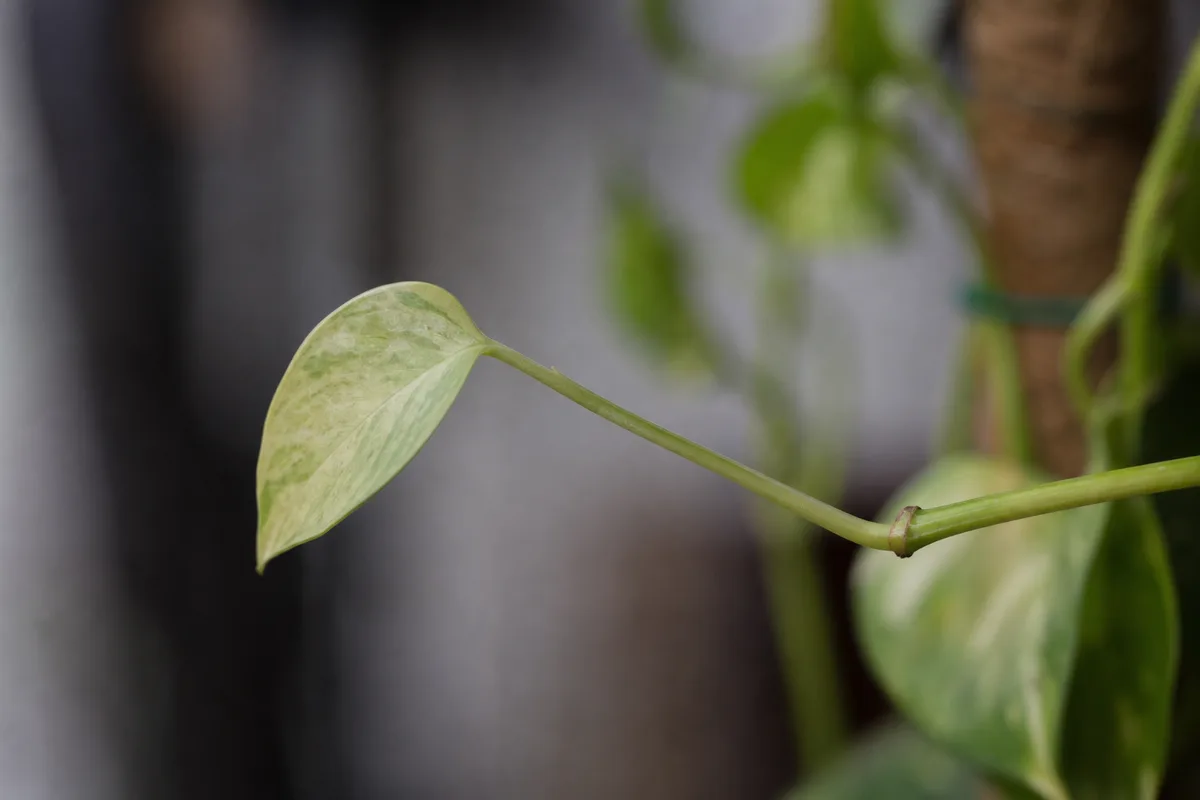
Not Enough Light symptoms on Golden Pothos - compare with healthy tissue on the same plant.
Typical low-light pattern:
- Long bare sections between leaves on newer vine tips
- New leaves noticeably smaller than older ones on the same stem
- Gold variegation fading or absent on the most recent leaves
- Entire plant or leading vines leaning toward one window or lamp
- Slow or stalled growth despite otherwise normal watering
- Lower leaves yellowing and dropping while top growth stays thin (often from slow dry-down and wet soil, not age alone)
What low light is not:
- Crispy brown patches on sun-facing leaves-that is usually too much direct sun
- Wilting that perks up within hours of watering-that points to underwatering on Golden Pothos
- White webbing or stippled leaves-spider mites, not light
- Uniform yellowing with mushy stems and sour soil-root rot on Golden Pothos, especially in dark, wet rooms
Golden Pothos rarely flowers, even in its native habitat, so lack of blooms is normal and not a reliable low-light signal.
How to confirm the cause
Work through these checks before pruning, fertilizing, or Golden Pothos repotting guide:
- Distance test - Measure roughly how far the pot sits from the nearest window. More than 6–8 feet from glass in a typical living room is often marginal for maintaining variegation and leaf size on Golden Pothos.
- Directional lean - If vines and leaf faces point toward one light source, the plant is actively seeking more intensity.
- New vs. old leaf comparison - Compare the size and variegation of the last three leaves on a growing tip to leaves from six months ago on the same vine. Smaller, greener new leaves strongly suggest light is the limiter-variegated cultivars lose color and new leaves stay small below about 150 foot-candles.
- Soil dry-down - Press your finger into the top 4–5 cm. If soil stays wet for two weeks or more in a dim spot, note that-fixing light often corrects the watering rhythm without other changes.
- Two-week placement trial - Move the pot to the brightest indirect spot you can offer without direct hot sun. Do not change fertilizer, pot size, or watering frequency during the trial. Success means the next leaves emerge closer together with stronger gold markings.
If the plant improves in brighter indirect light within two to three weeks, you have confirmed insufficient light. If symptoms persist, look at overwatering on Golden Pothos, pests, or cold drafts near the new spot.
First fix for Golden Pothos
Move the pot to bright indirect light and leave it there for at least two weeks before any other intervention.
Practical targets for most homes:
- East window: on the sill or up to 2 feet back, where morning sun is gentle
- West window: 2–4 feet back, or behind a sheer curtain if afternoon sun is strong
- South window: 3–5 feet back, or filtered through sheer fabric-avoid hot midday rays on the leaves
- North window or interior room: usually needs a grow light; natural light alone is often too weak for variegation
Slide the pot gradually over a few days if you are moving it from a very dark room to a much brighter one. A sudden jump into direct afternoon sun can scorch leaves even when the plant was starving for light.
Do not reach for fertilizer, extra water, or a larger pot to “wake up” a leggy pothos. Fertilizer cannot replace photons, and repotting stressed vines adds unnecessary root disturbance.
Step-by-step recovery after light improves
Once new growth shows tighter spacing and better variegation, reshape the plant:
- Identify salvageable vines - Find stems that still have healthy leaves and firm green tissue near the soil or crown.
- Prune stretched sections - Cut leggy vines just below a node, leaving at least two nodes with leaves on each remaining stem if possible. Stretched internodes will not compact on their own-plants not receiving enough light stretch toward the light.
- Root the cuttings (optional) - Golden Pothos cuttings root easily in water or moist soil. Use pruned tips to fill sparse areas once the parent plant is stable in better light.
- Rotate weekly - Turn the container weekly so vines do not lean heavily to one side.
- Adjust watering - In brighter light the pot dries faster. Recheck the top 4–5 cm and water when that zone is dry, not on a fixed calendar.
If a vine is mostly bare with only a few leaves at the tip, cut it back harder to a node near the base. The plant will branch from nodes below the cut when light is adequate.
Recovery timeline
Expect the first new leaves after a light upgrade within one to three weeks in warm growing conditions. Those leaves should be larger and more variegated than the stretched growth above them.
Old elongated stems remain long permanently. Judge success by node spacing and leaf quality on new growth, not by waiting for existing bare vines to leaf out along their length.
Full visual recovery-dense foliage instead of thin trailing strings-usually takes one to two growing seasons if you prune after light improves and keep watering matched to the brighter spot.
Signs you are on track:
- New leaves closer together on vine tips
- Gold variegation returning on fresh growth
- Faster dry-down in the pot (a sign the plant is actively growing)
- Less leaning within a few weeks of weekly rotation
Signs the problem is worsening or another issue is involved:
- Yellowing spreads while soil stays wet in the new spot
- Leaf tips brown despite stable humidity-possible scorch from too much direct sun
- New growth stays tiny after four weeks in brighter light-reassess whether the spot is still too dim or pests are present
Lookalike symptoms
Overwatering - Yellow leaves, mushy stems, and fungus gnats often overlap with low light because dim rooms slow evaporation. Check soil moisture before assuming light alone is the issue. Fixing light without reducing water in a previously dark, wet pot can still leave roots stressed.
Underwatering - Leaves wilt and feel limp, then recover after a thorough soak. Low-light pothos more often stays perky but stretched; chronic drought can also shrink new leaves, so confirm dry-down depth.
Natural aging - An occasional yellow leaf on the lowest section of a long vine is normal. Widespread thin top growth with fading variegation is not normal aging-it is a placement problem.
Nutrient deficiency - Rare on pothos in fresh potting mix. Do not fertilize until light and watering are stable and new growth still looks pale after several weeks.
Mistakes to avoid
- Assuming tolerance means preference - Golden Pothos can hang on in low light, but it will not keep its gold pattern or full leaf size there long term.
- Jumping to direct sun - Moving a stretched plant into harsh south-window sun without acclimation burns foliage. Bright indirect light is the target first.
- Fertilizing a stressed vine - Extra nutrients do not fix etiolation and can burn roots if soil has been wet too long in a dark corner.
- Waiting for bare stems to refoliate - Nodes on long bare sections often stay dormant until you prune back to active growth near a light source.
- Ignoring seasonal light drop - A spot that worked in summer may be too dim by late winter; shift the pot closer to glass or add a lamp from October through March in northern latitudes.
Golden Pothos care cross-check
Light and water move together on Golden Pothos overview. In bright indirect light, water when the top half of soil dries-often every 7–10 days in active growth. In low light, stretch that interval toward 14–21 days and always verify with a finger test rather than a calendar.
Humidity between 30–50% is fine for Golden Pothos; low light rarely causes brown tips the way dry air or fluoride does. Temperature between 18–29°C (65–85°F) supports steady growth once light is adequate.
Keep trailing vines out of reach of pets. Golden Pothos contains calcium oxalate crystals that irritate mouths if chewed-relevant when you move a long vine to a brighter windowsill cats can reach.
How to prevent low-light stress
- Place new pots where you can see bright indirect light on the leaves for most of the day, not only where the basket looks decorative.
- Rotate the container weekly for balanced growth.
- Clean window glass seasonally-dust and film cut usable light more than most growers expect.
- Add a full-spectrum LED grow light 6–12 inches above the foliage for 12–14 hours daily in offices, north rooms, or winter months.
- Re-check placement when furniture moves or when outdoor trees leaf out and shade a formerly bright window.
- Match watering to the light level whenever you relocate the plant.
When to worry
Low light alone is a slow decline, not a same-day crisis. Escalate your response if:
- Soil stays soggy for weeks in a dark room and stems soften at the base
- More than a third of leaves yellow within days after a move-possible shock from too much sun or hidden root rot
- After four weeks in confirmed bright indirect light, new growth is still tiny and solid green-verify the light source is strong enough or inspect for pests
Golden Pothos is resilient. Even a heavily stretched plant can look full again within a season once light is corrected and leggy vines are pruned. The main limit is patience: old stretch does not reverse, but new growth in the right light can make the plant look healthy again.
When to use this page vs other Golden Pothos guides
- Golden Pothos watering guide - Use for routine moisture checks before assuming not enough light is the main issue.
- Golden Pothos problems hub - Browse all 16 common issues on this species.
- Leggy Growth on Golden Pothos - Different entry point when symptoms overlap with not enough light.
- Slow Growth on Golden Pothos - Different entry point when symptoms overlap with not enough light.
- Yellow Leaves on Golden Pothos - Different entry point when symptoms overlap with not enough light.