Brown Tips on Coleus: Causes, Checks & Fixes
Quick answer
Brown tips on Coleus usually mean dry indoor air, sun scorch on the wrong cultivar, wet-feet margin burn, fertilizer salts, or cold below about 50°F-not a single generic stress. First step: probe soil moisture, note which leaf faces are damaged, and check whether the pot sits near a vent or in harsh sun before changing humidity, light, or watering.
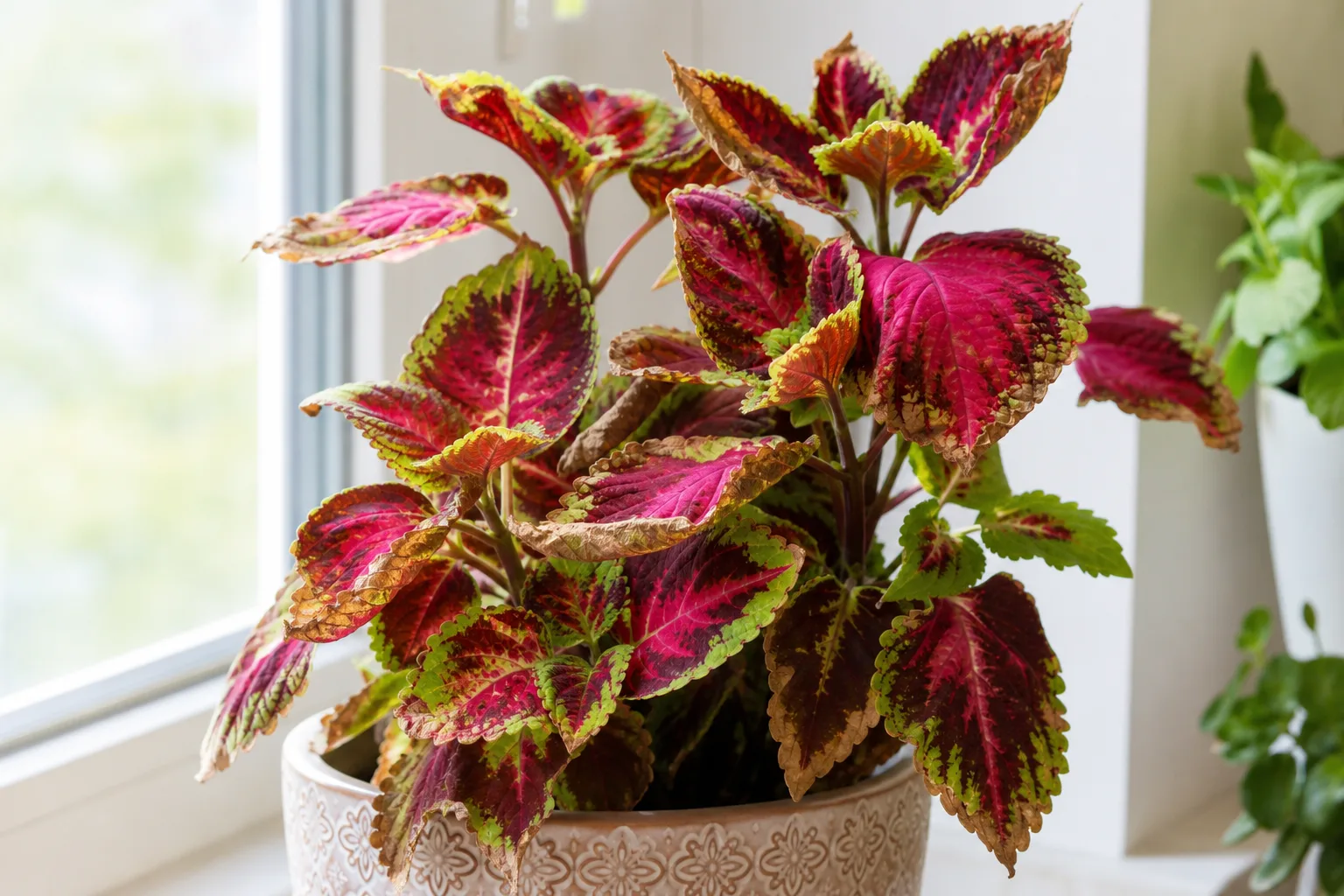
Brown Tips on Coleus: Causes, Checks & Fixes
This guide covers brown tips on Coleus. See also the general Brown Tips guide, watering, and light pages for this plant.
Brown Tips on Coleus: Causes, Checks & Fixes
Quick answer
Brown tips on Coleus (Plectranthus scutellarioides) rarely share one cause across every home. This tropical foliage plant shows edge damage from dry indoor air, sun scorch on the wrong cultivar, wet-feet margin burn, fertilizer salt buildup, or cold exposure-and each needs a different first fix.
Your first move is diagnostic, not corrective: probe soil moisture 2–3 cm deep, note which leaf surfaces are damaged, and check whether the pot sits near a heating vent, cold window, or harsh sun. Dry mix throughout with a light pot points to drought crisping. Wet heavy mix with muddy-brown leaves and scorched margins points to wet feet-not low humidity. Bleached or tan patches on the sun-facing leaf face after a move fit sun scorch. White crust on soil plus recent feeding fits salt burn. Even papery margins on multiple leaves with normal soil moisture and winter heat running fits dry air.
Do not increase humidity, flush salts, and move the plant on the same day. Match one first fix to what you confirmed.
What brown tips look like on Coleus
Symptoms differ by cause. Coleus leaves are thin and transpire quickly, so margin damage often appears before whole-leaf collapse-but the pattern tells you which stress is primary.
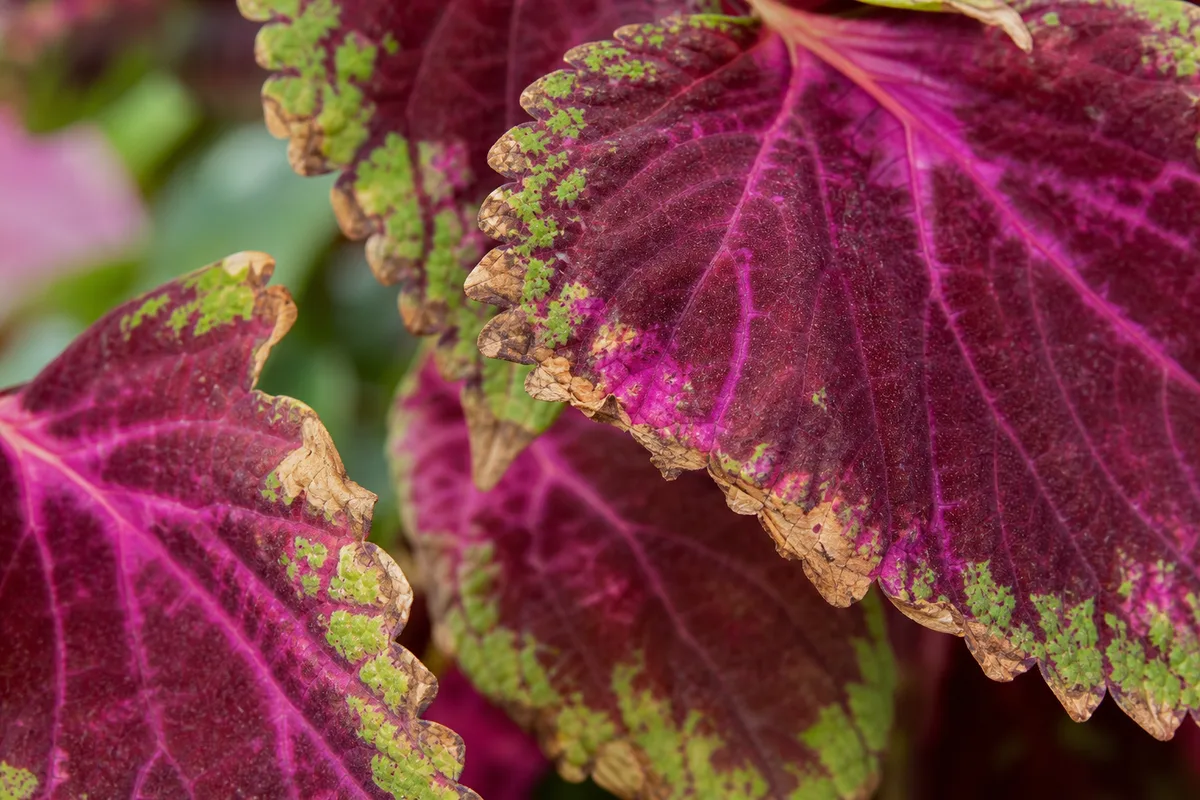
Papery brown margins and tips on thin coleus leaves - often dry air, salts, or sun scorch depending on which leaf face is affected.
Dry-air brown tips (common indoors in winter)
- Crisp, papery brown margins and tips, often on several leaves at once
- Soil moisture normal or slightly dry-not waterlogged
- Damage worse on leaves nearest heating vents, radiators, or cold window glass
- New growth may look fine initially; older outer leaves brown first
- Stems stay firm; no angular blotches or fuzzy undersides
Sun scorch and photobleaching
- Bleached yellow to white zones on exposed leaf areas, turning brown and brittle in severe cases-matching sunscald symptoms on coleus
- Hits the leaf face that faces the window or afternoon sun-not random tips only
- Common after moving a shade-type Kong or Fishnet Stockings cultivar into direct sun without acclimation
- Chartreuse, lime, and pale-variegated leaves scorch faster than burgundy types-even on sun-tolerant series
- Often worse in hot, dry weather when the plant cannot keep up with transpiration
Wet-feet scorched margins
- Muddy brown leaves with scorched leaf margins while the mix feels wet or heavy-the classic wet feet pattern on coleus
- Plant may look stunted; lower leaves yellow
- Pot stays heavy days after watering; saucer may hold runoff
- Not the same as papery dry-air tips-tissue looks dull and water-stressed, not crisp from evaporation
- Common in pots without drainage, cachepots that trap water, or cool dim rooms where soil never dries
Salt and fertilizer burn
- Crispy brown tips and edges, sometimes on multiple leaves after a feed cycle
- White or pale crust on soil surface, pot rim, or clay pot exterior
- Follows heavy or frequent summer feeding on fast-growing coleus
- Stems usually firm if rot has not started
- New leaves may emerge with burned tips if salts remain high
Cold damage
- Brown or blackened tips after nights below about 50°F (10°C) on outdoor or porch plants
- May affect outer leaves first after an unexpected cold snap
- Different from slow winter dry-air browning indoors
Why Coleus gets brown tips
Coleus evolved in warm, humid tropical and subtropical climates with filtered light-not beside a winter radiator or in a baking parking-lot pot. Leaf margins are the last tissue to receive water when roots cannot keep up, when air pulls moisture faster than roots replace it, or when salts reverse water flow at the root tips.
Five causes cover most home cases:
Low humidity and draft stress. Coleus prefers moderate to high humidity-roughly 50–70%-and loses leaf moisture quickly in heated rooms that drop below about 40% relative humidity. Brown leaf tips and edges are a common sign of low humidity in homes, especially during winter heating.
Sun scorch on the wrong exposure. Varieties not bred for sun will bleach and discolor in full sun, while several sun-tolerant cultivars thrive in full hot sun when acclimated. University of Minnesota Extension lists modern lines such as ColorBlaze®, Main Street, Heartbreaker, and FlameThrower® for full sun or shade, while Kong® prefers full shade and scorches quickly in unprotected midday rays. Pale and chartreuse leaves lack protective pigment and crisp faster than burgundy types.
Wet feet from poor drainage or overwatering on Coleus. Coleus must have good soil drainage. Poorly drained soils and excessive watering produce stunted plants with muddy brown leaves and scorched leaf margins-a pattern Clemson HGIC calls wet feet. Damaged roots cannot supply leaf edges even when the surface looks wet.
Fertilizer salt buildup. Fast summer growth invites frequent feeding. Soluble salts left behind as water evaporates concentrate in the root zone and can scorch leaf tips-the same mechanism extension guides describe for houseplants with brown tips, reduced growth, and white soil crust.
Cold exposure. Coleus is a tender annual in most climates, killed by frost. Prolonged exposure to temperatures below about 50°F damages leaf tissue at the margins before the whole plant fails .
Coleus is not a succulent. Brief drought can crisp tips, but chronic wet soil is equally dangerous because of root rot on Coleus and wet-feet scorch. If someone suggests one universal fix, run the confirmation checks below first.
Lookalike symptoms to rule out
| Pattern | Likely cause | First step |
|---|---|---|
| Papery margins, normal soil, near vent or low RH | Dry air / low humidity | Move off vent; raise ambient humidity |
| Bleached patches on sun-facing leaf face | Sun scorch | Reduce direct sun; acclimate gradually |
| Muddy brown leaves, wet heavy pot, scorched margins | Wet feet / overwatering | Stop watering; improve drainage |
| Crispy tips, white soil crust, recent feed | Salt / fertilizer burn | Stop feed; flush if drainage good |
| Brown tips after cold nights outdoors | Cold damage | Move to warmth; trim dead tissue |
| Large angular brown blotches, fuzzy leaf undersides | Downy mildew | Improve airflow; separate from other plants |
| Dramatic wilt that recovers within an hour after soak | underwatering on Coleus | Water thoroughly; see watering guide |
Downy mildew shows large brown angular blotches and downy growth-not clean margin necrosis alone. Root rot adds yellowing, stunting, and soft stems at the base.
For overlap with dedicated guides: even margin browning in winter often fits our low humidity on Coleus page when a hygrometer reads below 40% RH. Chronic wet soil with limp leaves fits overwatering on Coleus.
How to confirm the cause
Work through this order before changing anything:
- Cultivar and light history. Check the label if you have it. Kong, Fishnet Stockings, and many older large-leaf types need filtered light; ColorBlaze and Main Street tolerate more sun when acclimated. Did the plant move windows, go outdoors, or sit behind freshly cleaned glass recently?
- Soil moisture at depth. Push your finger or a skewer 2–3 cm (1 inch) deep near the pot edge-not only the surface. Bone dry throughout with a light pot suggests drought. Wet clinging mix days after watering suggests wet feet.
- Pot weight and drainage. Lift the pot. Confirm drain holes are clear and no saucer is holding standing water. A heavy pot that never lightens is overwatering risk, not humidity risk.
- Damage pattern on leaves. Even margins on many leaves → dry air or salts. Bleached sun-facing patches → scorch. Muddy dull brown with wet soil → wet feet. Angular blotches with fuzzy undersides → disease, not this guide.
- Room placement. Note proximity to heating vents, radiators, fireplaces, AC drafts, and cold window panes. Coleus shows vent-side browning within one to two weeks in winter.
- Hygrometer check (indoor winter). Place a meter near the canopy for 24 hours. Below 40% RH supports dry-air stress; above 50% with tip burn suggests sun, salts, or wet feet instead.
- Recent feeding and salt crust. Any soluble fertilizer in the last two to four weeks during fast growth raises salt-burn probability. Look for white residue on soil or pot rim.
- Temperature. Outdoor or porch coleus after nights below about 50°F may show cold-browned tips unrelated to indoor humidity.
Write down which pattern matched. Three different confirmed causes need three different first fixes-not humidity plus flush plus relocation at once.
First fix for Coleus
Match one action to what you confirmed:
- Dry air, firm stems, normal soil, low RH or vent proximity: Move the pot off forced-air paths and cold window contact. Add a pebble tray or small humidifier to raise ambient humidity-do not water more because leaves look dry.
- Sun scorch after exposure jump: Shift to bright indirect light or morning sun only. Hold there 7–14 days, then increase exposure gradually if the cultivar is sun-tolerant. See our Coleus light guide for cultivar routing.
- Wet soil, muddy leaves, scorched margins: Stop watering until the top 2–3 cm dries. Empty the saucer. Do not mist and do not flush-saturated roots need air, not more water through the pot.
- White crust or heavy recent feeding with good drainage: Stop all fertilizer. Scrape surface salt crust, then flush with plain water equal to about twice the pot volume until it runs freely from drain holes. Empty the saucer immediately so salts are not reabsorbed.
- Cold damage on outdoor plants: Move to a stable warm spot above 60°F. Remove fully dead leaves only; wait for new growth before resuming normal outdoor placement.
Make one correction first. Do not repot, prune heavily, and fertilize on the same day.
Step-by-step recovery by cause
After dry-air tip burn
- Relocate off vents and radiators.
- Run a humidifier or pebble tray to target 50–70% RH near the canopy-not constant leaf misting in dim corners.
- Keep the normal watering rhythm from our Coleus watering guide: water when the top 2–3 cm dries, not on a calendar alone.
- Trim fully brown tips for appearance if you wish, leaving a thin brown edge to avoid wounding green tissue.
After sun scorch
- Reduce direct sun to bright indirect or morning exposure only.
- Remove fully dead, brittle leaves.
- Acclimate back toward the cultivar’s tolerance over 7–14 days-ColorBlaze types can handle more than Kong types.
- Increase watering slightly as light increases, because transpiration rises in brighter spots.
After wet-feet margin burn
- Let the mix dry throughout before the next watering.
- Confirm drainage holes and discard standing saucer water after every session.
- If stems soften or smell sour, unpot and inspect roots-see overwatering on Coleus and root rot on Coleus.
- Do not fertilize until firm new growth appears for several weeks.
After salt or fertilizer burn
- Pause all feeding until new leaves show clean margins.
- Flush once as described above; repeat after two weeks only if crust returns and drainage stays excellent.
- When growth resumes, feed at label strength during active summer months only-Clemson HGIC suggests June through August applications for in-ground coleus, not heavy winter feeding on indoor plants.
After cold damage
- Hold in warmth and bright indirect light.
- Pinch damaged tips once new growth starts if the stem remains firm.
- Harden off before returning outdoors in spring.
Recovery timeline
Dry-air tip burn often stabilizes within one to two weeks after humidity and placement improve-new leaves in two to four weeks should show cleaner margins during active growth.
Sun scorch recovery depends on how much tissue bleached. New leaves in 10–14 days after corrected light tell you whether exposure is still too strong.
Wet-feet scorch does not follow a cosmetic timeline. Seven to ten days of proper dry-down with firm stems and no spread is the minimum sign you avoided escalation.
Salt burn recovery takes one to three weeks after flushing before new growth looks normal, depending on salt concentration.
Existing brown tips stay brown. Judge success by new foliage and firm stems, not by old leaves re-greening.
What not to do
Do not increase humidity when the problem is wet soil scorch-misting and extra water worsen root stress.
Do not flush a pot that drains poorly or a plant with soft stems and sour-smelling mix-you will waterlog rotting roots.
Do not move a shade-type cultivar into full afternoon sun to “fix” pale color without acclimation-that trades dull green for crisp brown edges.
Do not feed to green up browned tips. Fertilizer on stressed or dormant roots builds salts and scorches margins further.
Do not stack Coleus repotting guide, heavy pruning, and pesticide on the same day as a humidity or light correction. One stress at a time.
Avoid wetting foliage routinely to “help humidity.” Wetting foliage while watering contributes to downy mildew and stem rot-use ambient humidity strategies instead.
How to prevent brown tips on Coleus
Align everyday care with how coleus actually grows in your space:
- Light: Match exposure to cultivar-sun-tolerant lines for bright windows and morning patio sun; Kong and shade types for filtered light. Details in our Coleus light guide.
- Water: Keep evenly moist, well-drained soil-water when the top inch of soil is dry, never leave saucers full. Full rhythm in our Coleus watering guide.
- Humidity: Target 50–70% RH indoors in winter; keep pots off vents.
- Feed: Fertilize during active growth at label rates; leach salts every four to six months if you feed frequently through summer. See our Coleus fertilizer guide.
- Moves: Acclimate to stronger sun over 7–14 days. Bring containers indoors before nights drop below about 50°F in autumn.
Inspect weekly while problems are still small-coleus shows stress on leaf edges before the whole plant collapses.
When to worry
Escalate immediately if margins brown while soil stays wet for days, stems soften at the base, or large angular blotches with downy growth appear on leaf undersides-that is root stress or downy mildew, not cosmetic tip burn.
Also act promptly if tips turn black after frost or prolonged chill on outdoor plants.
Cosmetic tips on firm stems with stable new growth can wait for the next scheduled care check-no emergency repot or feed required.
Related Coleus guides: light, watering, fertilizer, low humidity, not enough light, overwatering. Species overview: Coleus.
When to use this page vs other Coleus guides
- Coleus watering guide - Use for routine moisture checks before assuming brown tips is the main issue.
- Coleus problems hub - Browse all 16 common issues on this species.
- Low Humidity on Coleus - Different entry point when symptoms overlap with brown tips.
- Underwatering on Coleus - Different entry point when symptoms overlap with brown tips.
- Overwatering on Coleus - Different entry point when symptoms overlap with brown tips.